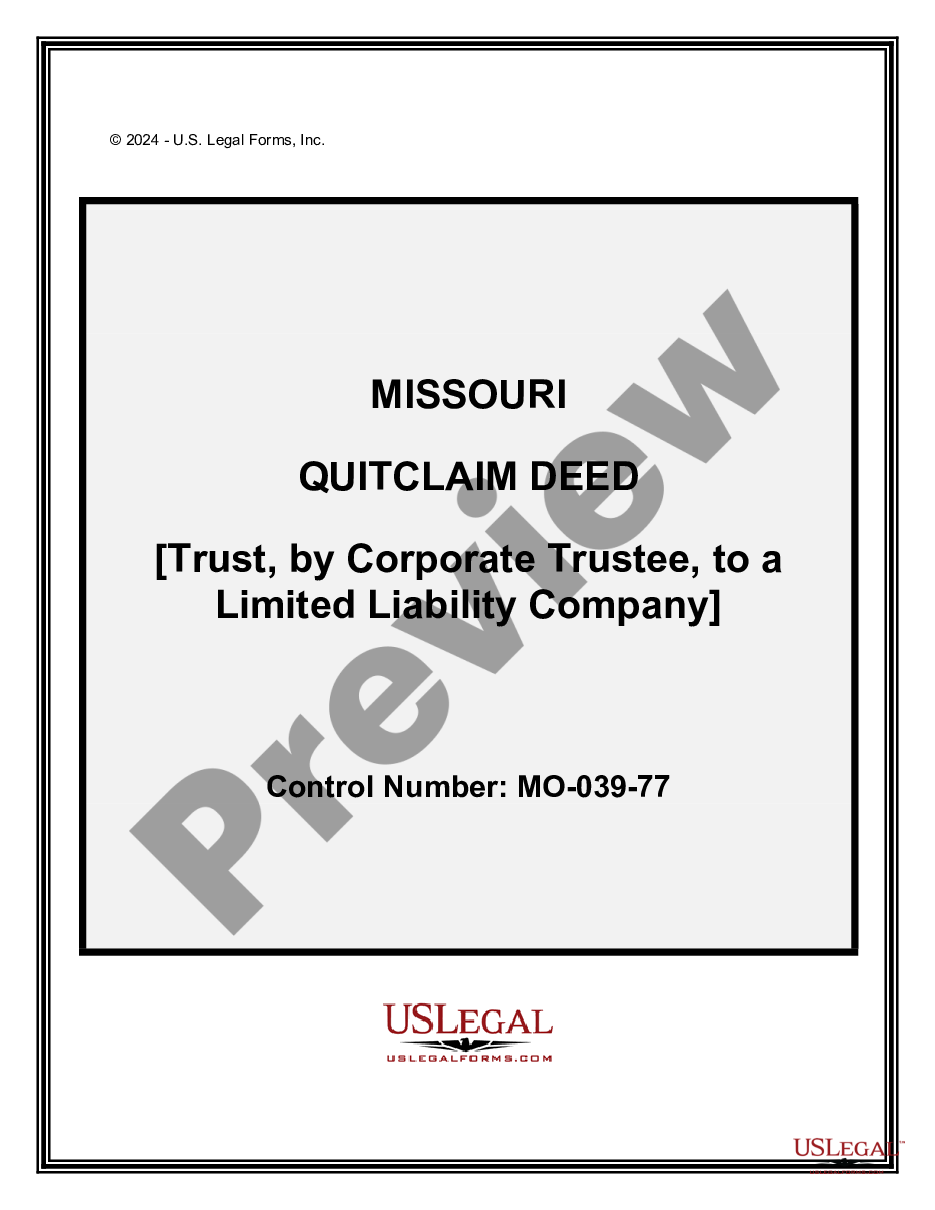
Missouri Quitclaim Deed from Trust, Acting Through Corporate Trustee to Limited Liability Company
What is this form?
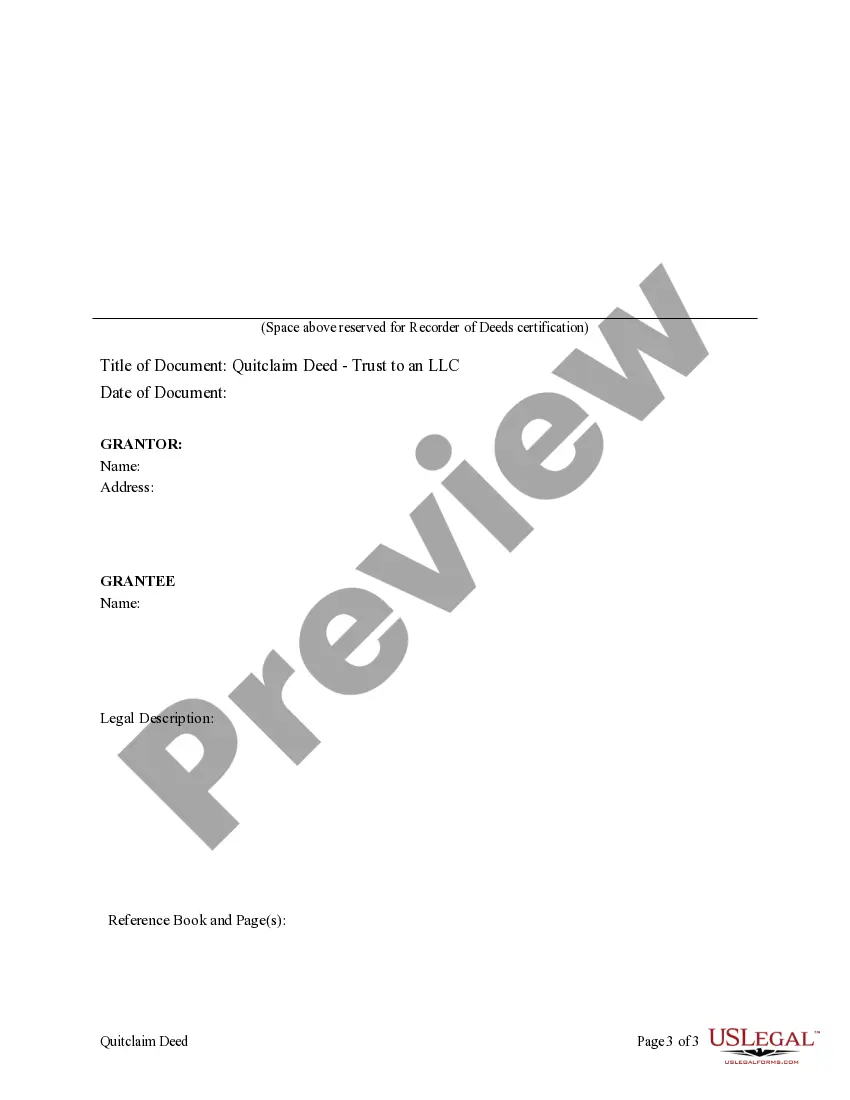
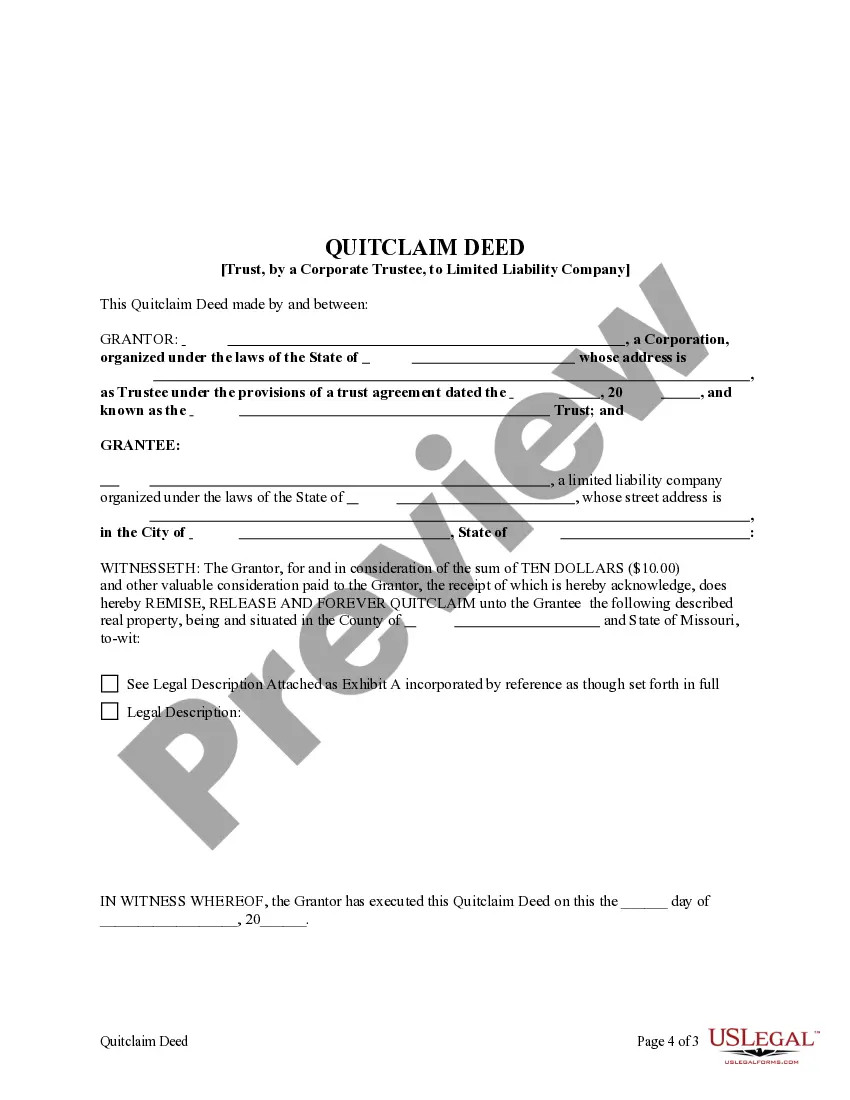
This form is a Quitclaim Deed from a Trust, acting through a corporate Trustee, to a Limited Liability Company (LLC). It allows the Grantor, which is the Trust, to convey ownership of specified property to the Grantee, the LLC. Unlike warranties or other types of deeds, a quitclaim deed transfers only the interest the Grantor has in the property, without guaranteeing that the title is clear. This form complies with all state statutory laws, making it a reliable option for transferring property ownership.
Main sections of this form
- Names and addresses of the Grantor (Trust) and Grantee (LLC).
- Description of the property being conveyed.
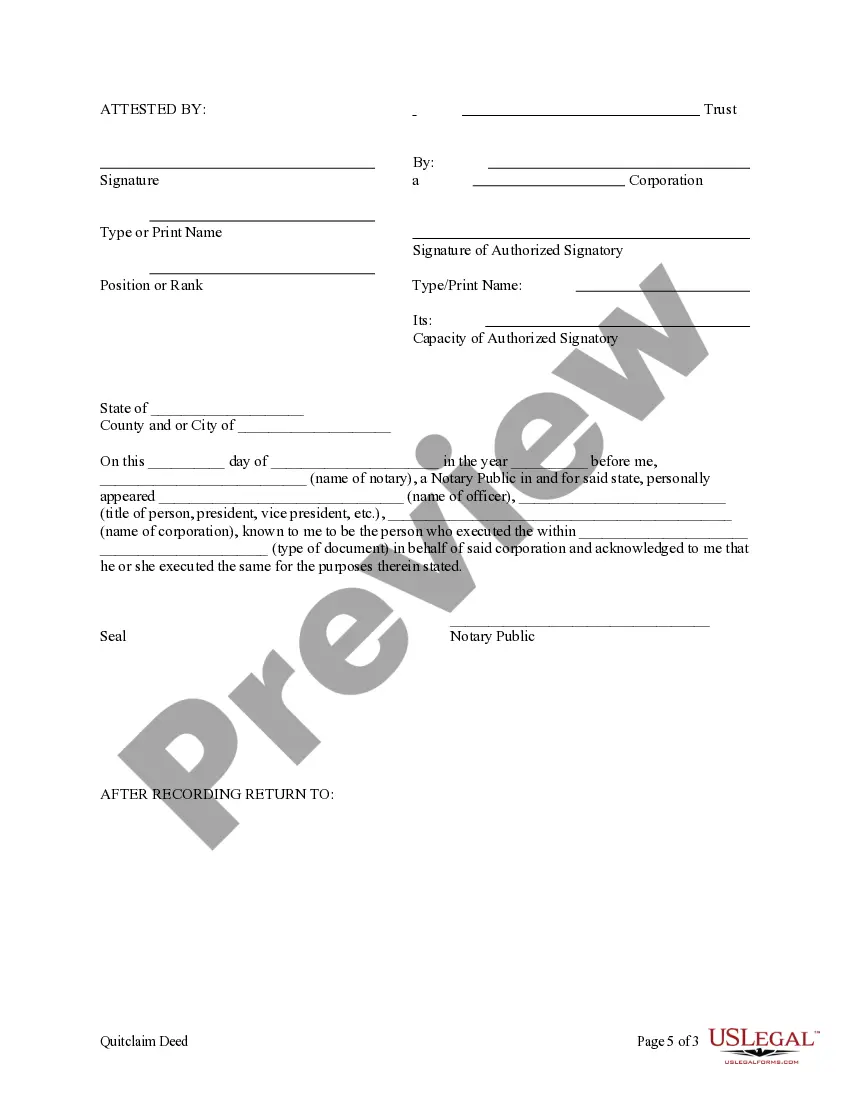
- Signature of the corporate Trustee acting on behalf of the Trust.
- Date of execution of the Quitclaim Deed.
- Statement of consideration (value exchanged for the transfer).




When to use this form
This form is typically used when a Trust wants to transfer property assets to a Limited Liability Company. Situations might include managing investment properties or changing the property's ownership structure for liability protection. This document is beneficial when the property in question is no longer needed by the Trust or when the Trust is dissolving. It is also used in estate planning to facilitate property transactions.
Who can use this document
- Trustees acting on behalf of a Trust.
- Members or managers of a Limited Liability Company receiving property.
- Individuals involved in real estate transactions requiring a quitclaim deed.
- Anyone looking to simplify the transfer of property ownership without warranties.
Instructions for completing this form
- Identify the Grantor and Grantee by entering their legal names and addresses.
- Provide a detailed description of the property being conveyed.
- Include the signature of the corporate Trustee representing the Trust.
- Enter the date when the deed is executed.
- Specify the consideration amount, if applicable.
Notarization requirements for this form
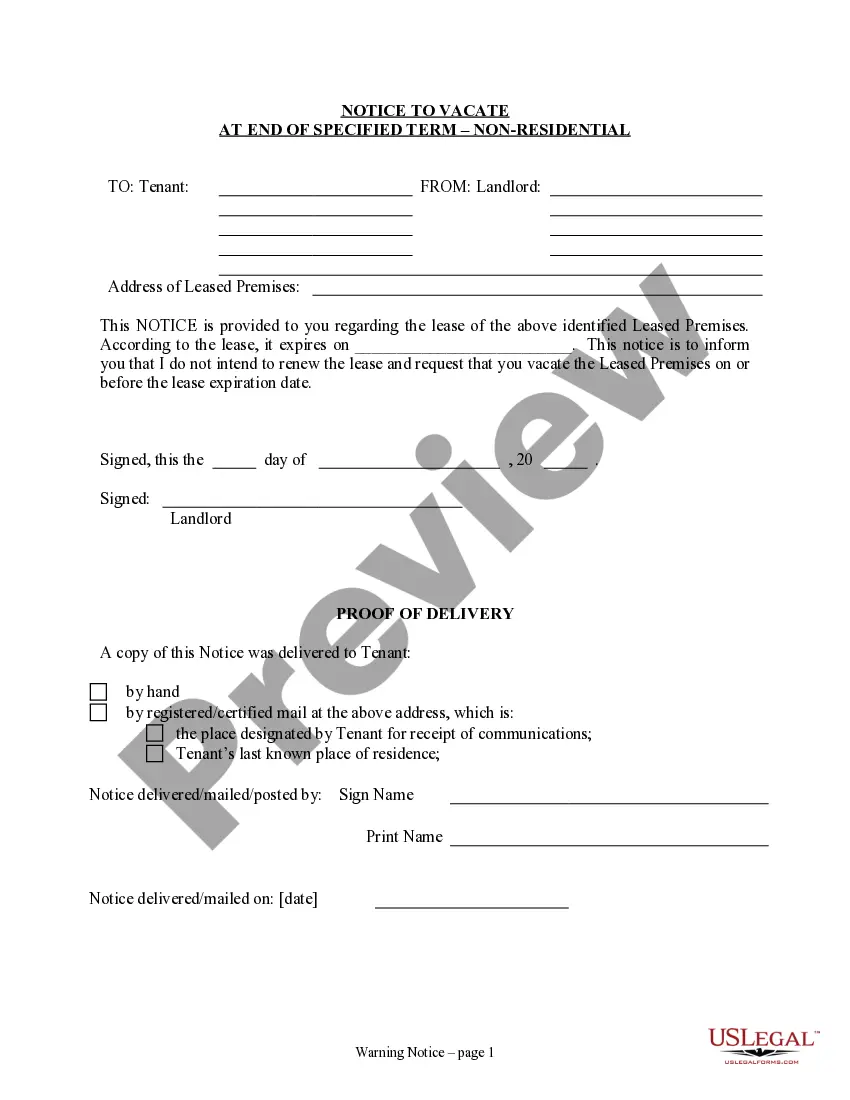
This form does not typically require notarization unless specified by local law. However, notarization can help validate the authenticity of the deed and may be required by certain recorders in some jurisdictions. It's advisable to check local regulations to confirm.
Get your form ready online
Our built-in tools help you complete, sign, share, and store your documents in one place.
Make edits, fill in missing information, and update formatting in US Legal Forms—just like you would in MS Word.
Download a copy, print it, send it by email, or mail it via USPS—whatever works best for your next step.
Sign and collect signatures with our SignNow integration. Send to multiple recipients, set reminders, and more. Go Premium to unlock E-Sign.
If this form requires notarization, complete it online through a secure video call—no need to meet a notary in person or wait for an appointment.
We protect your documents and personal data by following strict security and privacy standards.

Make edits, fill in missing information, and update formatting in US Legal Forms—just like you would in MS Word.

Download a copy, print it, send it by email, or mail it via USPS—whatever works best for your next step.

Sign and collect signatures with our SignNow integration. Send to multiple recipients, set reminders, and more. Go Premium to unlock E-Sign.

If this form requires notarization, complete it online through a secure video call—no need to meet a notary in person or wait for an appointment.

We protect your documents and personal data by following strict security and privacy standards.
Common mistakes
- Failing to properly identify the property being conveyed.
- Not securing the necessary signature from the corporate Trustee.
- Neglecting to date the Quitclaim Deed, which can affect its validity.
- Assuming that a Quitclaim Deed guarantees clear title.
Benefits of completing this form online
- Convenient access to forms 24/7 without the need for legal consultations.
- Edit and complete the form digitally to save time and reduce errors.
- Forms are compliant and updated to meet state requirements.
- Easy downloading for printing, mailing, or electronic filing.
Looking for another form?
Form popularity
FAQ
To obtain a quitclaim deed in Missouri, you can either create one yourself or use a template from a reputable source. The deed must clearly outline the transfer from the trust, acting through a corporate trustee, to a limited liability company. US Legal Forms provides a variety of customizable templates that save you time and ensure your deed meets all necessary legal standards.
You do not necessarily need a lawyer to file a quitclaim deed in Missouri, but having legal guidance can be beneficial. A lawyer can help ensure that the deed correctly reflects the transfer from a trust, acting through a corporate trustee, to a limited liability company. If you prefer to manage this independently, US Legal Forms offers user-friendly resources that guide you through filing, ensuring compliance with local regulations.
Yes, you can prepare your own quitclaim deed in Missouri. However, you must ensure that it meets all legal requirements and clearly states the intent to transfer property from the trust, acting through a corporate trustee, to a limited liability company. Using resources like US Legal Forms can help simplify this process, providing templates that comply with state laws, making it easier for you to create a valid document.
A trustee deed transfers property from a trust, while a quitclaim deed transfers ownership without guaranteeing the title's validity. In the context of a Missouri Quitclaim Deed from Trust, Acting Through Corporate Trustee to Limited Liability Company, the quitclaim deed simplifies the process by allowing the corporate trustee to convey property efficiently. Understanding these differences can help you choose the right document for your real estate transactions, ensuring you protect your interests.
To create a valid Missouri Quitclaim Deed from Trust, Acting Through Corporate Trustee to Limited Liability Company, you need to include essential elements. First, you must state the grantor's name, the grantee's name, and a clear description of the property. Additionally, the deed must be signed by the grantor in the presence of a notary public. Finally, you should record the deed with the appropriate county office to ensure it is legally binding.
How to Quitclaim Deed to LLC. A quitclaim deed to LLC is actually a very simple process. You will need a deed form and a copy of the existing deed to make sure you identify titles properly and get the legal description of the property.
When you're ready to transfer trust real estate to the beneficiary who is named in the trust document to receive it, you'll need to prepare, sign, and record a deed. That's the document that transfers title to the property from you, the trustee, to the new owner.
Yes, a quit claim deed supercedes the trust. The only thing that can be done is to file a suit in court challenging the deed as the product of fraud and undue influence. A court action like that will cost thousands of dollars, but might be worth it if the house was owned free and clear.
California Property TaxesTransferring real property to yourself as trustee of your own revocable living trust -- or back to yourself -- does not trigger a reassessment for property tax purposes. (Cal. Rev. & Tax Code § 62(d).)
In the context of a California mortgage transaction, a trust deed also transfer ownership. Only this time, the title is being placed in the hands of a third-party trustee, who holds the property on behalf of the lender and the homeowner-borrower until the mortgage is paid.