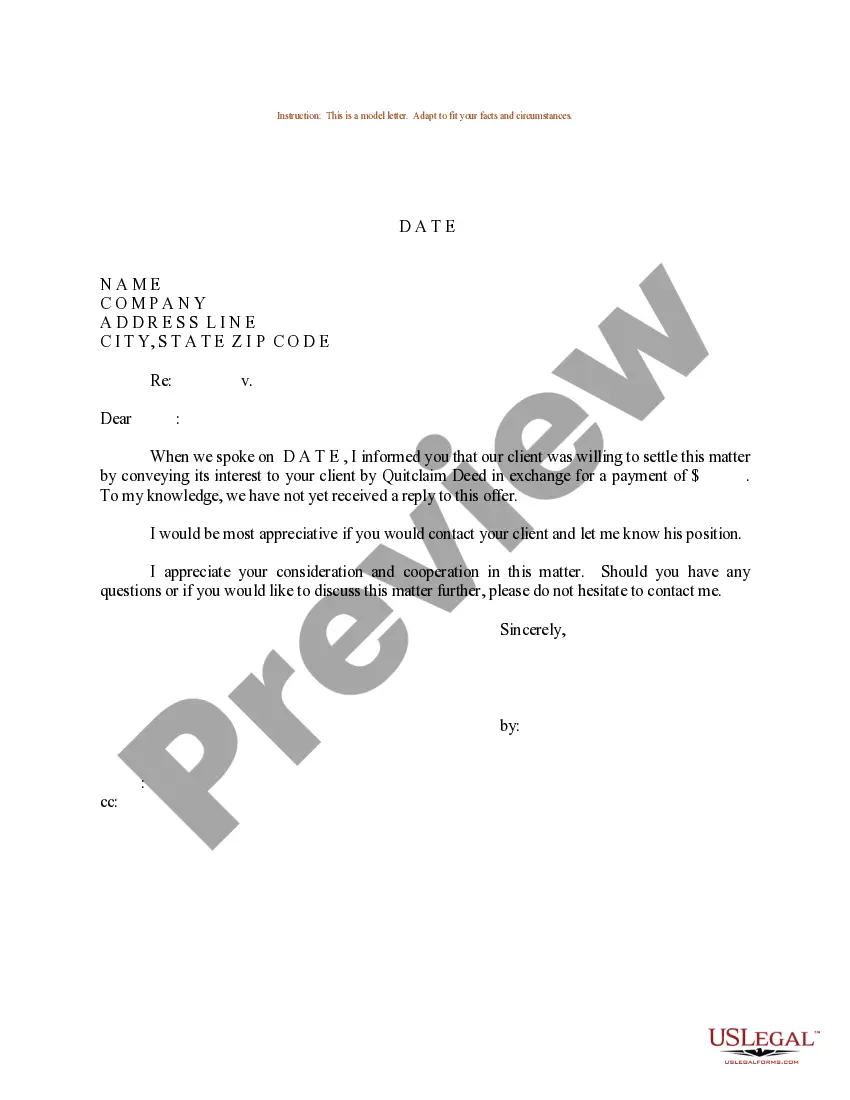
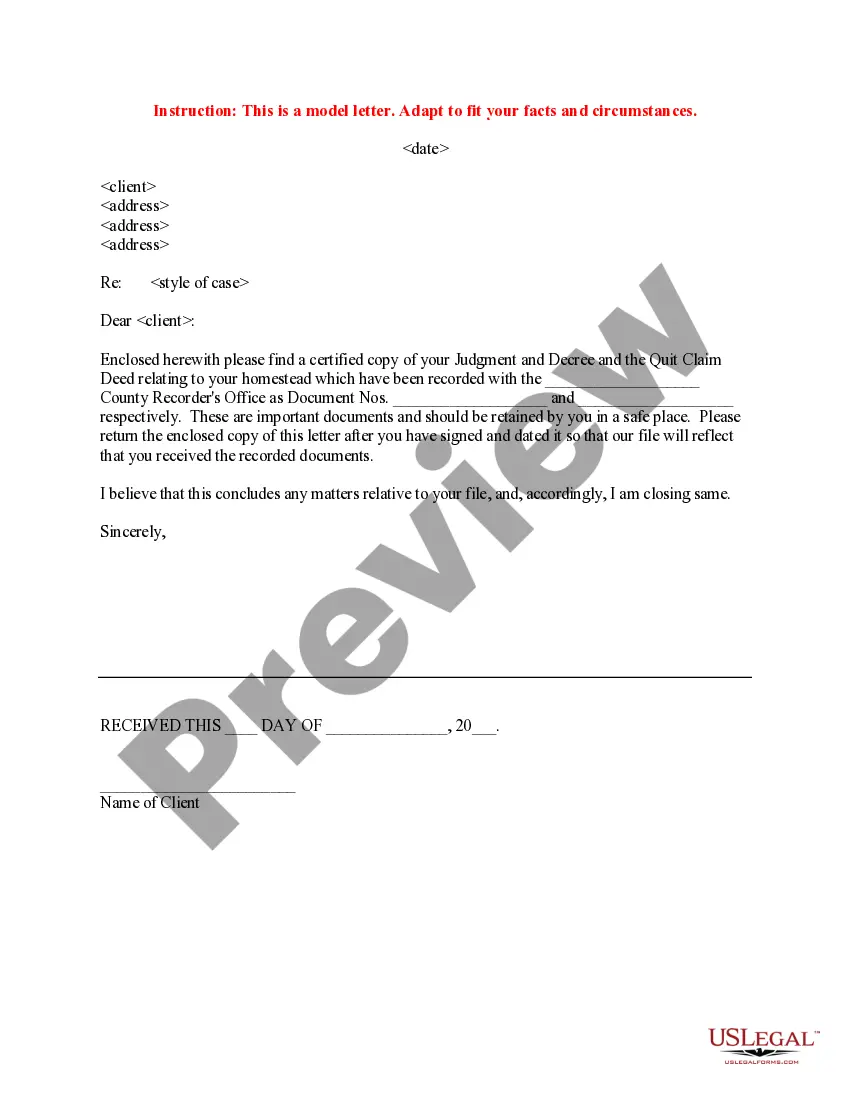
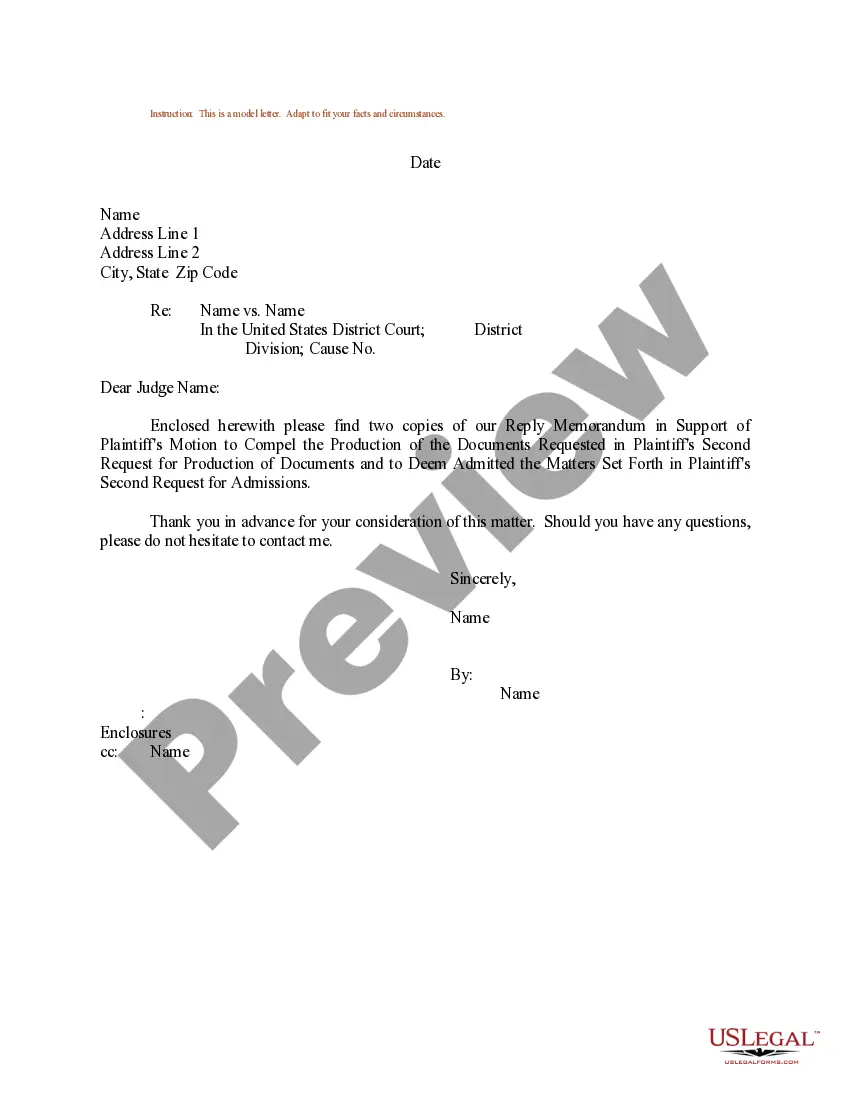
Minnesota Sample Letter to Client regarding Real Estate Documents related to Homestead
Description

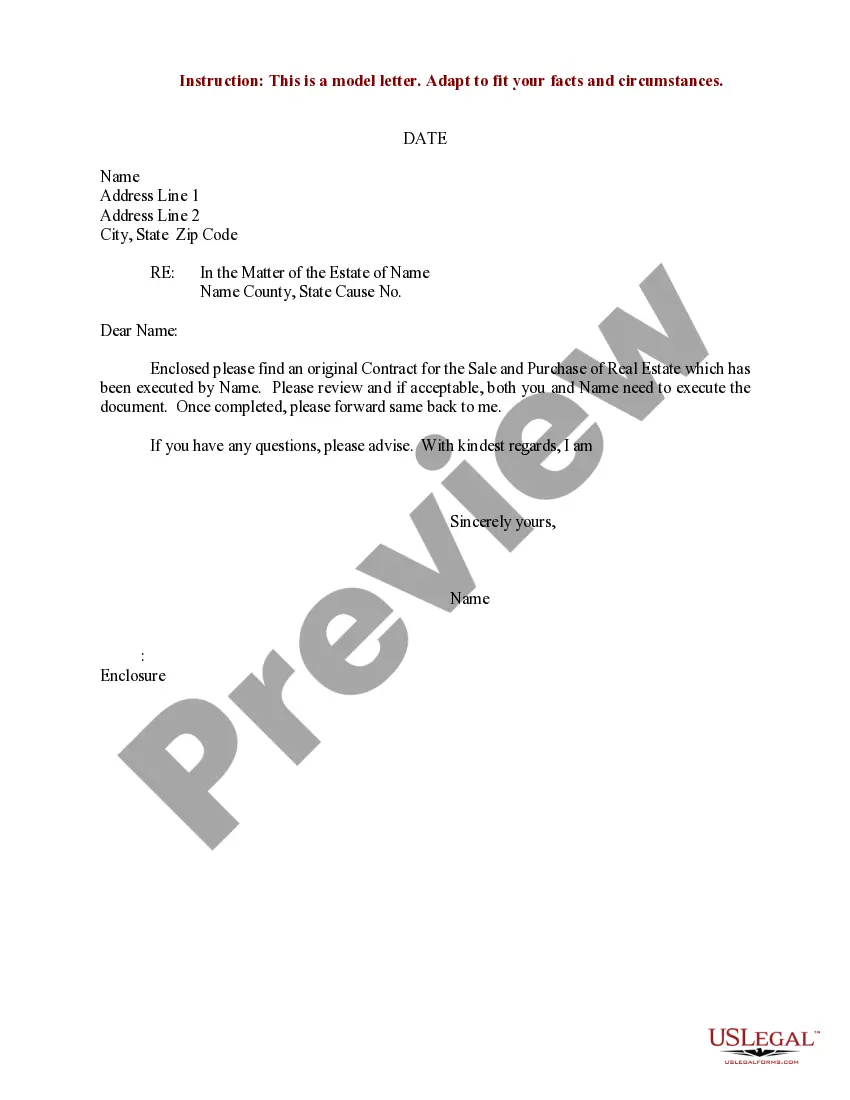



How to fill out Sample Letter To Client Regarding Real Estate Documents Related To Homestead?
Choosing the best legitimate document web template can be a battle. Needless to say, there are a variety of themes accessible on the Internet, but how can you find the legitimate kind you want? Use the US Legal Forms site. The assistance delivers a huge number of themes, for example the Minnesota Sample Letter to Client regarding Real Estate Documents related to Homestead, which you can use for business and personal needs. Each of the types are checked by specialists and meet up with state and federal demands.
When you are already registered, log in to your account and click on the Down load switch to obtain the Minnesota Sample Letter to Client regarding Real Estate Documents related to Homestead. Utilize your account to check with the legitimate types you might have purchased in the past. Go to the My Forms tab of your own account and obtain another duplicate from the document you want.
When you are a brand new end user of US Legal Forms, listed below are simple guidelines so that you can stick to:
- Very first, be sure you have chosen the proper kind for the city/area. It is possible to look through the shape while using Review switch and browse the shape description to guarantee this is the best for you.
- In the event the kind fails to meet up with your expectations, make use of the Seach discipline to discover the proper kind.
- Once you are certain the shape is proper, select the Acquire now switch to obtain the kind.
- Choose the costs plan you would like and enter in the necessary information and facts. Build your account and buy your order with your PayPal account or Visa or Mastercard.
- Pick the file structure and obtain the legitimate document web template to your product.
- Total, revise and printing and indicator the acquired Minnesota Sample Letter to Client regarding Real Estate Documents related to Homestead.
US Legal Forms will be the most significant local library of legitimate types that you can find different document themes. Use the service to obtain appropriately-produced files that stick to status demands.
Form popularity
FAQ
Residential non-homestead properties are residential properties that are not occupied by the owner or a qualifying relative. Residential non-homestead includes: Class 4b(1) residential real estate containing less than four units that does not qualify as class 4bb, other than seasonal residential recreational.
You may qualify for homestead if you answer yes to any of these statements: You are a Minnesota resident. You own the property in your own name ? not as a business entity. You live in the property year-round. You or your property co-owner have a social security number or an individual taxpayer identification number.
Claiming Multiple Properties If a property is occupied by a married owner, the owner's spouse may not claim another property as a homestead unless the spouse does not occupy the house due to 1 of the following reasons: Marriage dissolution proceedings are pending. The spouses are legally separated.
Effective beginning with assessment year 2024. EXPLANATION OF THE BILL Under current law, the homestead market value exclusion reduces the taxable market value for all homesteads valued below $413,800. The exclusion is 40% of the first $76,000 of market value, yielding a maximum exclusion of $30,400.
Minnesota statute allows homeowners to claim up to $390,000 in property value, or $975,000 if agricultural, as a "homestead." State law limits this exemption to 160 acres, which in practice may apply to farms, but has removed what was once a half-acre limit on property within city limits.
To qualify for homestead: You must own the property, or be a relative or in-law of the owner (son, daughter, parent, grandchild, grandparent, brother, sister, aunt, uncle, niece or nephew). You or your relative must occupy the property as the primary place of residence. You must be a Minnesota resident.
To qualify for homestead: You must own the property, or be a relative or in-law of the owner (son, daughter, parent, grandchild, grandparent, brother, sister, aunt, uncle, niece or nephew). You or your relative must occupy the property as the primary place of residence. You must be a Minnesota resident.
To receive relative homestead classification, the property must be the residence of any of the following: child, stepchild, daughter-in-law, son-in-law, parent, stepparent, parent-in-law, grandchild, grandparent, brother, brother-in-law, sister, sister-in-law, aunt, uncle, husband or wife.