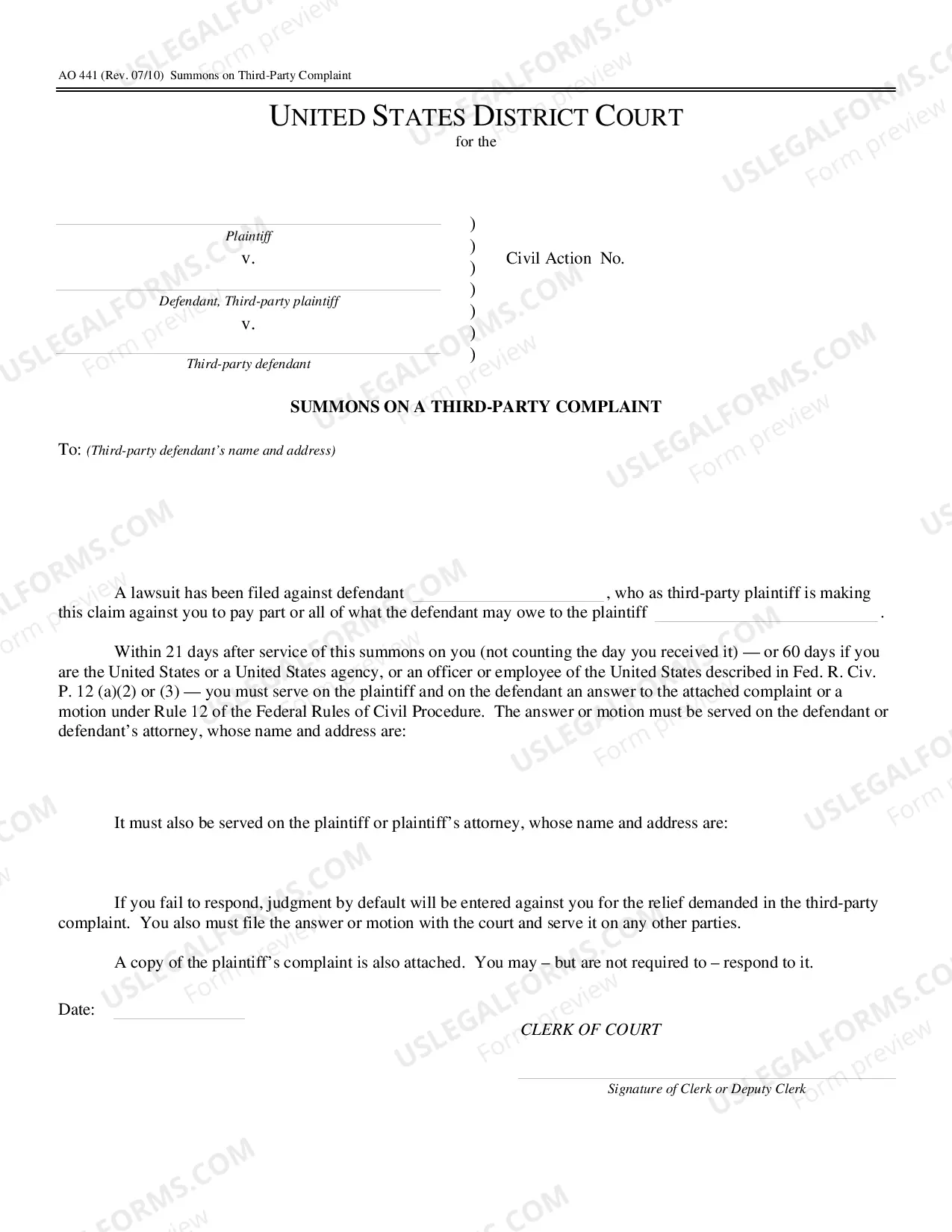
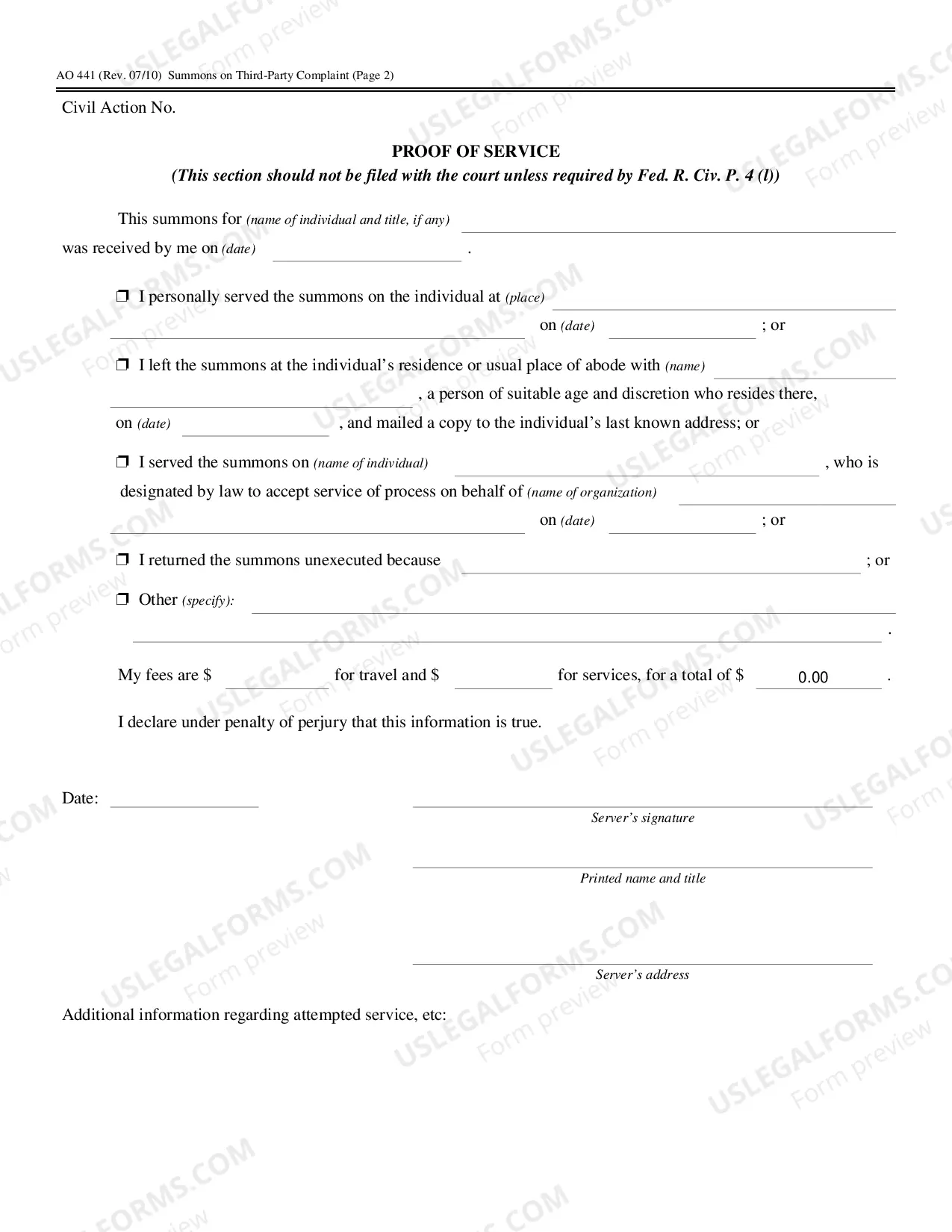
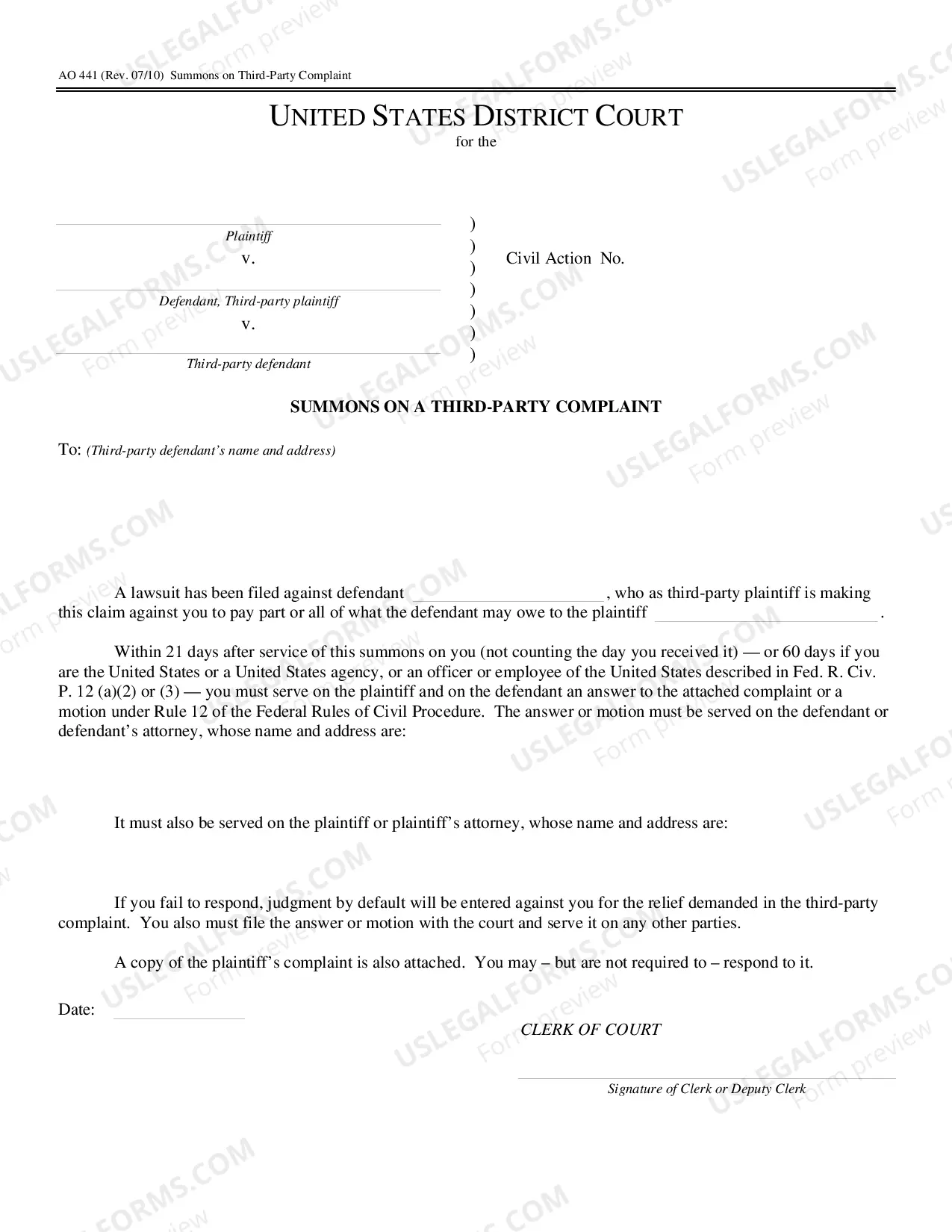
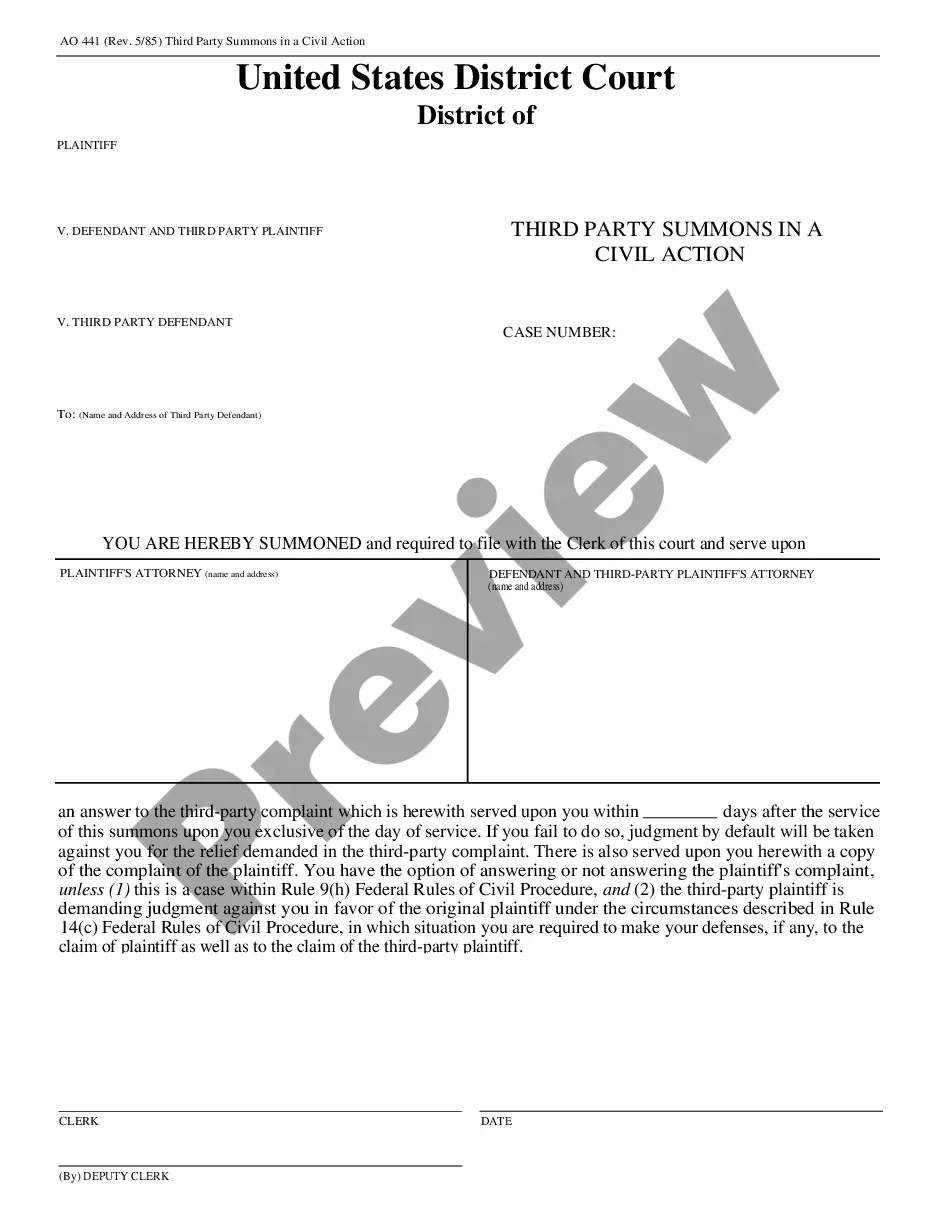
Minnesota (AO 441) Summons on a Third Party Complaint is a legal document used to serve notice to a third party (e.g., a business, landlord, or other entity) to appear in court and answer a complaint made by a plaintiff. The summons will outline the plaintiff’s allegations and the nature of the lawsuit, and inform the third party of their rights and obligations. This type of summons can be used in civil suits, landlord-tenant issues, and other legal proceedings. There are two types of Minnesota (AO 441) Summons on a Third Party Complaint: Summons on Third-Party Complaint (Form AO 441.1) and Summons on Third-Party Complaint (Form AO 441.2). Form AO 441.1 is used when the third party is an individual, while Form AO 441.2 is used when the third party is a corporation. Both forms require the plaintiff to provide the name and address of the third party, as well as the court’s location and a description of the claim. The summons must be signed by a judge and served on the third party, either in person or by mail.
Minnesota (AO 441) Summons on a Third Party Complaint
Description
Get your form ready online
Our built-in tools help you complete, sign, share, and store your documents in one place.
Make edits, fill in missing information, and update formatting in US Legal Forms—just like you would in MS Word.
Download a copy, print it, send it by email, or mail it via USPS—whatever works best for your next step.
Sign and collect signatures with our SignNow integration. Send to multiple recipients, set reminders, and more. Go Premium to unlock E-Sign.
If this form requires notarization, complete it online through a secure video call—no need to meet a notary in person or wait for an appointment.
We protect your documents and personal data by following strict security and privacy standards.

Make edits, fill in missing information, and update formatting in US Legal Forms—just like you would in MS Word.

Download a copy, print it, send it by email, or mail it via USPS—whatever works best for your next step.

Sign and collect signatures with our SignNow integration. Send to multiple recipients, set reminders, and more. Go Premium to unlock E-Sign.

If this form requires notarization, complete it online through a secure video call—no need to meet a notary in person or wait for an appointment.

We protect your documents and personal data by following strict security and privacy standards.
Looking for another form?
Key Concepts & Definitions
AO 441 Summons on a Third Party Complaint: A legal document issued under federal court procedures, used in civil litigation to formally notify a third-party defendant about a claim or relief being requested against them in an ongoing lawsuit. Federal Court Procedure: Guidelines and rules governed by federal law directing how cases are handled in United States federal courts. Pro Se Filing: Refers to the act of representing oneself in court, without the assistance of a lawyer.
Step-by-Step Guide on Handling an AO 441 Summons
- Review the Summons: Carefully read the summons to understand the specifics of the claim against you.
- Seek Legal Advice: Consider consulting an attorney to discuss your legal obligations and options.
- File a Response: Prepare and file an answer or a motion in response to the summons with the court before the deadline.
- Attend Required Hearings: Participate in all scheduled court proceedings, possibly including mediation or trial.
- Monitor the Case: Keep track of any developments and deadlines in the case using tools like online judiciary services for criminal case searches or updates.
Risk Analysis in Third Party Summons in Federal Courts
Engaging with federal court procedures, especially as a non-professional (pro se), involves several risks:
- Legal Missteps: Misunderstanding the nuances of district court rules and federal court procedures can lead to procedural errors, possibly affecting the case outcome.
- Financial Exposure: Third-party defendants might incur significant legal costs and potential liabilities if the claim leads to a judgment against them.
- Timeliness: Failing to respond to the summons in a timely manner can result in a default judgment, compounding potential losses.
Best Practices in Responding to an AO 441 Summons
- Documentation: Maintain comprehensive records of all communications and filings related to the case.
- Compliance with Protocols: Ensure all court protocols, such as bankruptcy filing procedures or judicial conduct policies, are followed meticulously.
- Utilize Resources: Leverage online judiciary services for case management and make use of court interpreter services if needed to ensure proper understanding of all proceedings.
Common Mistakes & How to Avoid Them
- Ignoring the Summons: Never disregard a court summons. Always respond within the specified timeframe.
- Informal Agreements: Avoid making any informal agreements without court approval or legal documentation.
- Lack of Preparation: Insufficient preparation for court appearances and failure to adhere to jury service instructions can negatively impact your case.
Related Legal Terminology Brief
- District Court Rules: Specific regulations that dictate the procedures in U.S. district courts.
- Federal Courts Vacancies: Unfilled positions within the federal judiciary system that can affect case processing times and judicial availability.
- Bankruptcy Filing Procedure: The standardized process outlined for filing bankruptcy in a federal court.
- Judicial Conduct Policies: Guidelines that ensure integrity and fairness in judicial behaviors and court proceedings.
FAQs About AO 441 Summons and Federal Court Procedures
- What is the deadline to respond to an AO 441 summons? Typically, a third party defendant has 21 days to respond after being served, unless otherwise specified by the court.
- Can a third-party defendant file a counterclaim? Yes, if they believe they have a claim against the plaintiff, they can file a counterclaim during their response.
- What happens if I ignore an AO 441 summons? Ignoring a summons can lead to a default judgment against you, which might include financial liabilities.
How to fill out Minnesota (AO 441) Summons On A Third Party Complaint?
US Legal Forms is the easiest and most economical method to discover suitable legal templates.
It is the largest online collection of business and personal legal documents prepared and verified by legal experts.
Here, you can access printable and fillable forms that adhere to national and local regulations - just like your Minnesota (AO 441) Summons on a Third Party Complaint.
Review the form description or preview the document to ensure you’ve found the one that meets your needs, or search for another one using the search tab above.
Click Buy now when you’re confident about its suitability with all the requirements, and choose the subscription plan that you prefer most.
- Acquiring your template involves just a few straightforward steps.
- Users with an existing account and a valid subscription simply need to Log In to the web service and download the document to their device.
- Then, they can locate it in their profile under the My documents section.
- And here’s how to obtain a correctly drafted Minnesota (AO 441) Summons on a Third Party Complaint if you’re using US Legal Forms for the first time.
Form popularity
FAQ
Typically, a summons is issued at the same time as a complaint or shortly after. The summons serves to notify the defendant of the legal action being taken against them and compels their response. In the case of a Minnesota (AO 441) Summons on a Third Party Complaint, both documents work together to inform all parties of the claims and required actions, ensuring fair legal proceedings.
Yes, you are legally obligated to respond to a third party subpoena, as it is a formal request for information or testimony. Ignoring or failing to comply with a subpoena can lead to legal consequences, including fines or other penalties. If you receive a Minnesota (AO 441) Summons on a Third Party Complaint, it is advisable to seek legal counsel to ensure your rights are protected and to understand your obligations.
A 3rd party summons is a legal document that notifies a third party of their involvement in a legal action initiated by one of the primary parties. This summons typically outlines the claims against the third party and requires them to respond or appear in court. In the context of Minnesota (AO 441) Summons on a Third Party Complaint, this process allows for the efficient resolution of disputes by including all relevant parties.
In legal contexts, a 'third party' refers to someone who is not directly involved in a particular legal dispute but may be relevant to the case. This can include individuals or entities that might have information or interests in the matter at hand. When discussing the Minnesota (AO 441) Summons on a Third Party Complaint, it is essential to understand that the third party may be brought into the case to address specific claims or responsibilities.
A complaint is a legal document that outlines the claims made by the plaintiff against the defendant. In contrast, a summons is a notice that informs the defendant they are being sued and mandates their appearance in court. When dealing with a Minnesota (AO 441) Summons on a Third Party Complaint, both documents are essential for properly initiating legal proceedings and ensuring all parties are informed.
A third party complaint allows a defendant to bring another party into an existing lawsuit, claiming that this third party is liable for some or all of the damages. This process typically involves filing a Minnesota (AO 441) Summons on a Third Party Complaint, which formally notifies the third party of their involvement. This mechanism can streamline the resolution of disputes by addressing all relevant parties in one action.
To serve a summons in Minnesota, you must deliver it to the individual or entity named in the summons. This can be done through personal service or by mail, depending on the circumstances. If you need assistance with the process, consider using the resources available on the uslegalforms platform to ensure compliance with all legal requirements.
Yes, a third party complaint requires a summons to notify the third party of the legal action being taken against them. The Minnesota (AO 441) Summons on a Third Party Complaint must be served alongside the complaint to ensure the third party has the opportunity to respond. This process is critical for maintaining the integrity of the legal proceedings.
Rule 4.03 in Minnesota governs the service of process and outlines the requirements for issuing a summons. This rule ensures that all parties receive proper notification of the lawsuit, promoting fairness in the legal process. Understanding this rule is essential when preparing a Minnesota (AO 441) Summons on a Third Party Complaint.
Yes, a summons is mandatory when initiating a legal action in Minnesota, including a Minnesota (AO 441) Summons on a Third Party Complaint. It serves as a formal notice to the parties involved, informing them of the legal proceedings. Without a summons, the court may not have jurisdiction over the third party, which can lead to complications in your case.