Minnesota Affidavit and Order to Show Cause for Contempt
What this document covers
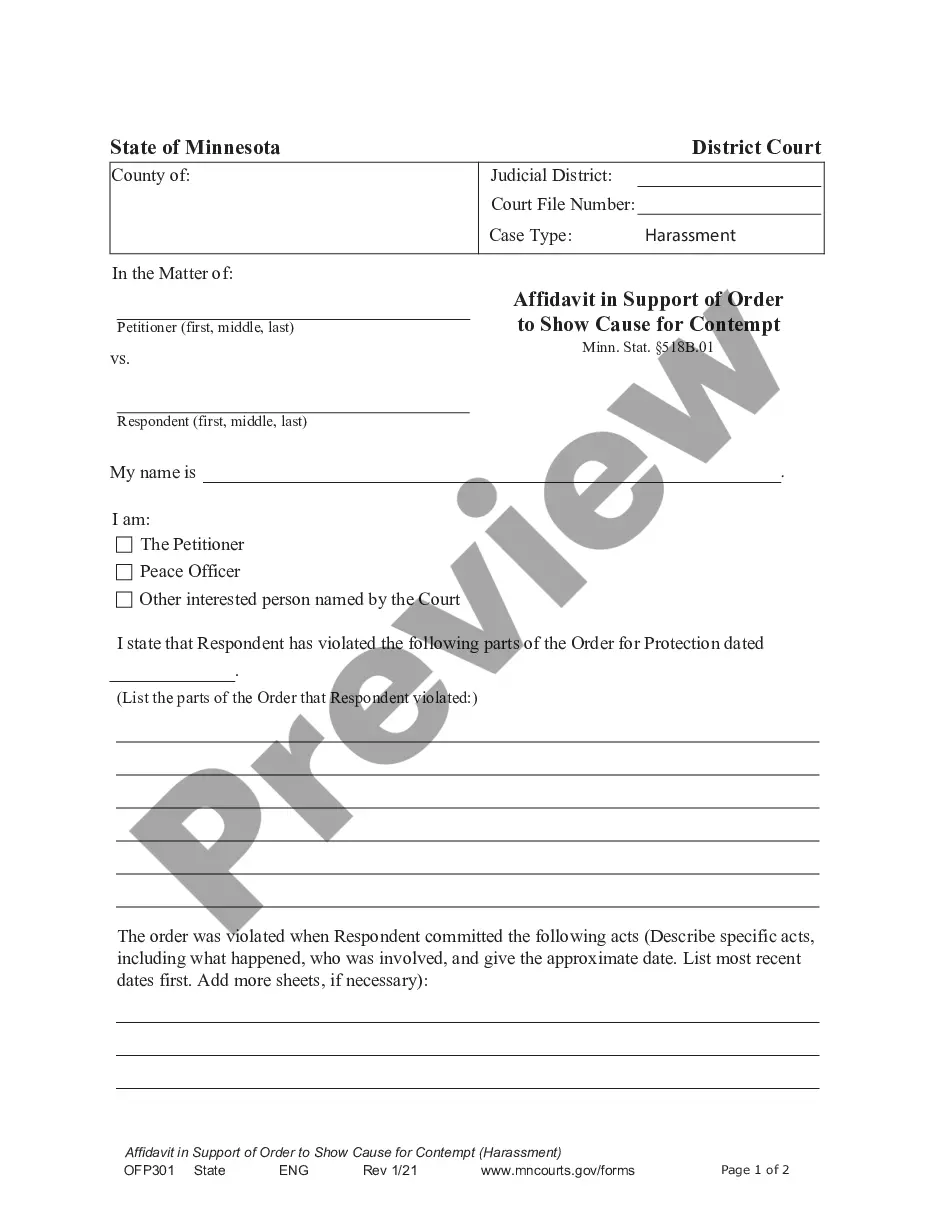
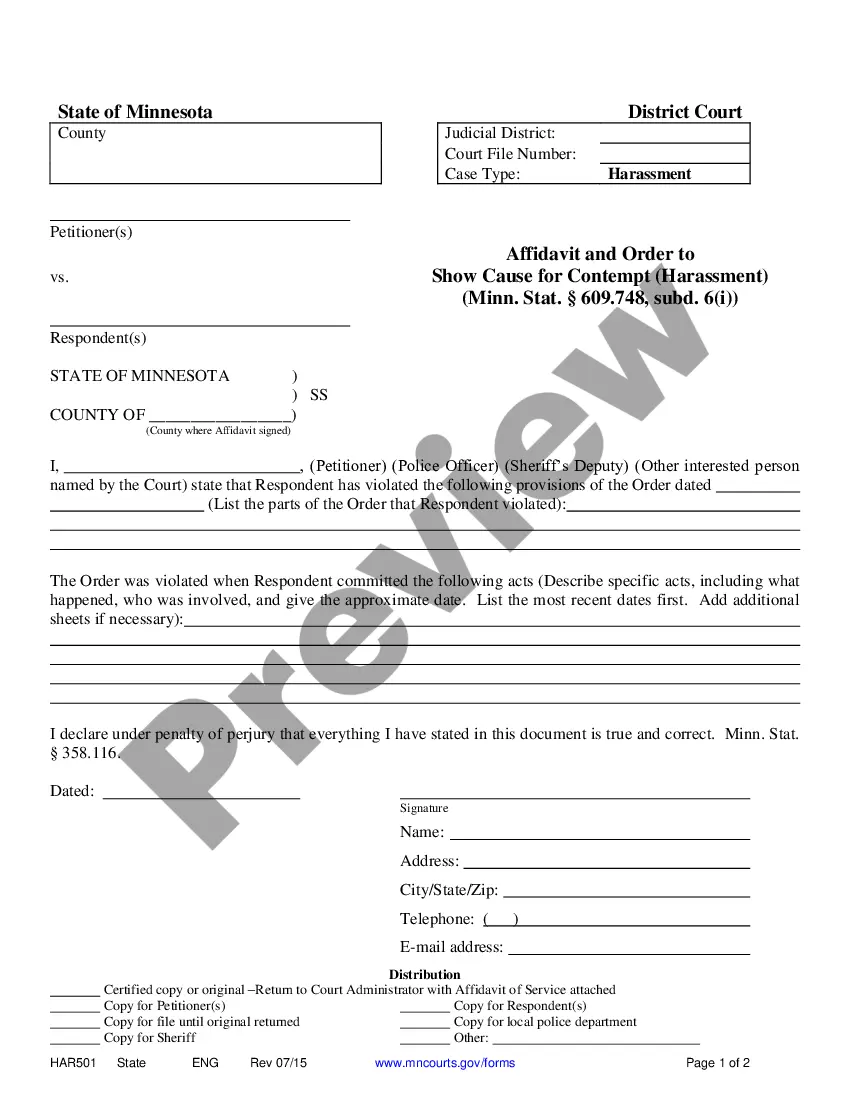
The Affidavit and Order to Show Cause for Contempt is a legal document used in Minnesota to initiate a court procedure when a respondent violates an Order for Protection. This form helps the petitioner request enforcement of the court's order by illustrating the violations committed by the respondent. This affidavit is specifically tailored for harassment cases, setting it apart from other contempt forms that may deal with different types of cases or legal issues.
Key parts of this document
- Petitioner and Respondent information: Names and roles of the parties involved.
- Details of the violation: A clear description of how the Order for Protection has been violated.
- Timeline of events: A chronological account of specific acts committed by the respondent.
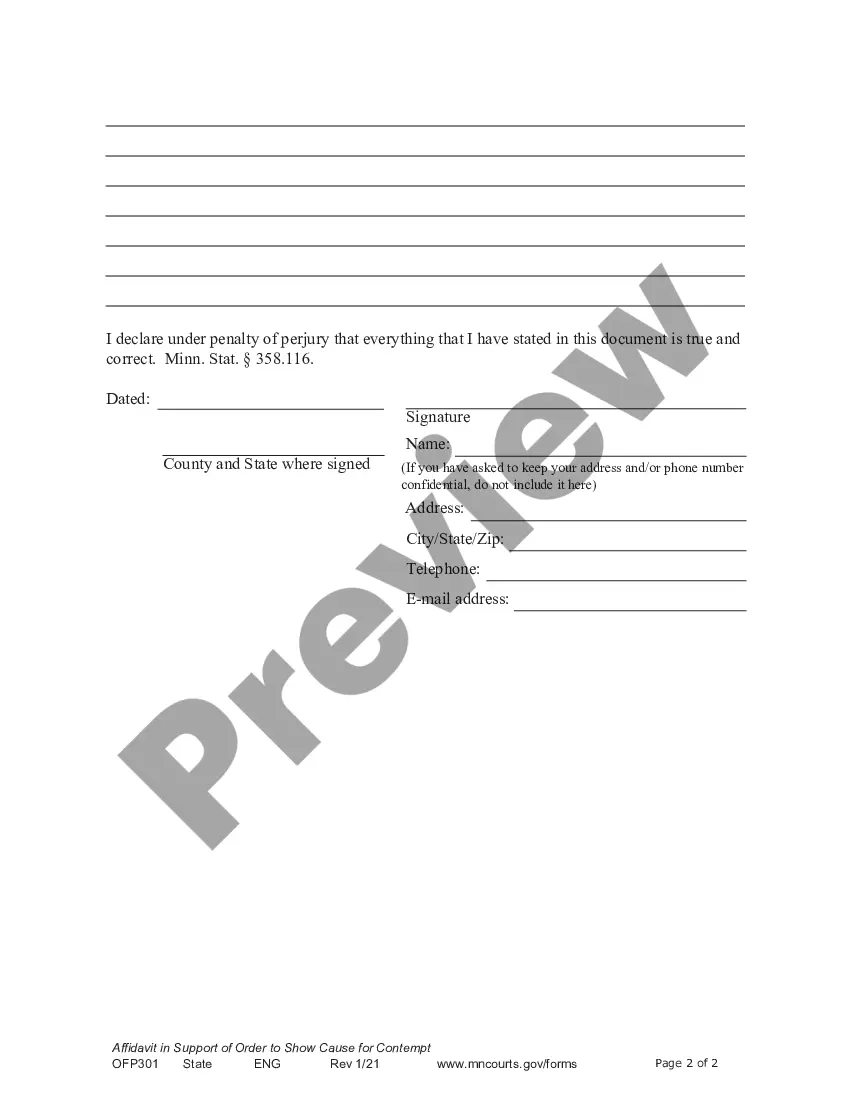
- Affirmation of truth: A declaration under penalty of perjury confirming the accuracy of the affidavit information.
- Contact information: Spaces for the petitionerâs address, phone number, and email (with privacy considerations).
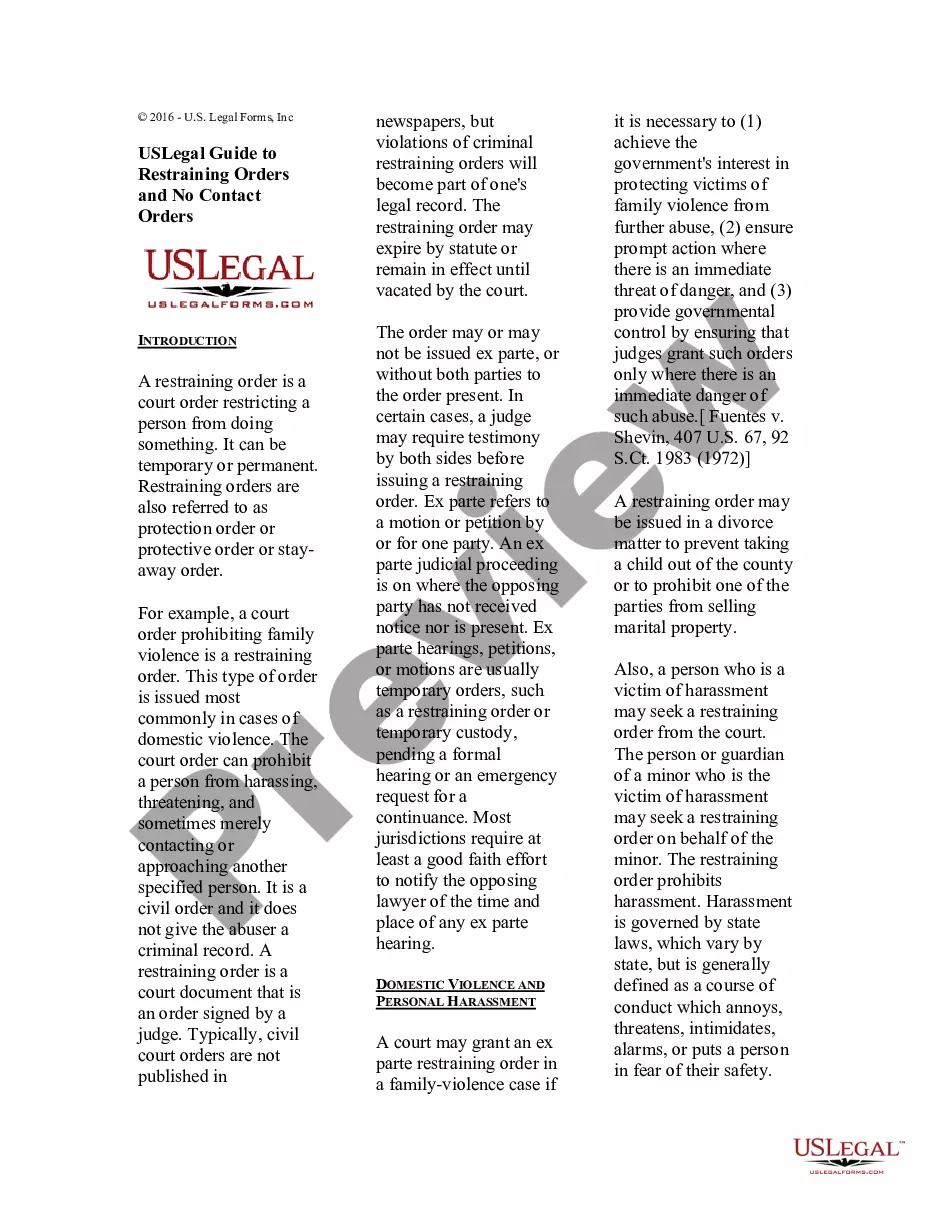
When this form is needed
This form is appropriate to use when a respondent fails to comply with the terms outlined in a prior Order for Protection. Common scenarios include instances of harassment, threats, or any actions that violate the protective order, making it necessary for the petitioner to seek formal legal recourse to address the non-compliance.
Who this form is for
- Individuals who have obtained an Order for Protection and believe the order has been violated.
- Family members or legal representatives of the petitioner who are authorized to act on their behalf.
- Peace officers or other interested parties named by the court that have witnessed violations of the order.
How to complete this form
- Identify the parties involved: Clearly state the names of the petitioner and respondent.
- Describe the violations: List the specific parts of the Order that the respondent has violated.
- Detail the acts: Provide a clear account of the incidents that constitute the violations, including dates and involved parties.
- Sign under penalty of perjury: Confirm the truthfulness of your statement by signing and dating the document.
- Provide your contact information: Enter your address and phone number if not confidential.
Is notarization required?
This form does not typically require notarization unless specified by local law. However, it's crucial to ensure that all information is accurate and truthful, as signing under penalty of perjury has legal implications.
Get your form ready online
Our built-in tools help you complete, sign, share, and store your documents in one place.
Make edits, fill in missing information, and update formatting in US Legal Forms—just like you would in MS Word.
Download a copy, print it, send it by email, or mail it via USPS—whatever works best for your next step.
Sign and collect signatures with our SignNow integration. Send to multiple recipients, set reminders, and more. Go Premium to unlock E-Sign.
If this form requires notarization, complete it online through a secure video call—no need to meet a notary in person or wait for an appointment.
We protect your documents and personal data by following strict security and privacy standards.

Make edits, fill in missing information, and update formatting in US Legal Forms—just like you would in MS Word.

Download a copy, print it, send it by email, or mail it via USPS—whatever works best for your next step.

Sign and collect signatures with our SignNow integration. Send to multiple recipients, set reminders, and more. Go Premium to unlock E-Sign.

If this form requires notarization, complete it online through a secure video call—no need to meet a notary in person or wait for an appointment.

We protect your documents and personal data by following strict security and privacy standards.
Mistakes to watch out for
- Failing to provide complete details of the violations, which may weaken the case.
- Not signing the affidavit, as this declaration is legally necessary.
- Listing events out of chronological order, making it harder for the court to follow the timeline.
Legal use & context
- This form serves as a legal mechanism for enforcing an Order for Protection in Minnesota.
- It is essential in cases of harassment where the safety of the petitioner is at risk.
- Filing this affidavit ensures that the court has a formal record of violations for potential legal action.
Looking for another form?

Form popularity
FAQ
To fill out the order to show cause form, start by clearly identifying the case number and the parties involved. Next, provide specific details regarding the contempt, including dates and actions that demonstrate the violation. It's crucial to include any supporting evidence or documentation. For a seamless experience, consider using the Minnesota Affidavit and Order to Show Cause for Contempt available on the US Legal Forms platform, which offers easy-to-follow templates and guidance.
It's basically an order directing a party to appear in court and explain why that party took (or failed to take) some action, or why the court should or should not grant the requested relief.The main objective of the show cause hearing is to get the party who is not following the court's order to do so.
If a person is found to be in contempt, the court is able to impose sanctions, which may include the following: jail time (usually 1-30 days) ordering the party held in contempt to pay the money owed. ordering the party held in contempt to pay the other party's attorney's fees.
There is a valid court order in effect. The other person knows about the court order. The facts show a plain violation of the order. You have given the person notice of the contempt hearing and a chance to be heard. Contempt is an appropriate remedy for the violation.
A response to an order to show cause typically requires you to show up in-person to the hearing. You can provide an answer to the order and state why you object to the order being issued.
It's basically an order directing a party to appear in court and explain why that party took (or failed to take) some action, or why the court should or should not grant the requested relief.The main objective of the show cause hearing is to get the party who is not following the court's order to do so.