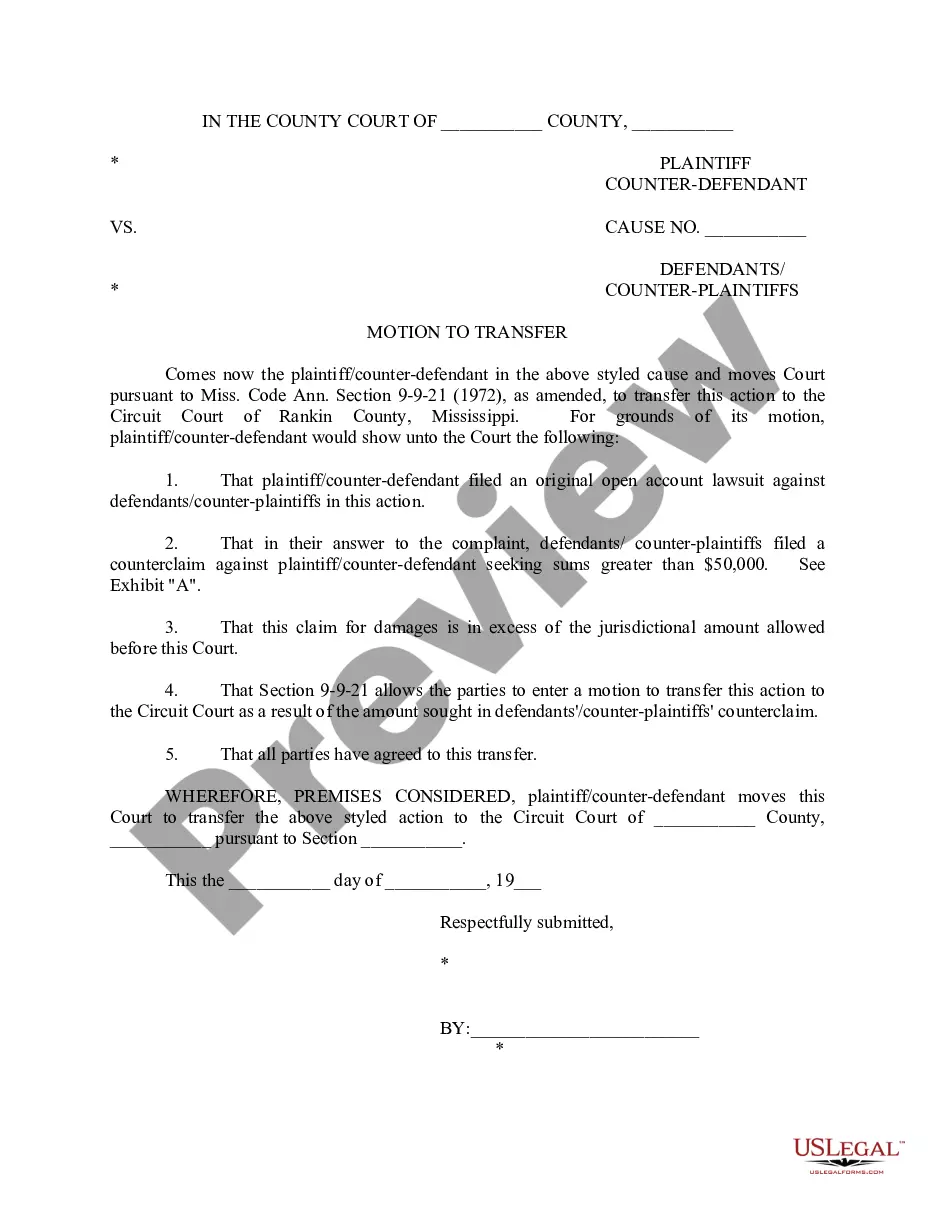
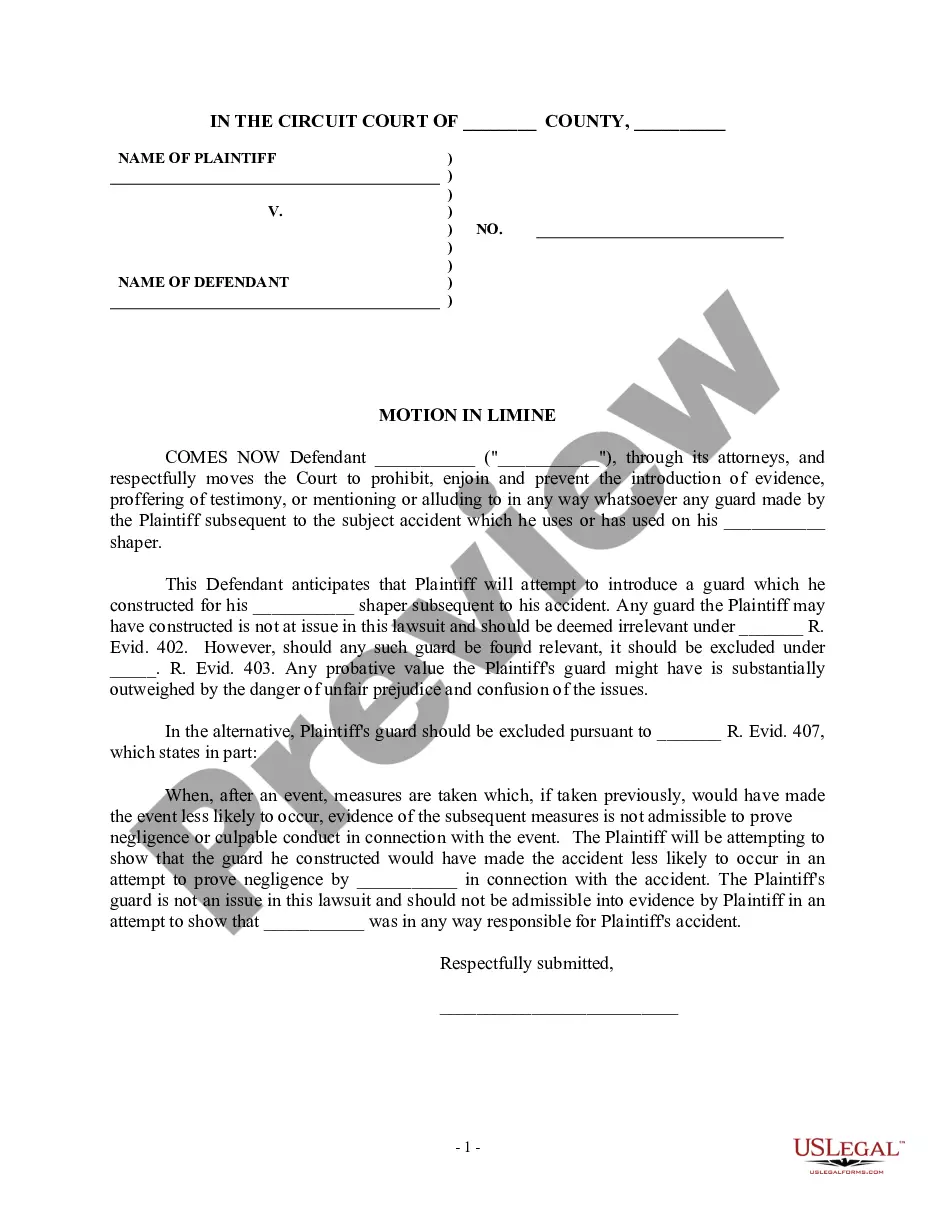
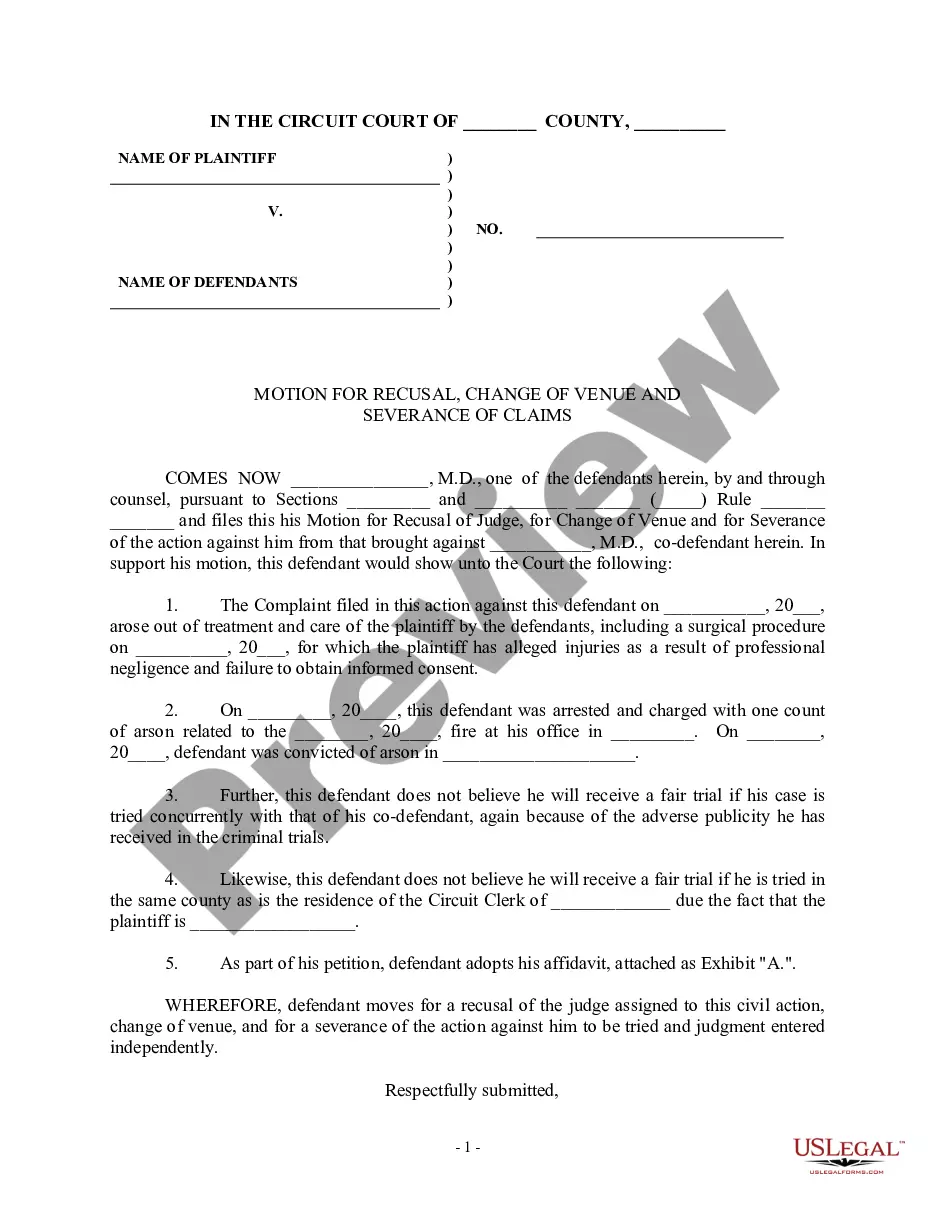
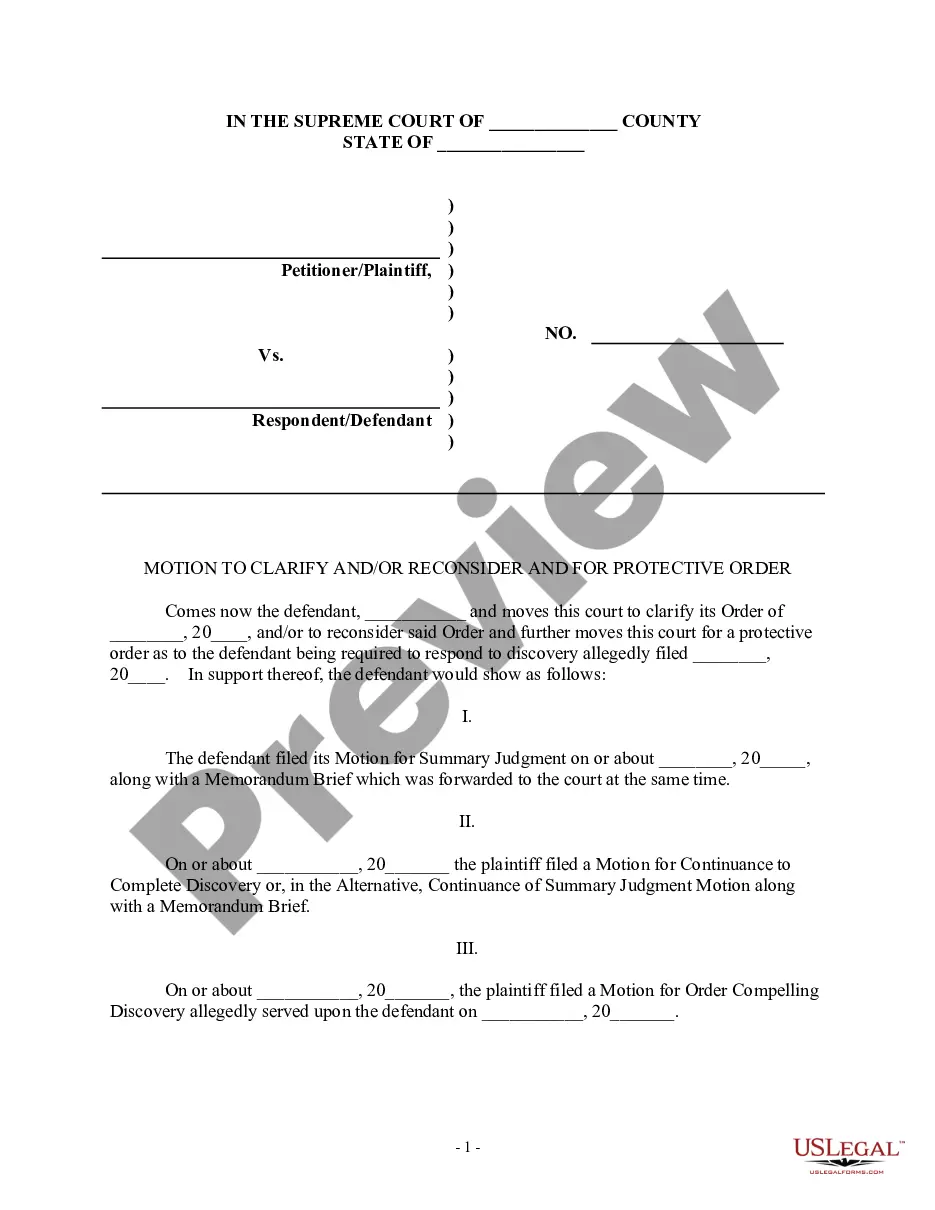
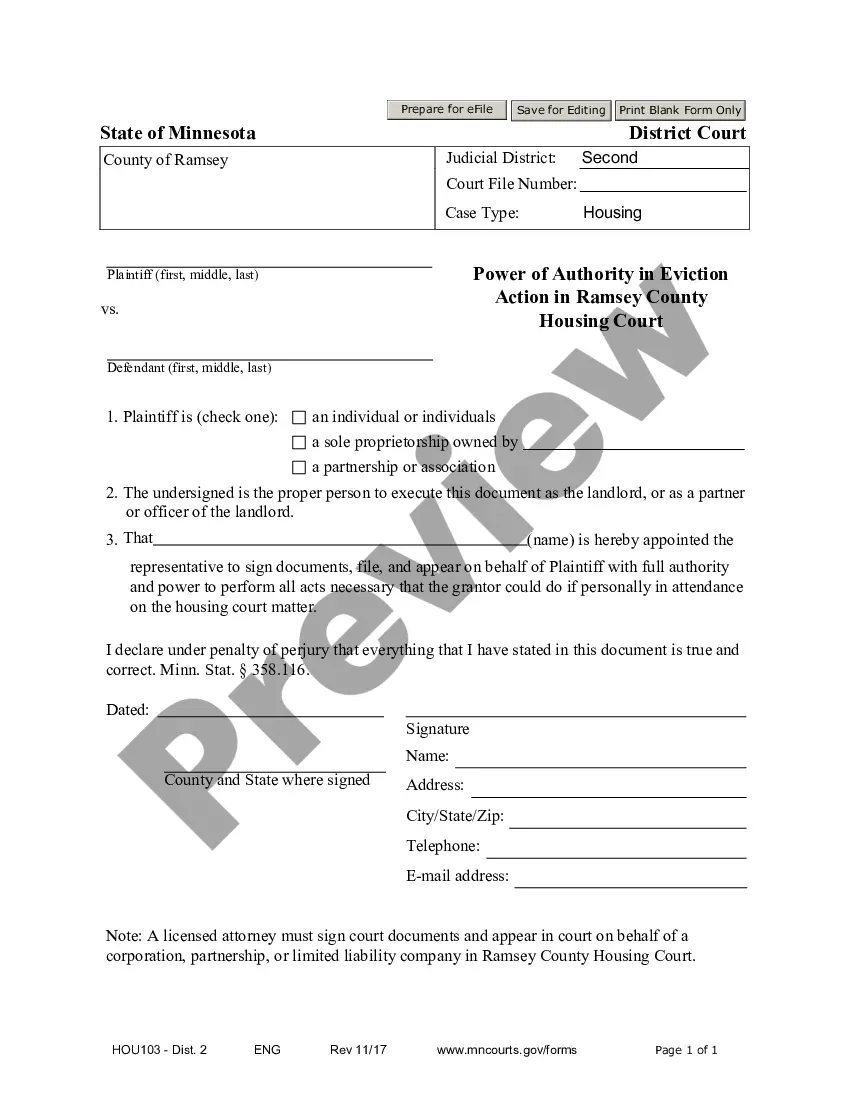
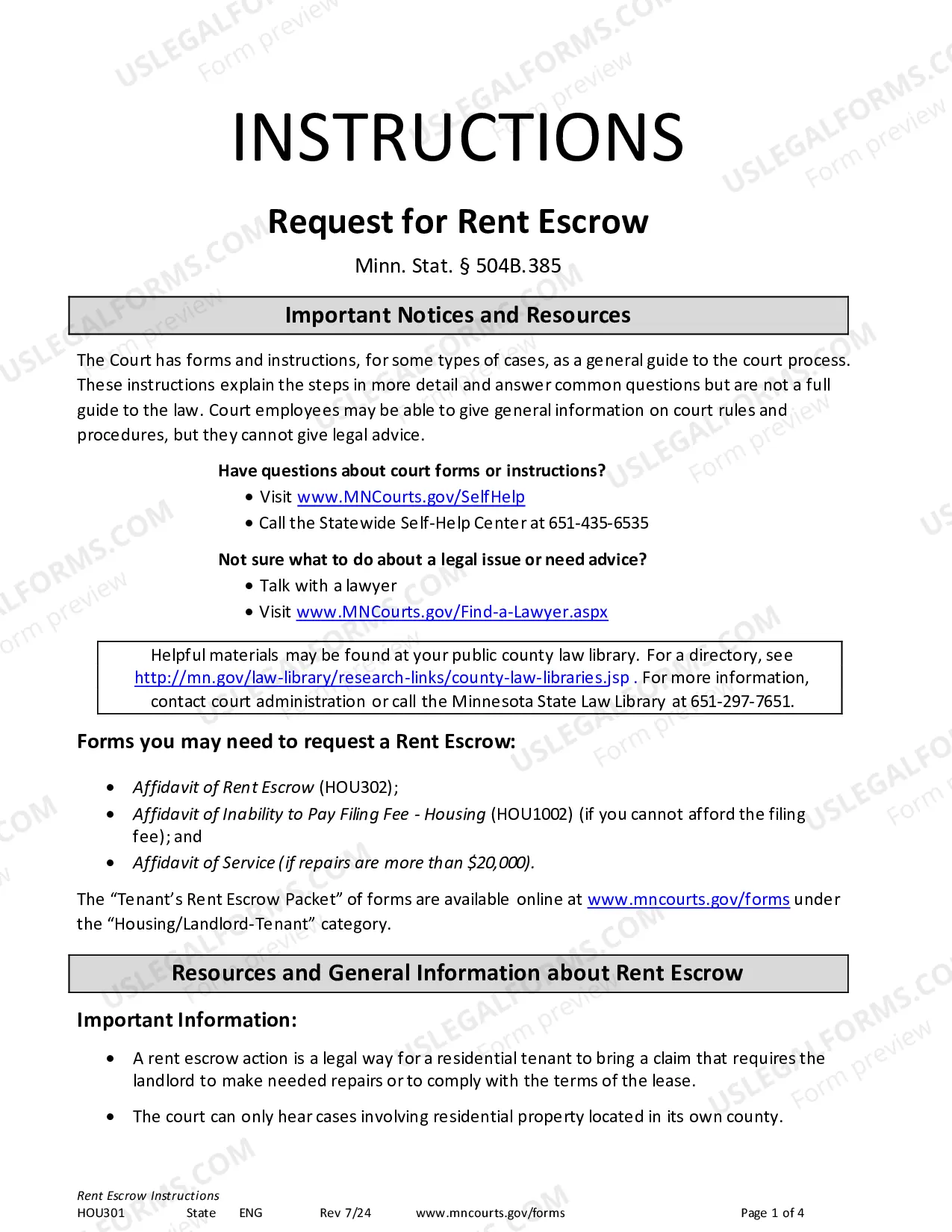
This is an official Minnesota court form for use in a housing case, a Power of Authority in Eviction Action. USLF amends and updates these forms as is required by Minnesota Statutes and Law.
Minnesota Power of Authority In Eviction Action
State:
Minnesota
Control #:
MN-HOU103
Format:
PDF
Instant download
This website is not affiliated with any governmental entity
Public form
Description

Get your form ready online
Our built-in tools help you complete, sign, share, and store your documents in one place.
Built-in online Word editor
Make edits, fill in missing information, and update formatting in US Legal Forms—just like you would in MS Word.
Export easily
Download a copy, print it, send it by email, or mail it via USPS—whatever works best for your next step.
E-sign your document
Sign and collect signatures with our SignNow integration. Send to multiple recipients, set reminders, and more. Go Premium to unlock E-Sign.
Notarize online 24/7
If this form requires notarization, complete it online through a secure video call—no need to meet a notary in person or wait for an appointment.
Store your document securely
We protect your documents and personal data by following strict security and privacy standards.

Make edits, fill in missing information, and update formatting in US Legal Forms—just like you would in MS Word.

Download a copy, print it, send it by email, or mail it via USPS—whatever works best for your next step.

Sign and collect signatures with our SignNow integration. Send to multiple recipients, set reminders, and more. Go Premium to unlock E-Sign.

If this form requires notarization, complete it online through a secure video call—no need to meet a notary in person or wait for an appointment.

We protect your documents and personal data by following strict security and privacy standards.
Looking for another form?


How to fill out Minnesota Power Of Authority In Eviction Action?
Obtain any template from 85,000 legal documents like Minnesota Power of Authority in Eviction Action online with US Legal Forms. Each template is composed and refreshed by state-licensed lawyers.
If you already possess a subscription, Log In. Once you arrive on the form’s page, click on the Download button and navigate to My documents to gain access to it.
If you haven’t subscribed yet, follow the guidelines listed below.
With US Legal Forms, you will consistently have swift access to the suitable downloadable template. The platform grants you access to forms and categorizes them to simplify your search. Utilize US Legal Forms to acquire your Minnesota Power of Authority in Eviction Action quickly and effortlessly.
- Verify the state-specific prerequisites for the Minnesota Power of Authority in Eviction Action you need to utilize.
- Examine the description and preview the sample.
- Once you are confident the template meets your needs, simply click Buy Now.
- Select a subscription plan that fits your financial situation.
- Establish a personal account.
- Make payment in one of two suitable methods: by card or through PayPal.
- Choose a format to download the document in; two options are available (PDF or Word).
- Download the document to the My documents tab.
- After your reusable template is prepared, print it out or save it to your device.
Form popularity
FAQ
The new law for power of attorney in Oklahoma strengthens the rights of individuals who grant someone else authority to act on their behalf. This law emphasizes transparency and accountability, ensuring that those with power of attorney act in the best interests of the principal. Understanding these changes can help property owners effectively manage eviction actions, especially when leveraging the Minnesota Power of Authority In Eviction Action.
Yes, you can appeal an eviction decision in Minnesota. If you believe the court's ruling was unjust, you have the right to file an appeal within a specific timeframe. This process allows you to present your case to a higher court, potentially overturning the initial decision and providing a fair chance to resolve the situation.
A power of attorney cannot evict you directly, but they can initiate the eviction process on behalf of the property owner. This means they can file necessary documents and represent the landlord in court. If you find yourself facing an eviction, it is essential to understand your rights and consult resources that detail the Minnesota Power of Authority In Eviction Action.
The new eviction law in Minnesota focuses on providing tenants with greater protections against unlawful evictions. It emphasizes the need for landlords to adhere to specific procedures before evicting a tenant. Understanding these regulations can help both landlords and tenants navigate the eviction process more effectively, ensuring compliance with the Minnesota Power of Authority In Eviction Action.
Yes, a power of attorney can initiate the eviction process on behalf of the property owner. However, it is crucial to ensure that the power of attorney document specifically grants authority for eviction actions. Utilizing a Minnesota Power of Authority In Eviction Action can streamline the process and ensure that all legal requirements are met, making it a smart choice for property owners.
The eviction process typically consists of three main stages: notice, court hearing, and enforcement. First, landlords must provide tenants with a written notice to vacate, which clearly states the reason for eviction. If the tenant does not leave, the landlord can file an eviction lawsuit, leading to a court hearing. Finally, if the court rules in favor of the landlord, they can proceed with enforcement, which often involves a sheriff removing the tenant.
If you win an eviction hearing, the court will pass a judgment in your favor. This judgment allows you to get a writ of possession.Even with this winning judgment, there are cases where tenants may still refuse to leave the property. As if the hearing never happened, they continue to live in your house.
Typically unless you've done something to "reinstate" the tenancy (such as the acceptance of rent for a period after the date of termination then statutorily the notice is still relevant.
If you do not vacate by the day in the notice, the landlord can then apply to the NSW Civil and Administrative Tribunal (NCAT) for a termination order. A termination order ends the tenancy and specifies the day by which you must give vacant possession.
If the tenant fails to pay rent and abide by the lease terms, the new owner may evict the tenant. The new owner must provide notice to vacate 90 days prior to the termination of the lease.