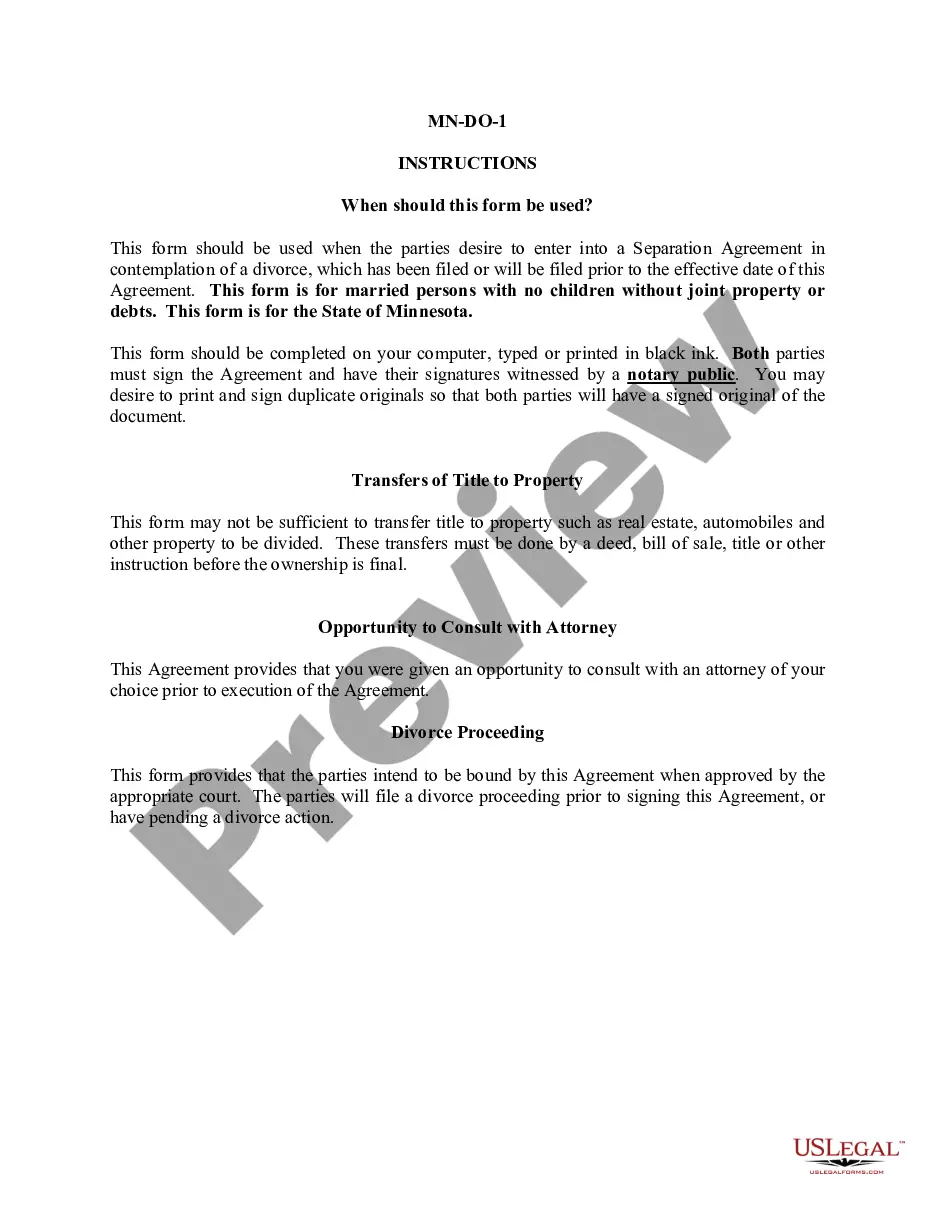
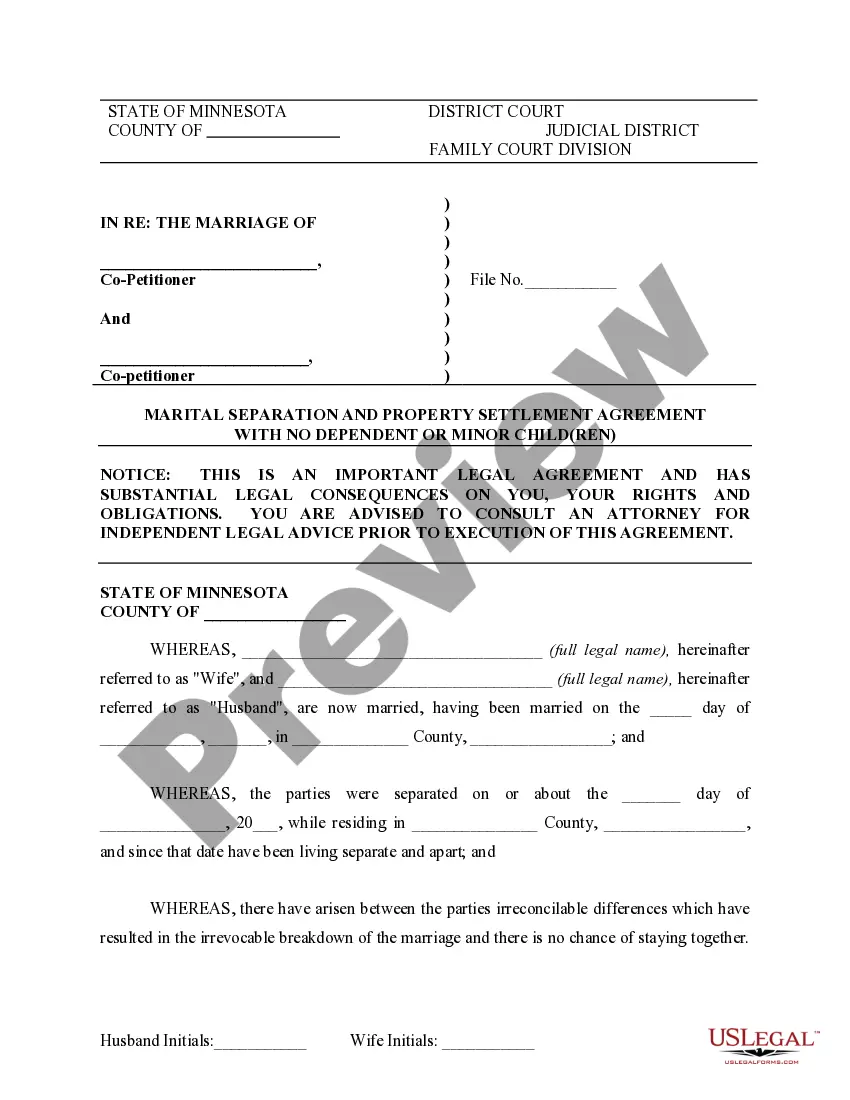
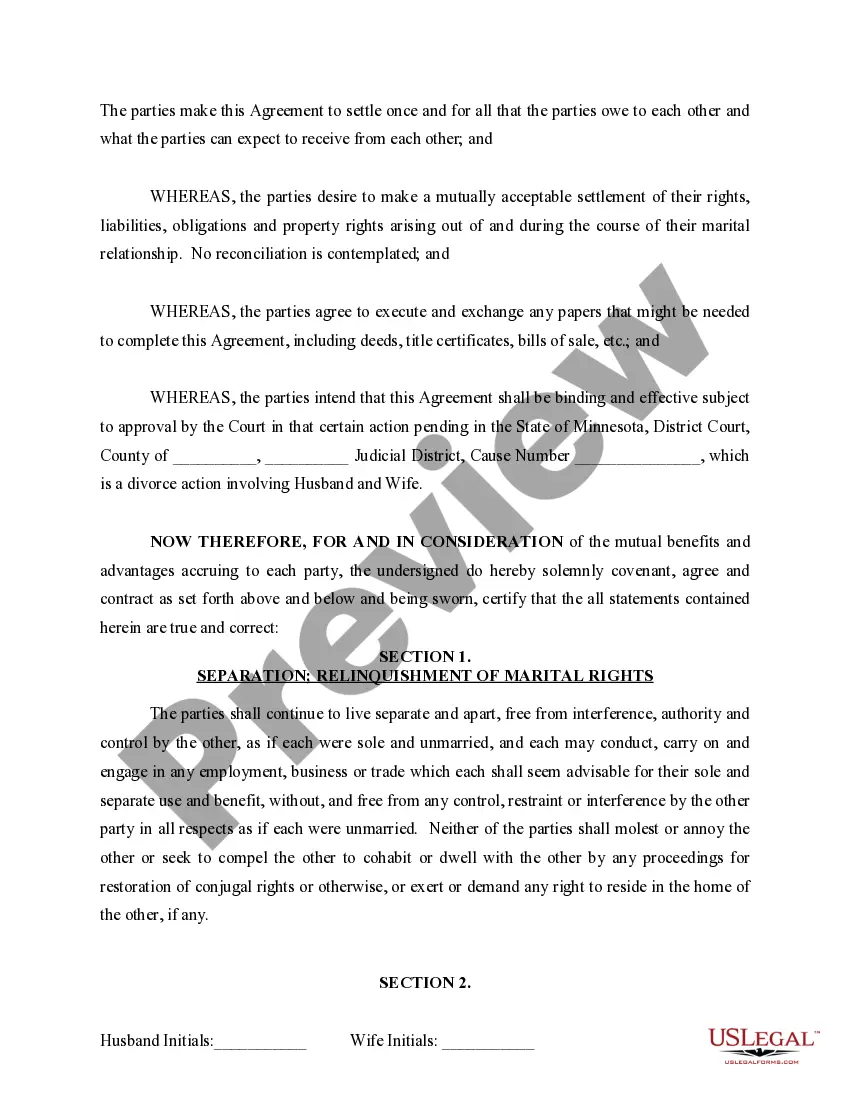
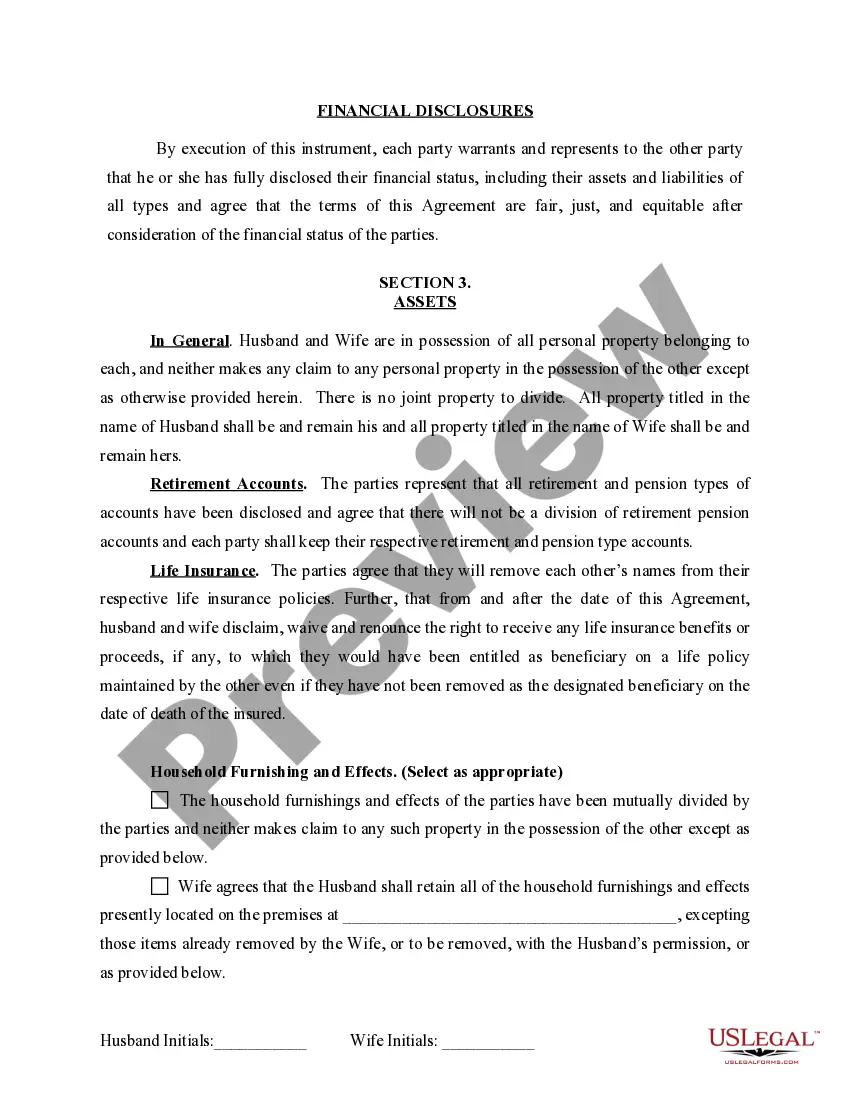
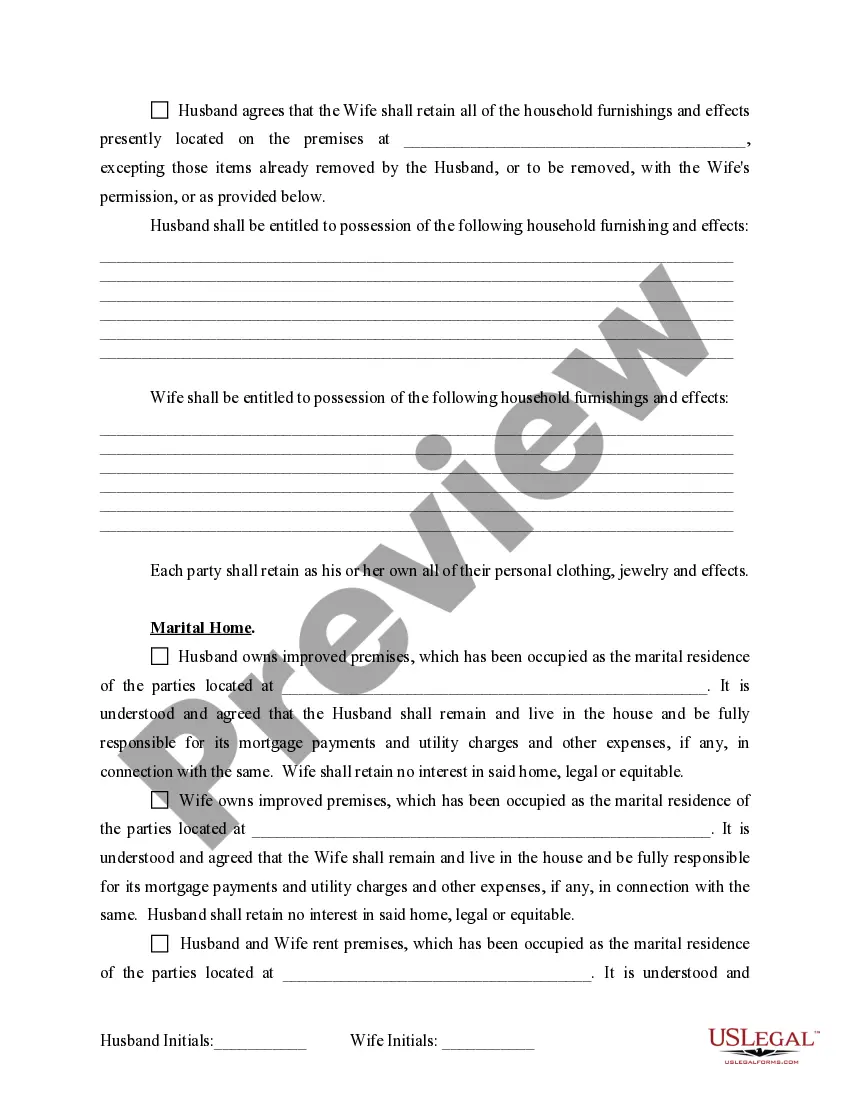
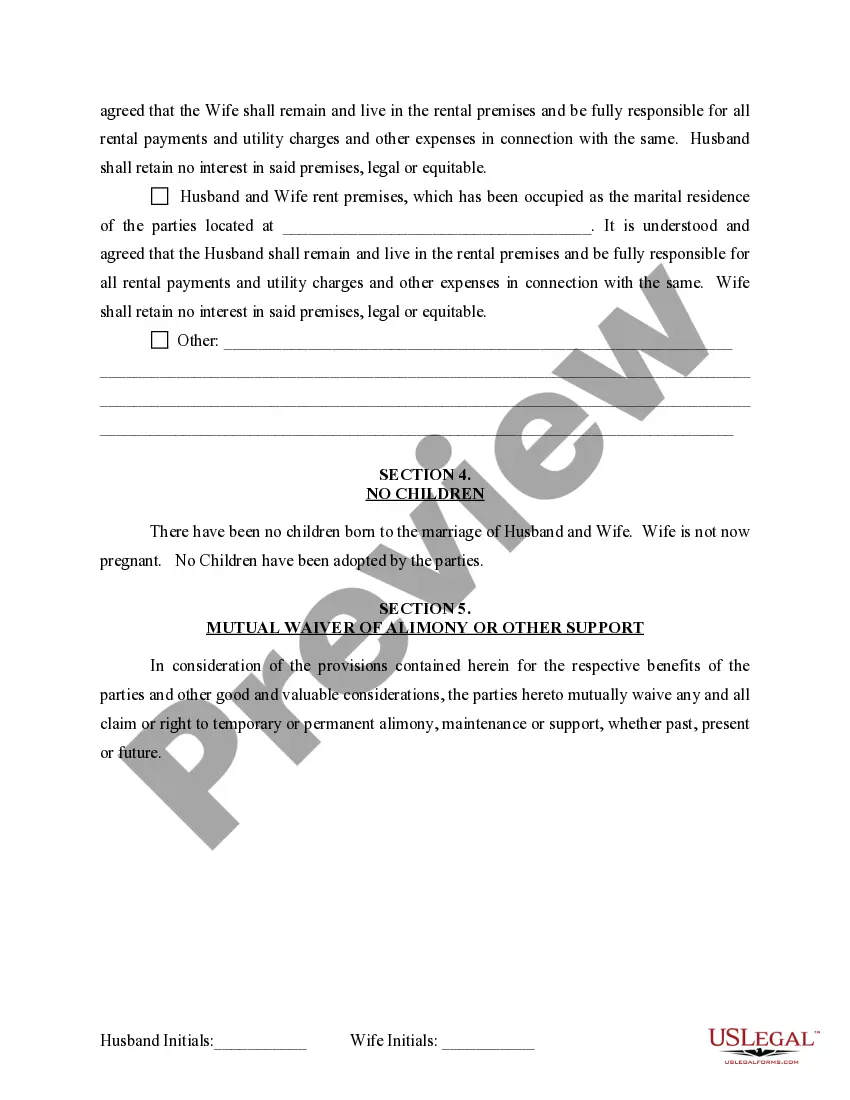
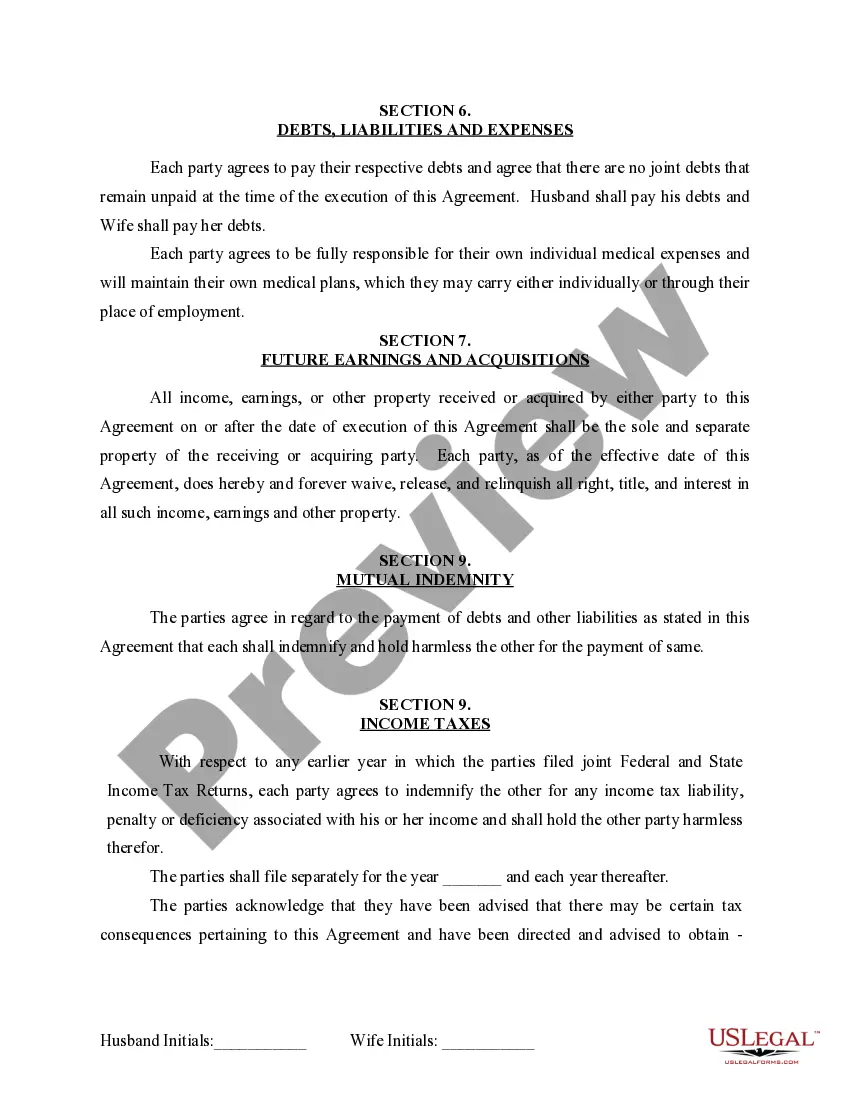
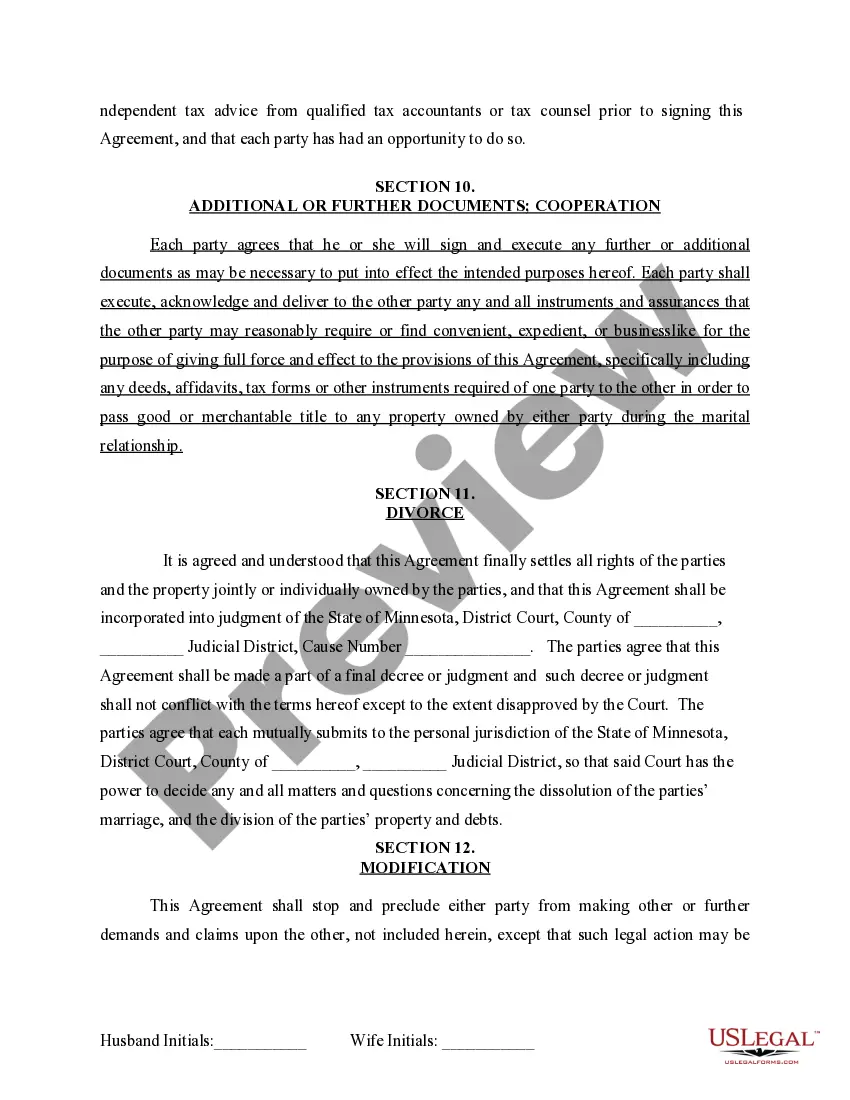
Marital Domestic Separation and Property Settlement Agreement for persons with No Children, No Joint Property or Debts where Divorce Action Filed
Note: This summary is not intended to be an all-inclusive
discussion of the law of separation agreements in Minnesota, but does include
basic and other provisions.
General Summary: Marital Termination Agreements, as
stipulations are a judicially-favored means of simplifying and expediting
dissolution litigation and, for this reason, are accorded the sanctity
of binding contracts. As "binding contracts," a party cannot repudiate
or withdraw from a stipulation without the consent of the other party,
except "by leave of the court for cause shown".
Property divisions are final and are not subject to modification
except where they are the product of mistake or fraud. A precondition
to this finality is the duty of the parties to a marital dissolution have
a duty to make a full and accurate disclosure of all assets and liabilities
to facilitate the trial court's property distribution.
Statutes:
MINNESOTA STATUTES
CHAPTER 518 MARRIAGE DISSOLUTION
Division of marital property:
Subdivision 1. General. Upon a dissolution of a marriage,
an annulment, or in a proceeding for disposition of property following
a dissolution of marriage by a court which lacked personal jurisdiction
over the absent spouse or lacked jurisdiction to dispose of the property
and which has since acquired jurisdiction, the court shall make a just
and equitable division of the marital property of the parties without regard
to marital misconduct, after making findings regarding the division of
the property. The court shall base its findings on all relevant factors
including the length of the marriage, any prior marriage of a party, the
age, health, station, occupation, amount and sources of income, vocational
skills, employability, estate, liabilities, needs, opportunity for future
acquisition of capital assets, and income of each party. The court shall
also consider the contribution of each in the acquisition, preservation,
depreciation or appreciation in the amount or value of the marital property,
as well as the contribution of a spouse as a homemaker. It shall be conclusively
presumed that each spouse made a substantial contribution to the acquisition
of income and property while they were living together as husband and wife.
The court may also award to either spouse the household goods and furniture
of the parties, whether or not acquired during the marriage. The court
shall value marital assets for purposes of division between the parties
as of the day of the initially scheduled prehearing settlement conference,
unless a different date is agreed upon by the parties, or unless the court
makes specific findings that another date of valuation is fair and equitable.
If there is a substantial change in value of an asset between the date
of valuation and the final distribution, the court may adjust the valuation
of that asset as necessary to effect an equitable distribution.
Subd. 1a. Transfer, encumbrance, concealment, or disposition
of marital assets. During the pendency of a marriage dissolution, separation,
or annulment proceeding, or in contemplation of commencing a marriage dissolution,
separation, or annulment proceeding, each party owes a fiduciary duty to
the other for any profit or loss derived by the party, without the consent
of the other, from a transaction or from any use by the party of the marital
assets. If the court finds that a party to a marriage, without consent
of the other party, has in contemplation of commencing, or during the pendency
of, the current dissolution, separation, or annulment proceeding, transferred,
encumbered, concealed, or disposed of marital assets except in the usual
course of business or for the necessities of life, the court shall compensate
the other party by placing both parties in the same position that they
would have been in had the transfer, encumbrance, concealment, or disposal
not occurred. The burden of proof under this subdivision is on the party
claiming that the other party transferred, encumbered, concealed, or disposed
of marital assets in contemplation of commencing or during the pendency
of the current dissolution, separation, or annulment proceeding, without
consent of the claiming party, and that the transfer, encumbrance, concealment,
or disposal was not in the usual course of business or for the necessities
of life. In compensating a party under this section, the court, in dividing
the marital property, may impute the entire value of an asset and
a fair return on the asset to the party who transferred, encumbered, concealed,
or disposed of it. Use of a power of attorney, or the absence of a restraining
order against the transfer, encumbrance, concealment, or disposal of marital
property is not available as a defense under this subdivision.
Subd. 2. Award of nonmarital property. If the court finds that either
spouse's resources or property, including the spouse's portion of the marital
property as defined in section 518.54, subdivision 5, are so inadequate
as to work an unfair hardship, considering all relevant circumstances,
the court may, in addition to the marital property, apportion up to one-half
of the property otherwise excluded under section 518.54, subdivision 5,
clauses (a) to (d), to prevent the unfair hardship. If the court apportions
property other than marital property, it shall make findings in support
of the apportionment. The findings shall be based on all relevant factors
including the length of the marriage, any prior marriage of a party, the
age, health, station, occupation, amount and sources of income, vocational
skills, employability, estate, liabilities, needs, and opportunity for
future acquisition of capital assets and income of each party.
Subd. 3. Sale or distribution while proceeding pending. (a) If
the court finds that it is necessary to preserve the marital assets of
the parties, the court may order the sale of the homestead of the parties
or the sale of other marital assets, as the individual circumstances may
require, during the pendency of a proceeding for a dissolution of marriage
or an annulment. If the court orders a sale, it may further provide for
the disposition of the funds received from the sale during the pendency
of the proceeding. If liquid or readily liquidated marital property other
than property representing vested pension benefits or rights is available,
the court, so far as possible, shall divide the property representing vested
pension benefits or rights by the disposition of an equivalent amount of
the liquid or readily liquidated property.
(b) The court may order a partial distribution of marital
assets during the pendency of a proceeding for a dissolution of marriage
or an annulment for good cause shown or upon the request of both parties,
provided that the court shall fully protect the interests of the other
party.
Subd. 4. Pension plans. (a) The division of marital property that
represents pension plan benefits or rights in the form of future pension
plan payments:
(1) is payable only to the extent of the amount of the
pension plan benefit payable under the terms of the plan;
(2) is not payable for a period that exceeds the time that pension
plan benefits are payable to the pension plan benefit recipient;
(3) is not payable in a lump sum amount from pension plan assets
attributable in any fashion to a spouse with the status of an active member,
deferred retiree, or benefit recipient of a pension plan;
(4) if the former spouse to whom the payments are to be made dies
prior to the end of the specified payment period with the right to any
remaining payments accruing to an estate or to more than one survivor,
is payable only to a trustee on behalf of the estate or the group of survivors
for subsequent apportionment by the trustee; and
(5) in the case of public pension plan benefits or rights, may
not commence until the public plan member submits a valid application for
a public pension plan benefit and the benefit becomes payable.
(b) The individual retirement account plans established under chapter
354B may provide in its plan document, if published and made generally
available, for an alternative marital property division or distribution
of individual retirement account plan assets. If an alternative division
or distribution procedure is provided, it applies in place of paragraph
(a), clause (5). Section 518.58.
Modification of orders or decrees:
Subdivision 1. Authority. After an order for maintenance
or support money, temporary or permanent, or for the appointment of trustees
to receive property awarded as maintenance or support money, the court
may from time to time, on motion of either of the parties, a copy of which
is served on the public authority responsible for child support enforcement
if payments are made through it, or on motion of the public authority responsible
for support enforcement, modify the order respecting the amount of maintenance
or support money, and the payment of it, and also respecting the appropriation
and payment of the principal and income of property held in trust, and
may make an order respecting these matters which it might have made in
the original proceeding, except as herein otherwise provided. A party or
the public authority also may bring a motion for contempt of court if the
obligor is in arrears in support or maintenance payments.
Subd. 2. Modification.
(a) The terms of an order respecting maintenance or support
may be modified upon a showing of one or more of the following:
(1) substantially increased or decreased earnings of a
party;
(2) substantially increased or decreased need of a party or the
child or children that are the subject of these proceedings;
(3) receipt of assistance under the AFDC program formerly codified
under sections 256.72 to 256.87 or 256B.01 to 256B.40, or chapter 256J
or 256K;
(4) a change in the cost of living for either party as measured
by the federal bureau of statistics, any of which makes the terms unreasonable
and unfair;
(5) extraordinary medical expenses of the child not provided for
under section 518.171; or
(6) the addition of work-related or education-related child care
expenses of the obligee or a substantial increase or decrease in existing
work-related or education-related child care expenses.
On a motion to modify support, the needs of any child the obligor has
after the entry of the support order that is the subject of a modification
motion shall be considered as provided by section 518.551, subdivision
5f.
(b) It is presumed that there has been a substantial change in circumstances
under paragraph (a) and the terms of a current support order shall be rebuttably
presumed to be unreasonable and unfair if:
(1) the application of the child support guidelines in
section 518.551, subdivision 5, to the current circumstances of the parties
results in a calculated court order that is at least 20 percent and at
least $50 per month higher or lower than the
current support order;
(2) the medical support provisions of the order established under
section 518.171 are not enforceable by the public authority or the custodial
parent;
(3) health coverage ordered under section 518.171 is not available
to the child for whom the order is established by the parent ordered to
provide; or
(4) the existing support obligation is in the form of a statement
of percentage and not a specific dollar amount.
(c) On a motion for modification of maintenance, including a motion
for the extension of the duration of a maintenance award, the court shall
apply, in addition to all other relevant factors, the factors for an award
of maintenance under section 518.552 that exist at the time of the motion.
On a motion for modification of support, the court:
(1) shall apply section 518.551, subdivision 5, and shall
not consider the financial circumstances of each party's spouse, if any;
and
(2) shall not consider compensation received by a party for employment
in excess of a 40-hour work week, provided that the party demonstrates,
and the court finds, that:
(i) the excess employment began after entry of the existing
support order;
(ii) the excess employment is voluntary and not a condition of
employment;
(iii) the excess employment is in the nature of additional, part-time
employment, or overtime employment compensable by the hour or fractions
of an hour;
(iv) the party's compensation structure has not been changed for
the purpose of affecting a support or maintenance obligation;
(v) in the case of an obligor, current child support payments are
at least equal to the guidelines amount based on income not excluded under
this clause; and
(vi) in the case of an obligor who is in arrears in child support
payments to the obligee, any net income from excess employment must be
used to pay the arrearages until the arrearages are paid in full.
(d) A modification of support or maintenance, including interest that
accrued pursuant to section 548.091, may be made retroactive only with
respect to any period during which the petitioning party has pending a
motion for modification but only from the date of service of notice of
the motion on the responding party and on the public authority if public
assistance is being furnished or the county attorney is the attorney of
record.
However, modification may be applied to an earlier period if the
court makes express findings that:
(1) the party seeking modification was precluded from serving
a motion by reason of a significant physical or mental disability, a material
misrepresentation of another party, or fraud upon the court and that the
party seeking modification, when no longer
precluded, promptly served a motion;
(2) the party seeking modification was a recipient of federal Supplemental
Security Income (SSI), Title II Older Americans, Survivor's Disability
Insurance (OASDI), other disability benefits, or public assistance based upon need during the period
for which retroactive modification is sought; or
(3) the order for which the party seeks amendment was entered by
default, the party shows good cause for not appearing, and the record contains
no factual evidence, or clearly erroneous evidence regarding the individual
obligor's ability to pay.
The court may provide that a reduction in the amount allocated for
child care expenses based on a substantial decrease in the expenses is
effective as of the date the expenses decreased.
(e) Except for an award of the right of occupancy of the homestead,
provided in section 518.63, all divisions of real and personal property
provided by section 518.58 shall be final, and may be revoked or modified
only where the court finds the existence of conditions that justify reopening
a judgment under the laws of this state, including motions under section
518.145, subdivision 2. The court may impose a lien or charge on the divided
property at any time while the property, or subsequently acquired property,
is owned by the parties or either of them, for the payment of maintenance
or support money, or may sequester the property as is provided by section
518.24.
(f) The court need not hold an evidentiary hearing on a motion
for modification of maintenance or support.
(g) Section 518.14 shall govern the award of attorney fees for
motions brought under this subdivision.
Subd. 3. Maintenance on death or remarriage. Unless otherwise agreed
in writing or expressly provided in the decree, the obligation to pay future
maintenance is terminated upon the death of either party or the remarriage
of the party receiving maintenance.
Subd. 4. Child support on death of obligor. Unless otherwise agreed
in writing or expressly provided in the order, provisions for the support
of a child are not terminated by the death of a parent obligated to support
the child. When a parent obligated to pay support dies, the amount of support
may be modified, revoked, or commuted to a lump sum payment, to the extent
just and appropriate in the circumstances.
Subd. 4a. Automatic termination of support.
(a) Unless
a court order provides otherwise, a child support obligation in a specific
amount per child terminates automatically and without any action by the
obligor to reduce, modify, or terminate the order upon the emancipation
of the child as provided under section 518.54, subdivision 2.
(b) A child support obligation for two or more children that is
not a support obligation in a specific amount per child continues in the
full amount until the emancipation of the last child for whose benefit
the order was made, or until further order of the court.
(c) The obligor may request a modification of the obligor's child
support order upon the emancipation of a child if there are still minor
children under the order. The child support obligation shall be determined
based on the income of the parties at the time the modification is sought.
Subd. 5. Form. The state court administrator's office shall prepare
and make available to court administrators, obligors, and persons to whom
child support is owed a form to be submitted by the obligor or the person
to whom child support is owed in support of a motion for a modification
of an order for support or maintenance or for contempt of court.
Section 518.64.
Decree, finality and reopening:
Subdivision 1. Appeal. A decree of dissolution of marriage
or of legal separation is final when entered, subject to the right of appeal.
When entered, the findings of fact and conclusions of law may constitute
the judgment and decree. An appeal from the decree of dissolution that
does not challenge the finding that the marriage is irretrievably broken
does not delay the finality of that provision of the decree which dissolves
the marriage beyond the time for appealing from that provision. A party
may remarry before the time for appeal has run if it is not contested that
the marriage is irretrievably broken or if a stipulation that the marriage
is irretrievably broken is incorporated in the decree of dissolution.
Subd. 2. Reopening. On motion and upon terms as are just, the court
may relieve a party from a judgment and decree, order, or proceeding under
this chapter, except for provisions dissolving the bonds of marriage, annulling
the marriage, or directing that the parties are legally separated, and
may order a new trial or grant other relief as may be just for the following
reasons:
(1) mistake, inadvertence, surprise, or excusable neglect;
(2) newly discovered evidence which by due diligence could not
have been discovered in time to move for a new trial under the rules of
civil
(3) fraud, whether denominated intrinsic or extrinsic, misrepresentation,
or other misconduct of an adverse party;
(4) the judgment and decree or order is void; or
(5) the judgment has been satisfied, released, or discharged, or
a prior judgment and decree or order upon which it is based has been reversed
or otherwise vacated, or it is no longer equitable that the judgment and
decree or order should have prospective application.
The motion must be made within a reasonable time, and for a reason
under clause (1), (2), or (3), not more than one year after the judgment
and decree, order, or proceeding was entered or taken. A motion under this
subdivision does not affect the finality of a judgment and decree or order
or suspend its operation. This subdivision does not limit the power of
a court to entertain an independent action to relieve a party from a judgment
and decree, order, or proceeding or to grant relief to a party not actually
personally notified as provided in the rules of civil procedure, or to
set aside a judgment for fraud upon the court. Section 518.145.
Case Law:
Stipulations are a judicially-favored means of simplifying and expediting
dissolution litigation and, for this reason, are "accorded the sanctity
of binding contracts."
Shirk v. Shirk, 561 N.W.2d 519 (Minn. 1997). As "binding
contracts," a party cannot repudiate or withdraw from a stipulation without
the consent of the other party, except "by leave of the court for cause
shown." Shirk v. Shirk, 561 N.W.2d 519 (Minn. 1997). Thus, even
though the district court had yet to adopt the parties' stipulation or
incorporate it into a dissolution judgment, appellant could not repudiate
or withdraw from the stipulation absent respondent's consent or the court's
permission. Toughill v. Toughill, 609 N.W.2d 634 (Minn.App.
2000).
The district court is a third party to dissolution proceedings and
has the authority to refuse to accept the terms of a stipulation "in part
or in toto." Karon v. Karon,
435 N.W.2d 501, 503 (Minn. 1989).
When a judgment and decree is entered based on a stipulation, the
stipulation is merged into the judgment and cannot thereafter be attacked
by a party seeking relief from the judgment and decree. Shirk
v. Shirk, 561 N.W.2d 519, 522 (Minn. 1997). The sole
relief from the judgment and decree lies in meeting the requirements
of Minn.Stat. § 518.145, subd. 2. Shirk v. Shirk, 561
N.W.2d 519, 522 (Minn. 1997).
Property divisions are final and are not subject to modification
except where they are the product of mistake or fraud. Kerr v. Kerr,
243 N.W.2d 313 (Minn. 1976); see Minn.Stat. § 518.64 (1984).
Mere unforeseen circumstances will not permit a reopening of the judgment.
Hestekin
v. Hestekin, 587 N.W.2d 308, 310 (Minn.App. 1998).
The parties to a marital dissolution have a duty to make a full
and accurate disclosure of all assets and liabilities to facilitate the
trial court's property distribution. Fraud on the court must amount to
an intentional course of material misrepresentation or non-disclosure,
having the result of misleading the court and opposing counsel and making
the property settlement grossly unfair. Ronnkvist v. Ronnkvist,
331 N.W.2d 764, 765-66 (Minn. 1983)
Custody provisions contained in a stipulated decree must be accorded
a good deal of deference, in that they represent the terms specifically
agreed to by the parties and adopted by the court. Where * * * the parties
have agreed, by stipulated decree, to joint legal custody and joint physical custody, and the court has accepted
that denomination, the parties will be bound by it. Ayers v. Ayers,
508 N.W.2d 515, 520 (Minn. 1993).