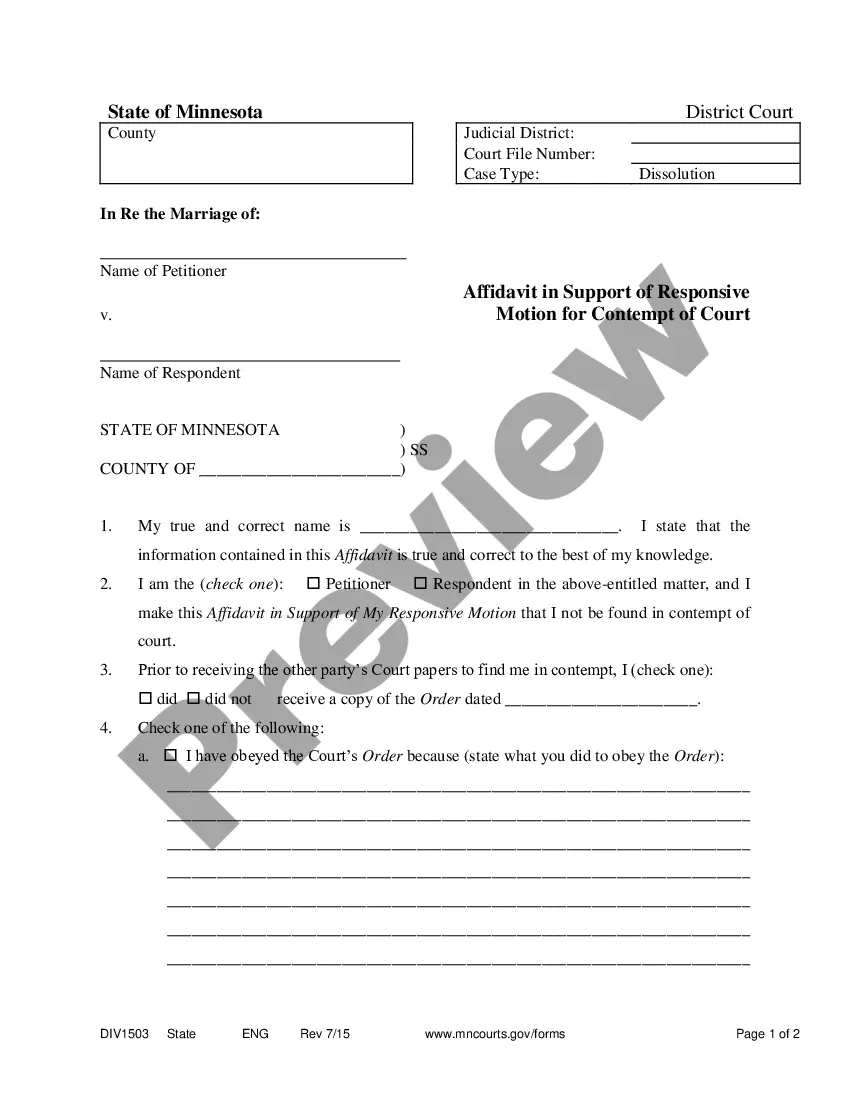
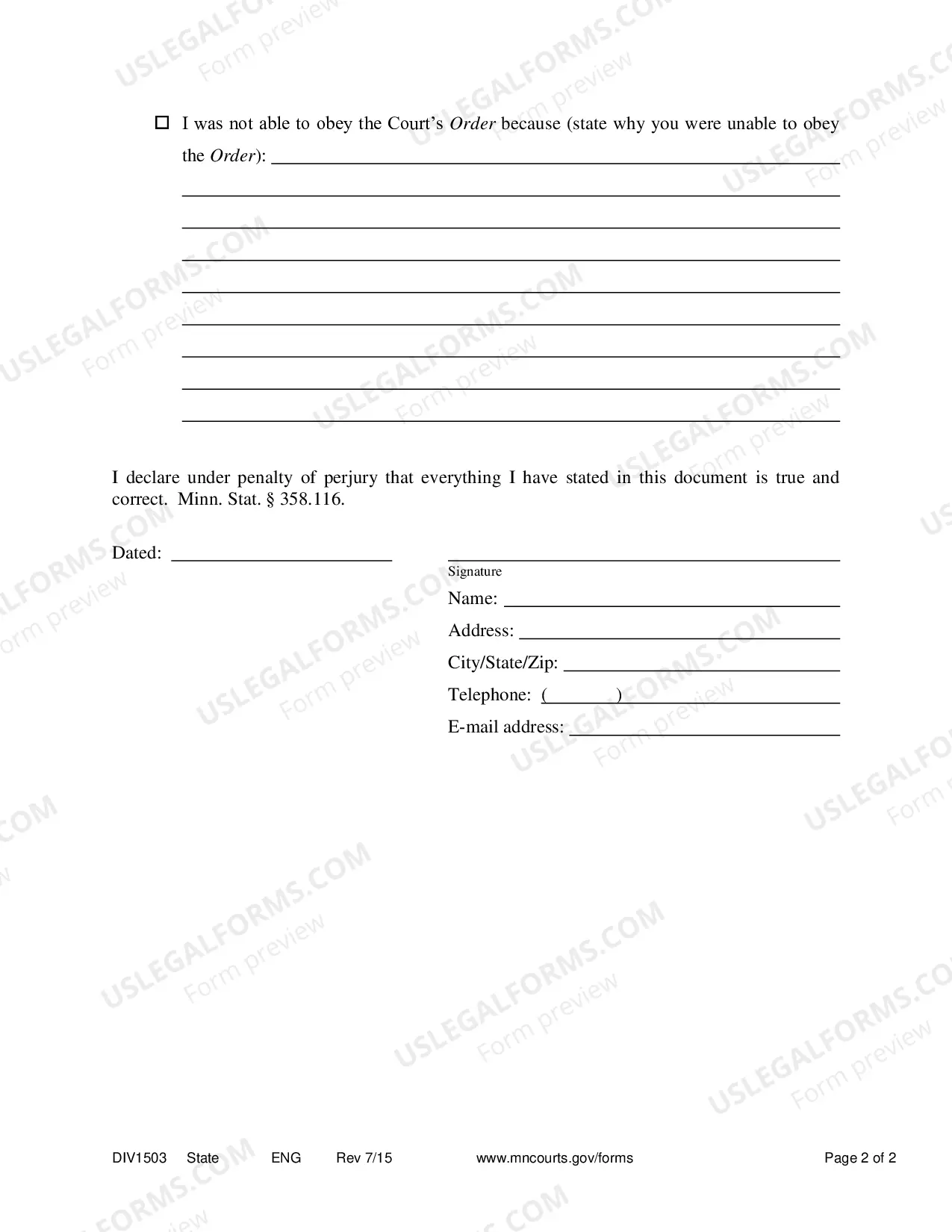
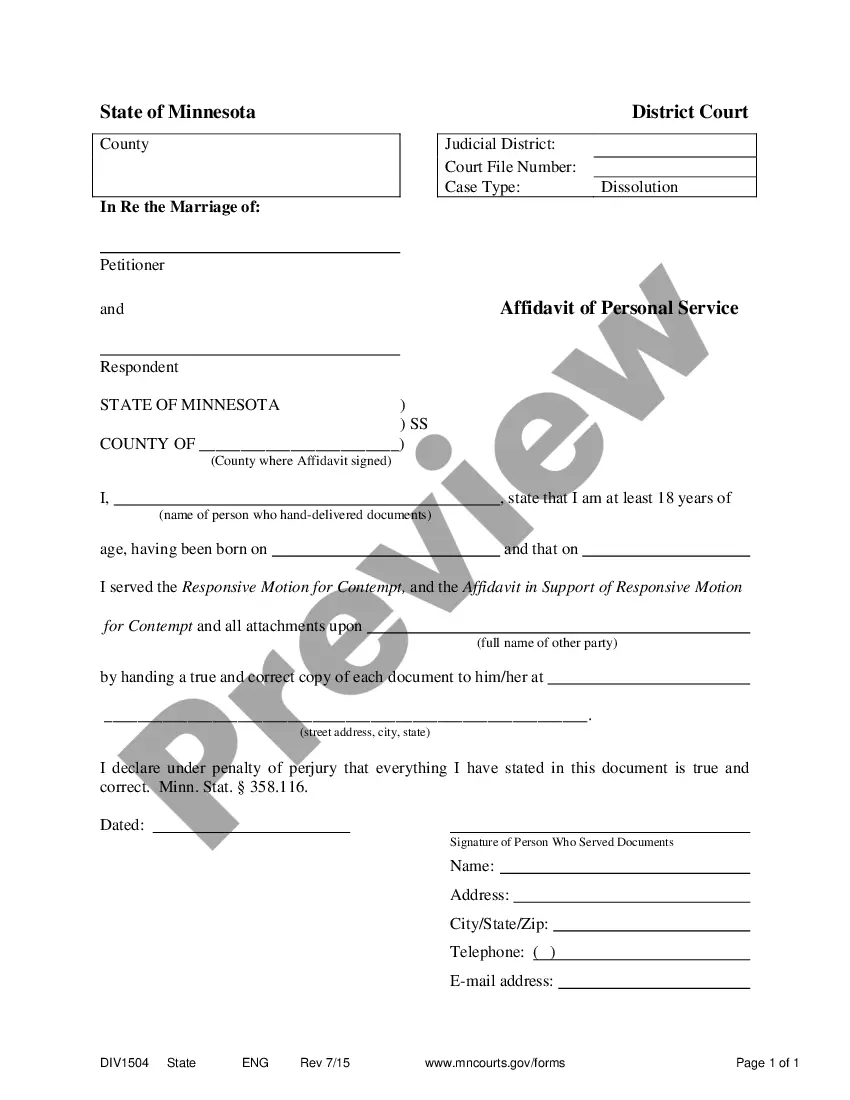
This is an official Minnesota court form for use in a divorce case, an Affidavit in Support of Responsive Motion for Contempt. USLF amends and updates these forms as is required by Minnesota Statutes and Law.
Minnesota Affidavit in Support of Responsive Motion for Contempt
Instant download
This website is not affiliated with any governmental entity
Public form
Description
Free preview
Get your form ready online
Our built-in tools help you complete, sign, share, and store your documents in one place.
Built-in online Word editor
Make edits, fill in missing information, and update formatting in US Legal Forms—just like you would in MS Word.
Export easily
Download a copy, print it, send it by email, or mail it via USPS—whatever works best for your next step.
E-sign your document
Sign and collect signatures with our SignNow integration. Send to multiple recipients, set reminders, and more. Go Premium to unlock E-Sign.
Notarize online 24/7
If this form requires notarization, complete it online through a secure video call—no need to meet a notary in person or wait for an appointment.
Store your document securely
We protect your documents and personal data by following strict security and privacy standards.

Make edits, fill in missing information, and update formatting in US Legal Forms—just like you would in MS Word.

Download a copy, print it, send it by email, or mail it via USPS—whatever works best for your next step.

Sign and collect signatures with our SignNow integration. Send to multiple recipients, set reminders, and more. Go Premium to unlock E-Sign.

If this form requires notarization, complete it online through a secure video call—no need to meet a notary in person or wait for an appointment.

We protect your documents and personal data by following strict security and privacy standards.
Looking for another form?



How to fill out Minnesota Affidavit In Support Of Responsive Motion For Contempt?
Obtain any document from 85,000 legal templates like the Minnesota Affidavit in Support of Responsive Motion for Contempt online with US Legal Forms. Every form is composed and refreshed by state-authorized lawyers.
If you already possess a subscription, Log In. Once on the document’s page, click on the Download button and navigate to My documents to access it.
If you haven’t signed up yet, follow the instructions below.
With US Legal Forms, you will always have immediate access to the correct downloadable template. The platform provides access to forms and categorizes them to simplify your search. Utilize US Legal Forms to quickly and easily acquire your Minnesota Affidavit in Support of Responsive Motion for Contempt.
- Verify the state-specific criteria for the Minnesota Affidavit in Support of Responsive Motion for Contempt that you need to utilize.
- Browse the description and preview the document.
- Once you are confident that the sample meets your requirements, simply click Buy Now.
- Choose a subscription plan that fits your financial situation.
- Establish a personal account.
- Make payment in one of two suitable methods: by credit card or through PayPal.
- Select a format to download the document in; two formats are available (PDF or Word).
- Download the document to the My documents section.
- Once your reusable template is prepared, print it out or save it to your device.
Form popularity
FAQ
Defending yourself against contempt charges involves demonstrating that you did not willfully violate a court order. This can be achieved by presenting evidence or arguments that clarify your actions and motivations. Utilizing a Minnesota Affidavit in Support of Responsive Motion for Contempt can play a pivotal role in articulating your defense and providing a structured approach to your case, helping you effectively communicate your side to the court.
To file a contempt of court in Minnesota, you must complete the appropriate legal forms and gather evidence supporting your claim. This typically involves detailing the specific court order that was violated and how the violation occurred. Utilizing resources like USLegalForms can provide you with the necessary templates, including the Minnesota Affidavit in Support of Responsive Motion for Contempt, to ensure your filing is accurate and complies with court requirements.
To respond to a motion for contempt, you should first read the motion thoroughly and understand the allegations. Then, prepare your response by outlining your position and any evidence that contradicts the claims. Submitting a Minnesota Affidavit in Support of Responsive Motion for Contempt can effectively communicate your arguments and demonstrate your compliance with court orders, which may help in resolving the issue.
An opposition to a motion for contempt is a legal document where you challenge the claims made in the motion. In this document, you will present your arguments and provide evidence as to why contempt should not be found. Crafting a strong opposition can be crucial, and utilizing a Minnesota Affidavit in Support of Responsive Motion for Contempt may strengthen your position by clearly outlining your reasons and evidence.
To write a reply to a response to a motion, first review the original motion and the response carefully. Identify the key points raised and address them directly in your reply. When preparing your Minnesota Affidavit in Support of Responsive Motion for Contempt, ensure that you clearly articulate your arguments and support them with relevant evidence. This structured approach will help you present a compelling case.
In Minnesota, an affidavit must generally be notarized to ensure its validity. This requirement applies to the Minnesota Affidavit in Support of Responsive Motion for Contempt, as notarization adds a layer of authenticity and trustworthiness. Notarization involves a notary public verifying the identity of the signer and witnessing the signing of the document. By using a platform like US Legal Forms, you can easily access templates and guidance to help you create and notarize your affidavit efficiently.
Fill out the forms. You have to fill out at least 2 forms, maybe more, to file your opposition. File the forms. Turn in your completed forms by mail or efiling. Serve the other party. Get ready for the hearing. Prepare an order.
Depending on the infraction, contempt of court consequences can include fines, compensatory visitation, a modification to the custody arrangement, and in some instances even jail time. In most cases, if someone is held in contempt, the court will first give them the opportunity to make amends for the violation.
Read the summons and make sure you know the date you must answer by. Read the complaint carefully. Write your answer. Sign and date the answer. Make copies for the plaintiff and yourself. Mail a copy to the plaintiff. File your answer with the court by the date on the summons.
Read the summons and make sure you know the date you must answer by. Read the complaint carefully. Write your answer. Sign and date the answer. Make copies for the plaintiff and yourself. Mail a copy to the plaintiff. File your answer with the court by the date on the summons.