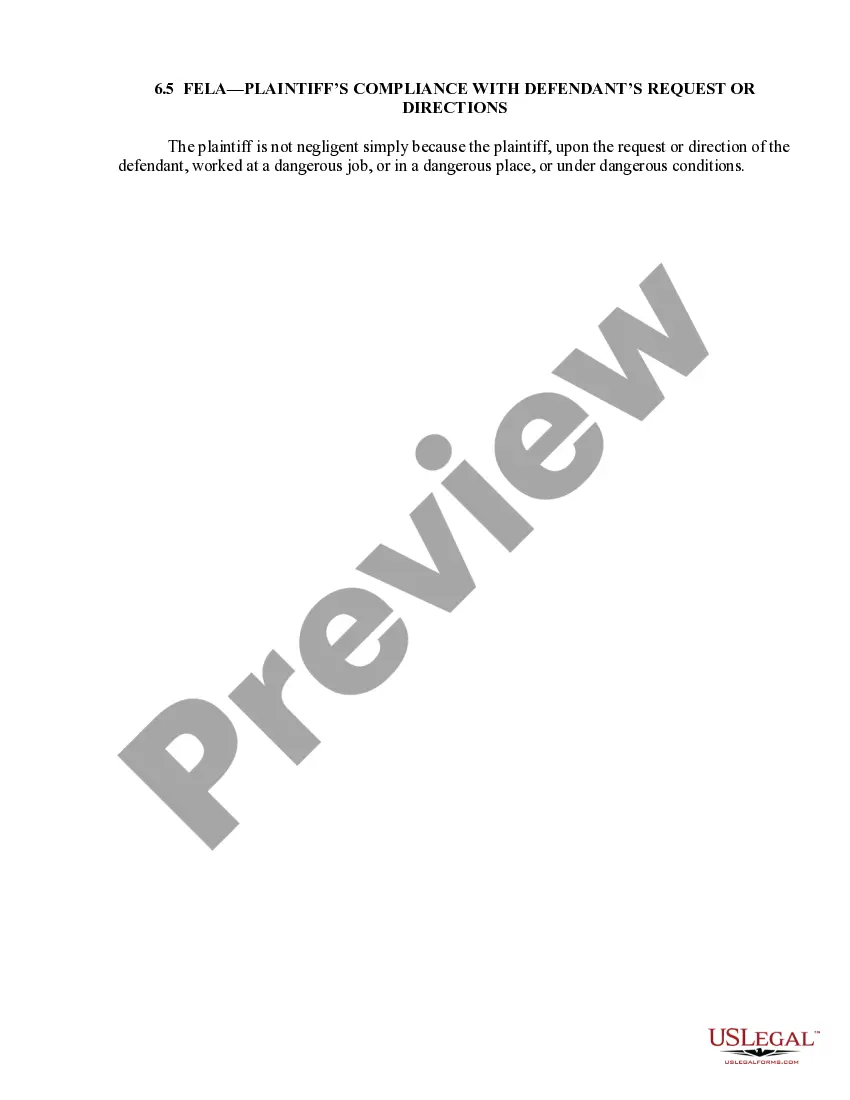
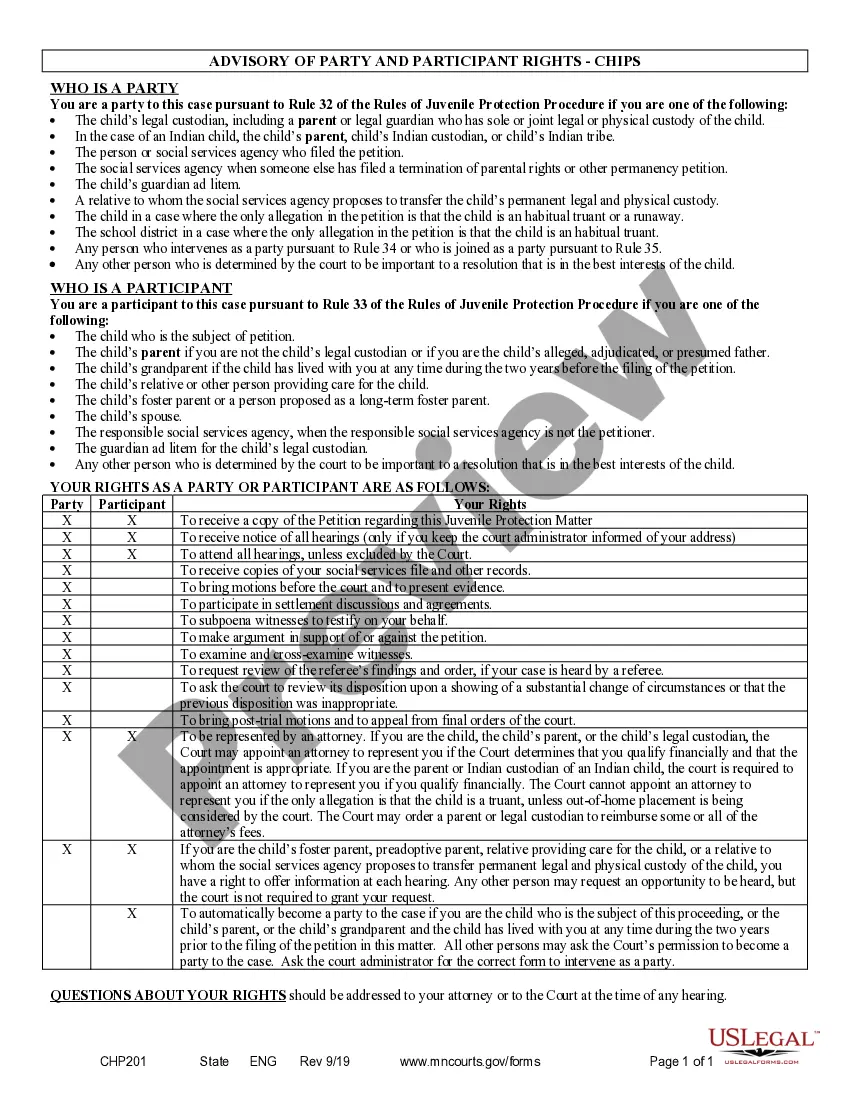
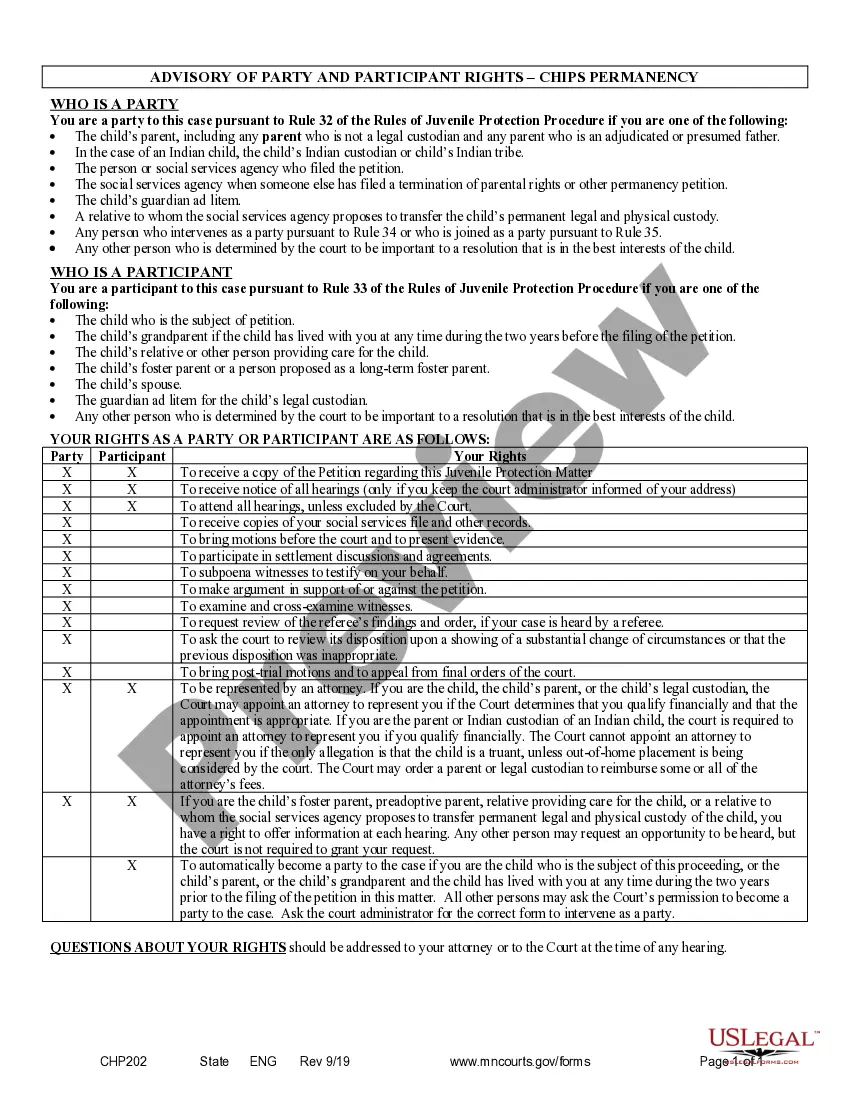
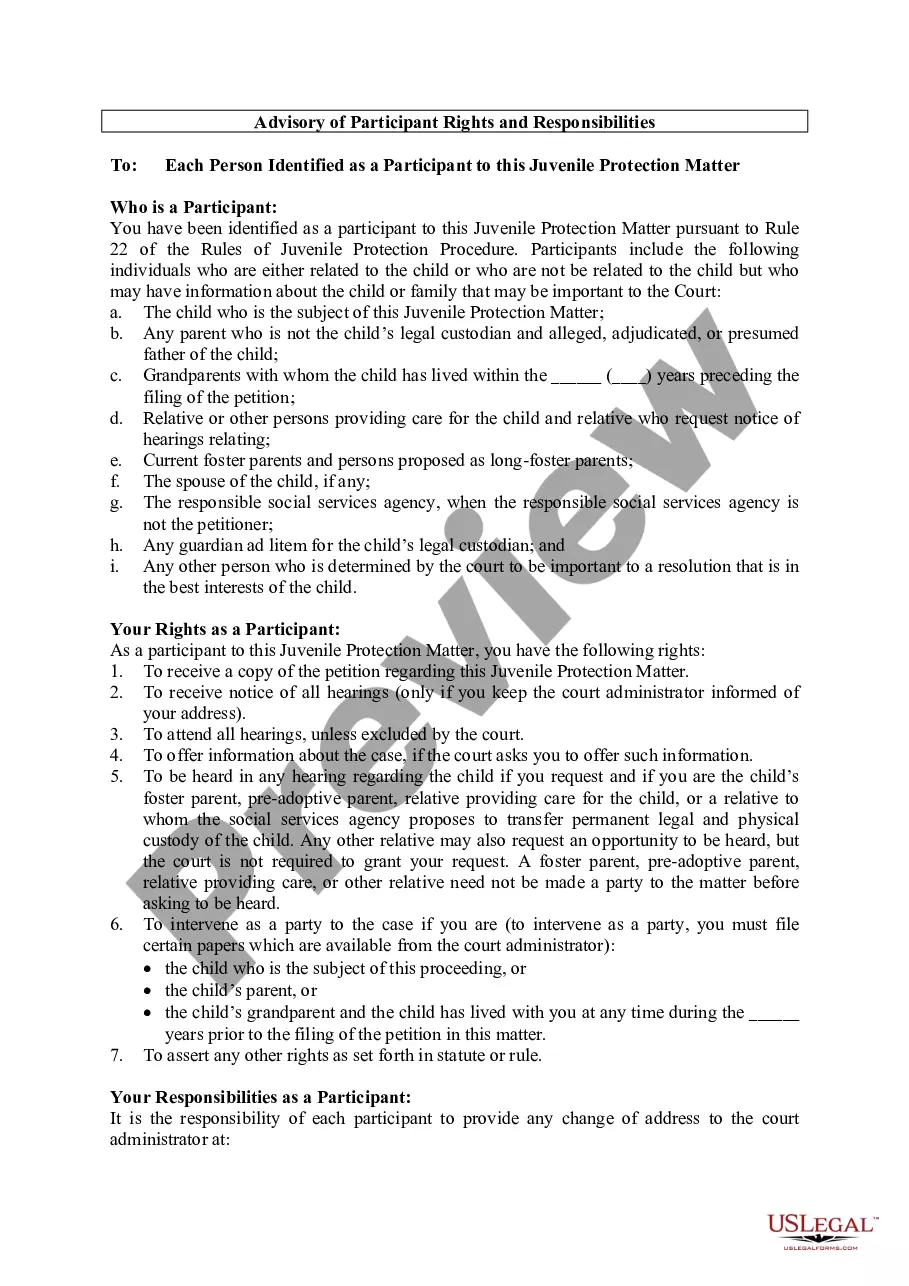
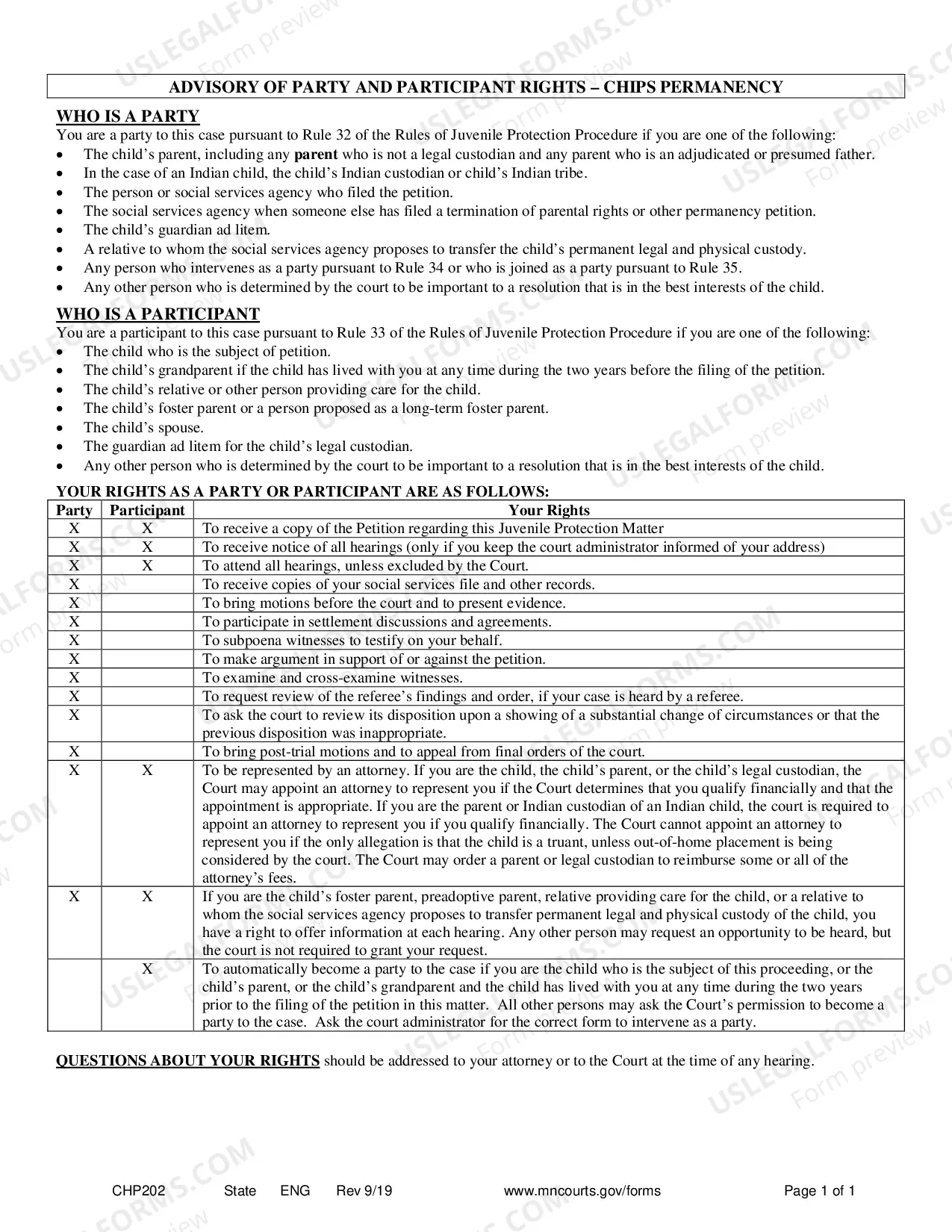
This is an official Minnesota court form for use in a minor case, an Advisory of Party Rights and Responsibilities. USLF amends and updates these forms as is required by Minnesota Statutes and Law.
Minnesota Advisory of Party Rights and Responsibilities
State:
Minnesota
Category:
Control #:
MN-CHP201
Format:
Word;
PDF;
Rich Text
Instant download
This website is not affiliated with any governmental entity
Public form
Description
Get your form ready online
Our built-in tools help you complete, sign, share, and store your documents in one place.
Built-in online Word editor
Make edits, fill in missing information, and update formatting in US Legal Forms—just like you would in MS Word.
Export easily
Download a copy, print it, send it by email, or mail it via USPS—whatever works best for your next step.
E-sign your document
Sign and collect signatures with our SignNow integration. Send to multiple recipients, set reminders, and more. Go Premium to unlock E-Sign.
Notarize online 24/7
If this form requires notarization, complete it online through a secure video call—no need to meet a notary in person or wait for an appointment.
Store your document securely
We protect your documents and personal data by following strict security and privacy standards.

Make edits, fill in missing information, and update formatting in US Legal Forms—just like you would in MS Word.

Download a copy, print it, send it by email, or mail it via USPS—whatever works best for your next step.

Sign and collect signatures with our SignNow integration. Send to multiple recipients, set reminders, and more. Go Premium to unlock E-Sign.

If this form requires notarization, complete it online through a secure video call—no need to meet a notary in person or wait for an appointment.

We protect your documents and personal data by following strict security and privacy standards.
Looking for another form?

How to fill out Minnesota Advisory Of Party Rights And Responsibilities?
Obtain any variant from 85,000 legal records including Minnesota Advisory of Party Rights and Responsibilities online with US Legal Forms. Each template is crafted and refreshed by state-certified attorneys.
If you possess a subscription, sign in. Once you arrive at the form’s page, click on the Download button and navigate to My documents to gain access to it.
If you have not subscribed yet, adhere to the guidelines below.
With US Legal Forms, you will consistently have immediate access to the appropriate downloadable sample. The service will provide you access to documents and organizes them into categories to enhance your search. Utilize US Legal Forms to acquire your Minnesota Advisory of Party Rights and Responsibilities quickly and effortlessly.
- Verify the state-specific criteria for the Minnesota Advisory of Party Rights and Responsibilities you wish to utilize.
- Examine the description and view the sample.
- Once you are assured that the template meets your needs, simply click Buy Now.
- Select a subscription plan that suits your financial plan.
- Establish a personal account.
- Make a payment in one of two suitable methods: by card or via PayPal.
- Choose a format to download the file in; two options are available (PDF or Word).
- Download the document to the My documents section.
- As soon as your reusable template is prepared, print it out or save it to your device.
Form popularity
FAQ
The rule of practice 521 in Minnesota outlines the Minnesota Advisory of Party Rights and Responsibilities, which serves to inform parties involved in legal proceedings about their rights and obligations. This rule ensures that individuals understand the legal process, making it easier for them to navigate their cases effectively. By providing clarity on responsibilities, the rule aims to promote fairness and transparency in the legal system. For those seeking assistance, US Legal Forms offers resources and documents that can help you comply with these requirements.
After a motion to intervene is granted, the intervening party becomes an official participant in the ongoing legal proceedings. This means they can present evidence, file motions, and engage with other parties as outlined in the Minnesota Advisory of Party Rights and Responsibilities. The court will notify all parties involved, ensuring that the rights of the newly intervened party are respected. Understanding these steps helps you prepare for your active role in the case.
Restricted identifiers in Minnesota refer to specific personal information that must be protected in legal documents to ensure privacy and security. These identifiers include sensitive data such as Social Security numbers and financial account information, which are safeguarded under the Minnesota Advisory of Party Rights and Responsibilities. Protecting this information is vital for maintaining confidentiality in legal proceedings. By being aware of these identifiers, you can better manage your privacy in legal contexts.
The notice of right to intervene in Minnesota informs individuals or entities that they may enter a legal proceeding to protect their interests. This notice is crucial as it is part of the Minnesota Advisory of Party Rights and Responsibilities, ensuring that all parties are aware of their potential rights to participate. This right is particularly important in cases where the outcome may significantly affect the intervener. Knowing your rights can empower you to take necessary legal actions.
A notice of intervention is a formal document that allows a third party to join an existing legal proceeding. In Minnesota, this process is guided by the Minnesota Advisory of Party Rights and Responsibilities, which outlines the rights and responsibilities of all parties involved. By filing this notice, the intervener asserts their interest in the case and seeks to protect their legal rights. Understanding this process can help you navigate the complexities of the legal system more effectively.
Minnesota is known for its lakes and forests, but it's also home to the Twin Cities: Saint Paul and Minneapolis. The Twin Cities are home to many Fortune 500 companies, including Best Buy, General Mills, Target, and Land 'o Lakes. The Mall of America in Bloomington, Minnesota is the largest mall in the United States.
To cover late or unpaid rent. To pay for damages to the rental beyond normal wear and tear.
Gas Safety Check. Smoke and Carbon Monoxide Alarms. Energy Performance Certificate (EPC) Tenancy Deposit Scheme. Tenancy Deposit 'Prescribed Information' Landlord Selective License. Furniture and Furnishings Regulation. Electrical Safety Standards Inspection/Report.
Tenants may withhold rent or exercise the right to repair and deduct if a landlord fails to take care of important repairs, such as a broken heater. For specifics, see Minnesota Tenant Rights to Withhold Rent or Repair and Deduct.