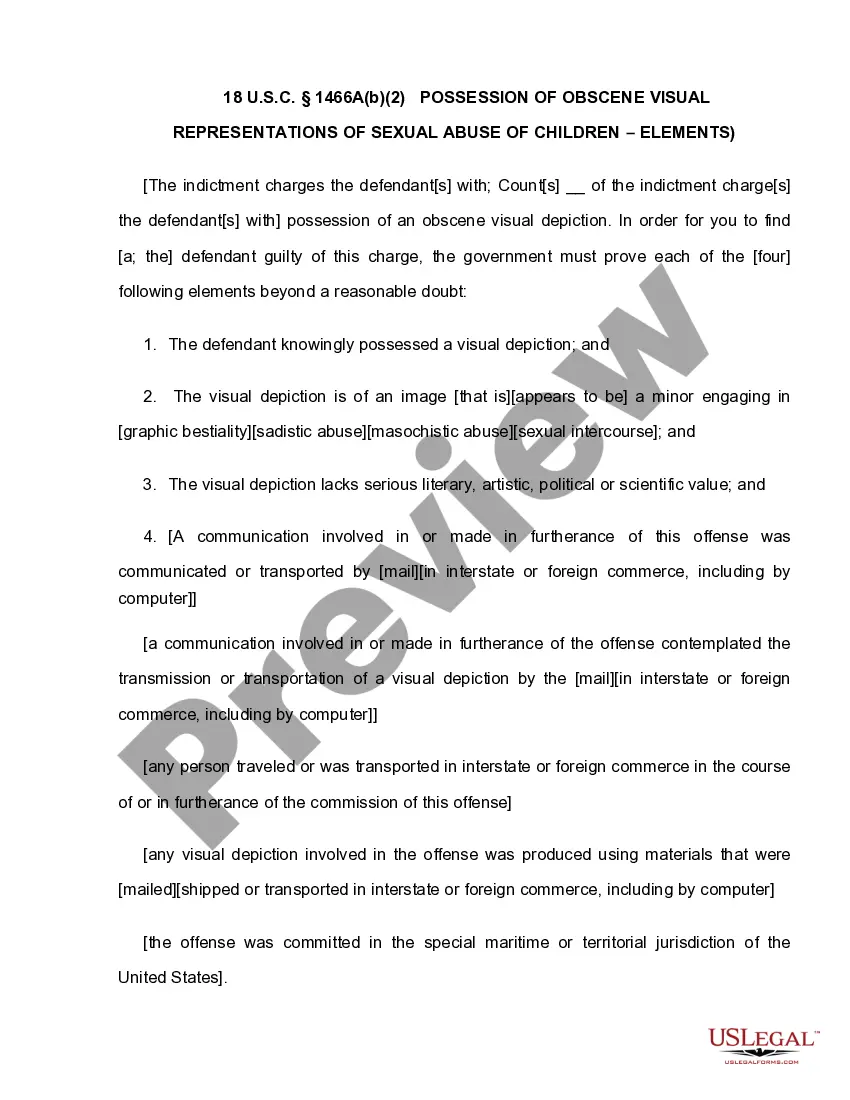
Minnesota Ex Parte Order allowing petitioner to proceed in forma pauperis
What this document covers
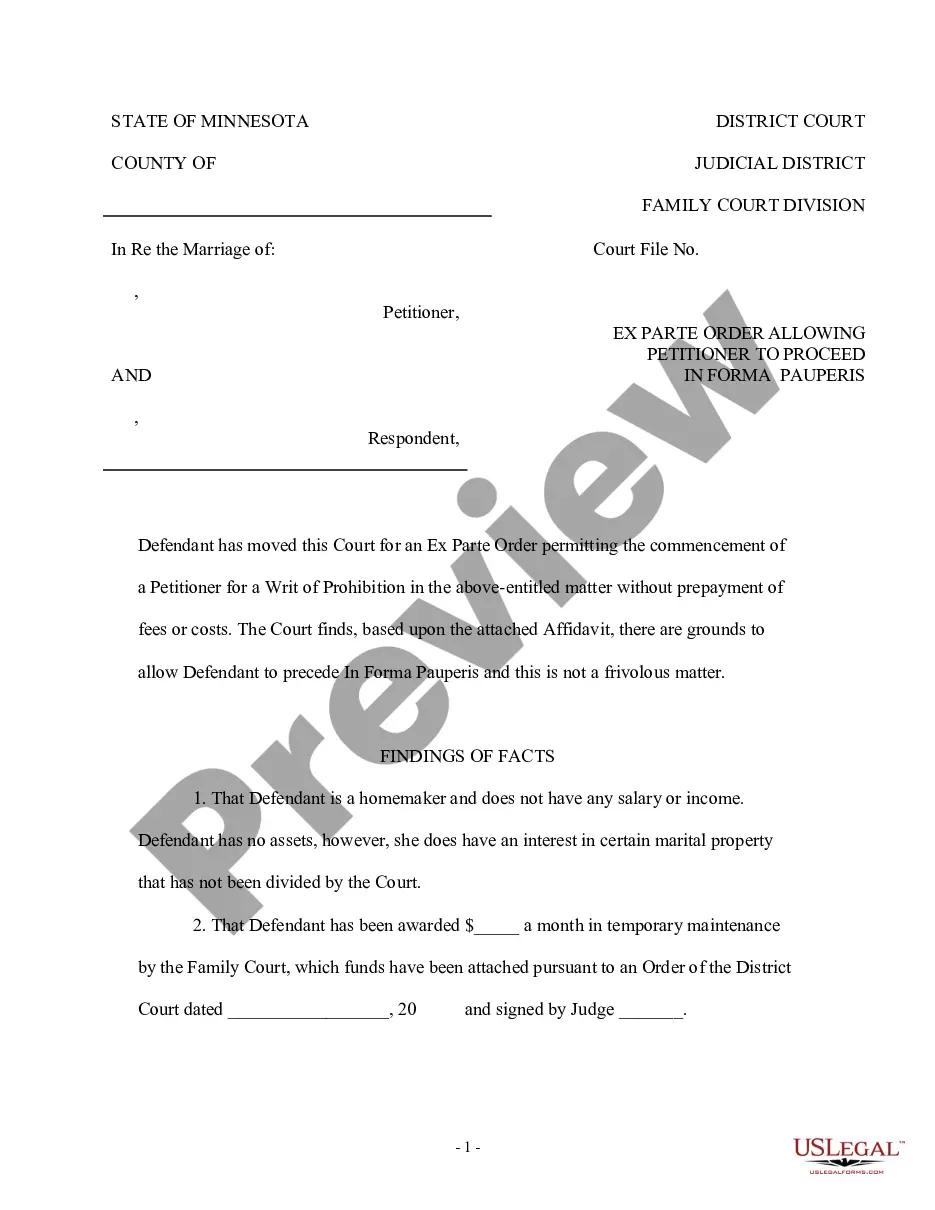
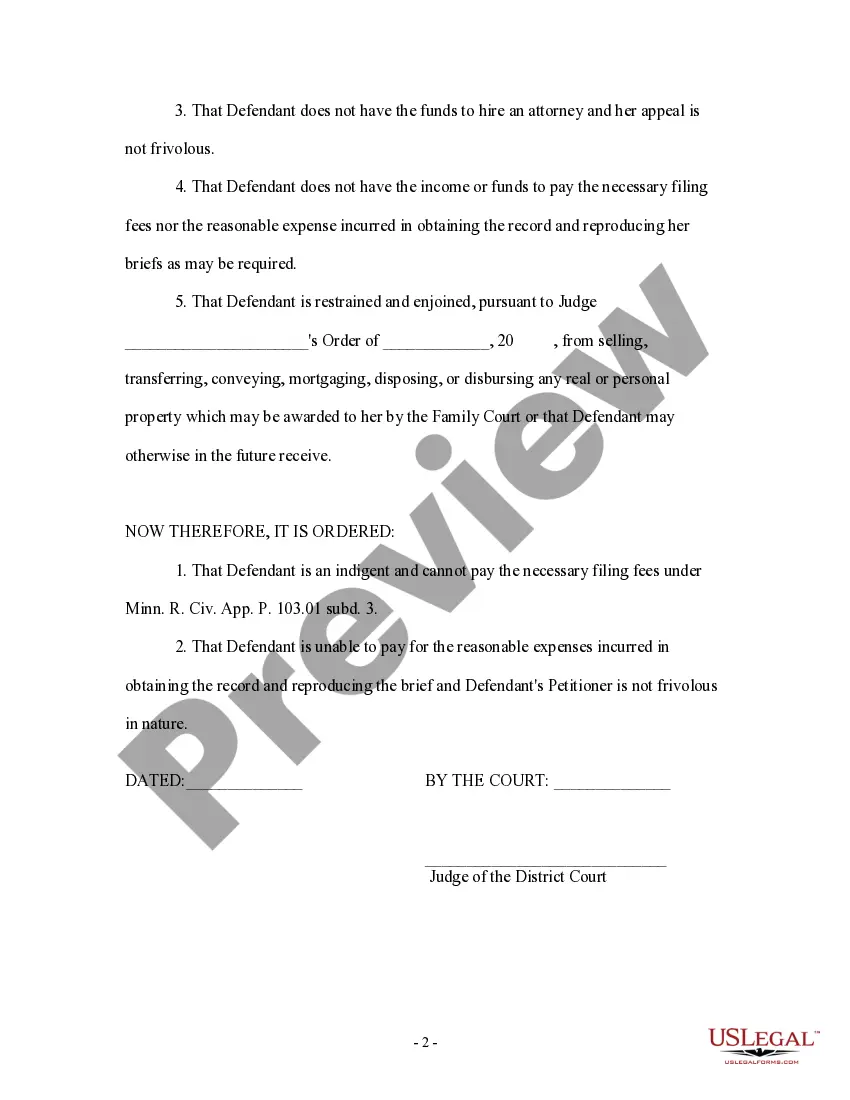
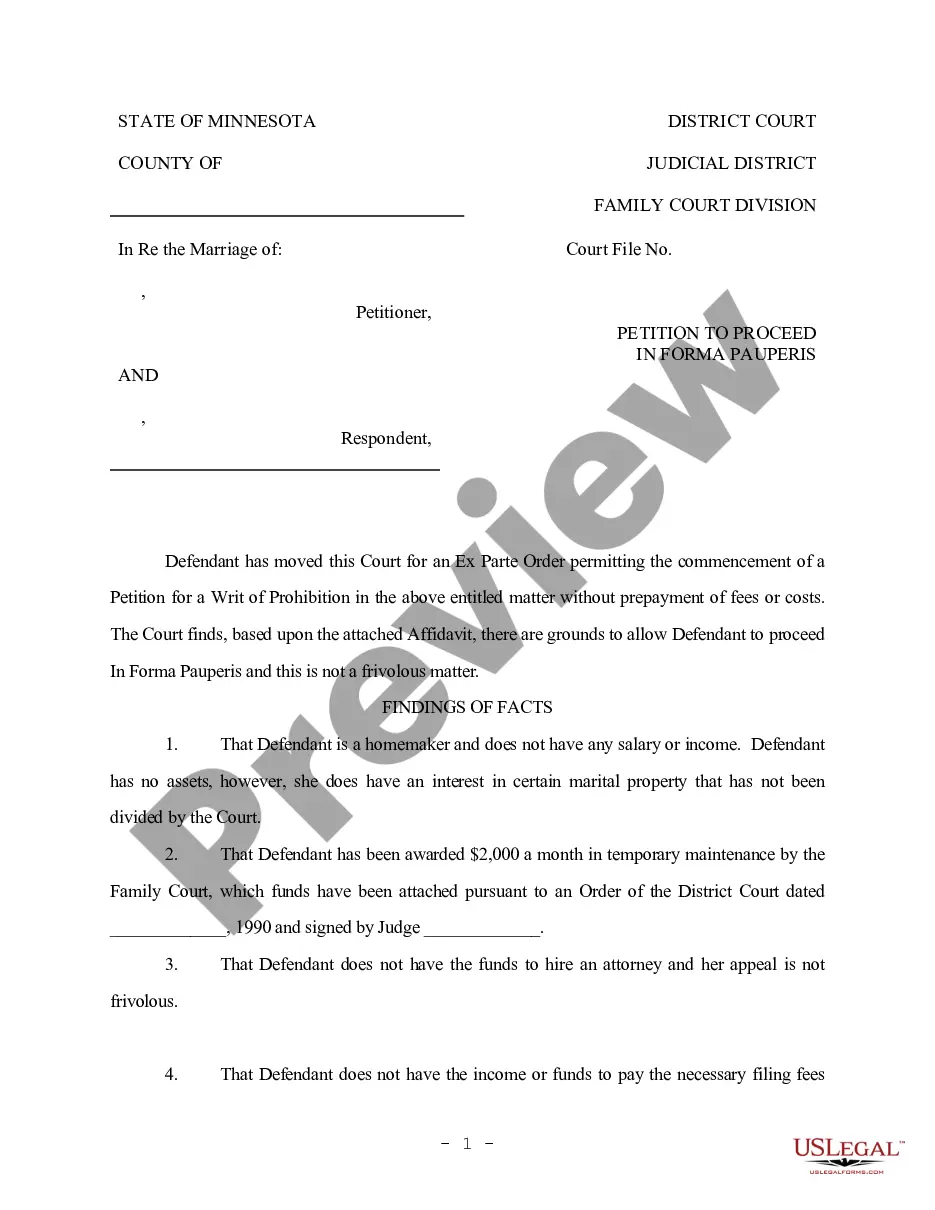
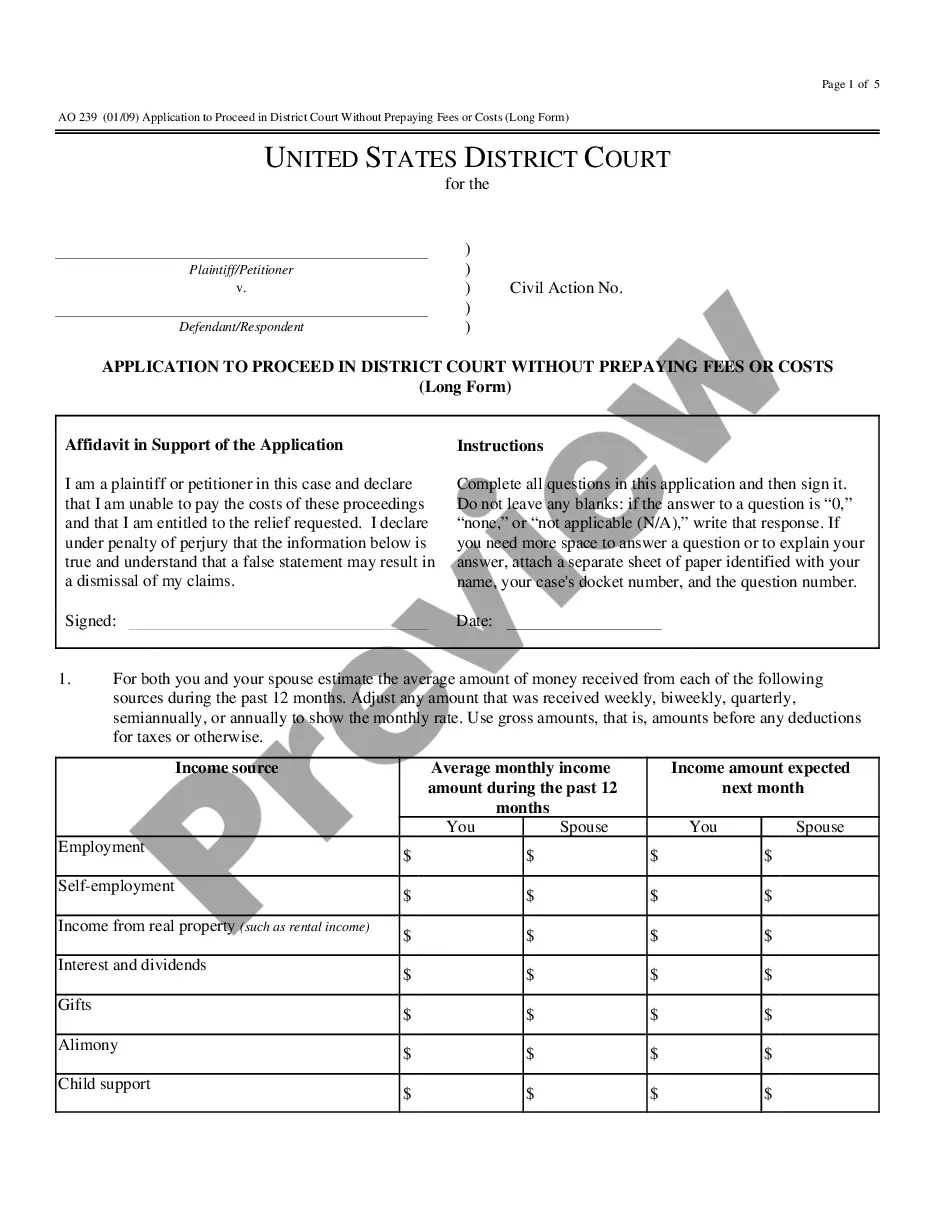
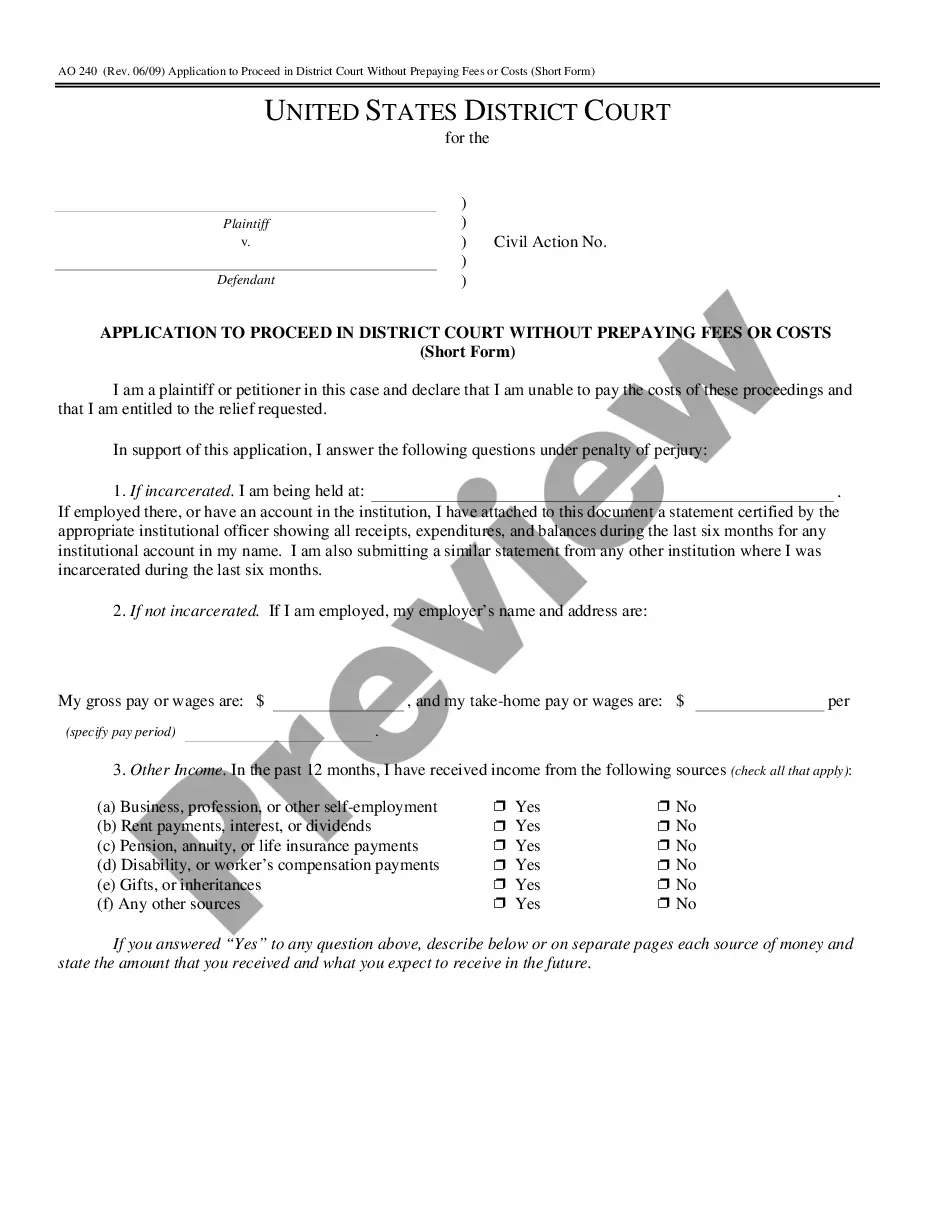
The Ex Parte Order allowing petitioner to proceed in forma pauperis is a legal document that permits an individual to file a Petition for a Writ of Prohibition without the need to prepay court fees due to financial hardship. This form is specifically designed for those who can demonstrate that they do not have sufficient income or assets to cover the costs associated with legal proceedings. Unlike other legal forms that require upfront payment, this order facilitates access to justice for individuals facing financial difficulties.
Main sections of this form
- Personal information of the petitioner, including name and contact details.
- Statement of financial status, outlining lack of income and assets.
- Findings of fact confirming indigence and inability to pay court fees.
- Judicial confirmation that the petitioner's case is not frivolous.
- Date and signature line for the presiding judge.
When this form is needed
This form is used when a defendant aims to challenge a legal decision without the financial means to pay for the court's filing fees. It is particularly relevant in situations where the individual is a homemaker or lacks a regular income, ensuring they can still pursue their legal rights and remedies without being barred by their financial status.
Who should use this form
- Individuals facing financial hardship who wish to file a legal petition.
- Defendants involved in cases requiring a Writ of Prohibition.
- Individuals with limited or no income seeking to access the legal system.
Steps to complete this form
- Provide your personal details, including full name and address.
- Clearly state your financial situation, outlining why you cannot pay court fees.
- Attach an affidavit or additional documentation supporting your claim of indigence.
- Sign and date the form where indicated, ensuring all fields are filled in correctly.
- Submit the completed form to the court as directed by local procedures.
Notarization guidance
In most cases, this form does not require notarization. However, some jurisdictions or signing circumstances might. US Legal Forms offers online notarization powered by Notarize, accessible 24/7 for a quick, remote process.
Get your form ready online
Our built-in tools help you complete, sign, share, and store your documents in one place.
Make edits, fill in missing information, and update formatting in US Legal Forms—just like you would in MS Word.
Download a copy, print it, send it by email, or mail it via USPS—whatever works best for your next step.
Sign and collect signatures with our SignNow integration. Send to multiple recipients, set reminders, and more. Go Premium to unlock E-Sign.
If this form requires notarization, complete it online through a secure video call—no need to meet a notary in person or wait for an appointment.
We protect your documents and personal data by following strict security and privacy standards.

Make edits, fill in missing information, and update formatting in US Legal Forms—just like you would in MS Word.

Download a copy, print it, send it by email, or mail it via USPS—whatever works best for your next step.

Sign and collect signatures with our SignNow integration. Send to multiple recipients, set reminders, and more. Go Premium to unlock E-Sign.

If this form requires notarization, complete it online through a secure video call—no need to meet a notary in person or wait for an appointment.

We protect your documents and personal data by following strict security and privacy standards.
Common mistakes to avoid
- Failing to provide thorough documentation of financial status.
- Inaccurate or incomplete personal information.
- Not completing the affidavit section if required.
- Submitting the form without a signature or date.
Benefits of completing this form online
- Immediate access to the form for quick completion and filing.
- Editability allows for customization to fit specific needs.
- Convenient access from home without needing to visit a law office.
- Reliable templates drafted by licensed attorneys ensure compliance with legal standards.
What to keep in mind
- The Ex Parte Order allows individuals with limited finances to access the court system without upfront fees.
- It must be supported by an affidavit detailing the individual's financial circumstances.
- This form is essential for those needing to file documents quickly and without financial barriers.
Looking for another form?




Form popularity
FAQ
An order to proceed in forma pauperis is a court order that allows an individual to pursue a legal case without payment of court fees due to financial hardship. This order is crucial for ensuring that everyone has access to justice, regardless of their economic status. Once granted, the order relieves the petitioner from the financial burden associated with filing fees and other court costs. In Minnesota, obtaining a Minnesota Ex Parte Order allowing petitioner to proceed in forma pauperis is a significant step for many seeking legal recourse.
When applying for forma pauperis, you must provide proof of your financial situation, typically through a financial affidavit. This document outlines your income, expenses, and assets. Courts may also require additional documentation, such as bank statements or proof of government assistance. By obtaining a Minnesota Ex Parte Order allowing petitioner to proceed in forma pauperis, you can effectively demonstrate your need for financial relief in legal proceedings.
Eligibility for forma pauperis status generally includes individuals who can demonstrate financial hardship. This may include low-income earners, those receiving government assistance, or individuals experiencing financial crises. Each court may have specific criteria to assess eligibility, but the fundamental requirement is proving that paying court fees would cause undue hardship. A Minnesota Ex Parte Order allowing petitioner to proceed in forma pauperis provides a pathway for eligible individuals to access legal services.
A Rule 60 motion in Minnesota is a request to the court to relieve a party from a final judgment or order. This motion is typically used when new evidence emerges or when a party was unable to participate in the original proceedings. It aims to ensure justice is served by allowing reconsideration of cases under certain circumstances. In some instances, individuals may pursue this motion while applying for a Minnesota Ex Parte Order allowing petitioner to proceed in forma pauperis.
Individuals facing financial hardship often file a petition in forma pauperis. This status allows them to seek legal action without the burden of court fees. Typically, low-income individuals, students, or those experiencing unexpected financial difficulties may qualify. In Minnesota, a Minnesota Ex Parte Order allowing petitioner to proceed in forma pauperis can significantly help those who need access to the legal system.
Ex parte (/025bks 02c8p025102d0rte026a, -i02d0/) is a Latin legal term meaning literally "from/out of the party/faction of" (name of party/faction, often omitted), thus signifying "on behalf of (name)". An ex parte decision is one decided by a judge without requiring all of the parties to the dispute to be present.
An ex parte order of protection is a temporary measure that can be filed quickly. A full protection order, or restraining order, is granted after a court hearing and lasts for a longer period of time than the ex parte order.
After the ex parte decree is set aside, the suit is again restored to file and parties are demoted to the position they held before the non-presence of the opposite party, and the court will take action with the suit de novo and determine on merits.
An order that is issued ex parte means that it is issued without prior notice to the other parent, based only on your affidavit/testimony.If the judge decides not to issue an ex parte order immediately, the judge must still schedule a hearing on the matter although it may not necessarily be within 14 days.
In civil procedure, ex parte is used to refer to motions for orders that can be granted without waiting for a response from the other side. Generally, these are orders that are only in place until further hearings can be held, such as a temporary restraining order.