Minnesota Notice of Court Ordered Education Program and Temporary Hearing Dates
What this document covers
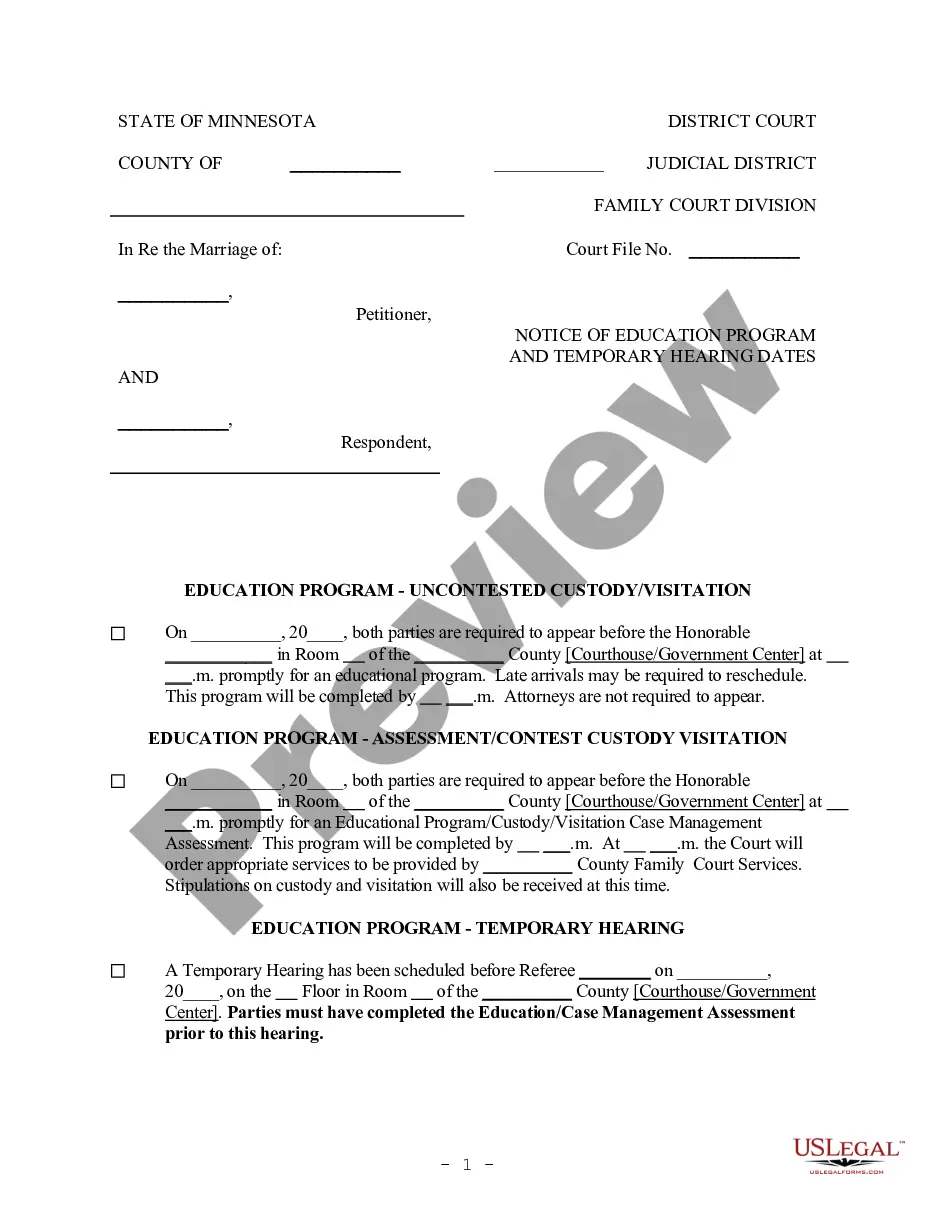
The Notice of Court Ordered Education Program and Temporary Hearing Dates is a legal document that informs parties involved in custody or visitation cases about mandatory court appearances related to educational programs or assessments. This form ensures that both parties are aware of their responsibilities to attend these sessions at the designated times. It serves a distinct purpose by outlining schedules for a custody/visitation education program and temporary hearings, differentiating it from other general notification forms in family law.
Form components explained
- Details the date, time, and location of the educational program for contested and uncontested custody/visitation cases.
- Specifies the presiding judge or referee and the courtroom information.
- Indicates the completion time for the educational program.
- Clarifies that attorneys are not required to attend the educational program.
- Outlines the requirement for parties to complete the educational assessment before any scheduled temporary hearings.
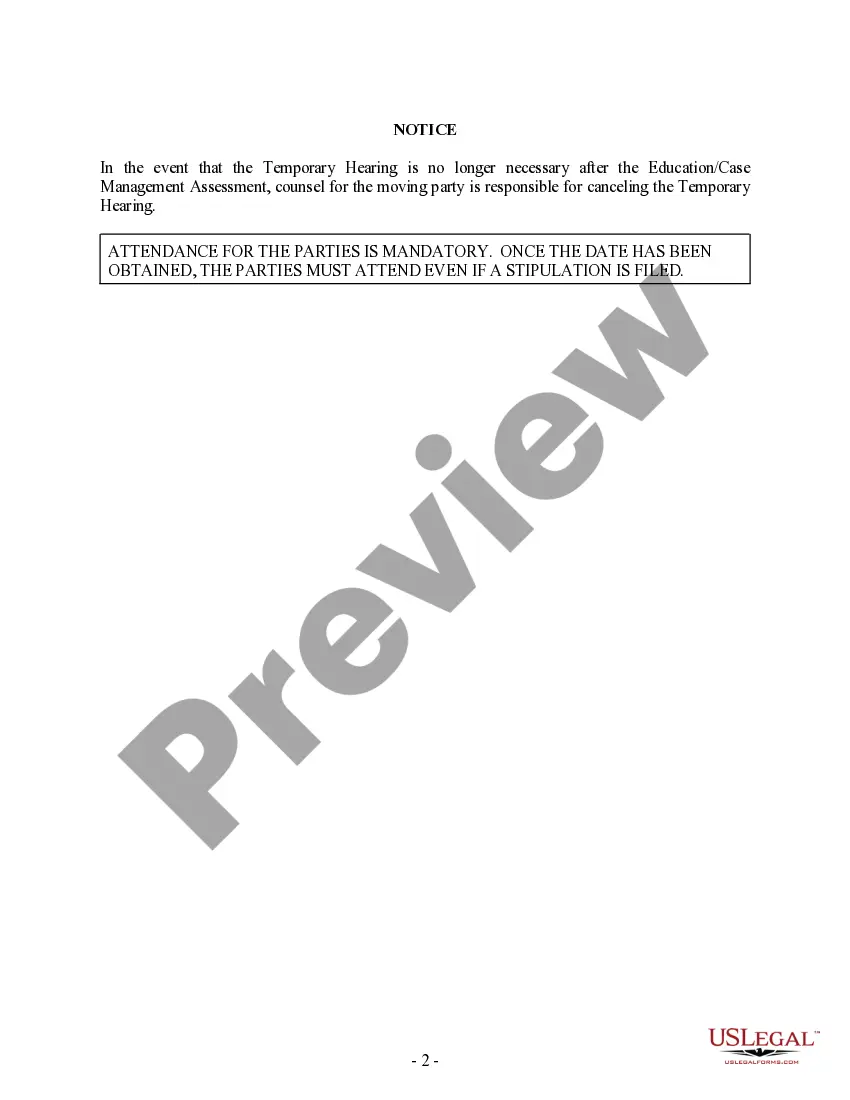
- Notifies that counsel must cancel the temporary hearing if it becomes unnecessary following the assessment.

When to use this document
This form is used when court-mandated attendance at educational programs or assessments is required in custody or visitation disputes. It is essential if parties are entering into negotiations regarding custody arrangements or when they are required to appear in court to receive services from family court. It ensures clear communication of necessary court dates and obligations.
Who should use this form
- Parents or guardians involved in custody or visitation disputes.
- Individuals who have received a court order to attend an educational program or assessment.
- Legal counsel representing clients in family law cases where this notice applies.
Completing this form step by step
- Enter the date of the scheduled court appearance.
- Provide the names of the parties involved and the presiding judge's name.
- Specify the court location, including room number and county information.
- Fill in the exact times for the education program and temporary hearing.
- Ensure that all parties understand their obligation to attend as mandated by the court.
Notarization requirements for this form
This form does not typically require notarization unless specified by local law. It is essential to review applicable regulations to confirm whether notarization is necessary for your case.
Get your form ready online
Our built-in tools help you complete, sign, share, and store your documents in one place.
Make edits, fill in missing information, and update formatting in US Legal Forms—just like you would in MS Word.
Download a copy, print it, send it by email, or mail it via USPS—whatever works best for your next step.
Sign and collect signatures with our SignNow integration. Send to multiple recipients, set reminders, and more. Go Premium to unlock E-Sign.
If this form requires notarization, complete it online through a secure video call—no need to meet a notary in person or wait for an appointment.
We protect your documents and personal data by following strict security and privacy standards.

Make edits, fill in missing information, and update formatting in US Legal Forms—just like you would in MS Word.

Download a copy, print it, send it by email, or mail it via USPS—whatever works best for your next step.

Sign and collect signatures with our SignNow integration. Send to multiple recipients, set reminders, and more. Go Premium to unlock E-Sign.

If this form requires notarization, complete it online through a secure video call—no need to meet a notary in person or wait for an appointment.

We protect your documents and personal data by following strict security and privacy standards.
Mistakes to watch out for
- Failing to enter the correct date or time for appearances.
- Not verifying the names of the parties and presiding judges.
- Ignoring the requirement for private attendance at the education program.
Benefits of using this form online
- Convenient access to legal forms from any device, allowing for easy downloading and printing.
- Editable templates that can be tailored to specific case details.
- Reliable forms drafted by licensed attorneys, ensuring compliance with legal standards.
Legal use & context
- This form is legally binding and recognized by the court, emphasizing the importance of compliance.
- It serves as an official record of court-ordered requirements, which can be referenced in future legal matters.
- Non-compliance with the terms can lead to penalties in custody or visitation rights.
Quick recap
- The form outlines mandatory court appearances for custody-related educational programs.
- It is crucial for parties to complete the education program before attending temporary hearings.
- Clear communication of court dates and obligations helps prevent delays and legal complications.
Looking for another form?

Form popularity
FAQ
Rule 68 in Minnesota deals with offers of judgment, allowing a party to make a formal offer to settle a case before trial. If the offer is not accepted and the final judgment is less favorable than the offer, the party who made the offer may recover certain costs. This rule can play a role in cases involving the Minnesota Notice of Court Ordered Education Program and Temporary Hearing Dates, as it may influence settlement discussions.
In Minnesota, Rule 69 governs the procedures for enforcing civil judgments. It establishes the rights of creditors and the responsibilities of debtors, outlining how debts can be collected through various legal means. Awareness of this rule is particularly important for those involved in the Minnesota Notice of Court Ordered Education Program and Temporary Hearing Dates.
Rule 69 execution refers to the legal process by which a court enforces a judgment. This execution may involve seizing assets or garnishing wages to satisfy a court-ordered payment. If you are navigating the Minnesota Notice of Court Ordered Education Program and Temporary Hearing Dates, understanding execution can help you manage your obligations effectively.
The rule 69 law in Minnesota provides guidelines for the enforcement of civil judgments. It allows creditors to pursue debtors through various means, including property seizure and wage garnishment. Familiarizing yourself with this law is crucial when dealing with the Minnesota Notice of Court Ordered Education Program and Temporary Hearing Dates.
To find your court date in Minnesota, visit the Minnesota Judicial Branch website, where you can access case information. You can search by name, case number, or other details. Additionally, if you are involved in a Minnesota Notice of Court Ordered Education Program or facing Temporary Hearing Dates, keeping track of your court dates is essential for compliance.
Rule 69 of the Minnesota Rules of Civil Procedure pertains to the enforcement of judgments. This rule outlines the procedures that a party may use to collect a judgment, including garnishments and execution against properties. Understanding this rule can help you navigate the complexities of the Minnesota Notice of Court Ordered Education Program and Temporary Hearing Dates effectively.
Rule of Practice 521 in Minnesota governs the procedures regarding the Minnesota Notice of Court Ordered Education Program and Temporary Hearing Dates. This rule outlines the requirements for parties involved in custody matters, ensuring they attend the educational program designed to benefit children during custody disputes. Understanding this rule is crucial for anyone navigating custody issues, and US Legal Forms offers resources to help clarify these procedures for you.
To obtain a temporary custody order in Minnesota, you should visit your local district court. It is essential to file the necessary paperwork, which includes a request for a temporary custody order along with supporting documents. Additionally, you may want to consider using resources like the Minnesota Notice of Court Ordered Education Program and Temporary Hearing Dates to help you understand the process. For more guidance, US Legal Forms can provide templates and assistance to simplify your filing.
In Minnesota, individuals may have valid reasons to refuse jury duty, such as financial hardship or personal circumstances. However, it's important to formally request an exemption and provide appropriate documentation. Understanding the implications of your jury duty, including how it relates to the Minnesota Notice of Court Ordered Education Program and Temporary Hearing Dates, can help you navigate the legal system effectively.
Rule 5.01 of the Minnesota Rules of Civil Procedure outlines how documents should be served to parties involved in a legal action. Proper service is crucial in maintaining fairness in legal proceedings. This rule becomes particularly relevant in the context of the Minnesota Notice of Court Ordered Education Program and Temporary Hearing Dates, as timely communication helps all parties stay informed.