Minnesota Boarding Stable Agreement - Horse Equine Forms
About this form
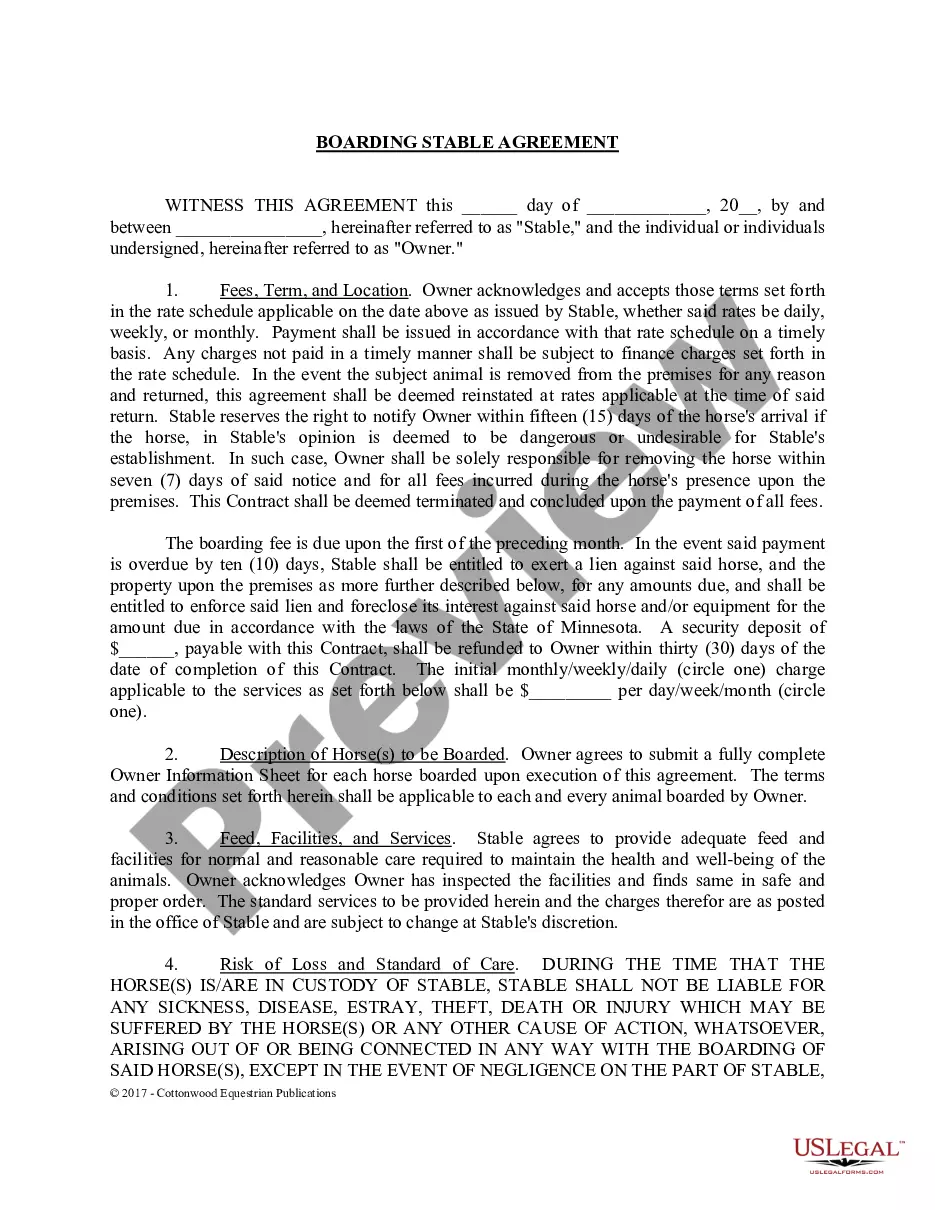
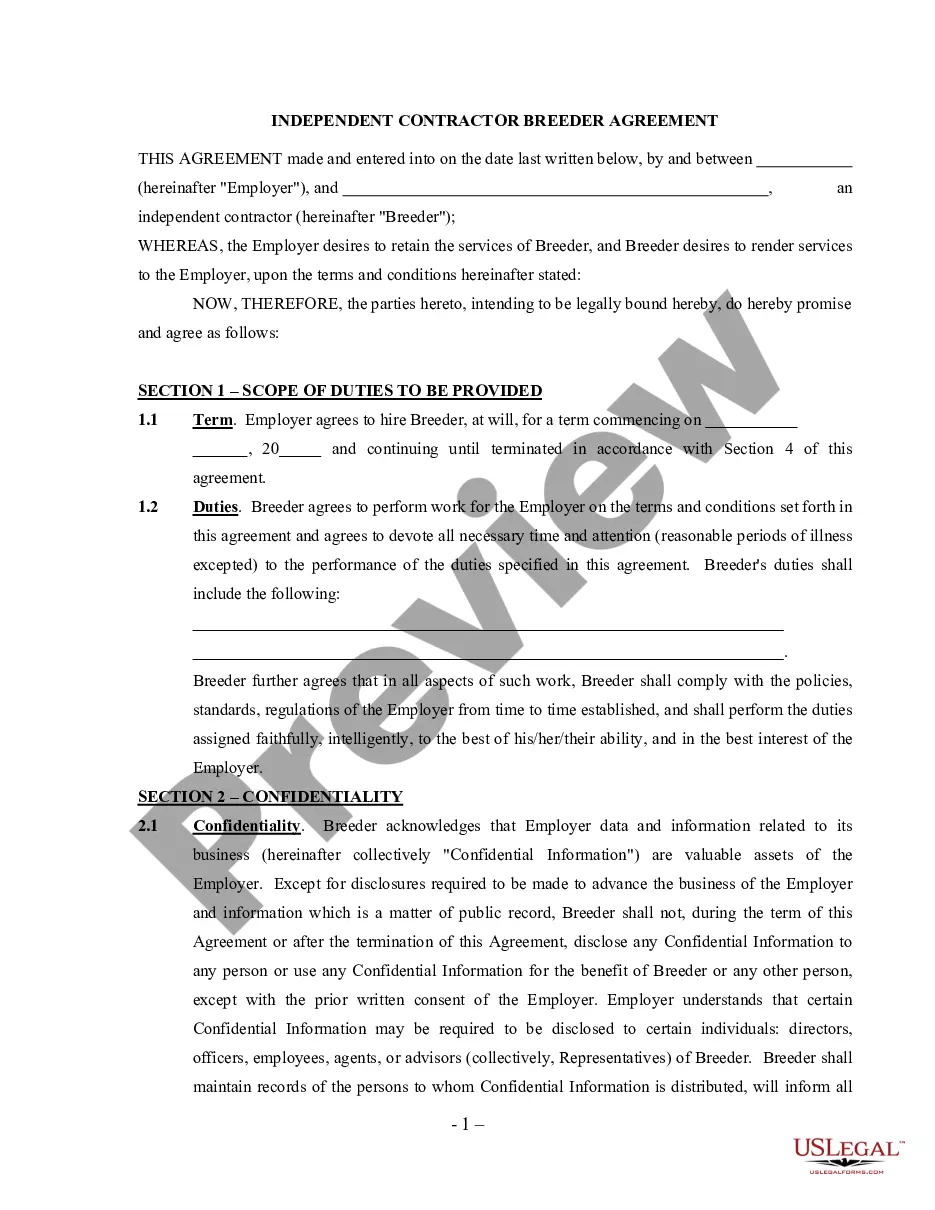
The Boarding Stable Agreement is a legal document that outlines the terms between a stable owner and a horse owner for the boarding of horses. This agreement is specifically designed to protect both parties by detailing fees, liability, care standards, emergency protocols, and any other essential provisions. Unlike general rental agreements, this form is tailored to equine boarding, ensuring both owners understand their rights and responsibilities in caring for the horse.
Main sections of this form
- Fees, termination, and location of the boarding arrangement
- Details of the horse(s) to be boarded
- Provisions for feed, facilities, and services provided by the stable
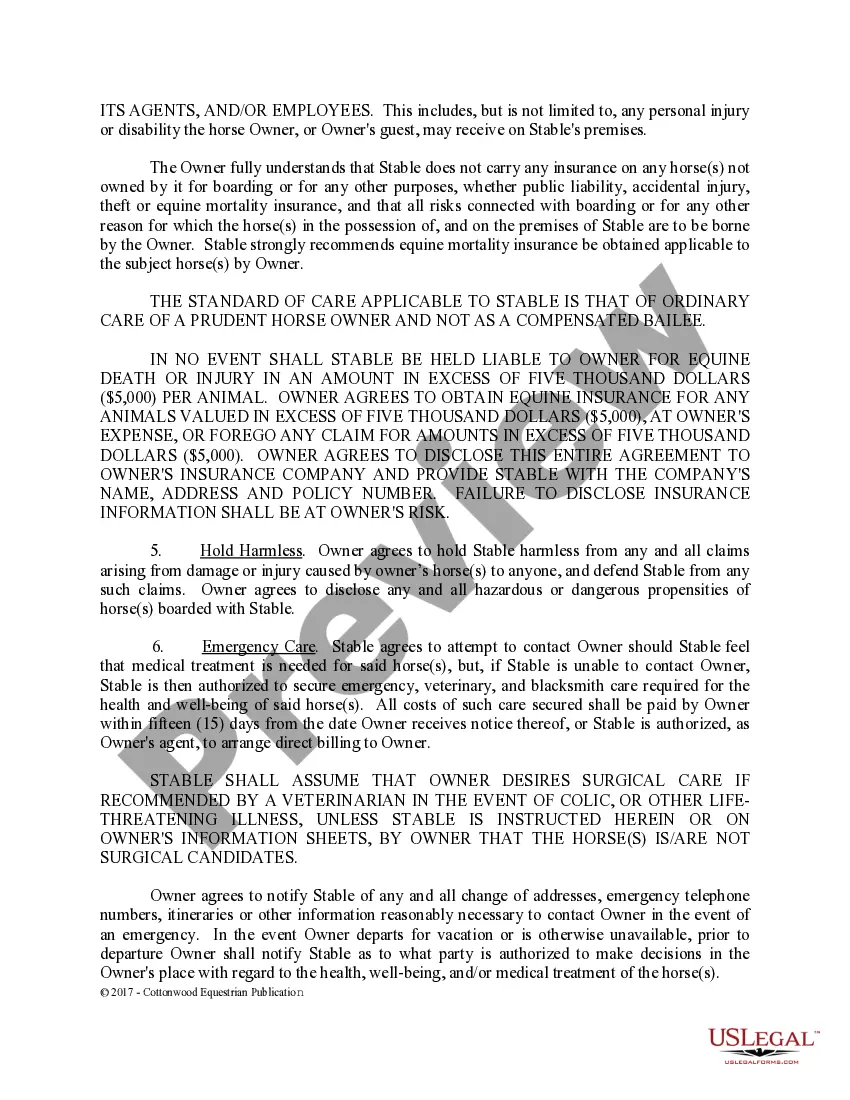
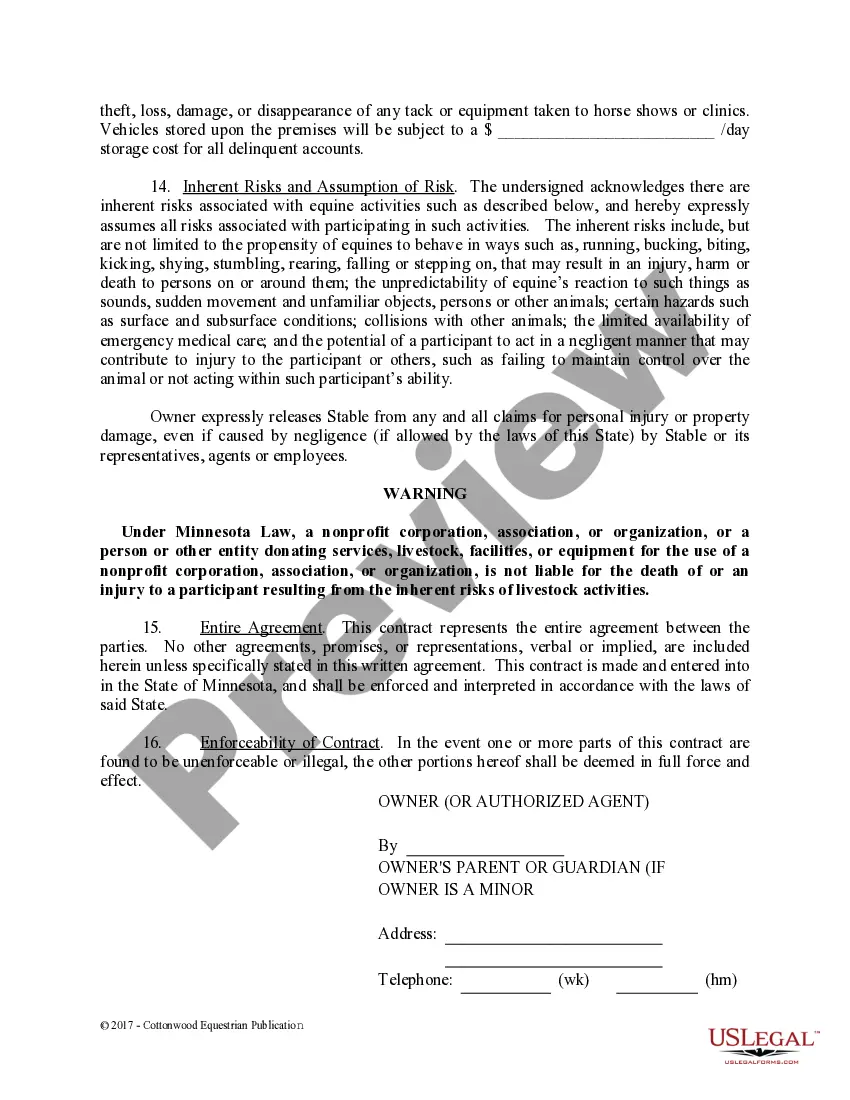
- Liability clauses detailing risk of loss and standard of care
- Emergency care authorization for veterinary services
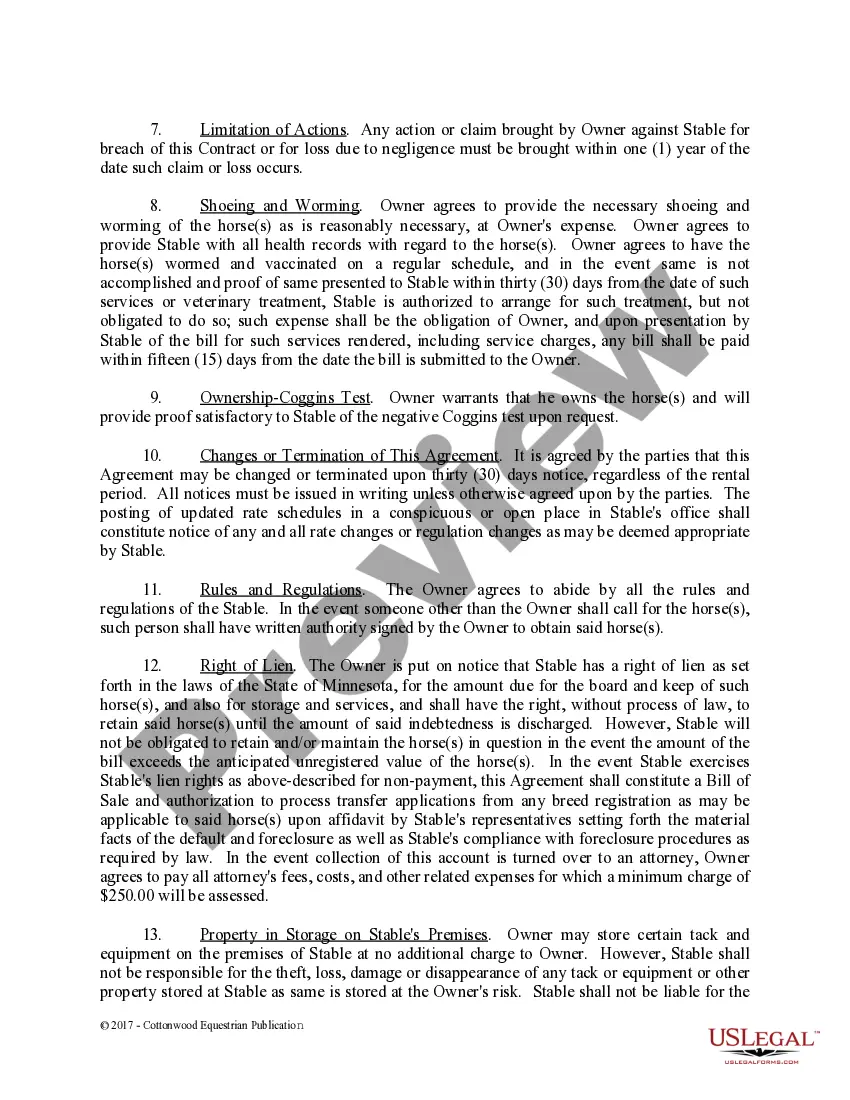
- Right of lien and conditions under which horses may be retained for non-payment
Situations where this form applies
This Boarding Stable Agreement should be used when a horse owner seeks a safe and formal arrangement for boarding their horse at a stable. It is essential in scenarios where there are multiple horses to board, as well as when specific services, care standards, or fees are crucial to agree upon. Using this agreement minimizes potential conflicts and outlines clear expectations for both parties involved.
Who needs this form
- Horse owners looking to board their horses in a stable
- Stable owners who provide boarding services for horses
- Equine professionals seeking a comprehensive agreement to manage horse care
Instructions for completing this form
- Identify and enter the names of the stable owner and horse owner at the beginning of the agreement.
- Specify the boarding fees and payment schedule based on the attached rate schedule.
- Provide complete information about each horse being boarded, including a health record if required.
- Include any specific services requested for the horse's care and the standard of care expected.
- Sign and date the agreement, ensuring all parties have a copy for their records.
Is notarization required?
Notarization is not commonly needed for this form. However, certain documents or local rules may make it necessary. Our notarization service, powered by Notarize, allows you to finalize it securely online anytime, day or night.
Get your form ready online
Our built-in tools help you complete, sign, share, and store your documents in one place.
Make edits, fill in missing information, and update formatting in US Legal Forms—just like you would in MS Word.
Download a copy, print it, send it by email, or mail it via USPS—whatever works best for your next step.
Sign and collect signatures with our SignNow integration. Send to multiple recipients, set reminders, and more. Go Premium to unlock E-Sign.
If this form requires notarization, complete it online through a secure video call—no need to meet a notary in person or wait for an appointment.
We protect your documents and personal data by following strict security and privacy standards.

Make edits, fill in missing information, and update formatting in US Legal Forms—just like you would in MS Word.

Download a copy, print it, send it by email, or mail it via USPS—whatever works best for your next step.

Sign and collect signatures with our SignNow integration. Send to multiple recipients, set reminders, and more. Go Premium to unlock E-Sign.

If this form requires notarization, complete it online through a secure video call—no need to meet a notary in person or wait for an appointment.

We protect your documents and personal data by following strict security and privacy standards.
Common mistakes to avoid
- Failing to specify all horses being boarded in the contract.
- Neglecting to review and sign the agreement before bringing horses to the stable.
- Not adhering to the payment schedule outlined in the agreement.
Benefits of using this form online
- Instant access to a professionally drafted legal document.
- Easy editing features allow customization to meet specific needs.
- The peace of mind that comes from a reliable and easy-to-understand format.
Legal use & context
- The agreement is enforceable under Minnesota law, outlining both parties' rights and obligations.
- It helps establish clear terms to avoid disputes over liability and care for the boarded horses.
- Failure to adhere to the contract can result in legal consequences, including liens on horses for unpaid fees.
Key takeaways
- The Boarding Stable Agreement defines the terms of horse boarding, detailing fees and responsibilities.
- It is essential for horse owners and stables to protect their interests and outline obligations clearly.
- Using this form minimizes potential disputes and provides a legal framework for the boarding relationship.
Looking for another form?

Form popularity
FAQ
In Minnesota, the general guideline is to have at least one to two acres of land per horse for adequate space and grazing. This amount allows for proper management of the horse's health and well-being, as well as the maintenance of the land. However, keep in mind that factors such as the quality of the pasture and the horse's activity level can affect these needs. For those looking to formalize their horse boarding arrangements, a Minnesota Boarding Stable Agreement - Horse Equine Forms can provide valuable insights into managing space and resources effectively.
To write a horse boarding contract, start by clearly defining the terms of the agreement, including services provided, fees, payment schedules, and duration. You should detail the responsibilities of both the horse owner and the stable owner, ensuring all aspects are covered. Utilizing a Minnesota Boarding Stable Agreement - Horse Equine Forms can streamline this process, as it contains essential clauses and provisions tailored for your needs. This form not only simplifies the drafting process but also helps protect both parties by outlining their rights and responsibilities.
When you earn income from horse boarding, it is essential to report this income on your tax return. Typically, you will need to report it as self-employment income, especially if you operate a boarding stable as a business. To ensure you comply with tax regulations, consider using the Minnesota Boarding Stable Agreement - Horse Equine Forms available on the US Legal Forms platform. This resource can help streamline your documentation and provide clarity on your obligations.
Self-care board is what it sounds like: housing your horse at someone else's facility but feeding and managing him yourself.
Housing. If you don't own enough land to support a horse, boarding at a barn or stable is the next best option. A horse is assigned a stall and you're given access to trails, a pasture or arena. The cost of boarding averages $400 to $500 per month but can go as high as $1,200 to $2,500 in metropolitan areas.
In this day and age of law suits and precarious economies the right boarding agreement can offer you substantial support and protection. Horse owner has signed and agrees to require each of his or her guests to sign a LIABILITY RELEASE (exhibit "A").
In most stables, each horse is kept in a box or stall of its own. These are of two principal types: Boxes allowing freedom of movement Horses are able to turn around, choose which way to face and lie down if they wish. These can also be known as a loose box (BrE), a stable (BrE), a stall (AmE) or box stall (AmE).