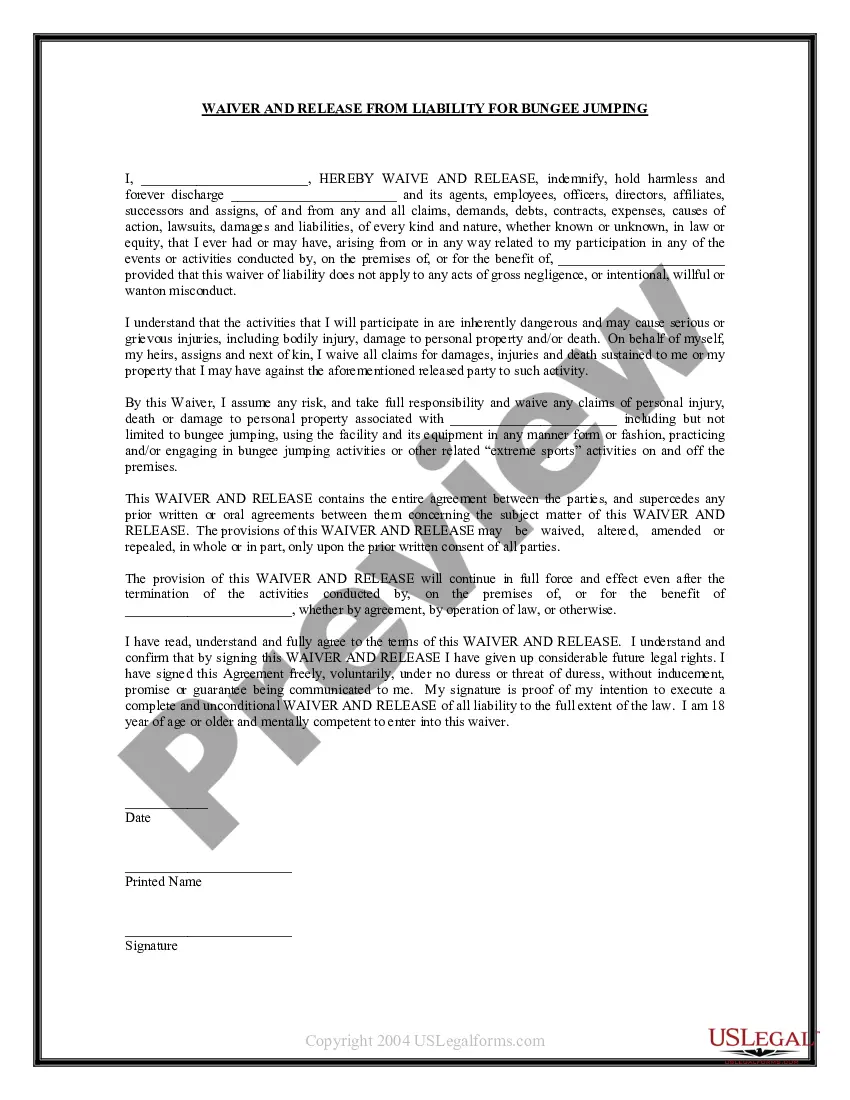
Michigan Waiver and Release From Liability For Adult for Bungee Jump
Description

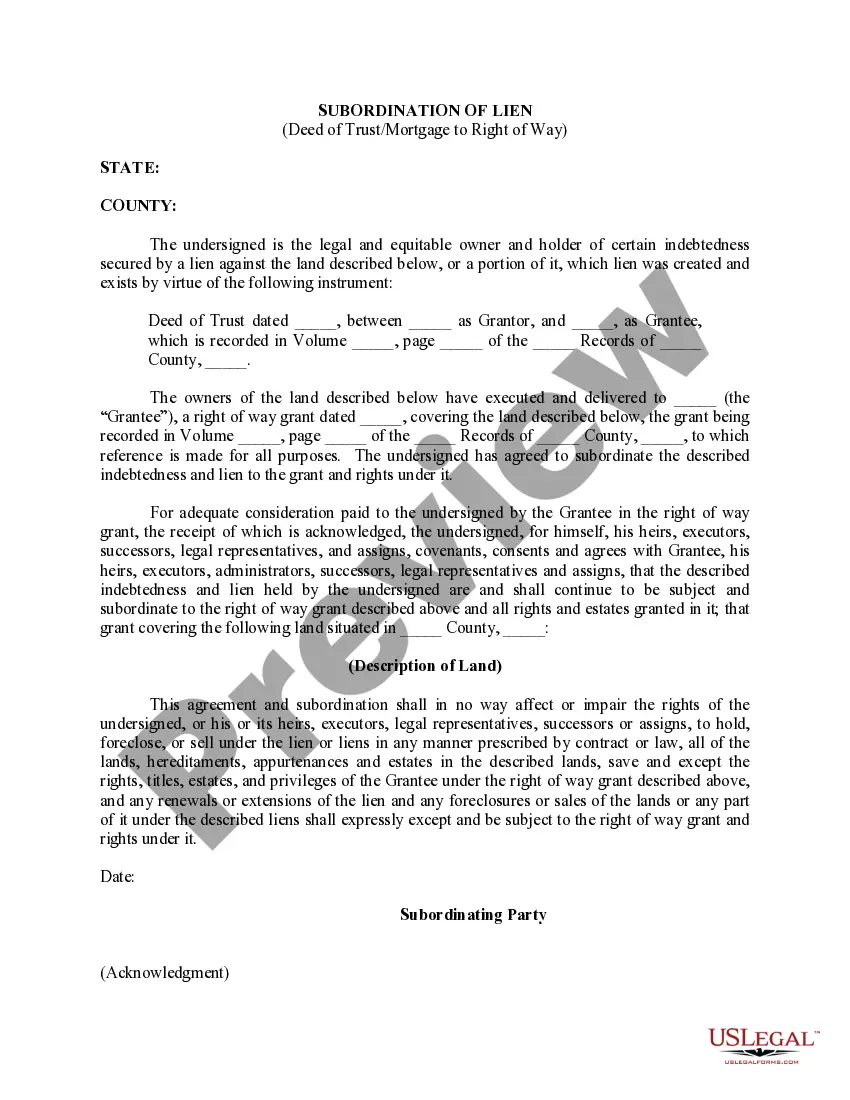
How to fill out Waiver And Release From Liability For Adult For Bungee Jump?
If you wish to finalize, acquire, or print legal document templates, utilize US Legal Forms, the largest collection of legal forms available online.
Take advantage of the site’s straightforward and user-friendly search to find the documents you need.
Various templates for commercial and personal uses are organized by categories and states, or keywords. Employ US Legal Forms to obtain the Michigan Waiver and Release From Liability For Adult for Bungee Jump in just a few clicks.
Step 5. Complete the transaction. You can use your credit card or PayPal account to process the payment.
Step 6. Choose the format of the legal document and download it to your device. Step 7. Fill out, edit, and print or sign the Michigan Waiver and Release From Liability For Adult for Bungee Jump. Every legal document template you obtain is yours indefinitely. You have access to each form you downloaded in your account. Visit the My documents section and select a form to print or download again. Compete and acquire, and print the Michigan Waiver and Release From Liability For Adult for Bungee Jump with US Legal Forms. There are millions of professional and state-specific forms that you can use for your business or personal requirements.
- If you are already a US Legal Forms customer, Log In to your account and click the Acquire button to obtain the Michigan Waiver and Release From Liability For Adult for Bungee Jump.
- You can also access forms you previously downloaded in the My documents section of your account.
- If this is your first time using US Legal Forms, follow the instructions below.
- Step 1. Ensure you have selected the form for your specific city/state.
- Step 2. Utilize the Review feature to examine the content of the form. Be sure to read the description.
- Step 3. If you are not satisfied with the form, use the Search field at the top of the screen to find alternative versions of the legal form template.
- Step 4. Once you have found the form you need, click the Purchase now button. Select the pricing plan you prefer and enter your details to register for an account.
Form popularity
FAQ
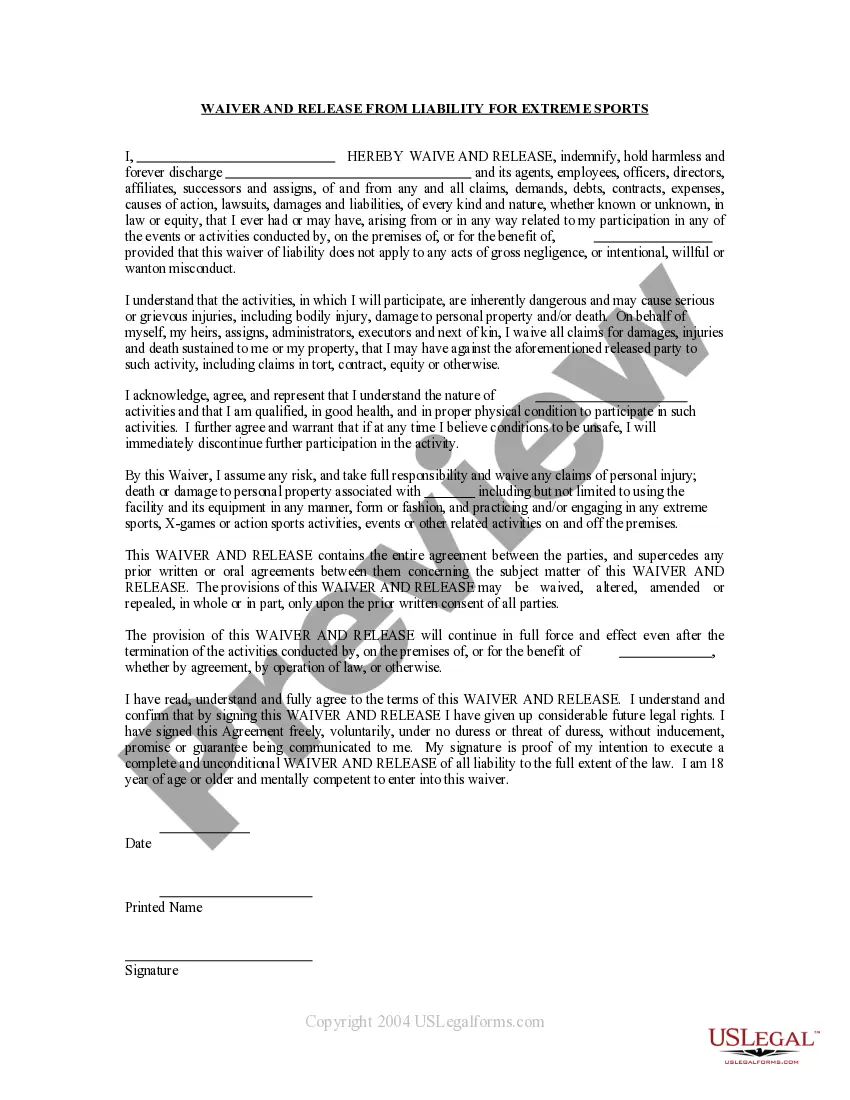
While you can write your own liability waiver, it's crucial to ensure it complies with Michigan laws. A well-structured Michigan Waiver and Release From Liability For Adult for Bungee Jump should include specific legal language and cover all necessary aspects. To avoid potential pitfalls, you may want to use uslegalforms, which provides templates that can help you create a legally sound waiver with ease.
Yes, liability waivers are generally enforceable in Michigan, including the Michigan Waiver and Release From Liability For Adult for Bungee Jump. However, certain conditions apply. The waiver should not cover gross negligence, and it must be clear and conspicuous. For peace of mind, consider using a service like uslegalforms to ensure your waiver meets all legal standards.
To create a valid Michigan Waiver and Release From Liability For Adult for Bungee Jump, the document must meet three essential requirements. First, it should clearly state the activity and the risks involved. Next, it must be signed voluntarily by the participant, ensuring they understand the consequences. Lastly, the language should be unambiguous, leaving no room for misinterpretation.
Generally, a liability waiver document is a legally binding agreement that relinquishes the right of one party to pursue legal remedy for injuries accrued on the property, regardless of fault involved.
There are two main reasons a company will have you sign a liability waiver: 1) to document in writing that you have been warned of potential risks and 2) to remove their responsibility for injuries that arise from ordinary negligence.
A Release of Liability is an agreement between two parties in which one gives up the right to hold the other legally responsible for current or future injuries, losses, and damages. The party waiving their right receives monetary or non-monetary compensation, also known as consideration.
HOW LONG SHOULD I KEEP A RELEASE? The department sponsoring the activity must keep releases for at least three years after the activity ends. Releases signed by a parent or guardian on behalf of a minor must be retained for at least three years after the activity ends or until the minor turns 20, whichever is longer.
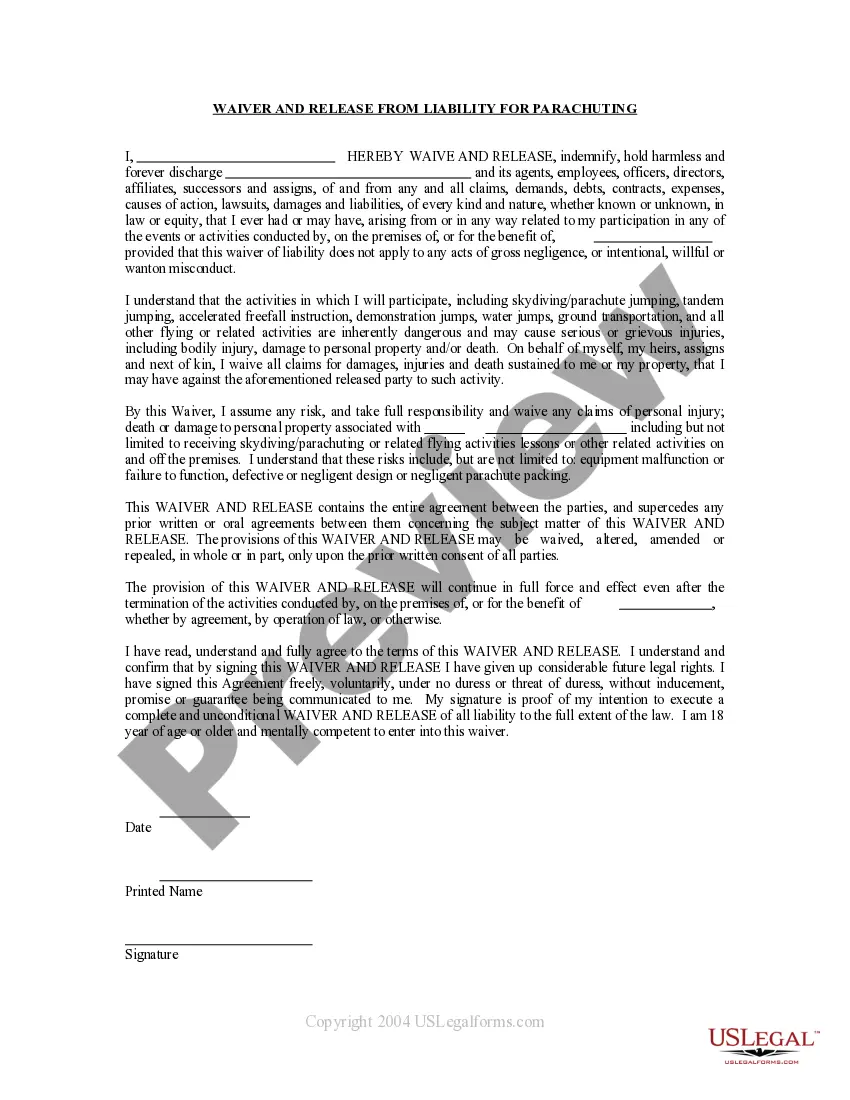
A release of liability, also known as a liability waiver or a hold harmless agreement, is a contract in which one party agrees not to hold another party liable for damages or injury. These contracts are common in fields that involve some risk to property, finances, or health.
So, do liability waivers hold up in court? if you are injured as a result of ordinary negligence, the liability waiver may fully protect the defendant and leave you without legal recourse. If you are injured as a result of gross negligence, then you may have a case.
Waivers must be stored by the department supervising the activity for at least three years after the activity ends. Waivers signed on behalf of a minor must be retained for three years after the activity ends or until the minor turns 20, whichever is longer.