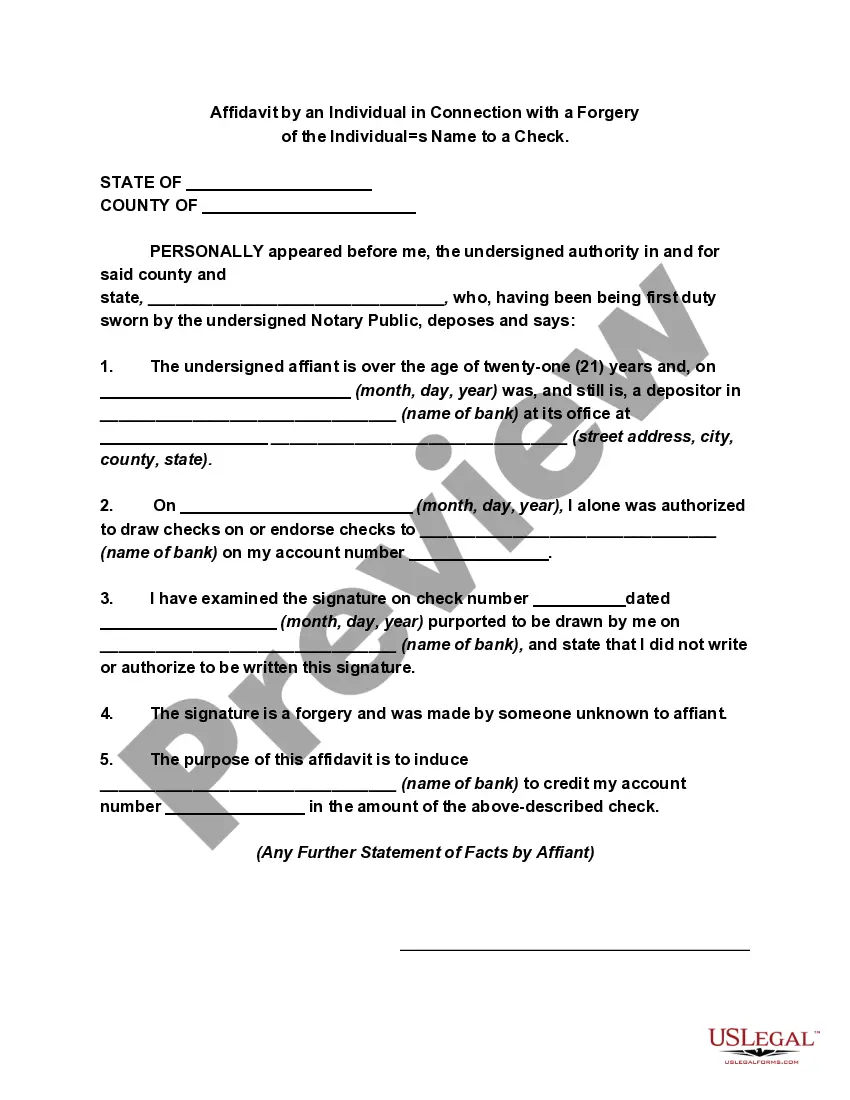
Michigan Affidavit by an Individual in Connection with a Forgery of the Individual's Name to a Check
Description

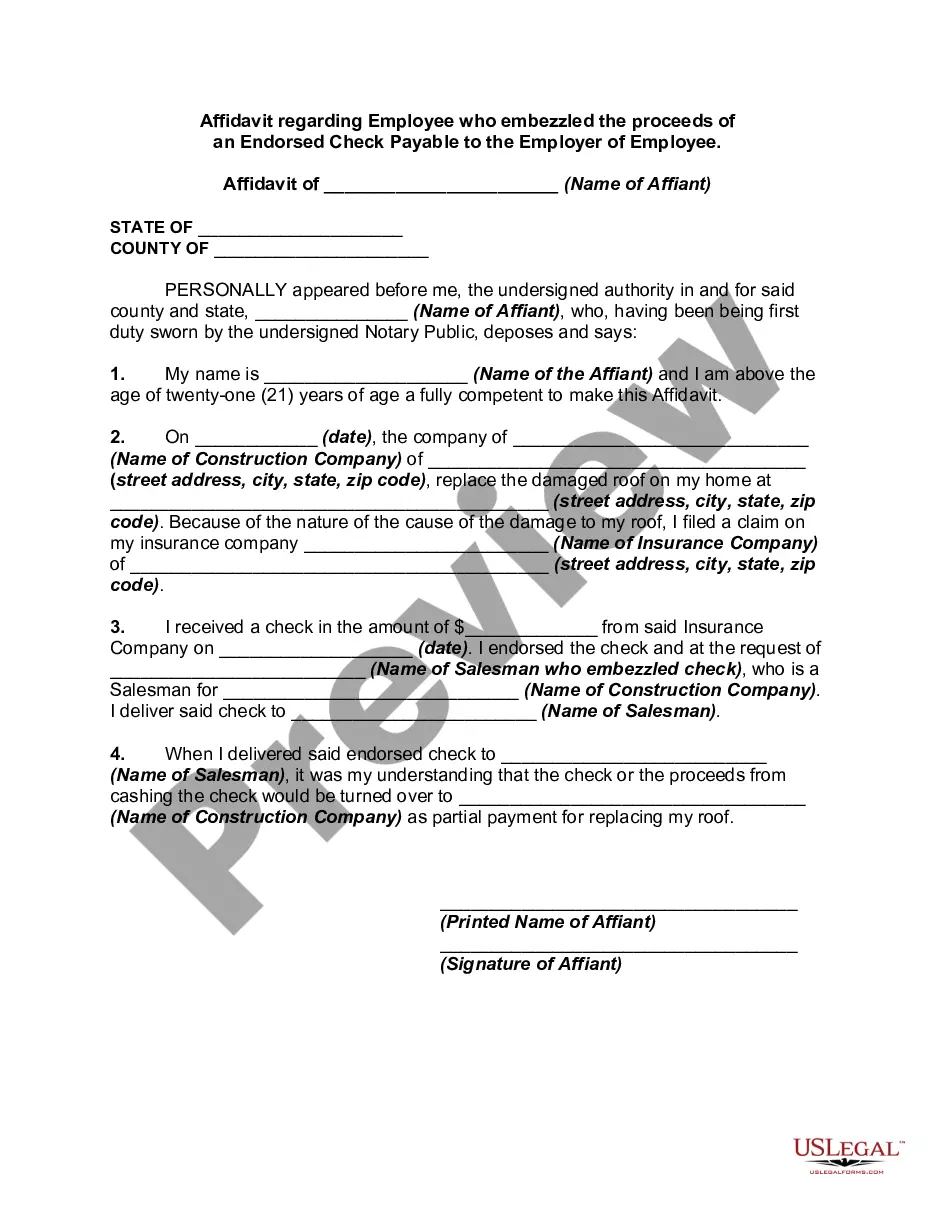
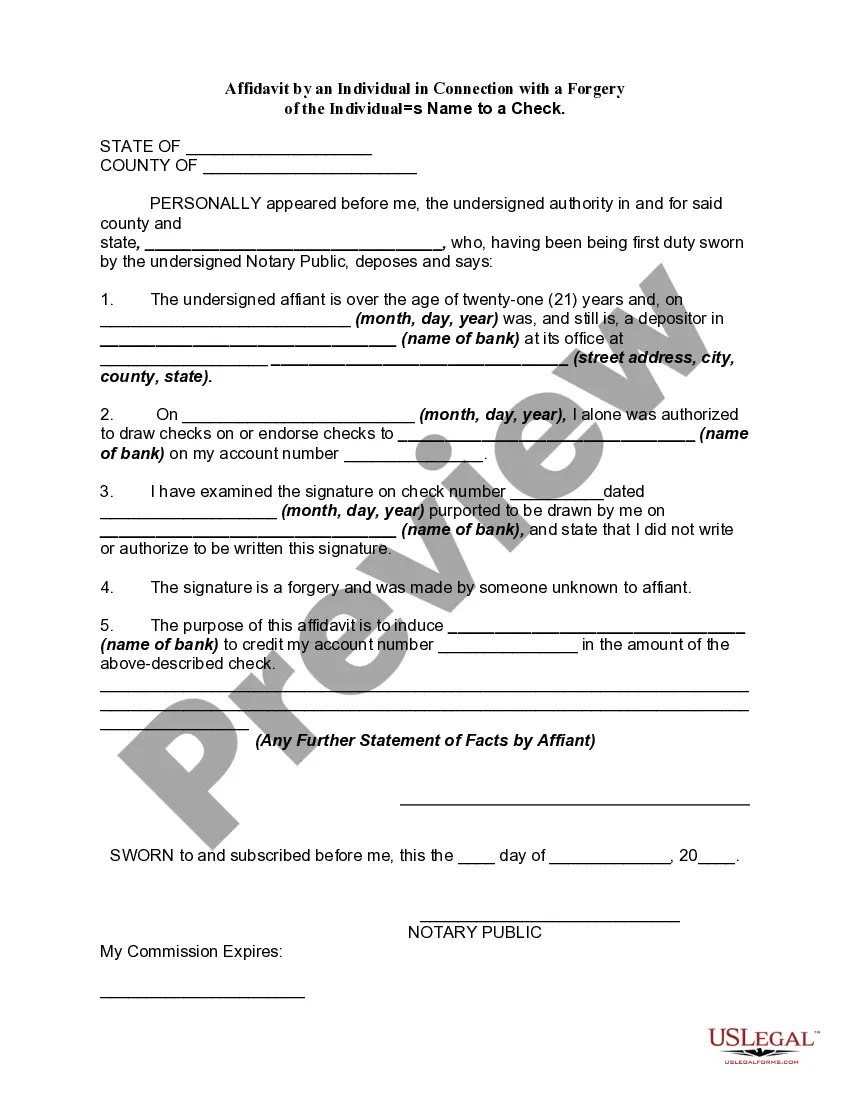
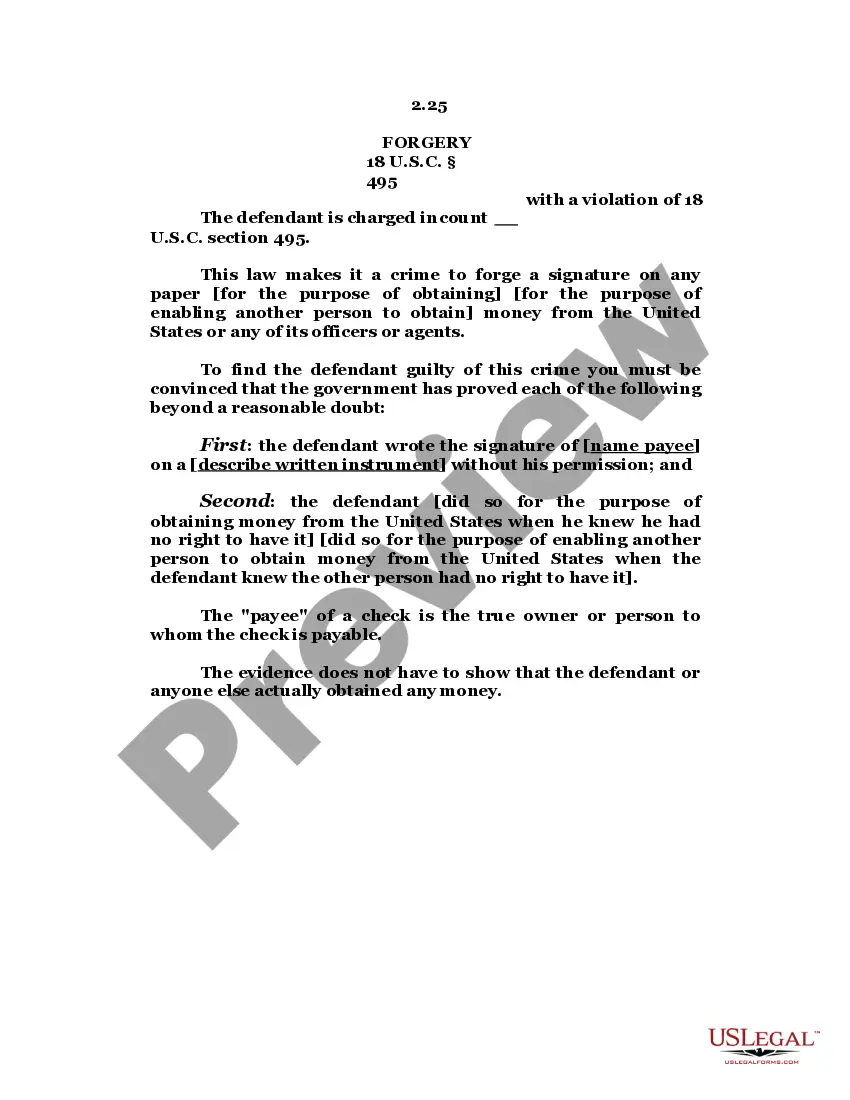
How to fill out Affidavit By An Individual In Connection With A Forgery Of The Individual's Name To A Check?
Are you currently in a situation where you require documents for both business or personal purposes almost all the time.
There are numerous legal document templates available online, but finding ones you can trust is not simple.
US Legal Forms provides thousands of form templates, such as the Michigan Affidavit by an Individual in Relation to a Forgery of the Individual's Name to a Check, that are designed to comply with federal and state regulations.
Utilize US Legal Forms, one of the most extensive collections of legal forms, to save time and avoid errors.
The service offers professionally crafted legal document templates that you can use for various purposes. Create an account on US Legal Forms and start simplifying your life.
- If you are already familiar with the US Legal Forms site and have an account, simply Log In.
- Then, you can download the Michigan Affidavit by an Individual in Relation to a Forgery of the Individual's Name to a Check template.
- If you do not have an account and want to start using US Legal Forms, follow these steps.
- Obtain the form you need and ensure it is for the correct city/region.
- Use the Review option to examine the form.
- Read the details to confirm that you have selected the right form.
- If the form is not what you are looking for, use the Search field to find a form that meets your needs and requirements.
- Once you find the appropriate form, click Get now.
- Choose the pricing plan you want, fill in the required information to create your account, and pay for the order using your PayPal or credit card.
- Select a convenient file format and download your copy.
- Find all the document templates you have purchased in the My documents menu. You can obtain another copy of the Michigan Affidavit by an Individual in Relation to a Forgery of the Individual's Name to a Check anytime, if needed. Just click on the necessary form to download or print the document template.
Form popularity
FAQ
A notary public in Michigan is not allowed to charge you more than $10 per notarial act. If a notary public is not a licensed attorney, they must include the following statement in their documents and advertisements: ?I am not an attorney and have no authority to give advice on immigration or other legal matters.?
In states that do not require statutory wording when performing the oath's oral ceremony, the notary will ask the signer: ?Do you solemnly swear under penalty of perjury that the statements in this document are true and correct to the best of your knowledge and belief, so help you God??
(1) A notary public shall place his or her signature on every record upon which he or she performs a notarial act. The notary public shall sign his or her name exactly as his or her name appears on his or her application for commission as a notary public.
249. (1) A person who utters and publishes as true a false, forged, altered, or counterfeit record, instrument, or other writing listed in section 248 knowing it to be false, altered, forged, or counterfeit with intent to injure or defraud is guilty of a felony punishable by imprisonment for not more than 14 years.
(1) An oath or affidavit other than an oath taken by a witness or a juror in a trial, or an oath required by law to be taken before a particular officer, may be taken before a justice, judge, or clerk of a court, or before a notary public.
Section 33 of the Michigan Notary Public Act allows a notary public to sign the name of a person who is unable to sign due to limited physical capacity if: The notary public is permitted and directed by the person to sign his or her name; The person is in the physical presence of the notary public; and.
When you get your will notarized, you add what's called a ?self-proving affidavit? to it. Self-proving affidavits need to be signed by the testator and two witnesses. The self-proving affidavit confirms that the will was executed properly. Michigan accepts self-proving wills.
Under Michigan's Notary Public Act, the commission of a notary public is automatically revoked if he or she is convicted of a felony; convicted of two or more misdemeanor offenses with a 12-month period; or convicted of three or more misdemeanor offenses with a five-year period.