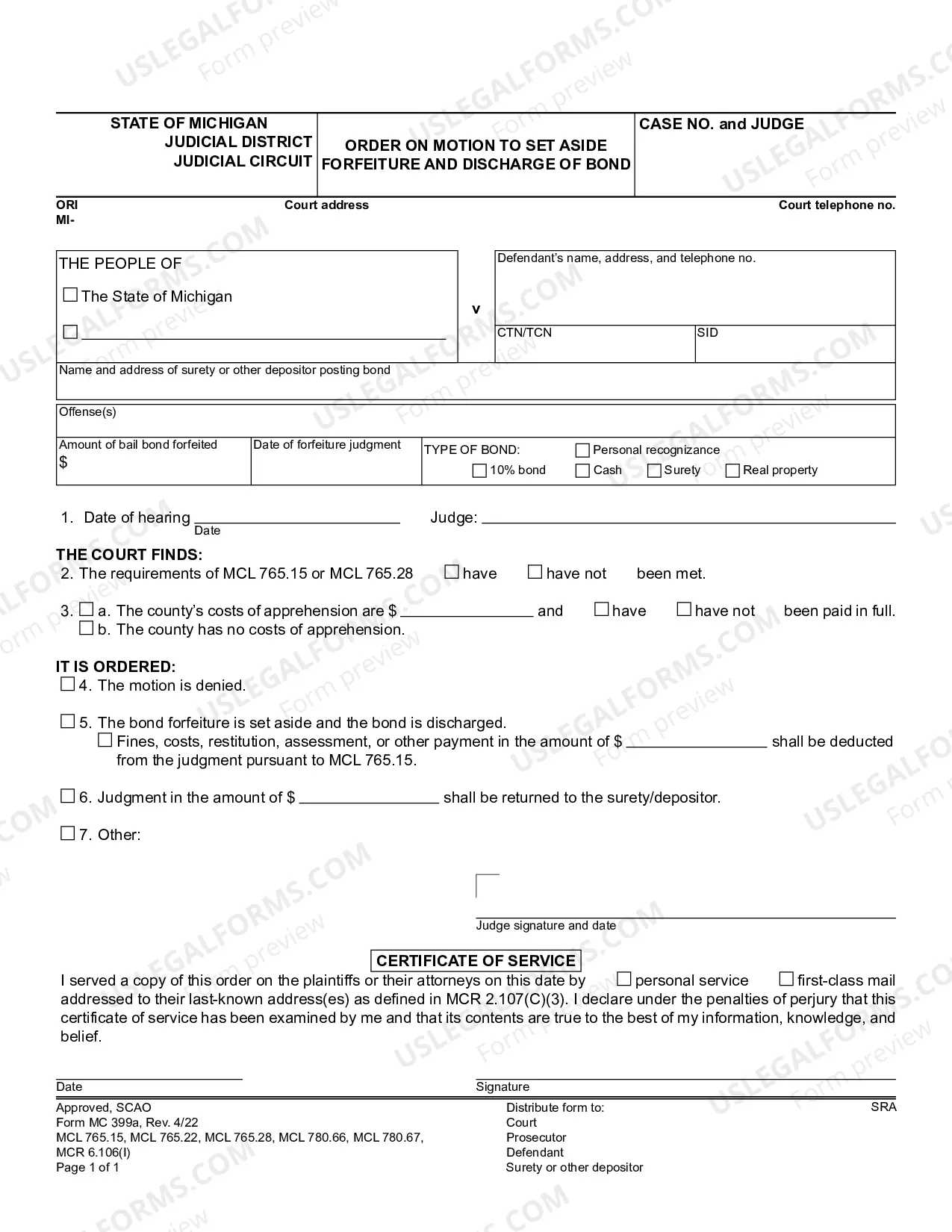
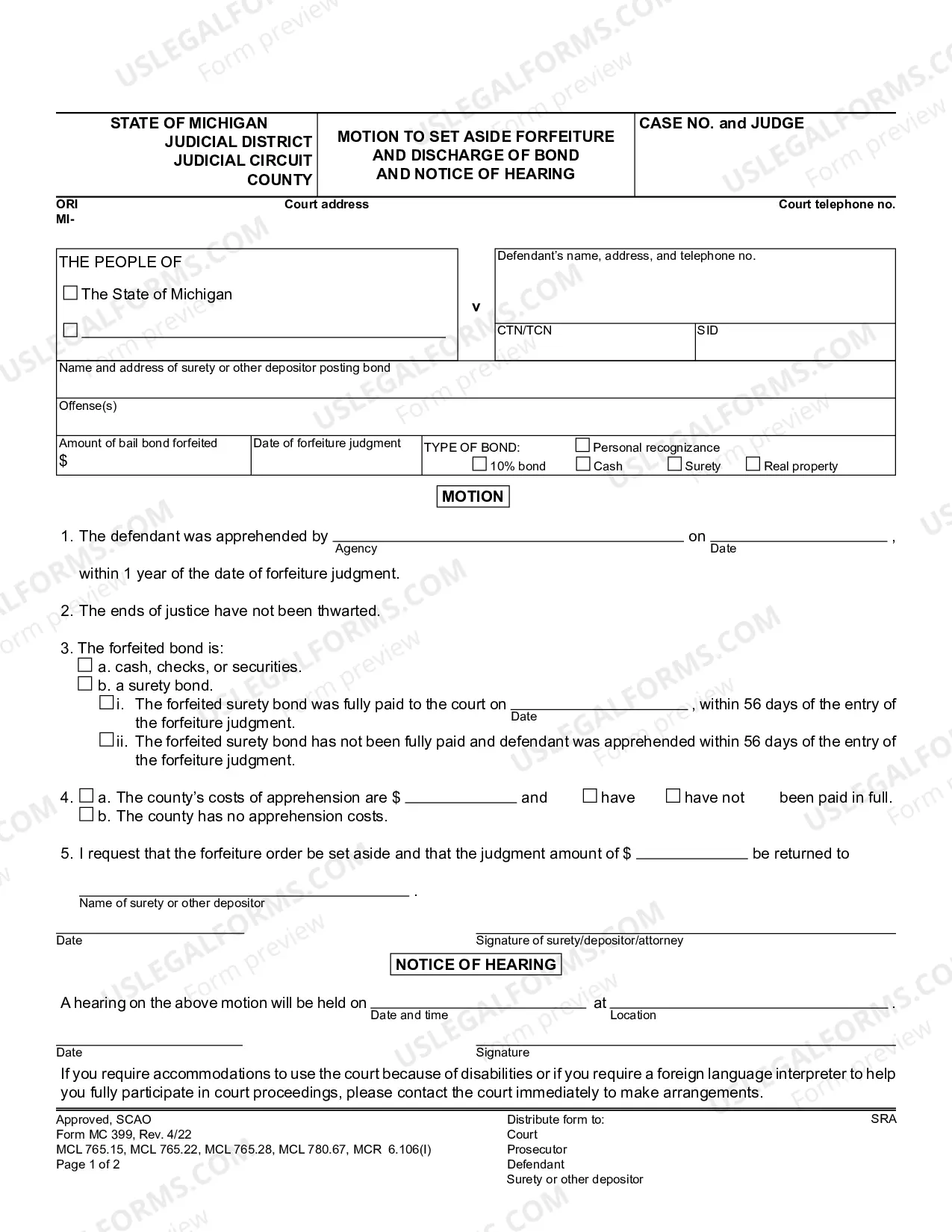
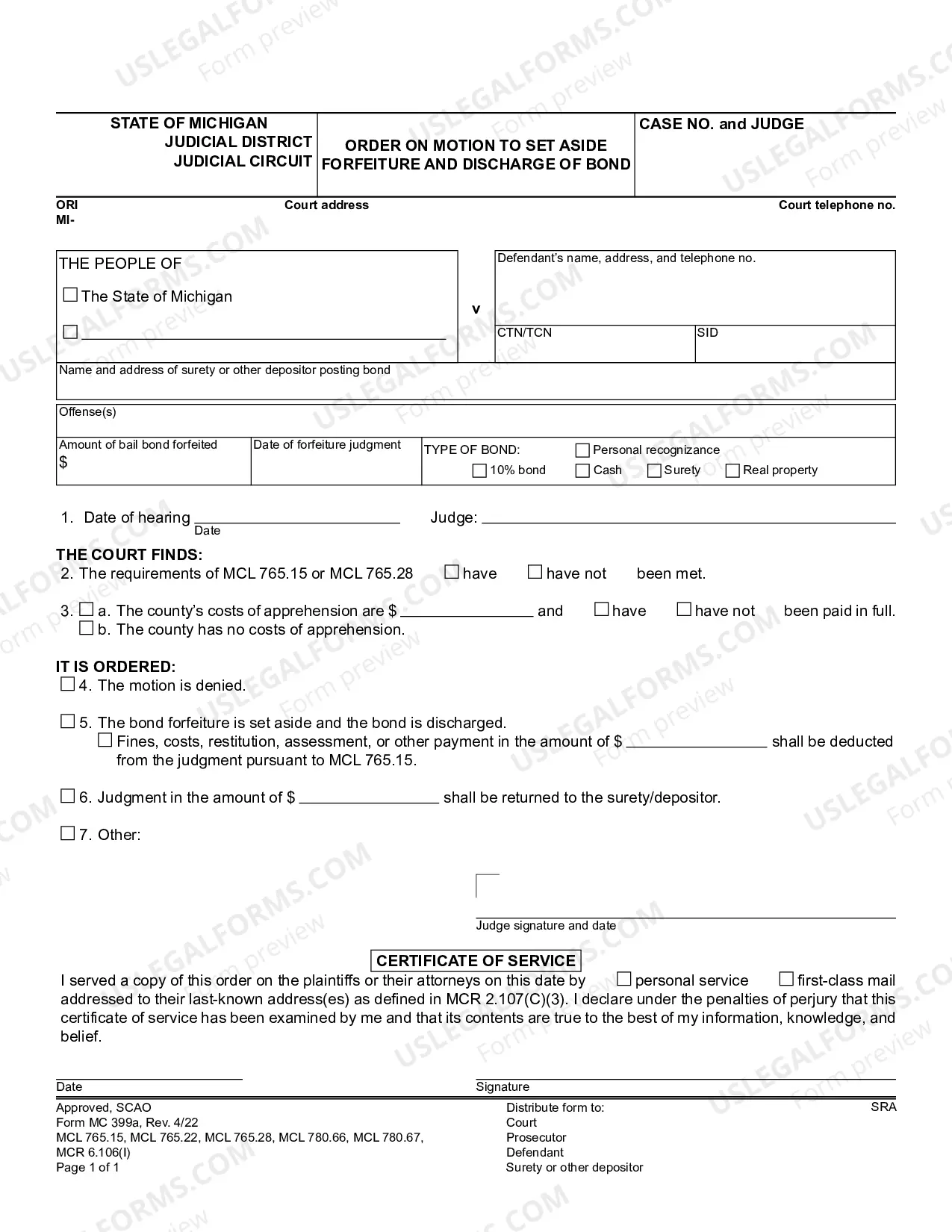
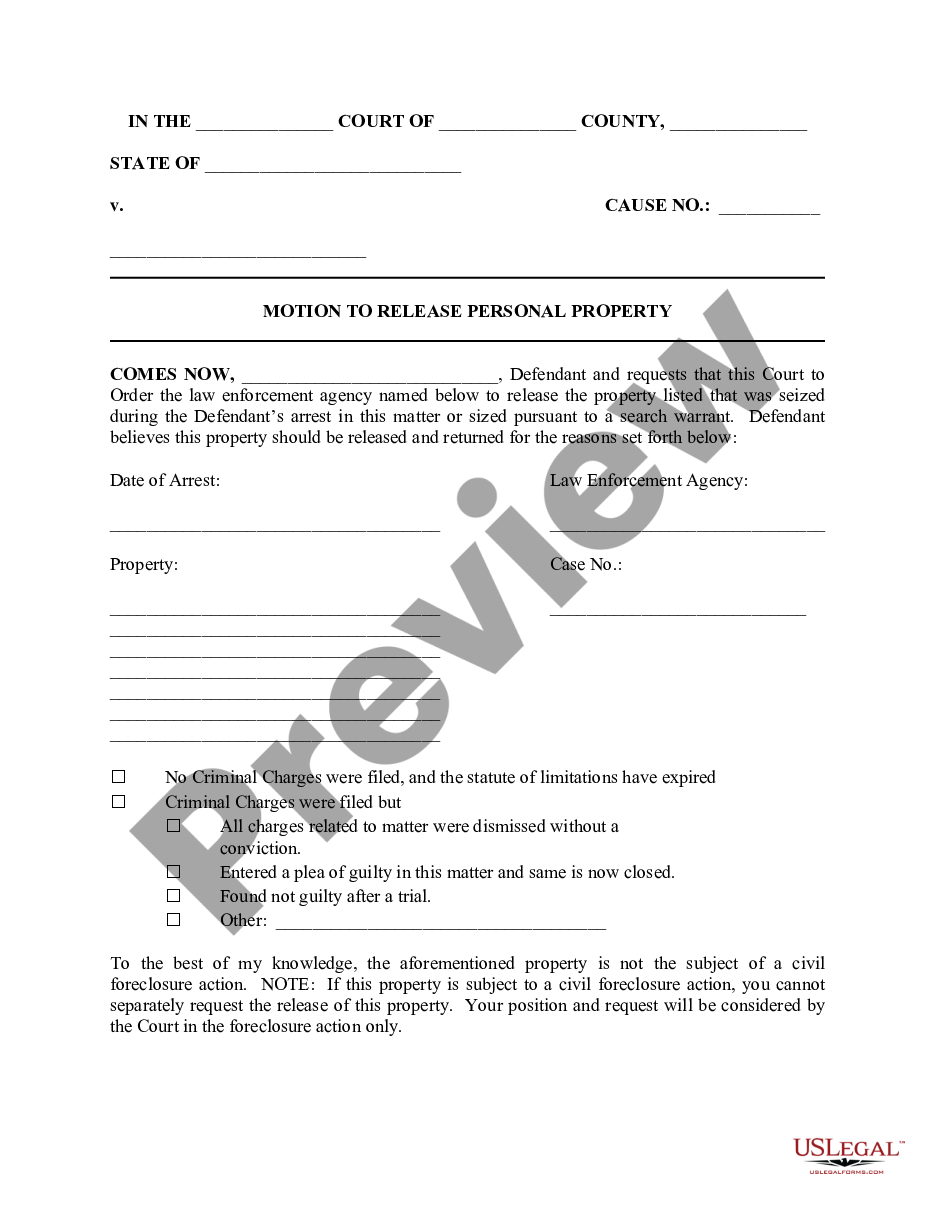
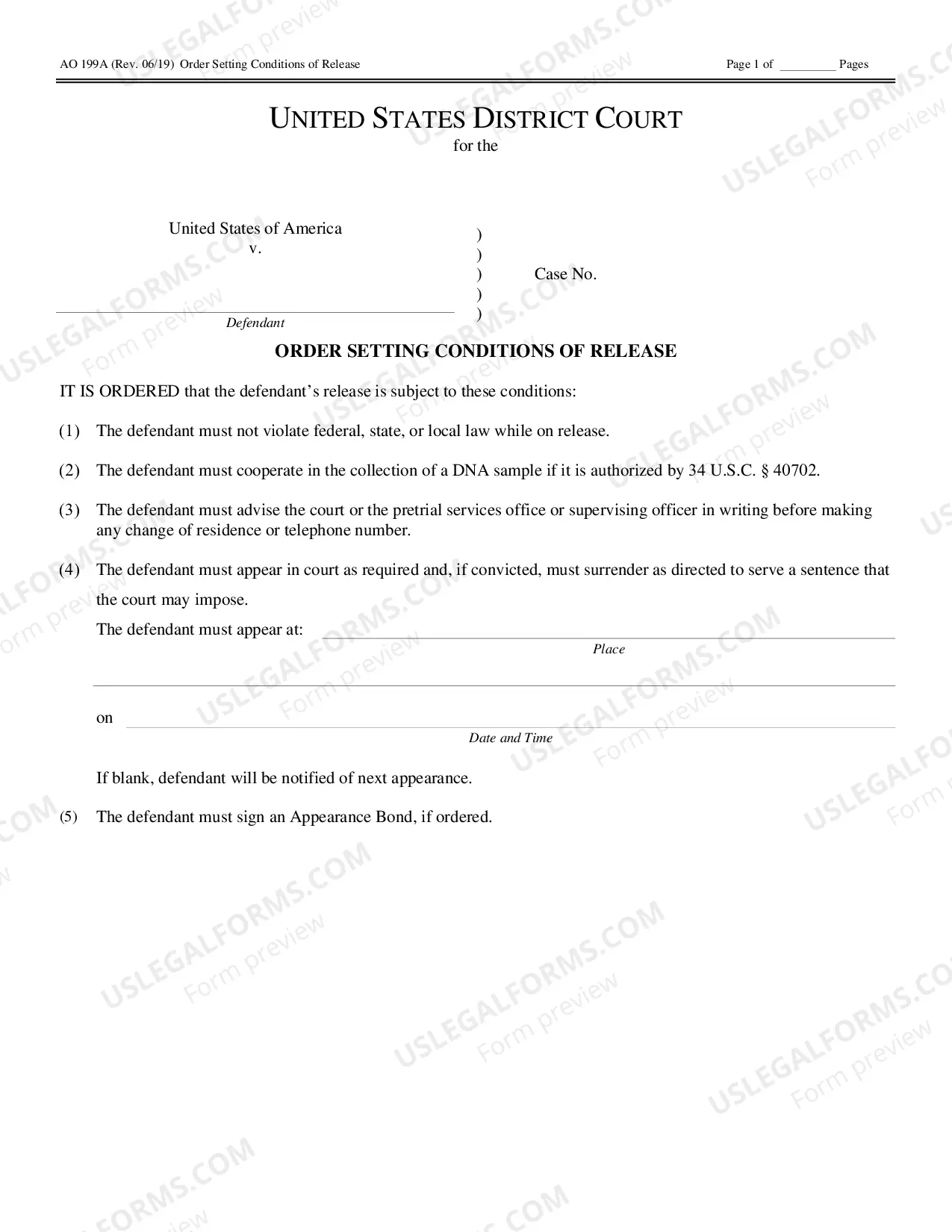
A Michigan Order on Motion to Set Aside Forfeiture and Discharge of Bond is an order issued by a Michigan court which sets aside a forfeiture and releases the bond posted in connection with the forfeiture. This order is typically issued in criminal cases when a defendant fails to appear for a court date or otherwise fails to comply with a court order. The order can also be used when a criminal defendant successfully appeals a forfeiture judgment or otherwise challenges the validity or legality of a forfeiture. There are two types of Michigan Order on Motion to Set Aside Forfeiture and Discharge of Bond: orders issued by the circuit court and orders issued by the district court. The circuit court order is issued when the forfeiture is appealed to the circuit court, while the district court order is issued when the forfeiture is challenged in district court.
Michigan Order on Motion to Set Aside Forfeiture and Discharge of Bond
Description
Get your form ready online
Our built-in tools help you complete, sign, share, and store your documents in one place.
Make edits, fill in missing information, and update formatting in US Legal Forms—just like you would in MS Word.
Download a copy, print it, send it by email, or mail it via USPS—whatever works best for your next step.
Sign and collect signatures with our SignNow integration. Send to multiple recipients, set reminders, and more. Go Premium to unlock E-Sign.
If this form requires notarization, complete it online through a secure video call—no need to meet a notary in person or wait for an appointment.
We protect your documents and personal data by following strict security and privacy standards.

Make edits, fill in missing information, and update formatting in US Legal Forms—just like you would in MS Word.

Download a copy, print it, send it by email, or mail it via USPS—whatever works best for your next step.

Sign and collect signatures with our SignNow integration. Send to multiple recipients, set reminders, and more. Go Premium to unlock E-Sign.

If this form requires notarization, complete it online through a secure video call—no need to meet a notary in person or wait for an appointment.

We protect your documents and personal data by following strict security and privacy standards.
Looking for another form?


How to fill out Michigan Order On Motion To Set Aside Forfeiture And Discharge Of Bond?
US Legal Forms is the most direct and economical method to find appropriate legal templates.
It’s the largest online collection of business and personal legal documents created and validated by legal experts.
Here, you can discover printable and fillable forms that adhere to federal and state laws - just like your Michigan Order on Motion to Set Aside Forfeiture and Discharge of Bond.
Review the form details or preview the document to ensure you’ve found the one that meets your needs, or locate another one using the search tab above.
Click Buy now when you’re confident about its suitability for all the requirements, and select the subscription plan that appeals to you the most.
- Acquiring your template requires only a few easy steps.
- Users who already possess an account with an active subscription merely need to Log In to the site and download the form onto their device.
- Later, they can find it in their profile under the My documents section.
- And here’s how you can get a correctly drafted Michigan Order on Motion to Set Aside Forfeiture and Discharge of Bond if you are using US Legal Forms for the first time.
Form popularity
FAQ
To undo a bond, you first need to file a Michigan Order on Motion to Set Aside Forfeiture and Discharge of Bond. This legal motion can help you reverse the bond forfeiture. The process typically requires you to provide valid reasons for the motion and relevant documentation. Utilizing the US Legal Forms platform can simplify this process by providing the necessary forms and guidance you need to effectively navigate your situation.
In Michigan, to revoke a bond, a defendant or their attorney must file a motion with the court, detailing the reasons for the revocation. This often involves demonstrating compliance with bond conditions or highlighting any changes in circumstances that warrant revocation. Utilizing a Michigan Order on Motion to Set Aside Forfeiture and Discharge of Bond may facilitate this process. The US Legal Forms platform provides templates and guidance to ensure that you navigate this process efficiently.
A motion for bond forfeiture arises when a defendant fails to meet the conditions of their bond. In Michigan, this process allows the court to reclaim the bond amount if the defendant does not appear for court proceedings. To challenge such a forfeiture, one might file a Michigan Order on Motion to Set Aside Forfeiture and Discharge of Bond. This document serves to request the court to cancel the forfeiture and release the bond funds, assuming valid reasons are presented.
To set aside a judgment, you need to file a motion with the court and present valid reasons for your request. This involves filling out the necessary paperwork and potentially attending a court hearing. Successfully obtaining a Michigan Order on Motion to Set Aside Forfeiture and Discharge of Bond can greatly impact your situation, making it essential to gather the right evidence and follow proper court procedures.
The new forfeiture law in Michigan has undergone changes aimed at increasing transparency and protecting property owners. These changes often include stricter guidelines for civil asset forfeitures, making it necessary for law enforcement to provide clear justification for such actions. If you believe you have been unfairly affected, understanding this law can help you navigate your Michigan Order on Motion to Set Aside Forfeiture and Discharge of Bond.
Filing a motion in court in Michigan involves drafting your motion and the supporting documents, then submitting them to the appropriate court clerk. Ensure that you are following the court's formatting rules and procedures for filings. After submitting your motion, you may need to attend a hearing where you can further explain your Michigan Order on Motion to Set Aside Forfeiture and Discharge of Bond.
When filing a motion to set aside, you typically need to provide strong evidence demonstrating the need for your request. This could include new information that was unavailable during your original case or evidence that showcases a significant error in the court's decision. The clearer and more compelling your evidence, the greater the likelihood of a favorable outcome with your Michigan Order on Motion to Set Aside Forfeiture and Discharge of Bond.
To file a motion to set aside judgment in Michigan, start by preparing your motion documents, clearly stating your reasons for the request. You will need to file these documents with the court that issued the original judgment. In your motion, incorporate relevant details and evidence to support your case, as this will strengthen your Michigan Order on Motion to Set Aside Forfeiture and Discharge of Bond.
Yes, a bond forfeiture can often be reversed through a Michigan Order on Motion to Set Aside Forfeiture and Discharge of Bond. To initiate this process, you typically need to demonstrate legitimate reasons, such as a miscommunication regarding court appearances or new evidence that supports your case. Engaging with an attorney can significantly improve your chances of a successful reversal by guiding you through the legal requirements.