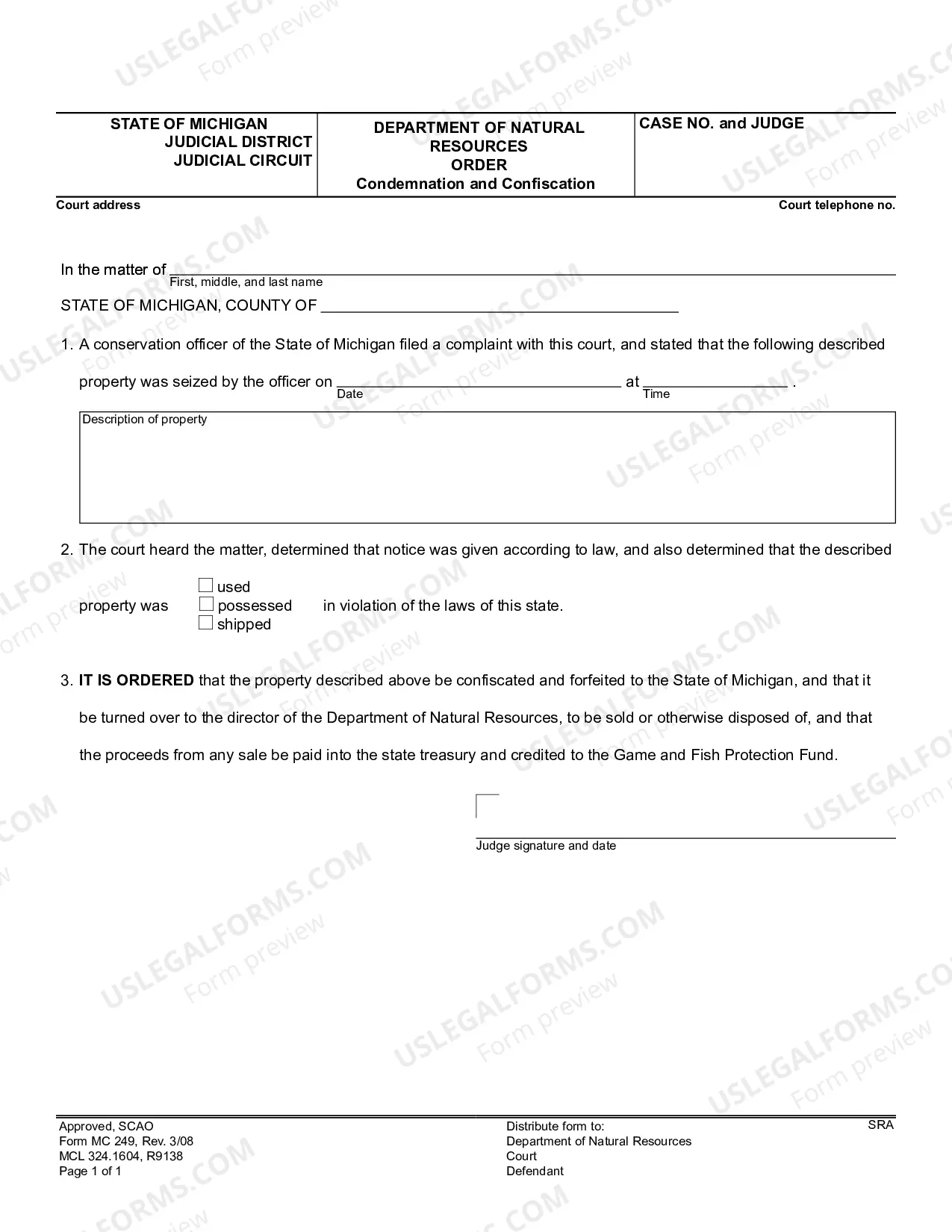
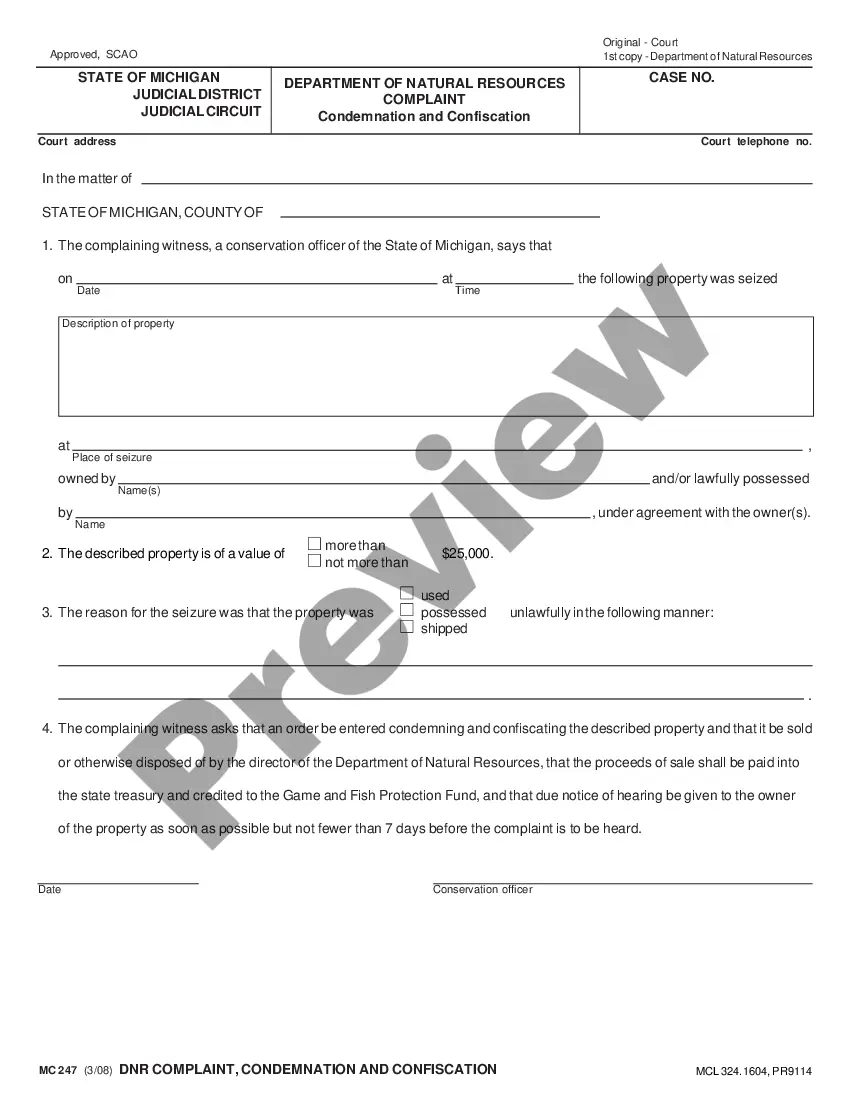
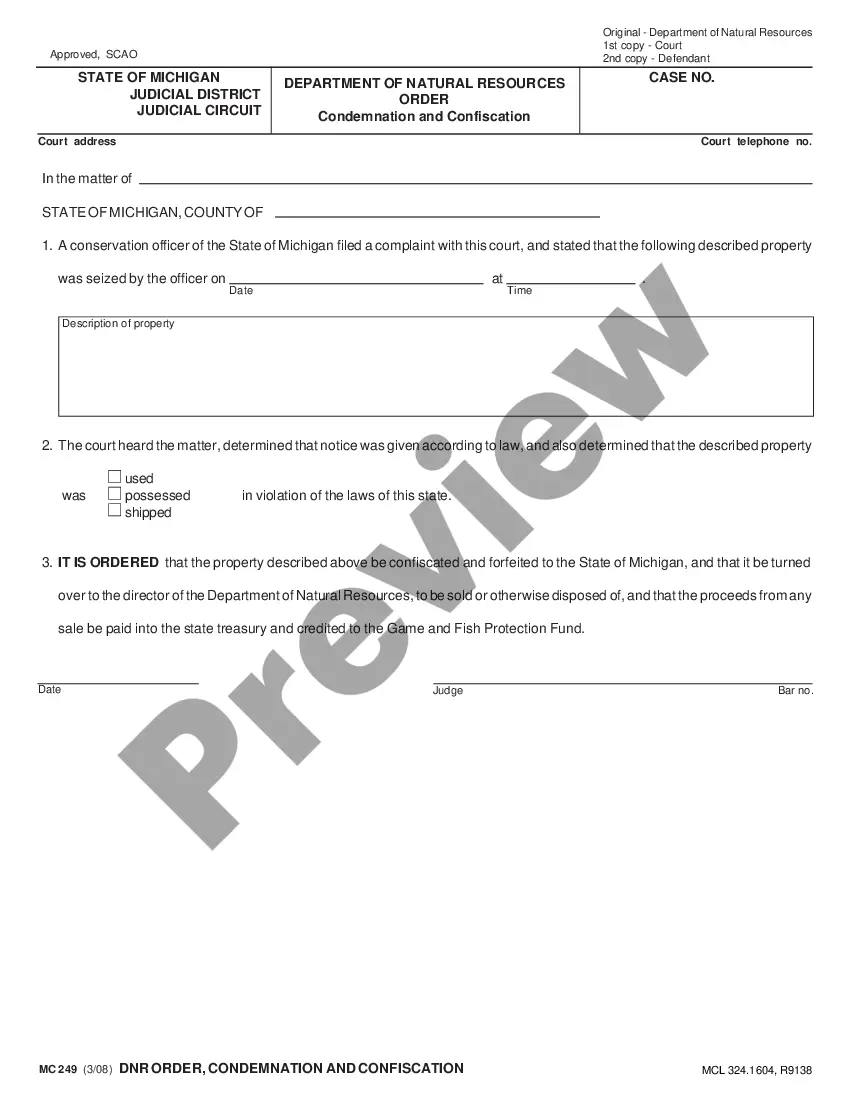
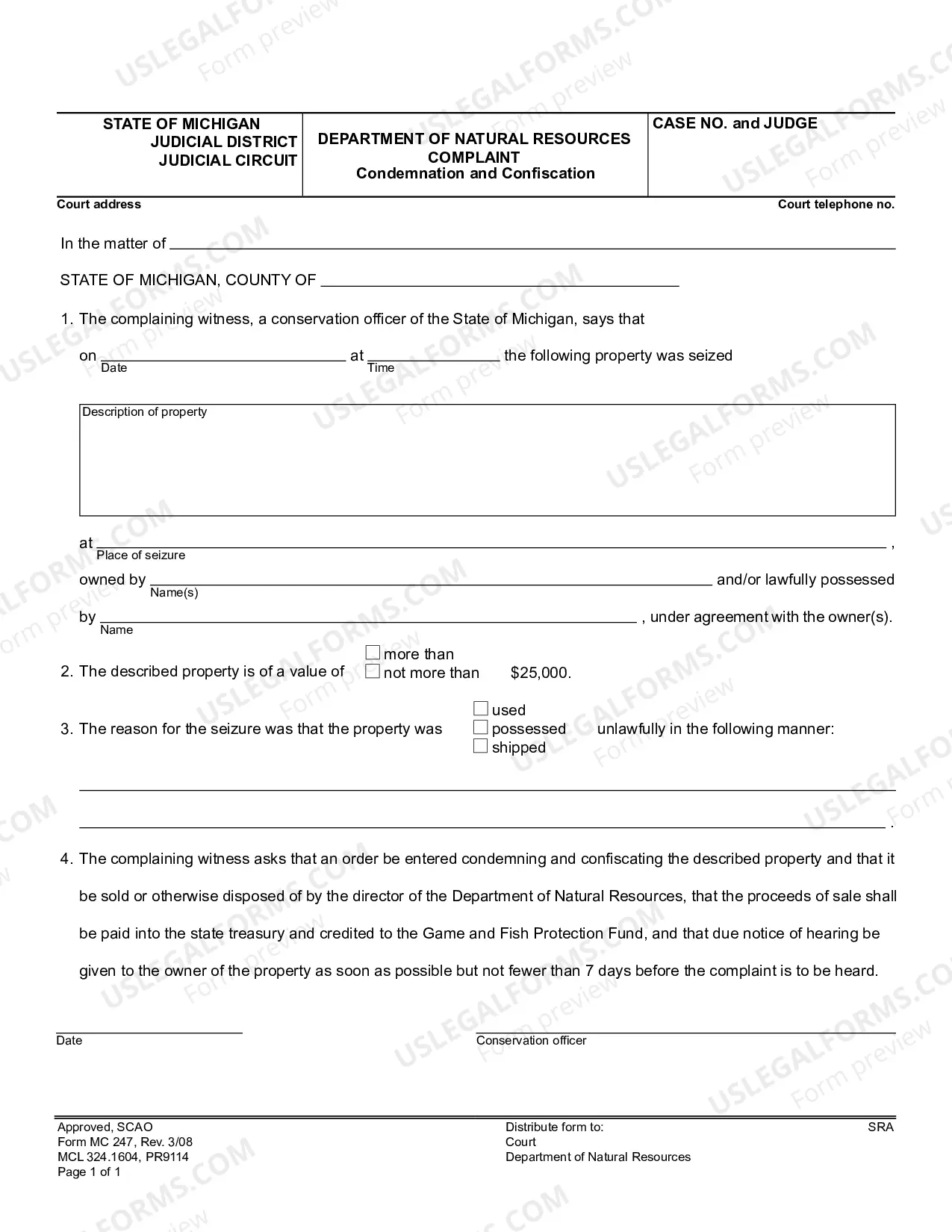
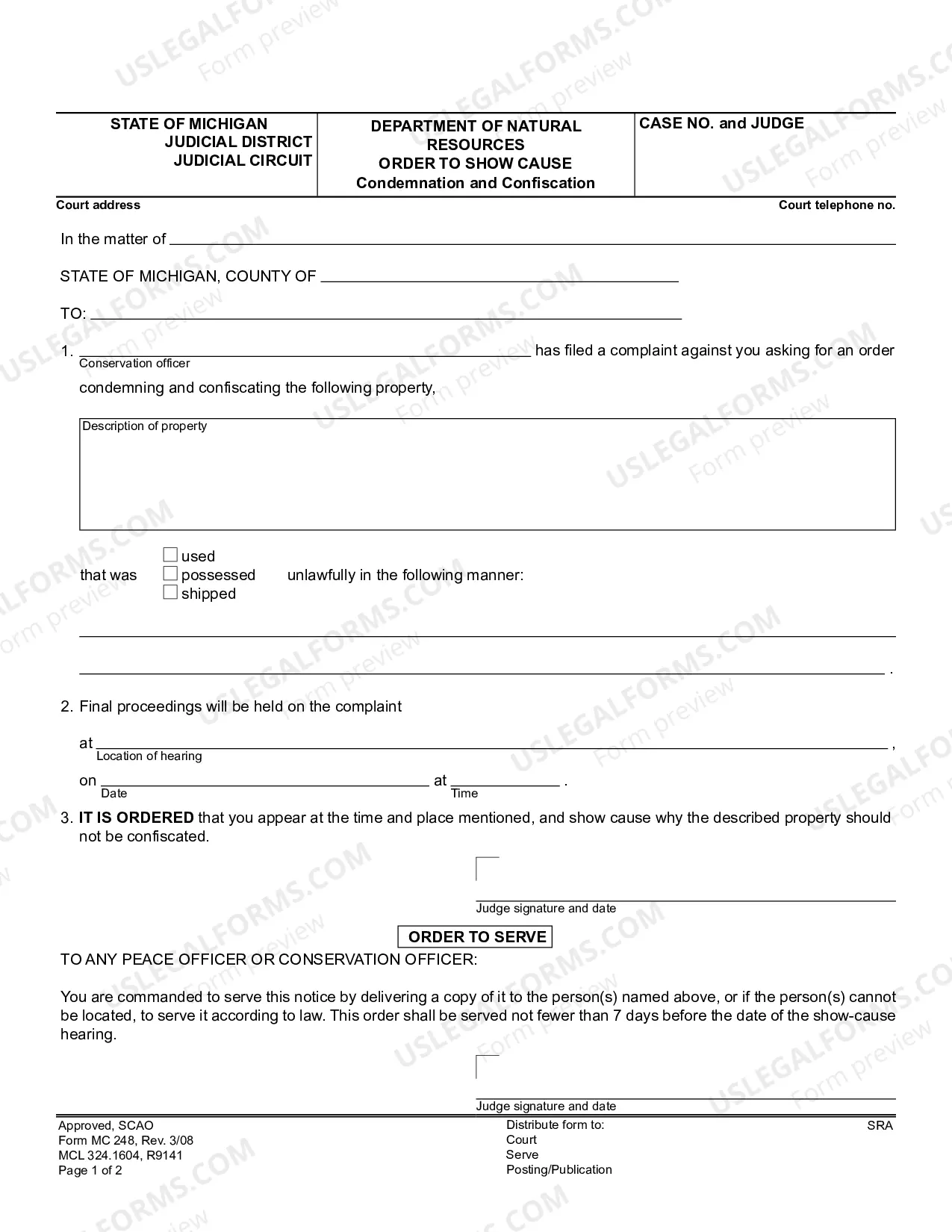
The Michigan Department of Natural Resources (MDR) Order, Condemnation and Confiscation process is a legal procedure used to protect the public from hazardous or otherwise dangerous property. This process allows the MDR to take control of land or other property if it is determined to be a threat to public safety or the environment. The MDR may order, condemn and confiscate property if it is determined to be: a public health hazard, a potential source of pollution or environmental degradation, an illegal activity, or otherwise a disturbance to the public welfare. There are three types of Michigan Department of Natural Resources Order, Condemnation and Confiscation: 1. Compulsory: This type of order is issued when the MDR has determined that the property poses an imminent risk to public health or the environment. This order requires that the property owner take immediate action to remedy the hazardous condition or risk having their property condemned and confiscated. 2. Negotiated: This type of order is issued when the MDR has determined that the property poses a potential threat to public safety or the environment. The MDR will negotiate with the property owner in order to reach an agreement that will protect the public from the potential hazards. 3. Discretionary: This type of order is issued when the MDR has determined that the property poses a minor threat to public safety or the environment. The MDR will use its discretion to determine an appropriate course of action to protect the public. The MDR may choose to allow the property owner to take corrective action or may order the property to be condemned and confiscated.
Michigan Department of Natural Resources, Order, Condemnation and Confiscation
Description
Get your form ready online
Our built-in tools help you complete, sign, share, and store your documents in one place.
Make edits, fill in missing information, and update formatting in US Legal Forms—just like you would in MS Word.
Download a copy, print it, send it by email, or mail it via USPS—whatever works best for your next step.
Sign and collect signatures with our SignNow integration. Send to multiple recipients, set reminders, and more. Go Premium to unlock E-Sign.
If this form requires notarization, complete it online through a secure video call—no need to meet a notary in person or wait for an appointment.
We protect your documents and personal data by following strict security and privacy standards.

Make edits, fill in missing information, and update formatting in US Legal Forms—just like you would in MS Word.

Download a copy, print it, send it by email, or mail it via USPS—whatever works best for your next step.

Sign and collect signatures with our SignNow integration. Send to multiple recipients, set reminders, and more. Go Premium to unlock E-Sign.

If this form requires notarization, complete it online through a secure video call—no need to meet a notary in person or wait for an appointment.

We protect your documents and personal data by following strict security and privacy standards.
Looking for another form?

How to fill out Michigan Department Of Natural Resources, Order, Condemnation And Confiscation?
Engaging with official papers demands diligence, precision, and utilizing properly structured templates. US Legal Forms has been assisting individuals nationwide for 25 years, so when you select your Michigan Department of Natural Resources, Order, Condemnation and Confiscation form from our collection, you can be assured it complies with federal and state regulations.
Interacting with our service is simple and efficient. To acquire the required document, all you need is an account with an active subscription. Here’s a concise guide for you to obtain your Michigan Department of Natural Resources, Order, Condemnation and Confiscation in just a few minutes.
All documents are designed for multiple uses, like the Michigan Department of Natural Resources, Order, Condemnation and Confiscation you see on this page. If you need them in the future, you can complete them without additional payment - just navigate to the My documents section in your profile and finalize your document whenever necessary. Try US Legal Forms and efficiently manage your business and personal paperwork while ensuring full legal compliance!
- Ensure to thoroughly review the form's content and its alignment with general and legal standards by previewing it or examining its description.
- Search for another official template if the one you opened does not align with your circumstances or state guidelines (the link for that is located at the upper corner of the page).
- Log in to your account and download the Michigan Department of Natural Resources, Order, Condemnation and Confiscation in your desired format. If it's your first experience with our site, click Buy now to proceed.
- Establish an account, select your subscription option, and pay using your credit card or PayPal account.
- Decide the format in which you wish to save your form and click Download. Print the document or upload it to a professional PDF editor for electronic submission.
Form popularity
FAQ
A request and order to seize property in Michigan refers to the legal mechanism by which authorities, such as the Michigan Department of Natural Resources, can take control of property believed to be connected to illegal activities or environmental harm. This order must be grounded in law and typically involves a court’s judgment. Understanding this process can empower property owners to handle situations where their rights might be at stake. Engaging with experts can simplify the navigation of these orders and enhance your understanding.
The condemnation law in Michigan allows the government to take private property for public use, provided they offer just compensation. Under this law, the Michigan Department of Natural Resources plays a role in determining the necessity of property acquisition for environmental or public safety purposes. The process includes filing an order, which must comply with established legal standards. Knowing your rights in these situations can help you navigate the complexities of property condemnation.
DNR forest resources professionals maintain healthy forests, manage wildfire, maintain responsible harvesting certifications and improve wildlife habitat. Click the box above to learn more about Michigan's state forests.
Oil, coal, natural gas, metals, stone and sand are natural resources. Other natural resources are air, sunlight, soil and water.
Water, air, and soil are three natural resources that we cannot live without. The Forest Service strives to protect, maintain, and restore these valuable assets now and into the future. Water is one of the most important natural resources flowing from forests.
Michigan ranks first in the United States in the production of calcium chloride (salt) and in gypsum, fourth in cement and sand and gravel, and is a large producer of crushed stone for a variety of purposes. These minerals are found in the sedimentary rocks of the Michigan Basin or in the extensive glacial deposits.
Oil and natural gas deposits are found throughout Michigan's lower peninsula and have been produced commercially since 1925. Depleted oil and gas fields and solution mined salt caverns are used extensively in Michigan as natural gas and liquified petroleum gas storage reservoirs.
Michigan is a major producer of cement, construction sand and gravel, iron ore, peat, and potash. It produces common clay, crushed and dimension stone, gypsum, industrial sand and gravel, lime, gemstones, and salt.
Forests 800-832-1355 or visit recreation.gov.