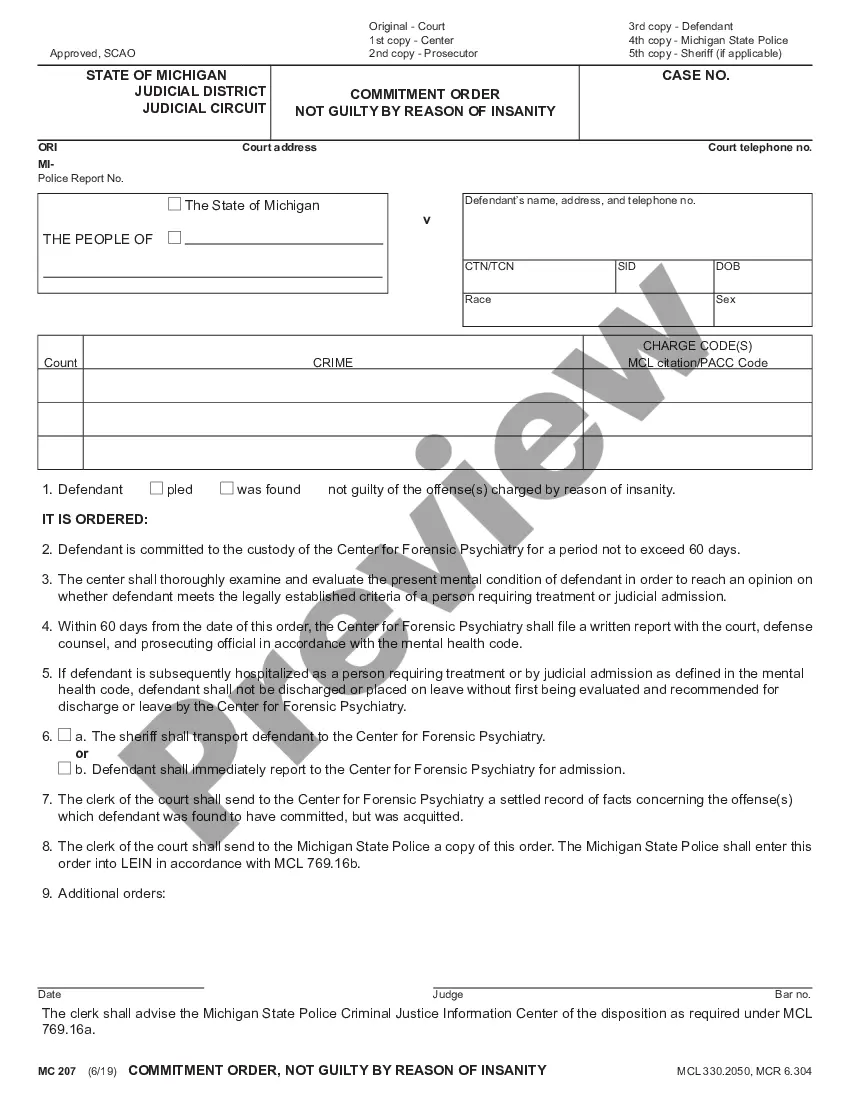
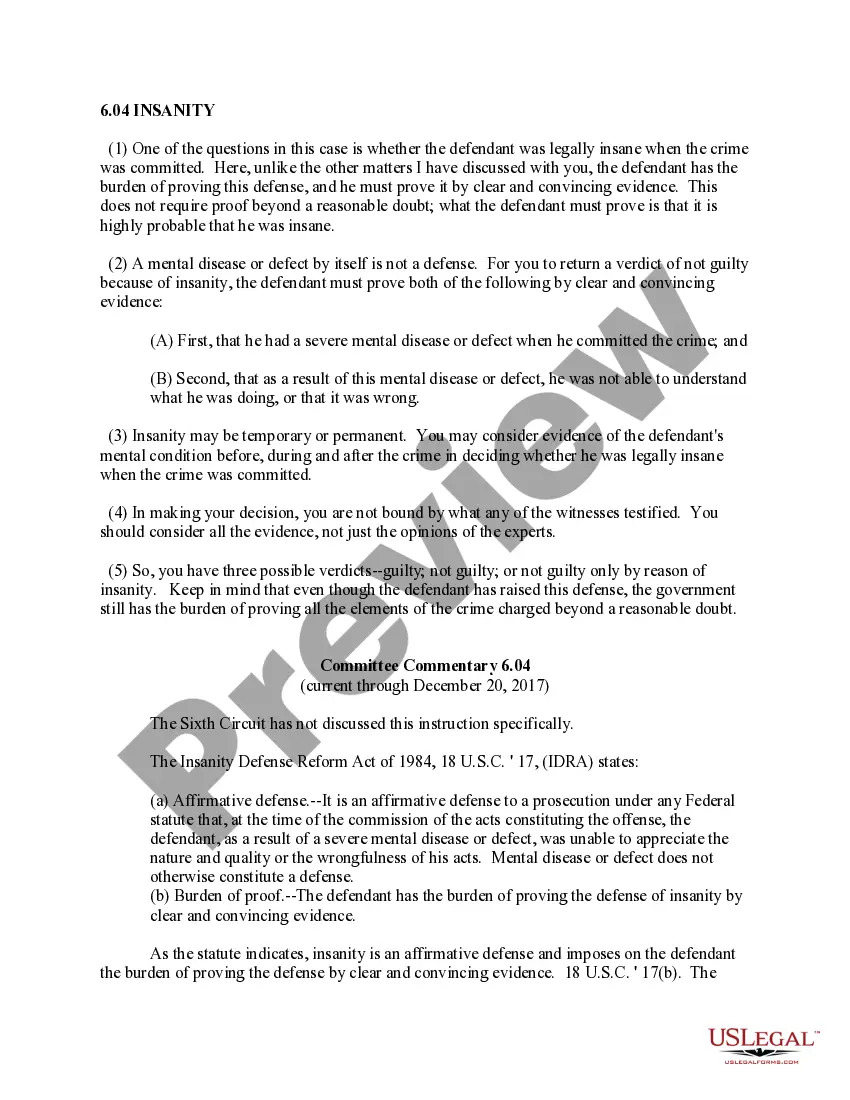
This Commitment Order,- Not Guilty by Reason of Insanity is an official document from the Michigan State Court Administration Office, and it complies with all applicable state and Federal codes and statutes. USLF updates all state and Federal forms as is required by state and Federal statutes and law.
Michigan Commitment Order, Not Guilty by Reason of Insanity
Instant download
This website is not affiliated with any governmental entity
Public form
Description
Get your form ready online
Our built-in tools help you complete, sign, share, and store your documents in one place.
Built-in online Word editor
Make edits, fill in missing information, and update formatting in US Legal Forms—just like you would in MS Word.
Export easily
Download a copy, print it, send it by email, or mail it via USPS—whatever works best for your next step.
E-sign your document
Sign and collect signatures with our SignNow integration. Send to multiple recipients, set reminders, and more. Go Premium to unlock E-Sign.
Notarize online 24/7
If this form requires notarization, complete it online through a secure video call—no need to meet a notary in person or wait for an appointment.
Store your document securely
We protect your documents and personal data by following strict security and privacy standards.

Make edits, fill in missing information, and update formatting in US Legal Forms—just like you would in MS Word.

Download a copy, print it, send it by email, or mail it via USPS—whatever works best for your next step.

Sign and collect signatures with our SignNow integration. Send to multiple recipients, set reminders, and more. Go Premium to unlock E-Sign.

If this form requires notarization, complete it online through a secure video call—no need to meet a notary in person or wait for an appointment.

We protect your documents and personal data by following strict security and privacy standards.
Looking for another form?



How to fill out Michigan Commitment Order, Not Guilty By Reason Of Insanity?
Obtain any template from 85,000 legal documents such as Michigan Commitment Order,- Not Guilty by Reason of Insanity available online with US Legal Forms. Each template is crafted and refreshed by state-certified lawyers.
If you already possess a subscription, Log In. Once you are on the form’s page, click the Download button and navigate to My documents to access it.
If you have not subscribed yet, follow the instructions below.
With US Legal Forms, you will always have immediate access to the correct downloadable sample. The platform provides access to documents and categorizes them to simplify your search. Use US Legal Forms to acquire your Michigan Commitment Order,- Not Guilty by Reason of Insanity quickly and effortlessly.
- Verify the state-specific criteria for the Michigan Commitment Order,- Not Guilty by Reason of Insanity you wish to utilize.
- Review the description and preview the template.
- Once you are confident that the sample meets your needs, simply click Buy Now.
- Select a subscription plan that fits your financial situation.
- Set up a personal account.
- Complete the payment using either of the two available methods: by card or via PayPal.
- Choose a format to download the document in; two options are available (PDF or Word).
- Download the document to the My documents section.
- After your reusable form is downloaded, print it out or save it to your device.
Form popularity
FAQ
When a defendant is found not guilty by reason of insanity, the court typically issues a Michigan Commitment Order, which mandates treatment in a mental health institution. This outcome is designed for rehabilitation rather than punishment, focusing on the underlying mental health issues. The commitment can last until the individual is deemed no longer a threat to themselves or others, requiring regular reviews by mental health professionals. Navigating this process can be complex, but legal assistance can help ensure your rights and treatment options are respected.
The primary criteria for a not guilty by reason of insanity plea include a profound mental disorder that significantly affects decision-making and the understanding of reality. In Michigan, the legal standard requires that the defendant could not appreciate the nature of the act committed. A thorough mental health assessment is crucial to support this plea, and your attorney can help identify the right experts to establish your case. Understanding these criteria can heavily influence your defense strategy.
To be found not guilty by reason of insanity, the defendant must demonstrate that a mental illness impaired their ability to understand right from wrong during the crime. The legal standards and definitions can differ across jurisdictions, including Michigan, but mental health evaluations play a key role in this determination. Engaging with a qualified attorney can help clarify eligibility and guide you through the intricate process involving a Michigan Commitment Order, Not Guilty by Reason of Insanity. Your legal representation will be vital in presenting your case effectively.
The success rate of not guilty by reason of insanity varies widely, with estimates often ranging from 20% to 30%. In Michigan, the commitment order can follow this verdict, leading to treatment in a mental health facility instead of traditional incarceration. It's crucial to consult with a legal professional who understands the specifics of your case and how Michigan's laws apply. Remember, each situation is unique, and expert guidance can greatly influence the outcome.
A 6500 motion in Michigan relates to seeking a review of a person's mental state following a determination of Not Guilty by Reason of Insanity. This legal action allows for reevaluation of an individual’s mental health status and potential release from commitment. Understanding this process is crucial, especially if you or someone you know is navigating the complexities of a Michigan Commitment Order. USLegalForms can offer the required documentation and assistance throughout this journey.
To initiate an involuntary commitment in Michigan, you must file a petition in court. This process involves demonstrating that the person poses a danger to themselves or others due to mental illness. A Michigan Commitment Order will require clear evidence and support from mental health professionals. Engaging with platforms like USLegalForms can simplify this process by providing necessary forms and guidance.
Typically, individuals found not guilty by reason of insanity in Michigan are subject to a Michigan Commitment Order, which leads to their placement in a mental health facility instead of prison. The length of this commitment varies and usually depends on the individual's treatment progress and ongoing evaluation. This legal outcome emphasizes rehabilitation rather than punishment, providing a structured path towards recovery and reintegration into society.
Proving not guilty by reason of insanity requires substantial evidence, often including expert testimony from mental health professionals. This evidence must establish that, due to a mental disorder, the defendant lacked the capacity to comprehend their actions or their consequences. The process usually includes comprehensive psychiatric evaluations and court proceedings, and using an experienced legal platform can simplify this challenging journey, especially in navigating a Michigan Commitment Order.
To successfully plead not guilty by reason of insanity in Michigan, defendants must demonstrate that they were unable to understand the nature of their actions or distinguish right from wrong due to a severe mental illness at the time of the offense. In Michigan, the legal standard is often based on the M’Naghten Rule, which focuses on cognitive functioning. Having an experienced attorney can help navigate this complex process effectively, ensuring all necessary evidence, including psychological evaluations, is presented to support your plea.