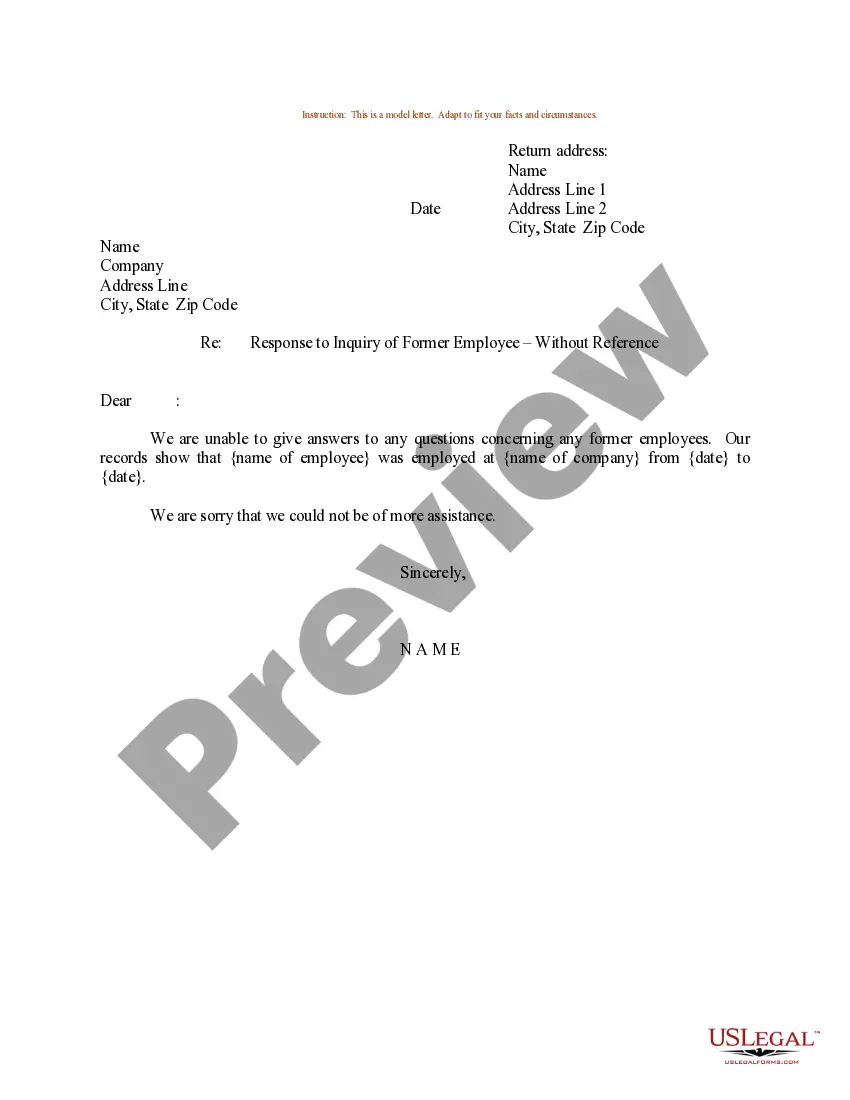
Michigan Regulatory Agreement
What is this form?
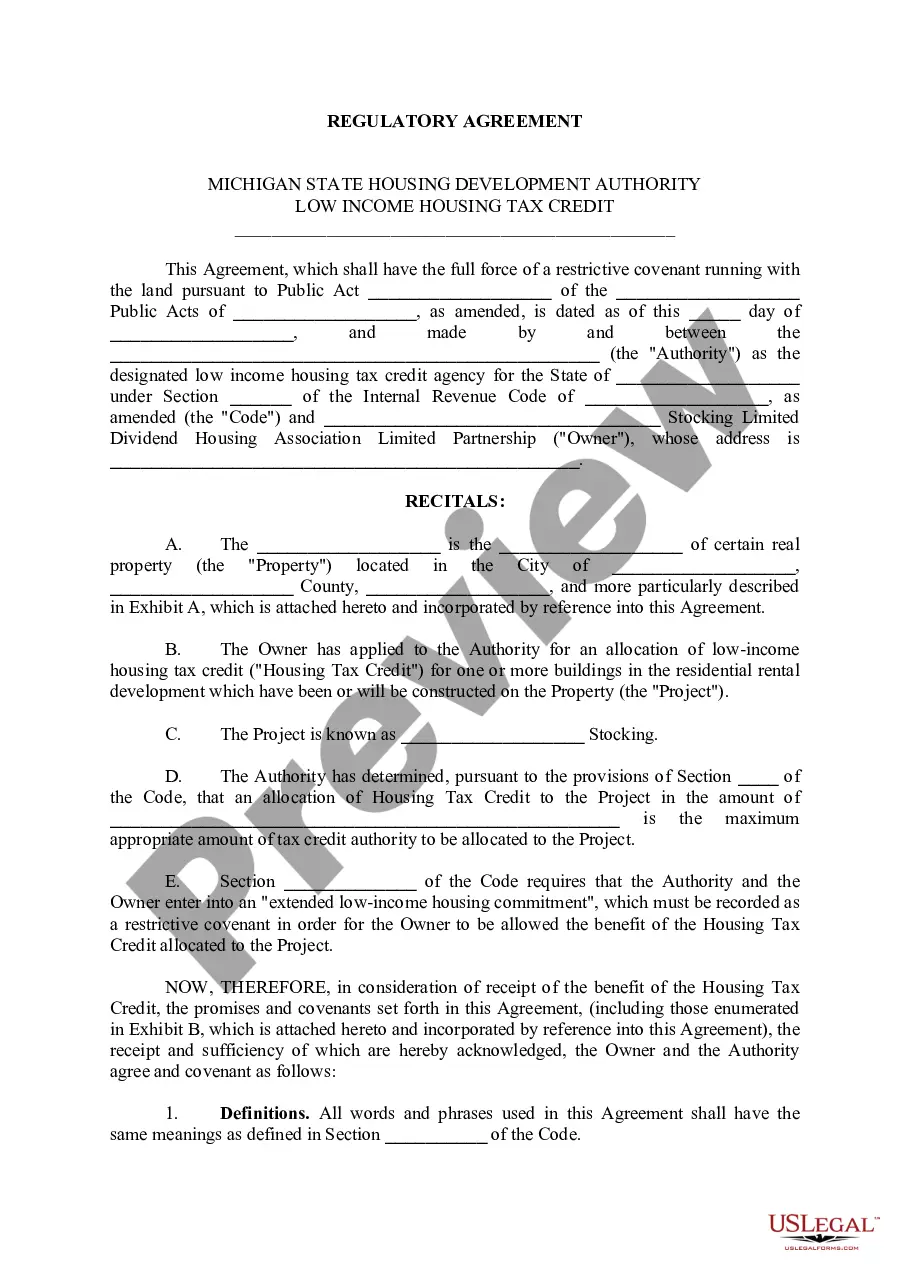
The Regulatory Agreement is a critical legal document between the housing authority and a project owner that establishes guidelines for the use and maintenance of low-income housing developments. This form ensures compliance with legal regulations regarding low-income housing tax credits, differentiating it from standard rental agreements by incorporating more complex stipulations about property management and tenant rights.
Key parts of this document
- Definitions of terms and phrases related to low-income housing tax credit.
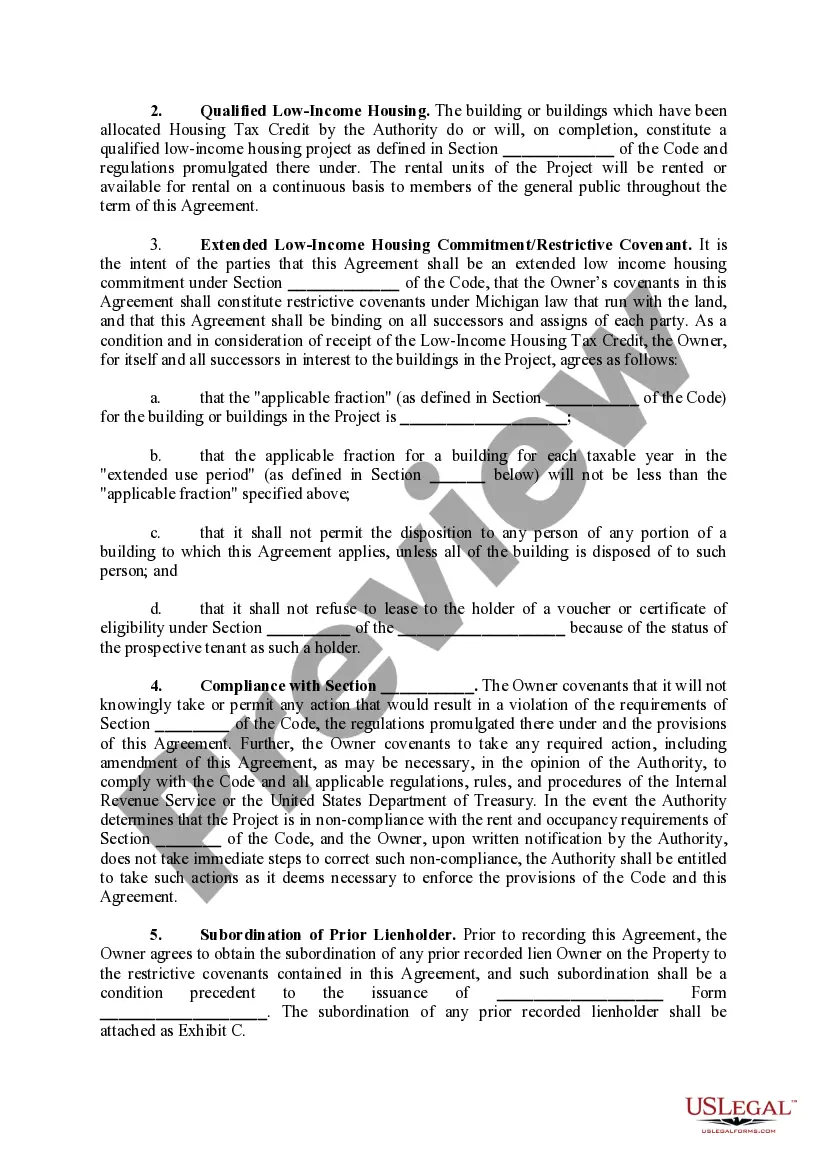
- Requirements for maintaining qualified low-income housing status.
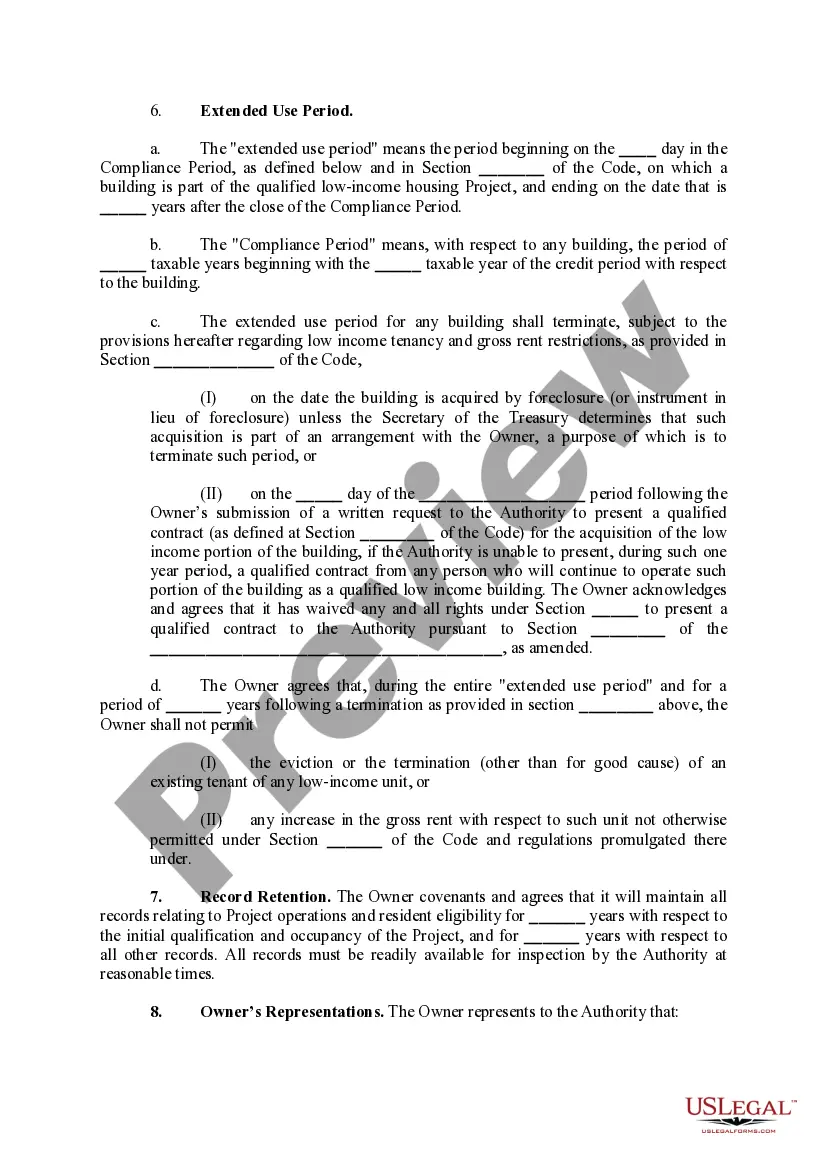
- Details on the âextended low-income housing commitmentâ as a restrictive covenant.
- Owner's obligations regarding tenant leasing and occupancy compliance.
- Procedures for record retention and authority compliance.
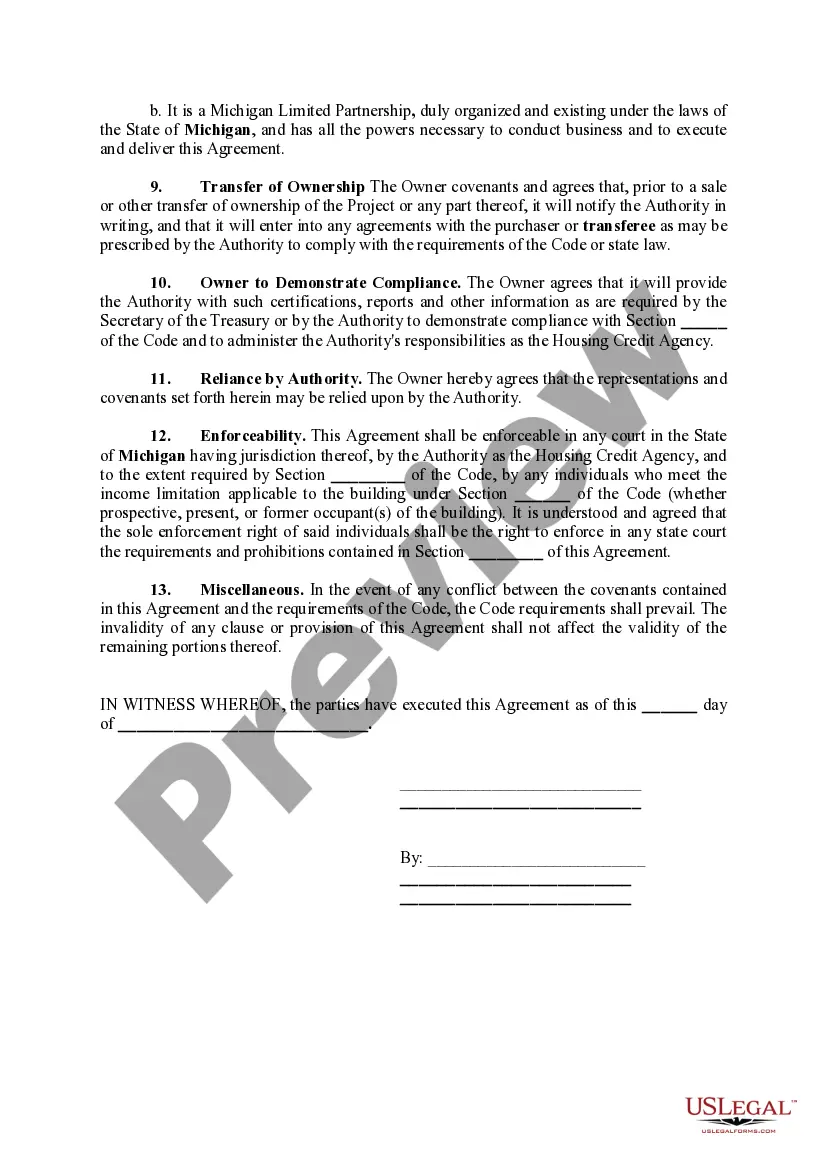
- Transfer of ownership requirements before selling the property.
Situations where this form applies
This form should be implemented when a property owner seeks tax credits for low-income housing projects. It is necessary when applying for an allocation of low-income housing tax credits for new developments or during the ownership transition of existing housing that remains compliant with low-income requirements. Use this agreement to formalize the commitments essential for tax credit approval and project eligibility.
Who needs this form
- Property owners or developers of low-income housing projects.
- Housing authorities or agencies responsible for overseeing low-income housing tax credits.
- Limited dividend housing associations seeking tax credit allocations.
- Individuals or entities managing multi-family residential developments that qualify for low-income tax incentives.
How to complete this form
- Identify and enter the parties involved, specifically naming the housing authority and the property owner.
- Provide details about the property location and describe the project as required.
- Fill in the tax credit allocation amount and establish the "extended use period" dates.
- Specify all restrictive covenant obligations that the owner must adhere to throughout the agreement.
- Gather necessary signatures from all parties involved and arrange for notarization if required.
Notarization guidance
Yes, this form must be notarized to be legally valid. The completed agreement will require signatures from the involved parties in the presence of a licensed notary public. US Legal Forms offers integrated online notarization services for easy and secure video calls, allowing for a hassle-free notarization process without the need for travel.
Get your form ready online
Our built-in tools help you complete, sign, share, and store your documents in one place.
Make edits, fill in missing information, and update formatting in US Legal Forms—just like you would in MS Word.
Download a copy, print it, send it by email, or mail it via USPS—whatever works best for your next step.
Sign and collect signatures with our SignNow integration. Send to multiple recipients, set reminders, and more. Go Premium to unlock E-Sign.
If this form requires notarization, complete it online through a secure video call—no need to meet a notary in person or wait for an appointment.
We protect your documents and personal data by following strict security and privacy standards.

Make edits, fill in missing information, and update formatting in US Legal Forms—just like you would in MS Word.

Download a copy, print it, send it by email, or mail it via USPS—whatever works best for your next step.

Sign and collect signatures with our SignNow integration. Send to multiple recipients, set reminders, and more. Go Premium to unlock E-Sign.

If this form requires notarization, complete it online through a secure video call—no need to meet a notary in person or wait for an appointment.

We protect your documents and personal data by following strict security and privacy standards.
Avoid these common issues
- Failing to define all relevant terms and phrases, which can lead to misunderstandings.
- Not completing all sections of the form, especially those regarding Owner's covenants.
- Neglecting to obtain the required subordination of prior lienholders before recording the agreement.
- Overlooking the need for compliance with state-specific laws and regulations.
Advantages of online completion
- Convenience: Downloadable access allows for immediate form retrieval and completion.
- Editability: Users can fill in the form digitally, minimizing errors and saving time.
- Reliability: Forms are drafted by licensed attorneys experienced in low-income housing agreements, ensuring legal compliance.
Looking for another form?

Form popularity
FAQ
While Michigan does not legally mandate an operating agreement, it is highly recommended for all LLCs. An operating agreement outlines the management structure and operational procedures of your business. Creating one helps prevent disputes among members and clarifies each member's rights and responsibilities. You can find templates and guidance on creating an operating agreement through US Legal Forms, ensuring your business aligns with the Michigan Regulatory Agreement.
In Michigan, an operating agreement for an LLC, while not legally required, is highly recommended. This document outlines the management structure and operational guidelines for the business, which can prevent disputes among members. Having a well-drafted operating agreement contributes to transparency and professionalism in your LLC. Platforms like uslegalforms can assist you in creating a comprehensive operating agreement that supports compliance with the Michigan Regulatory Agreement.
A regulatory agreement in real estate establishes specific guidelines that property owners must follow, often related to zoning or land use. These agreements ensure compliance with local laws and can involve aspects such as affordable housing requirements or environmental protections. For investors or developers, knowledge of these agreements is essential for navigating the property market effectively. The Michigan Regulatory Agreement can be a helpful tool for understanding community standards.
The 3x rent rule in Michigan states that a tenant's monthly income should be at least three times the monthly rent amount. This guideline helps landlords determine whether a tenant can afford the rent. Understanding this rule is crucial for both landlords and tenants before entering into a lease. Utilizing resources like the Michigan Regulatory Agreement can clarify these financial expectations.
While Michigan does not legally require an operating agreement for LLCs, having one is beneficial. An operating agreement helps delineate roles, responsibilities, and procedures within the LLC. This document can serve as a critical reference point in case of disputes or member changes. By drafting a Michigan Regulatory Agreement, you secure a solid foundation for your business operations.
To obtain a certificate of good standing in Michigan, you will need to contact the Michigan Department of Licensing and Regulatory Affairs. You can request this document online or via mail after ensuring your business is compliant with all state requirements. A certificate of good standing confirms your company’s compliance status and can be essential for certain business dealings. Having your legal documents, including a Michigan Regulatory Agreement, in order will speed up this process.
Most states do not require LLCs to have an operating agreement, but some strongly recommend it. States like California, New York, and Delaware emphasize the importance of this document for clarity and protection. Regardless of state law, establishing a Michigan Regulatory Agreement helps your LLC operate smoothly and avoid potential conflicts. Always check local regulations for the most accurate information.
In Michigan, the law does not mandate an operating agreement for LLCs, but it is advisable to have one. An operating agreement solidifies the ownership and operational guidelines of your business. By creating a Michigan Regulatory Agreement, you ensure that all members are on the same page regarding their rights and responsibilities. This proactive step enhances your LLC's credibility and stability.
While an operating agreement is not legally required in every state, it is highly recommended for any LLC. This document outlines the management structure and operating procedures of your business, offering clarity and protection. Having a well-crafted operating agreement can prevent disputes among members and provide a framework for decision-making. Therefore, if you operate in Michigan, implementing a Michigan Regulatory Agreement is a smart move.