Michigan Default Application, Entry
Understanding this form
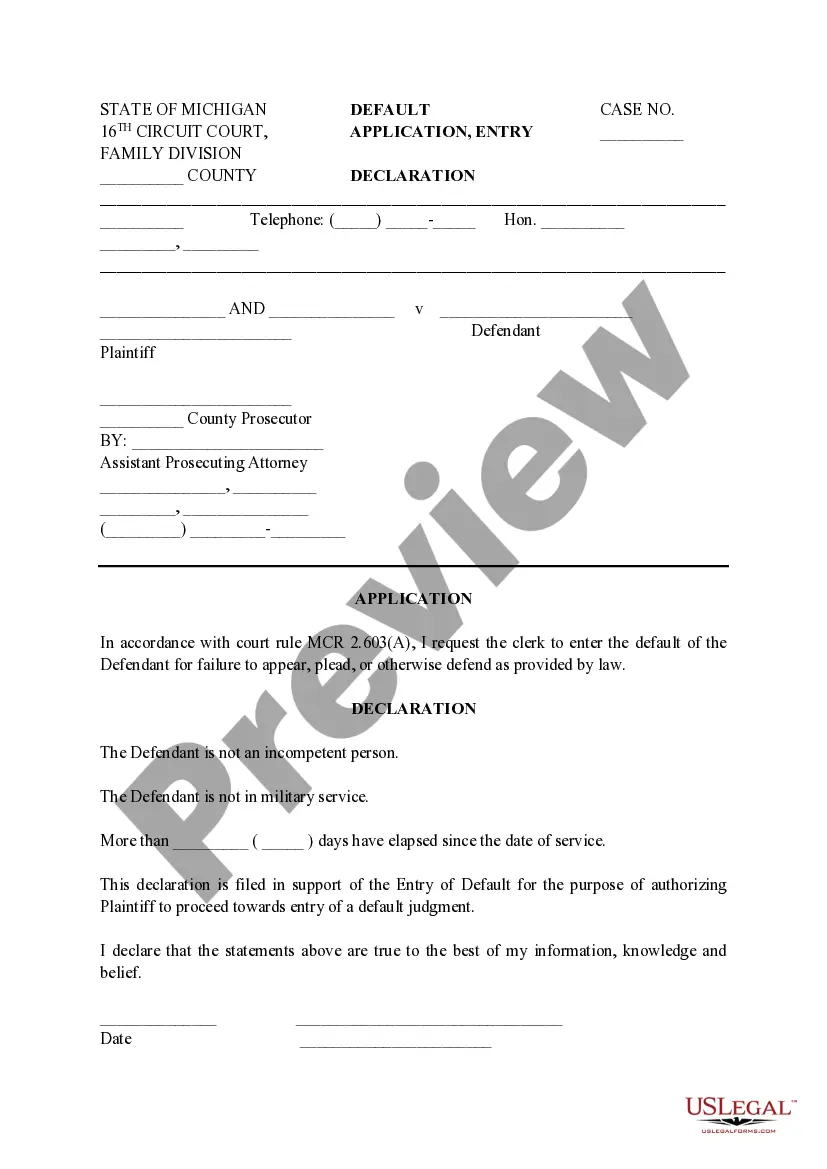
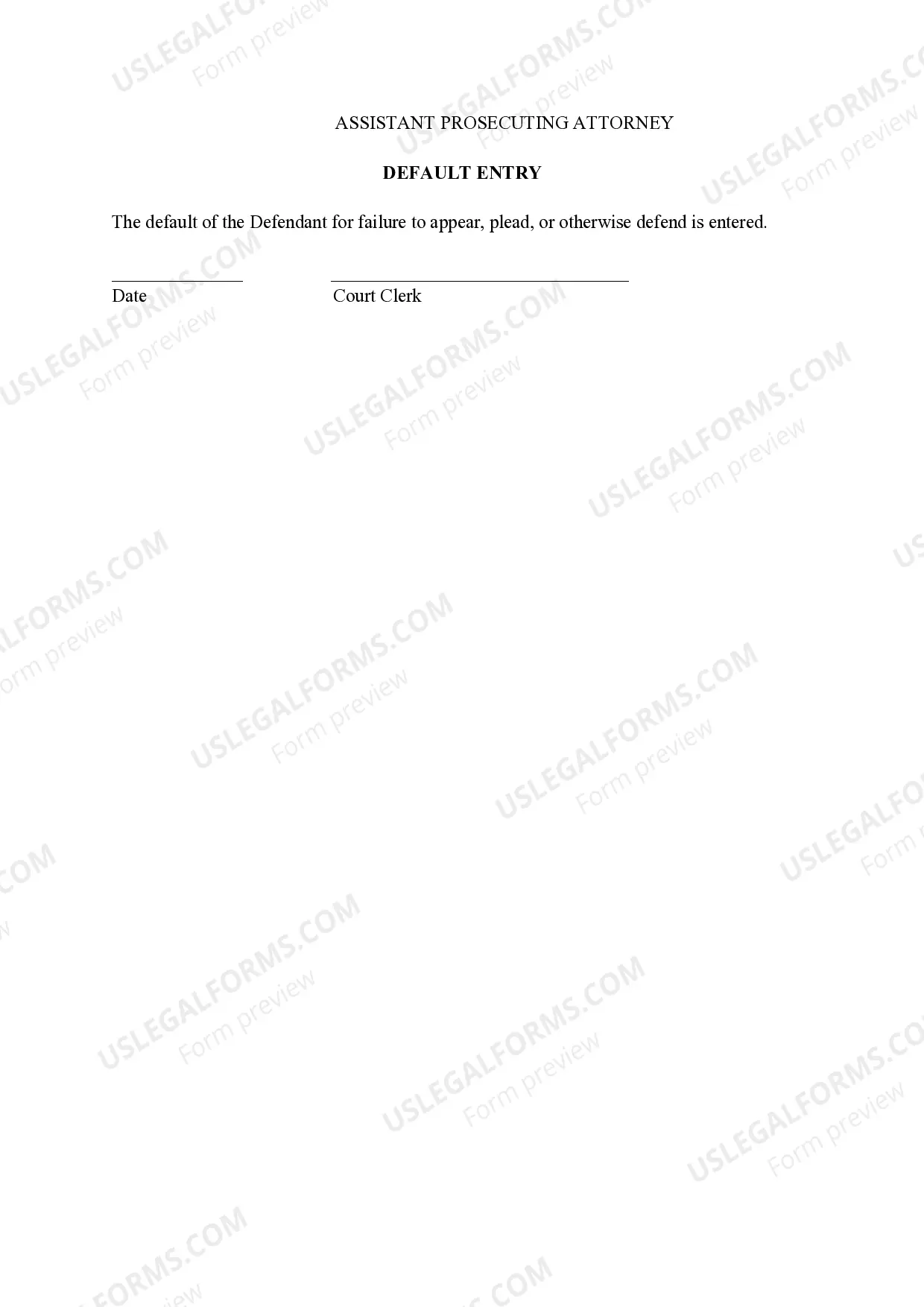
The Default Application, Entry is a legal document used to request the court to record a defendantâs failure to respond to a claim. This process, called entry of default, occurs when a plaintiff seeks to advance their case after the opposing party does not answer or defend against the allegations in a timely manner. This form is critical in ensuring that a plaintiff can move towards obtaining a default judgment if the defendant remains unresponsive.
Key components of this form
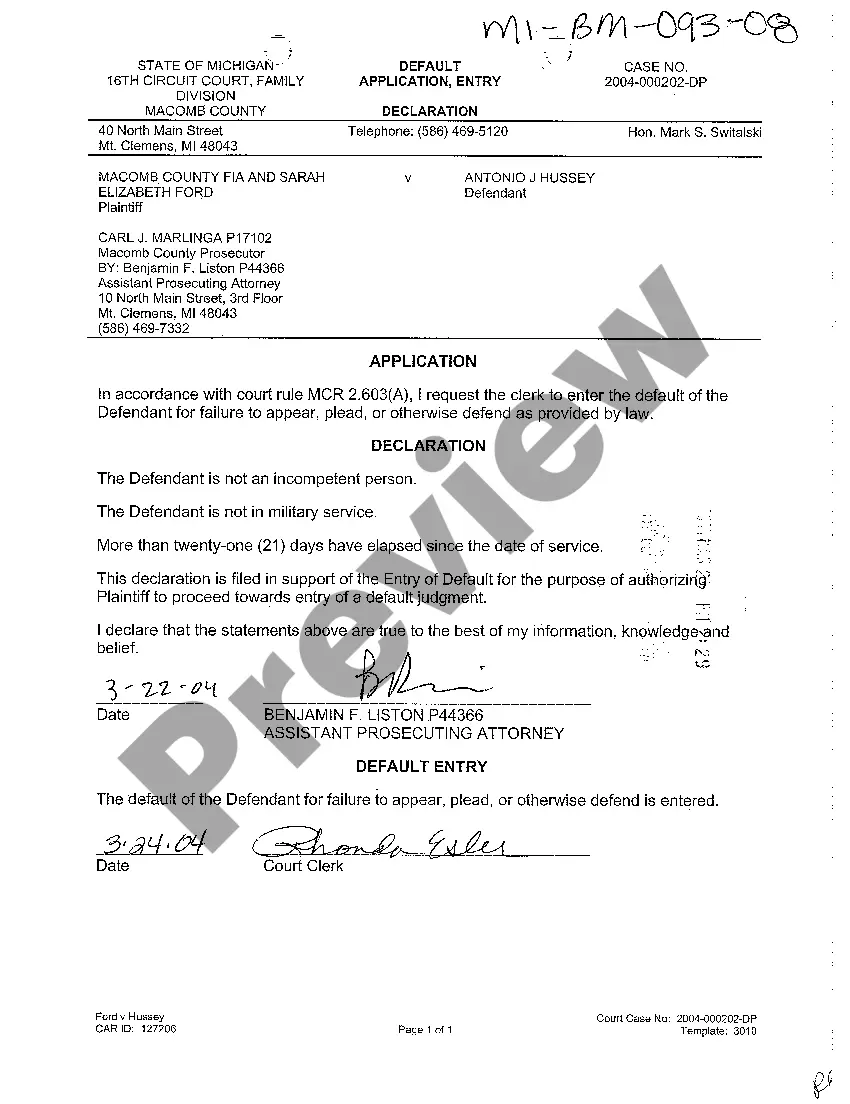
- Case Information: Includes the case number, court jurisdiction, and details about the involved parties.
- Application Section: A request for the court clerk to enter the default against the defendant for failing to respond.
- Declaration: Confirmations regarding the defendant's status, including competency and military service.
- Default Entry: Official notation by the clerk indicating that the default has been entered.
When to use this form
This form is used when a plaintiff has served a defendant with legal pleadings, and the defendant has not responded within the specified timeframe. This scenario often arises in civil litigation, such as family law cases, small claims, or other legal disputes where timely responses are mandated by law.
Who can use this document
- Individuals or parties filing a claim who have not received a response from a defendant.
- Legal representatives acting on behalf of plaintiffs in civil cases.
- Prosecutors seeking to proceed with cases where defendants have failed to appear.
Steps to complete this form
- Identify the case by entering the case number and naming the involved parties.
- Complete the application section by indicating the request for entry of default.
- Fill out the declaration confirming the defendant's status regarding competency and military service.
- Date and sign the application as the assistant prosecuting attorney or representing party.
- Submit the completed form to the court clerk for processing.
Notarization requirements for this form
In most cases, this form does not require notarization. However, some jurisdictions or signing circumstances might. US Legal Forms offers online notarization powered by Notarize, accessible 24/7 for a quick, remote process.
Get your form ready online
Our built-in tools help you complete, sign, share, and store your documents in one place.
Make edits, fill in missing information, and update formatting in US Legal Forms—just like you would in MS Word.
Download a copy, print it, send it by email, or mail it via USPS—whatever works best for your next step.
Sign and collect signatures with our SignNow integration. Send to multiple recipients, set reminders, and more. Go Premium to unlock E-Sign.
If this form requires notarization, complete it online through a secure video call—no need to meet a notary in person or wait for an appointment.
We protect your documents and personal data by following strict security and privacy standards.

Make edits, fill in missing information, and update formatting in US Legal Forms—just like you would in MS Word.

Download a copy, print it, send it by email, or mail it via USPS—whatever works best for your next step.

Sign and collect signatures with our SignNow integration. Send to multiple recipients, set reminders, and more. Go Premium to unlock E-Sign.

If this form requires notarization, complete it online through a secure video call—no need to meet a notary in person or wait for an appointment.

We protect your documents and personal data by following strict security and privacy standards.
Mistakes to watch out for
- Failing to confirm service of documents to the defendant before filing for default.
- Not providing accurate case information, such as the correct case number or parties' names.
- Omitting required declarations regarding the defendantâs status.
Benefits of using this form online
- Convenience of downloading the form anytime and from anywhere.
- Ability to easily fill out and edit the form before submission.
- Access to reliable legal documentation that meets state requirements.
What to keep in mind
- The Default Application, Entry is essential for plaintiffs to seek a default judgment.
- Filing this form requires accurate information about the defendantâs failure to respond.
- It is important to follow state-specific requirements, especially in Michigan.
Looking for another form?
Form popularity
FAQ
The entry of a default order is a legal document that officially acknowledges a party's failure to respond to a lawsuit in Michigan. This document allows the plaintiff to move forward with the case, often resulting in a judgment in favor of the party who filed the entry. Understanding the implications of a default order is vital, as it can significantly affect the outcome of your case. To learn more about making this process easier, consider exploring the resources available on the USLegalForms platform, where you can find templates and expert advice tailored to the Michigan Default Application, Entry.
To fill out the entry of default in the Michigan Default Application, Entry, begin by gathering all required information, such as the case number and the names of the parties involved. Ensure that you correctly state the reason for the default, typically indicating that the respondent failed to respond to the complaint within the designated time. It is crucial to verify that you meet the legal criteria to file this entry, as improper submission can delay your case. If you need assistance, the USLegalForms platform provides comprehensive guidance and templates to streamline this process, ensuring accuracy and compliance with local laws.
The entry of a default order means that the court officially recognizes that a party has failed to respond to a complaint. This order is the first step toward obtaining a default judgment, enabling the plaintiff to take further legal action. Being familiar with this concept is essential in your process of completing a Michigan Default Application, Entry.
A default judgment might be entered in cases where the defendant does not answer a complaint or fails to attend a scheduled hearing. This type of judgment serves to protect the plaintiff's interests when the defendant neglects their legal obligations. The understanding of this process is vital for those involved in a Michigan Default Application, Entry.
A default judgment can be entered when the defendant fails to respond within the mandated period after being served a complaint. This judgment allows the plaintiff to secure a decision without the defendant's input. For anyone navigating the complexities of a Michigan Default Application, Entry, knowing when this judgment can be requested is crucial.
A motion for default indicates a request to the court to acknowledge that one party did not respond to legal proceedings. This motion is instrumental in expediting the legal process, allowing the requesting party to obtain a resolution more quickly. Understanding this concept is beneficial for anyone working on their Michigan Default Application, Entry.
The motion for entry of default in Michigan allows a plaintiff to inform the court about the other party's failure to respond. It serves as a crucial mechanism to speed up the legal process and provide a pathway towards resolution. Properly filing this motion enhances your chances of success in your Michigan Default Application, Entry.
A motion for entry of default in Michigan is a formal request submitted to the court to recognize that the other party has not responded to the complaint. Once the court grants this motion, it enables the plaintiff to pursue further steps, including a default judgment. This process plays a vital role in your Michigan Default Application, Entry.
When an order for default is entered, it signifies that the court acknowledges the failure of the other party to respond. This order allows the plaintiff to move forward in seeking a judgment without competition from the defaulted party. Understanding this is critical in the context of your Michigan Default Application, Entry.
Rule 2.313 in Michigan sets the standards for entering a default when a party fails to respond to a complaint. This legal rule outlines the process for obtaining a default judgment against a defendant who does not appear in court. By understanding this rule, you can effectively navigate your Michigan Default Application, Entry.