Michigan Order for Discovery Conference
Understanding this form
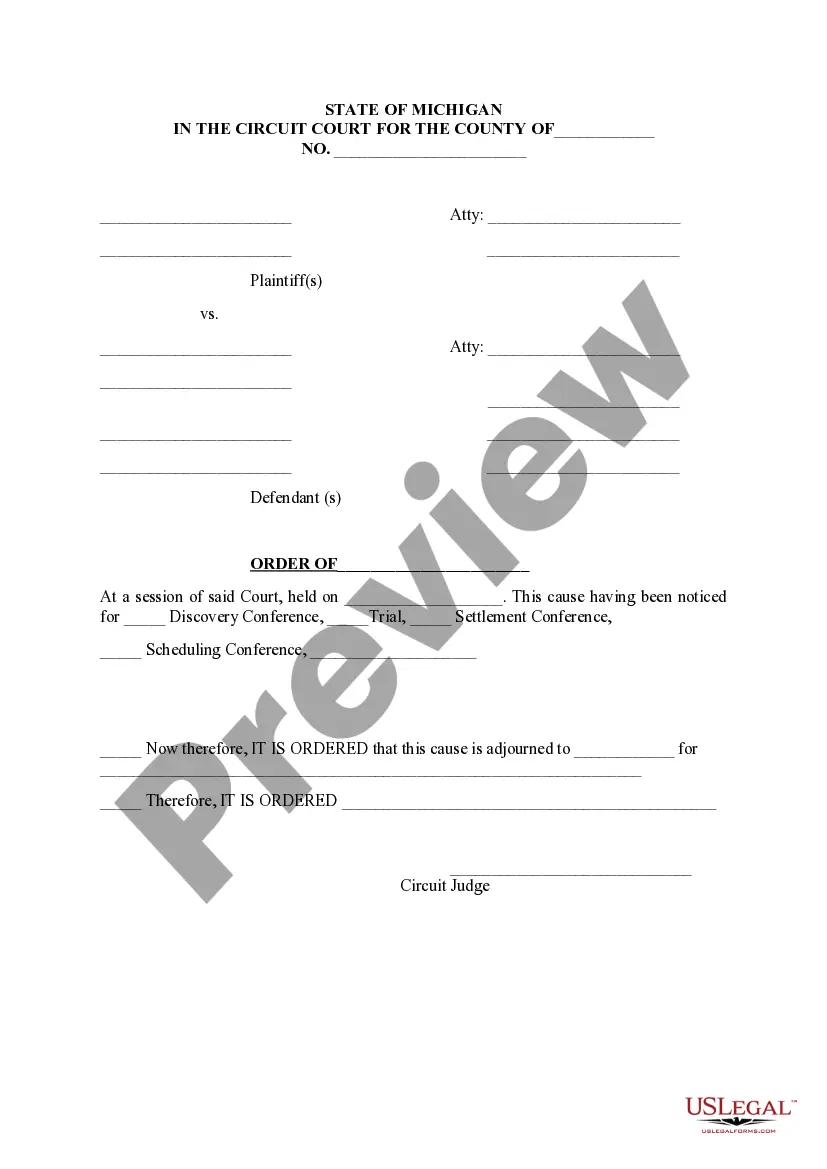
The Order for Discovery Conference is a legal document used in court to set the dates for discovery or settlement conferences, as well as trial dates. This form helps streamline the process of scheduling these important court proceedings, ensuring all parties are informed and prepared. Unlike similar forms, this order is specifically focused on establishing a timeline for discussions and evidence gathering within a legal case.
Form components explained
- Identification of the court and case number.
- Names of the parties involved (plaintiff and defendant).
- Specification of the type of conference being scheduled (discovery, trial, settlement).
- Date for the adjournment of the conference.
- Signature line for the circuit judge.
When to use this form
Use the Order for Discovery Conference when you need to officially schedule a discovery or settlement conference with the court. This form is typically used after a lawsuit has been initiated and parties wish to establish a timeline for gathering evidence, negotiating settlements, or preparing for trial. It is essential for ensuring that all parties have a clear understanding of the court's direction and scheduling.
Who needs this form
This form should be used by:
- Plaintiffs or defendants in a civil litigation case.
- Attorneys representing parties in court proceedings.
- Legal representatives involved in scheduling discovery or trial dates.
Steps to complete this form
- Enter the name of the county and court information at the top of the form.
- Fill in the case number and the names of the plaintiff(s) and defendant(s).
- Select the type of conference you are scheduling (discovery, trial, etc.).
- Specify the new date for the adjournment of the conference.
- Provide any necessary additional instructions or details as directed.
- Obtain the signature of the circuit judge to finalize the order.
Does this form need to be notarized?
This form does not typically require notarization unless specified by local law. Always check your jurisdictionâs requirements to ensure compliance.
Get your form ready online
Our built-in tools help you complete, sign, share, and store your documents in one place.
Make edits, fill in missing information, and update formatting in US Legal Forms—just like you would in MS Word.
Download a copy, print it, send it by email, or mail it via USPS—whatever works best for your next step.
Sign and collect signatures with our SignNow integration. Send to multiple recipients, set reminders, and more. Go Premium to unlock E-Sign.
If this form requires notarization, complete it online through a secure video call—no need to meet a notary in person or wait for an appointment.
We protect your documents and personal data by following strict security and privacy standards.

Make edits, fill in missing information, and update formatting in US Legal Forms—just like you would in MS Word.

Download a copy, print it, send it by email, or mail it via USPS—whatever works best for your next step.

Sign and collect signatures with our SignNow integration. Send to multiple recipients, set reminders, and more. Go Premium to unlock E-Sign.

If this form requires notarization, complete it online through a secure video call—no need to meet a notary in person or wait for an appointment.

We protect your documents and personal data by following strict security and privacy standards.
Typical mistakes to avoid
- Failing to include complete and accurate case details.
- Not selecting the correct type of conference for your needs.
- Omitting the judge's signature or not following local submission rules.
- Entering incorrect dates or missing deadlines for scheduling.
Why use this form online
- Convenience of downloading and completing the form from anywhere.
- Editability allows for quick adjustments to the document.
- Access to legally vetted templates drafted by licensed attorneys.
- Time-saving compared to drafting forms from scratch.
Legal use & context
- This order is used to formalize the scheduling of legal conferences.
- It is essential for maintaining timelines and adherence to court procedures.
- Failure to properly complete this form can result in delays or complications in your case.
Key takeaways
- The Order for Discovery Conference is essential for scheduling legal meetings.
- Accurate completion is necessary to avoid common pitfalls.
- This form is a straightforward way to manage court dates efficiently.
Looking for another form?

Form popularity
FAQ
Before Michigan could attain statehood, it needed to secure a population threshold and develop a functioning governance structure. Resolving territorial disputes with neighboring states, particularly regarding Toledo, was also essential. Congress required Michigan to establish a constitution that aligned with federal guidelines. The Michigan Order reflects both challenges and progress in the journey to becoming a state.
The Michigan emergency Plan outlines procedures and protocols for responding to natural disasters and emergencies effectively. This comprehensive plan aims to mobilize resources and ensure rapid recovery for residents during crises. It emphasizes coordination between local, state, and federal agencies to enhance public safety. Understanding this plan relates directly to the Michigan Order of governance in emergency situations.
Michigan faced delays in achieving statehood due to various territorial disputes, especially concerning the Toledo region. A lack of sufficient population and economic infrastructure at different points also contributed to the holdup. Finally, negotiations ultimately resolved the disputes, allowing Michigan to join the Union. Exploring the history of the Michigan Order can shed light on how such state decisions are made.
Michigan's path to statehood was lengthy due to conflicts with neighboring states and ongoing border disputes, particularly with Ohio. The territory had to navigate these challenges and demonstrate sufficient population and economic stability to gain statehood. The approval process handled by Congress added to the delays. Understanding the Michigan Order regarding state formation can reveal much about the legislative process.
Toledo's location in Ohio rather than Michigan stems from historical disputes over territory in the 19th century, known as the Toledo War. Although both states claimed the area, a resolution ultimately favored Ohio. This decision resulted from political negotiations and strategic interests at the time. The boundaries defined the Michigan Order concerning state territories and rights.
In Michigan, the order of heirs refers to the legal hierarchy determining who inherits a deceased person's property when there is no will. Typically, assets are distributed to the spouse and children first, followed by siblings and parents if no direct descendants exist. Understanding this order is crucial for estate planning and ensuring that your assets go to the intended recipients. Utilizing resources from uslegalforms can clarify Michigan Orders related to inheritance.
While some reports suggest that Michigan faces population declines, it is also experiencing economic growth in specific sectors. The state has made strides in technology, manufacturing, and tourism, often revitalizing its cities. Hence, it's essential to look at both perspectives when considering Michigan’s status. The context of the Michigan Order can assist in understanding municipal regulations as demographics shift.
A protective order in Michigan is a legal directive aimed at safeguarding individuals from harassment, abuse, or stalking. This order can establish certain restrictions on the alleged abuser, such as prohibiting contact. When you seek a protective order, you engage with laws to enhance your safety and well-being. Understanding the Michigan Order process can help you navigate this important legal step.
To enter Michigan, you can choose to drive, fly, or take a train. Major airports, such as Detroit Metropolitan Airport, receive travelers from across the country. If you’re driving, ensure you have proper documentation ready, especially if your visit relates to a Michigan Order. Once you're here, you'll find various attractions and resources to assist with your needs.
You can get your Michigan driving record online by visiting the Michigan Secretary of State’s website. There, you will need to provide your driver's license number and other necessary identification. By following the prompts, you can successfully retrieve your driving record without leaving home. This convenience is especially helpful for those managing a Michigan Order.