Michigan Record of Divorce or Annulment
What this document covers
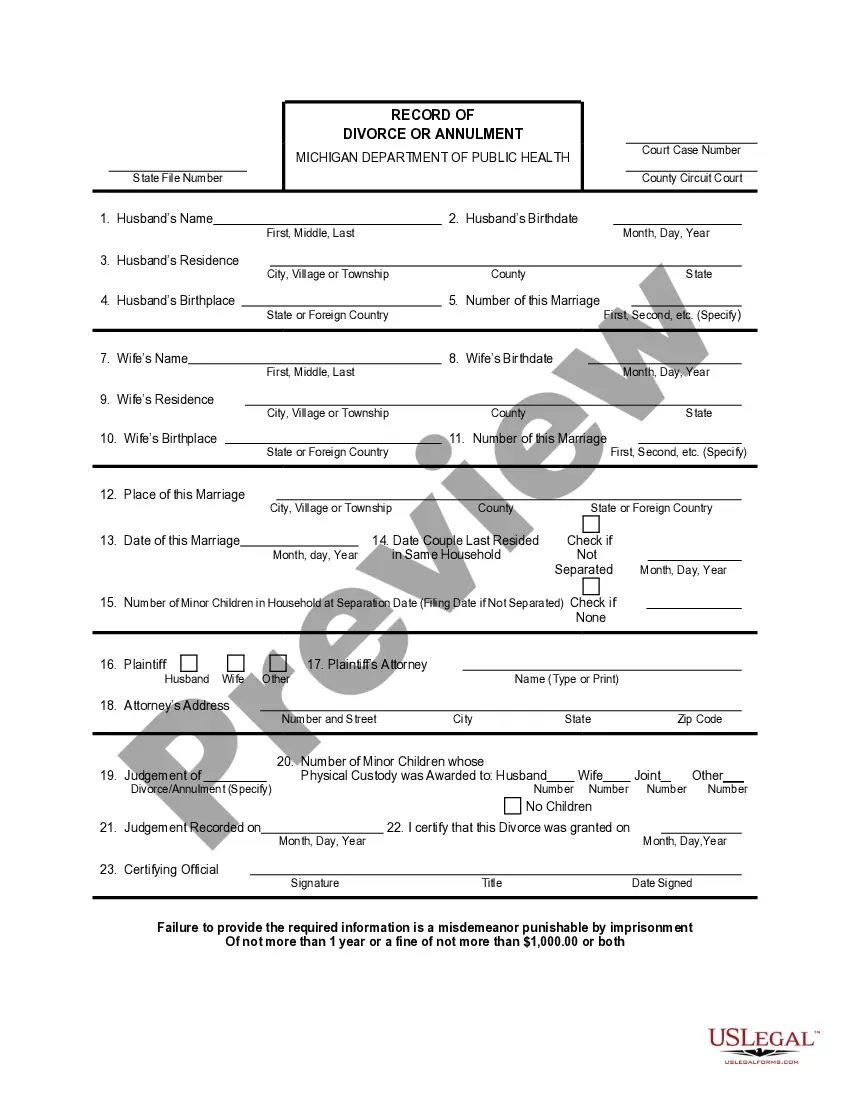
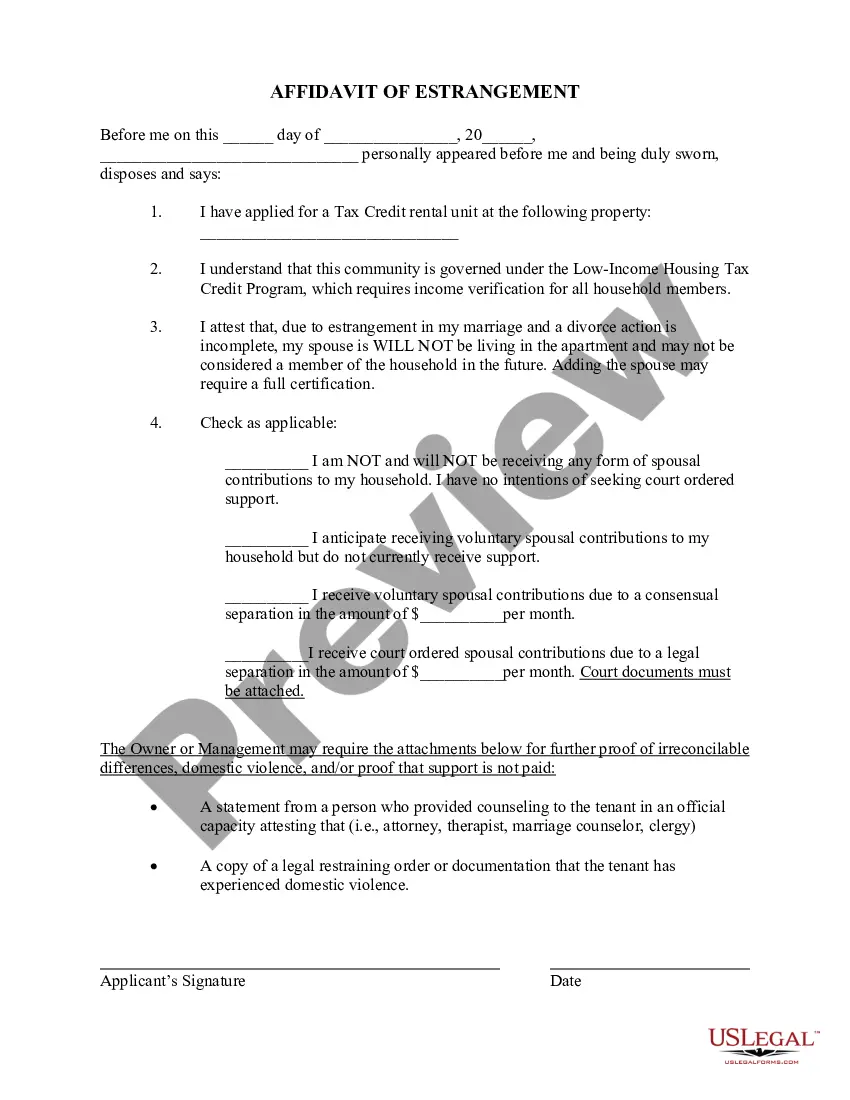
The Record of Divorce or Annulment is an administrative form used to document and track divorce or annulment proceedings within the legal system. This form ensures that the state maintains accurate records of marital dissolutions. Unlike petitions or final decrees, which involve the parties' requests, this form primarily serves a bureaucratic purpose and is essential for governmental recordkeeping.
Main sections of this form
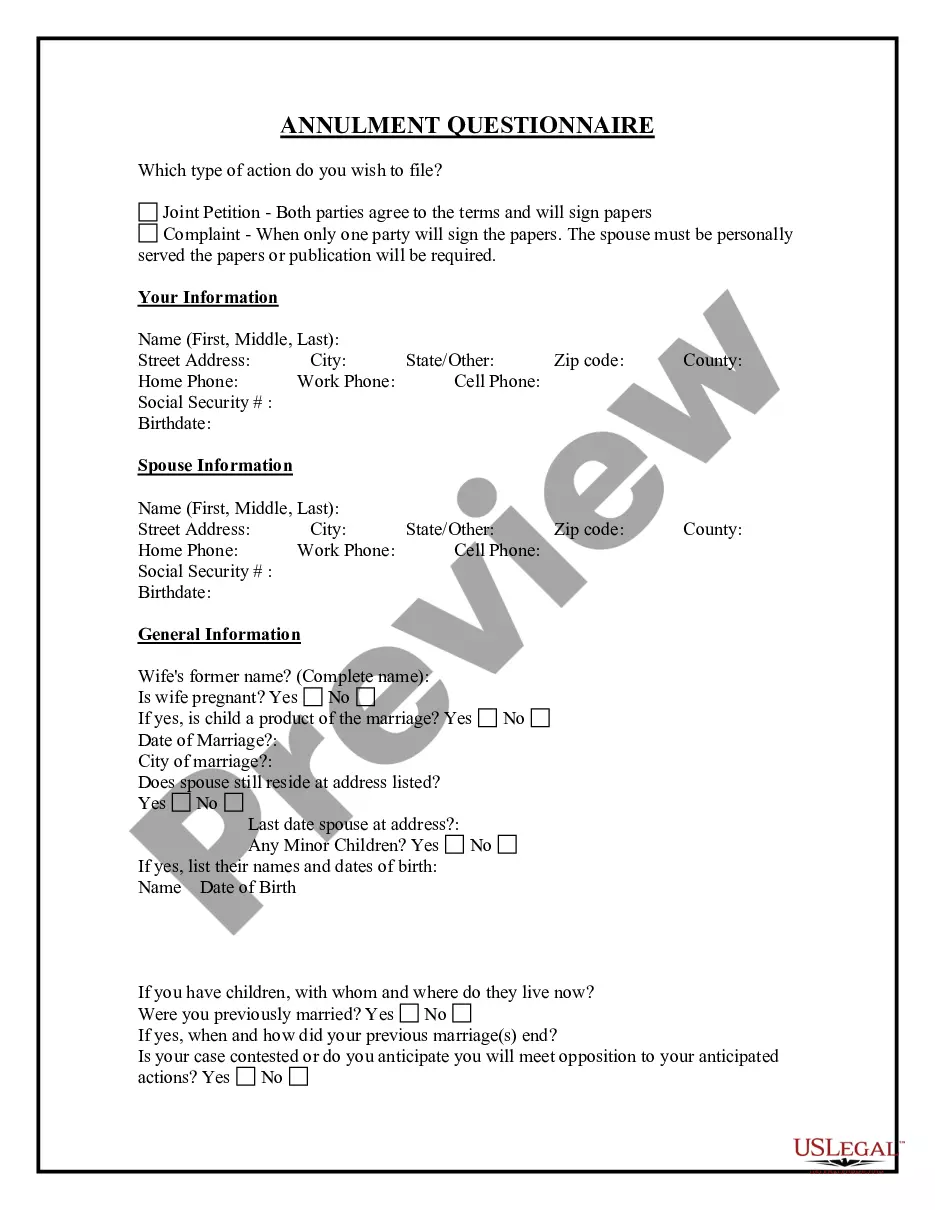
- Names of both parties involved in the divorce or annulment.
- Date of marriage and date of separation/divorce filings.
- Legal grounds for the divorce or annulment.
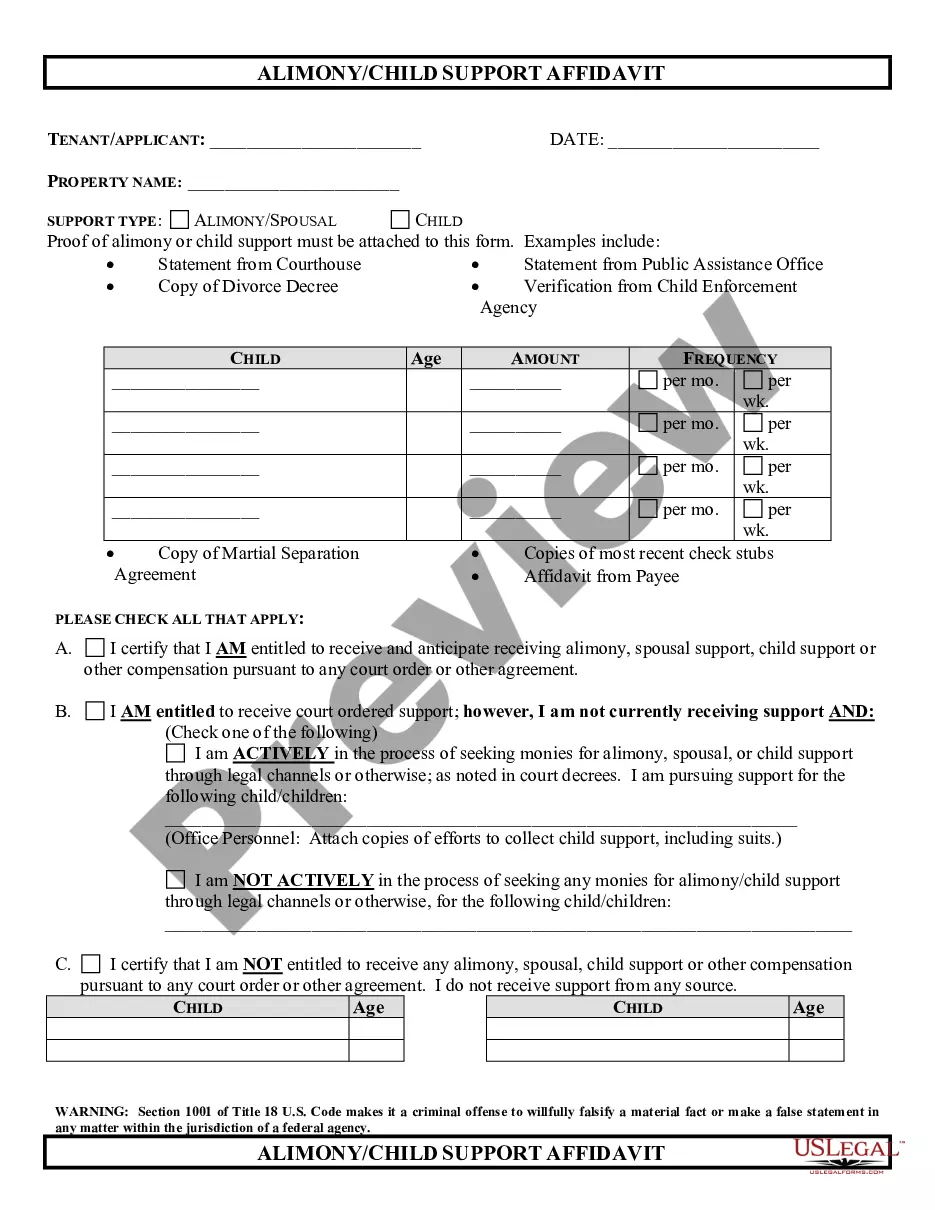
- Details regarding any dependent children, if applicable.
- Signature lines for the involved parties and a witness, if required.
When this form is needed
This form should be used when a couple has finalized their divorce or annulment proceedings and needs to formally record the dissolution of their marriage. It is typically required to be submitted to the court during the final hearing to ensure that all legal obligations are properly documented and registered with the state.
Who should use this form
This form is intended for:
- Individuals who are finalizing a divorce or annulment.
- Legal representatives of either party involved in the divorce.
- County clerks or court personnel responsible for maintaining marriage dissolution records.
Steps to complete this form
- Identify and enter the full names of both parties involved in the divorce or annulment.
- Provide the dates of marriage and the date of separation or the divorce filing.
- List the legal grounds for the divorce or annulment as per the law.
- If applicable, include information on any dependent children.
- Sign and date the form where prompted, and ensure it is witnessed if required by local law.
Does this form need to be notarized?
Notarization is generally not required for this form. However, certain states or situations might demand it. You can complete notarization online through US Legal Forms, powered by Notarize, using a verified video call available anytime.
Get your form ready online
Our built-in tools help you complete, sign, share, and store your documents in one place.
Make edits, fill in missing information, and update formatting in US Legal Forms—just like you would in MS Word.
Download a copy, print it, send it by email, or mail it via USPS—whatever works best for your next step.
Sign and collect signatures with our SignNow integration. Send to multiple recipients, set reminders, and more. Go Premium to unlock E-Sign.
If this form requires notarization, complete it online through a secure video call—no need to meet a notary in person or wait for an appointment.
We protect your documents and personal data by following strict security and privacy standards.

Make edits, fill in missing information, and update formatting in US Legal Forms—just like you would in MS Word.

Download a copy, print it, send it by email, or mail it via USPS—whatever works best for your next step.

Sign and collect signatures with our SignNow integration. Send to multiple recipients, set reminders, and more. Go Premium to unlock E-Sign.

If this form requires notarization, complete it online through a secure video call—no need to meet a notary in person or wait for an appointment.

We protect your documents and personal data by following strict security and privacy standards.
Common mistakes
- Failing to include both parties' full legal names as they appear on official documents.
- Omitting the date of separation, which is crucial for the record.
- Not signing the form, which may render it invalid.
- Filling out the form using incorrect or outdated legal terms.
Benefits of using this form online
- Quick access to accurate legal templates drafted by licensed attorneys.
- Convenient download options for on-the-go completion and submission.
- Increased reliability with up-to-date legal information.
- Editability allows users to customize fields to their specific situation.
Key takeaways
- The Record of Divorce or Annulment is essential for officially documenting a divorce.
- Ensure all information is accurate and complete to avoid delays or issues.
- Check state-specific requirements for any additional instructions.
Looking for another form?
Form popularity
FAQ
If you are married, you can file your annulment in California as long as you live in California. There is no required length of time for residency like there is for a divorce. And you can file in the county where you live (again, there is no 3-month residency requirement like with a divorce).
You or Your Spouse Must Be a Michigan Resident You must file your divorce in circuit court in the county where either you or your spouse has lived for at least ten days before filing. Most people file in the county where they live, but you do not have to. You can file where your spouse lives.
How much does it cost to file for a divorce in Michigan? When you file for divorce, you are required to pay a filing fee of $175 and an $80 judgment fee. You must also pay a fee to have your spouse served as well.
Divorces and legal separations do not have a deadline. You can file for divorce or legal separation at any time. BUT annulments DO have a deadline. In general, once the statute of limitations runs out, you can no longer file for an annulment.
It is important to note that certified copies of divorce decrees can only be obtained in the county where the divorce was finalized. Accessing this record via the Office of Vital Records is the only way to obtain full and certified copies of these records.
Incapacity. Incapacity can include physical incapacity and mental incapacity. If one spouse suffered from a physical incapacity, defect or infirmity at the time of the marriage, the marriage may be annulled if a case is brought to court within two years of the marriage date.
LENGTH OF MARRIAGE: The length of a marriage is NOT a ground for an annulment. If you are married for only one hour, one day, one week, one month or one year you are not entitled to an annulment in Michigan unless one of the above ground exist and can be proven in Court.
Bigamy. If you or your spouse were already married to someone else at the time you entered into a marriage together, your marriage can be annulled. Kinship. Incapacity. Under age. Fraud or duress.
Divorce Records in the state of Michigan can be obtained through an online search. Web services available on the state website and other third-party websites provide online access to divorce records. Office hours are between a.m. and p.m., Mondays to Fridays (except holidays).