Michigan Certificate That No Foreclosure Proceedings Have Been Commenced - Corporation or LLC
About this form
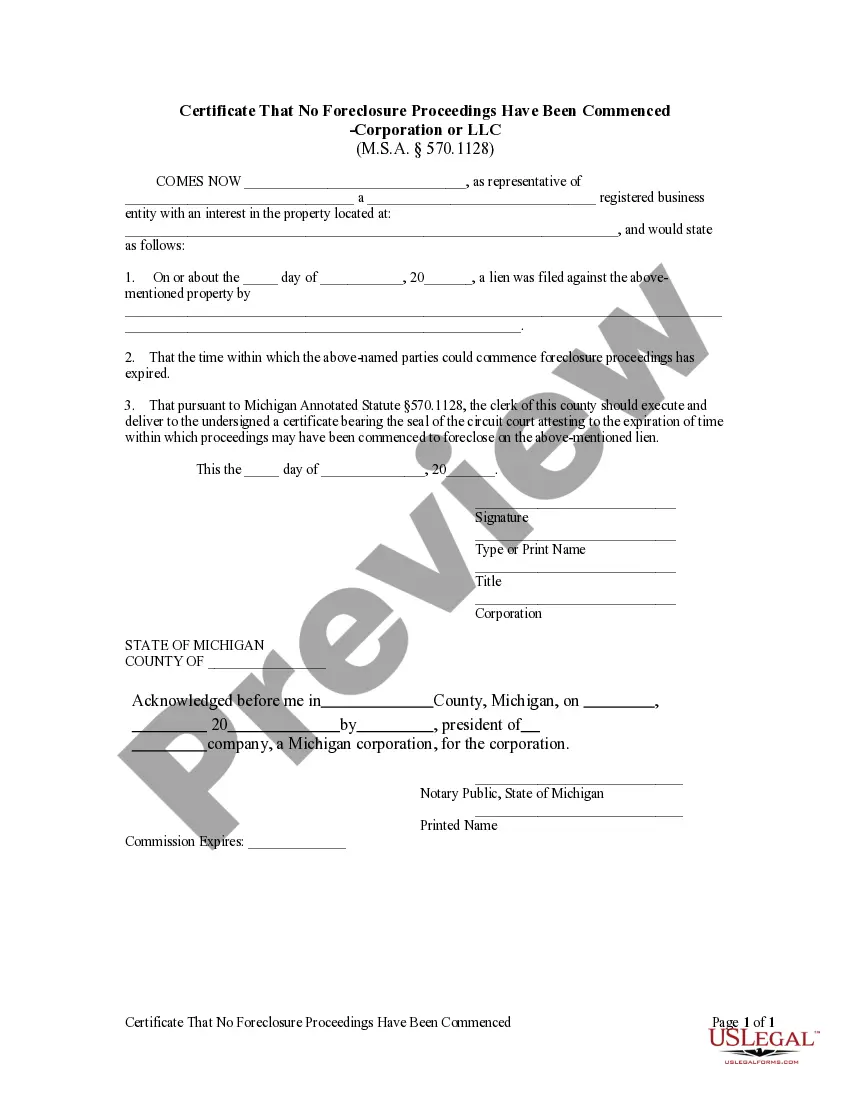
The Certificate That No Foreclosure Proceedings Have Been Commenced is a legal document used in Michigan by corporations or LLCs. It serves to affirm that no foreclosure actions have begun on a lien against a property after the statutory one-year period has expired. This form is essential for canceling the effectiveness of the lien, distinguishing it from other legal documents related to property disputes or debt collection.
Main sections of this form
- Identification of the representative filing the certificate.
- Details of the corporation or LLC involved.
- Specific property information to which the lien applies.
- Affirmation that the foreclosure time period has lapsed.
- Request for a certificate from the county clerk.
- Signature of the representative along with title and notary acknowledgment.
When to use this document
This form should be used by a corporation or LLC when the statutory timeline for foreclosure has lapsed without any proceedings being initiated. It is particularly relevant when you want to render an expired lien ineffective and formally document this status with the county clerk. This helps in clearing the title to the property and confirming ownership rights.
Intended users of this form
- Corporations or LLCs that hold a legal interest in a property.
- Representatives or agents of the corporate entity responsible for managing property.
- Legal professionals assisting clients with property lien issues.
How to prepare this document
- Identify the corporation or LLC and the representative filling out the form.
- Provide the property address that is subject to the lien.
- State the date the lien was filed and the entity that filed it.
- Affirm that the period for foreclosure has expired.
- Sign the document and have it notarized to ensure legal validity.
Notarization requirements for this form
This form must be notarized to be legally valid. US Legal Forms provides secure online notarization powered by Notarize, allowing you to complete the process through a verified video call.
Get your form ready online
Our built-in tools help you complete, sign, share, and store your documents in one place.
Make edits, fill in missing information, and update formatting in US Legal Forms—just like you would in MS Word.
Download a copy, print it, send it by email, or mail it via USPS—whatever works best for your next step.
Sign and collect signatures with our SignNow integration. Send to multiple recipients, set reminders, and more. Go Premium to unlock E-Sign.
If this form requires notarization, complete it online through a secure video call—no need to meet a notary in person or wait for an appointment.
We protect your documents and personal data by following strict security and privacy standards.

Make edits, fill in missing information, and update formatting in US Legal Forms—just like you would in MS Word.

Download a copy, print it, send it by email, or mail it via USPS—whatever works best for your next step.

Sign and collect signatures with our SignNow integration. Send to multiple recipients, set reminders, and more. Go Premium to unlock E-Sign.

If this form requires notarization, complete it online through a secure video call—no need to meet a notary in person or wait for an appointment.

We protect your documents and personal data by following strict security and privacy standards.
Common mistakes
- Failing to provide complete property and lien details.
- Not signing the document before a notary.
- Ignoring the deadline for filing or requesting the certificate.
Why complete this form online
- Convenient access to complete the form at any time, avoiding the need for office visits.
- Edit and customize the form easily before finalizing.
- Structured templates ensure compliance with legal requirements, reducing errors.
Summary of main points
- The form is essential for corporations or LLCs in Michigan to confirm lien status.
- No foreclosure proceedings can commence after the designated time period.
- Properly completing and notarizing this form is crucial for legal effectiveness.
- The form serves as a necessary measure to protect property interests against lapsed liens.
Looking for another form?



Form popularity
FAQ
Forming an LLC in Michigan involves several key steps. First, you need to choose a name for your LLC that complies with state rules. After that, you will file Articles of Organization with the Michigan Department of Licensing and Regulatory Affairs. Lastly, securing a Michigan Certificate That No Foreclosure Proceedings Have Been Commenced - Corporation or LLC can provide additional assurance of your LLC’s standing. Consider using resources like uslegalforms for guidance throughout this process.
How Liens Work. A lien provides a creditor with the legal right to seize and sell the collateral property or asset of a borrower who fails to meet the obligations of a loan or contract. The property that is the subject of a lien cannot be sold by the owner without the consent of the lien holder.
If a creditor gets a judgment against you, it can then place a lien on your property. The lien gives the creditor an interest in your property so that it can get paid for the debt you owe.And in some cases, the lien gives the creditor the right to force a sale of your property in order to get paid.
Someone who is owed money is generally not able to just put a lien on property without first securing a judgment. Securing a judgment requires the creditor to sue the debtor. This may be through circuit court in many jurisdictions. If under a certain dollar amount, this suit may be through the small claims court.
A lien is a legal right to claim a security interest in a property provided by the owner of the property to the creditor.The grantor (the owner of the property) is called the lienee while the party that receives the lien is referred to as the lienor or lien holder.
Pay off your debt. Fill out a release-of-lien form and have the lien holder sign it. Run out the statute of limitations. Get a court order. Make a claim with your title insurance company. Learn more:
Non-consensual liens arise from statutory or common law. The most notable example is a tax lien, which is imposed by law against the property of a taxpayer. If a taxpayer fails to pay the taxes owed to the government, the tax agency can seize his or her real or personal property for the amount of the lien.
The lien gives the creditor an interest in your property so that it can get paid for the debt you owe. If you sell the property, the creditor will be paid first before you receive any proceeds from the sale. And in some cases, the lien gives the creditor the right to force a sale of your property in order to get paid.
The Indian Contract Act, 1872 classifies the Right of Lien into two types: Particular Lien and General Lien. Section 170 of the aforesaid Act gives the exact definition of Particular Lien which states that the Bailee is free to hold control of a precise property with position to the charge which is due.
A security interest or legal right acquired in one's property by a creditor. A lien generally stays in effect until the underlying obligation to the creditor is satisfied. If the underlying obligation is not satisfied, the creditor may be able to take possession of the property involved.