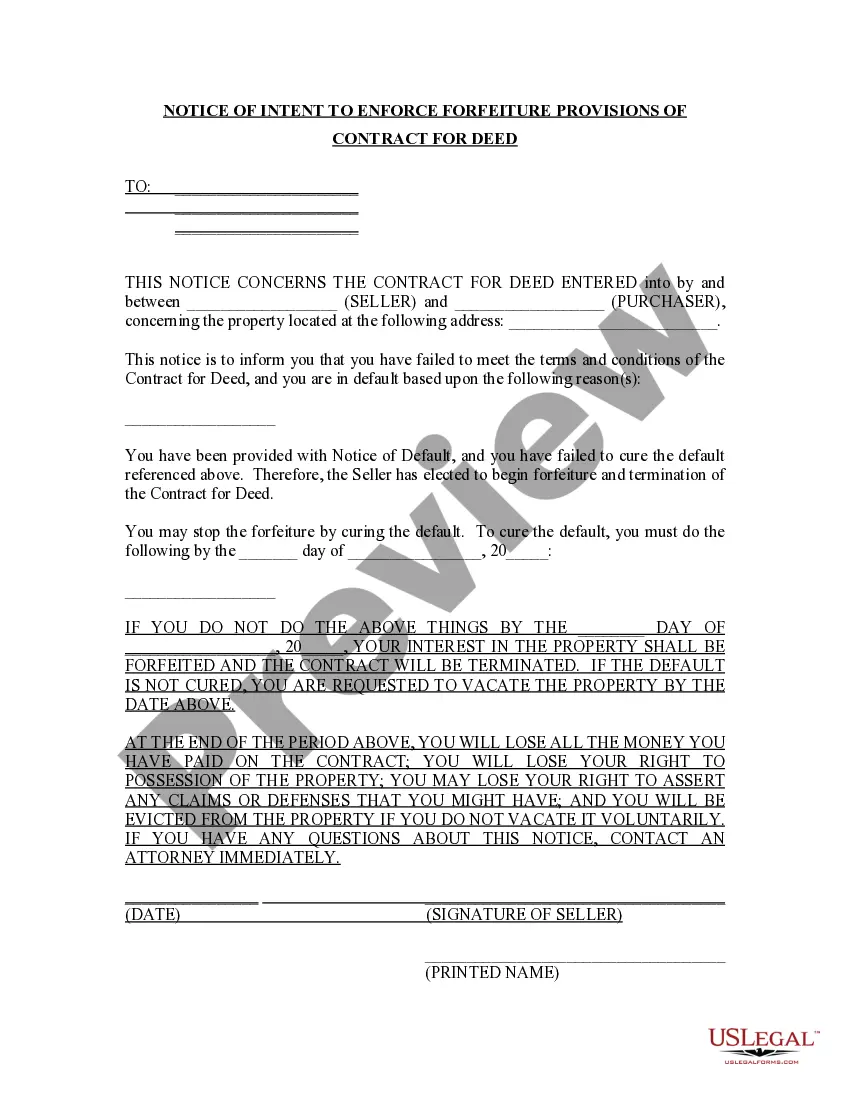
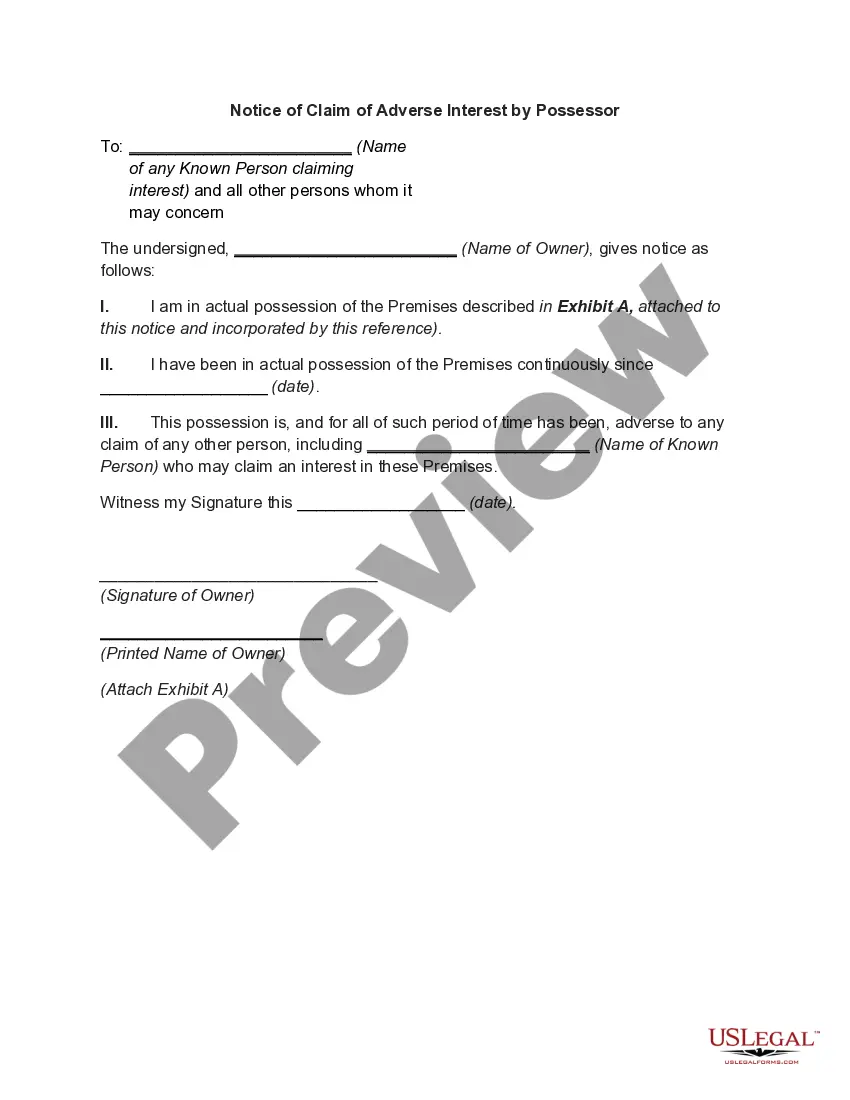
This Notice of Intent to Enforce Forfeiture Provisions of Contract for Deed is an initial notice of Seller's intent to enforce the forfeiture remedy of contract for deed if nonpayment or other breach is not cured. It is used specifically to inform the buyer that he/she has failed to meet the terms and conditions of the Contract for Deed and as a result, are in default based upon the reasons specified.
Michigan Notice of Intent to Enforce Forfeiture Provisions of Contact for Deed
State:
Michigan
Control #:
MI-00470-11
Format:
Word;
Rich Text
Instant download
Description
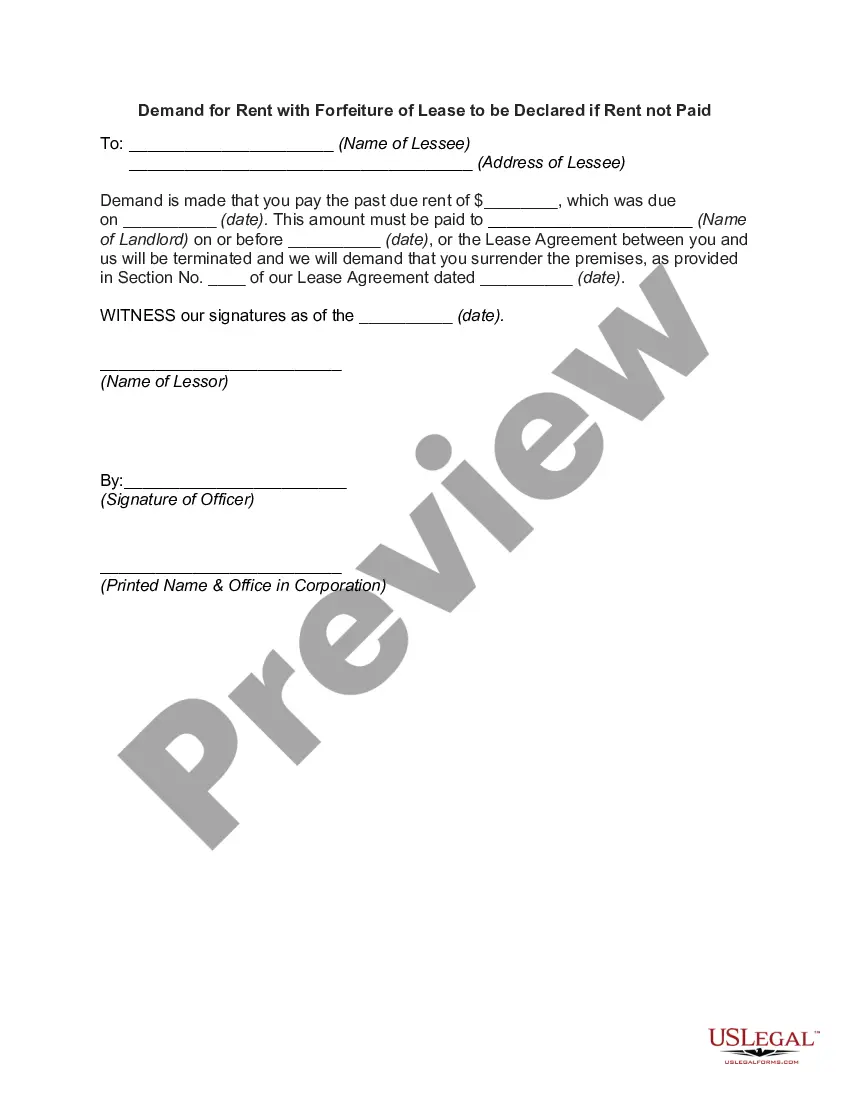
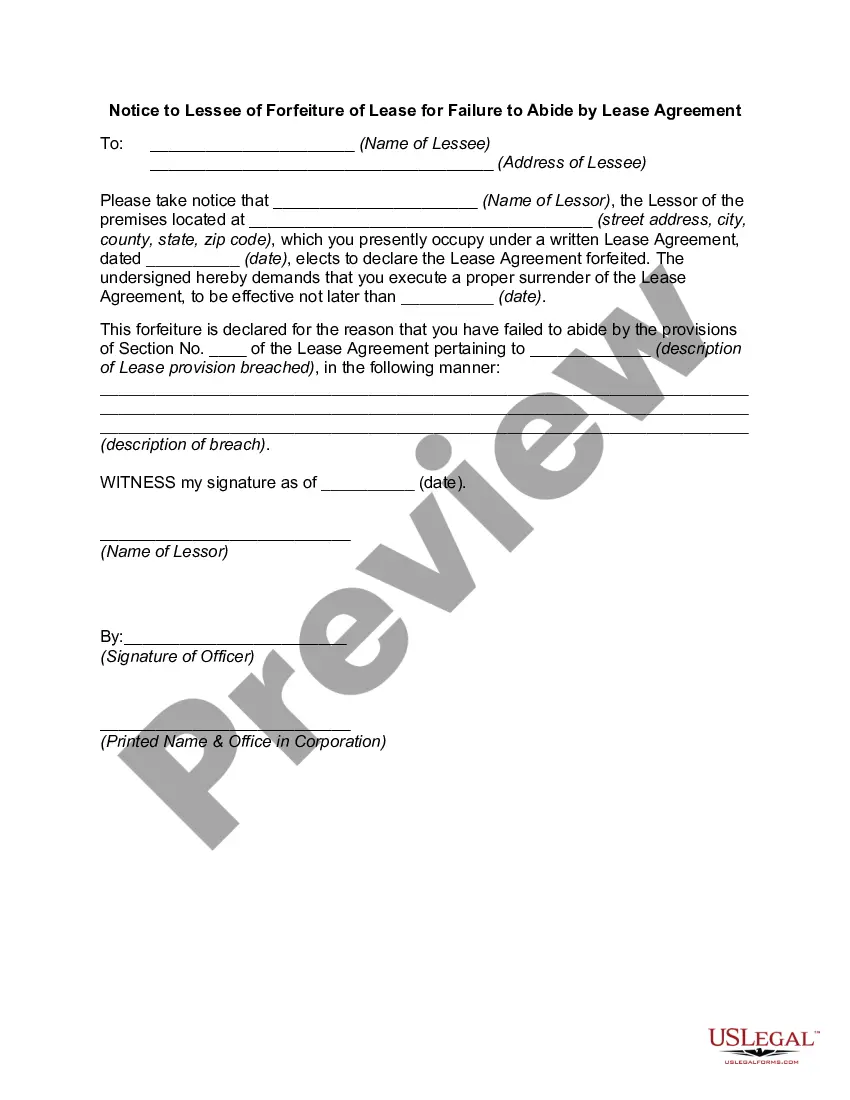

How to fill out Michigan Notice Of Intent To Enforce Forfeiture Provisions Of Contact For Deed?
Use US Legal Forms to get a printable Michigan Notice of Intent to Enforce Forfeiture Provisions of Contact for Deed. Our court-admissible forms are drafted and regularly updated by skilled lawyers. Our’s is the most comprehensive Forms library online and provides cost-effective and accurate templates for consumers and legal professionals, and SMBs. The documents are categorized into state-based categories and many of them might be previewed prior to being downloaded.
To download templates, users must have a subscription and to log in to their account. Hit Download next to any form you want and find it in My Forms.
For those who do not have a subscription, follow the tips below to easily find and download Michigan Notice of Intent to Enforce Forfeiture Provisions of Contact for Deed:
- Check out to make sure you get the right template in relation to the state it’s needed in.
- Review the form by looking through the description and by using the Preview feature.
- Press Buy Now if it is the document you want.
- Create your account and pay via PayPal or by card|credit card.
- Download the form to your device and feel free to reuse it multiple times.
- Make use of the Search field if you need to find another document template.
US Legal Forms offers thousands of legal and tax templates and packages for business and personal needs, including Michigan Notice of Intent to Enforce Forfeiture Provisions of Contact for Deed. Above three million users have already used our service successfully. Select your subscription plan and have high-quality documents in a few clicks.
Form popularity
FAQ
401(k) plan forfeitures occur when a participant terminates employment (voluntarily or involuntarily) prior to satisfying the required service years to become fully vested in his/her account.Participants are generally always 100% vested in the contributions made by the participant.
A land contract is not legally required to be recorded in Michigan. However, both the buyer and the seller may wish to record the contract to protect their interests in the property. Make sure the contract has been properly executed before recording it.
A land contract is a contract between a buyer and private seller for real property that has a home on it.The buyer will not get legal title until the total purchase price is paid. Land contracts can make property easier to sell because the seller decides the credit requirements and down payment amount.
The name of the notice that is given to property owners to appear in court to say why the property shouldn't be forfeited.
A: Yes you can, but you will need a good real estate attorney to do this for you, one that can structure this type of transaction.Ask someone who has recently sold a home or property, if they would recommend an attorney to get started.
Forfeiture. A foreclosure action extinguishes any claim the mortgagor may have to the real property securing a defaulted loan, whereas a forfeiture refers generally to the loss of a right to something as a result of nonperformance of an obligation or condition.
Criminal forfeiture is an action brought as a part of the criminal prosecution of a defendant.Civil judicial forfeiture is an in rem (against the property) action brought in court against the property. The property is the defendant and no criminal charge against the owner is necessary.
Forfeiture is the loss of any property without compensation as a result of defaulting on contractual obligations, or as a penalty for illegal conduct.
Forfeiture refers to a loss of any property, money, or assets without consideration or compensation in return. A forfeiture generally occurs due to default in complying with repayment obligations under a contract. It can also be used as a penalty for an illegal way of conducting business.