Michigan Domestic Relations - Scheduling Conference Order
What this document covers
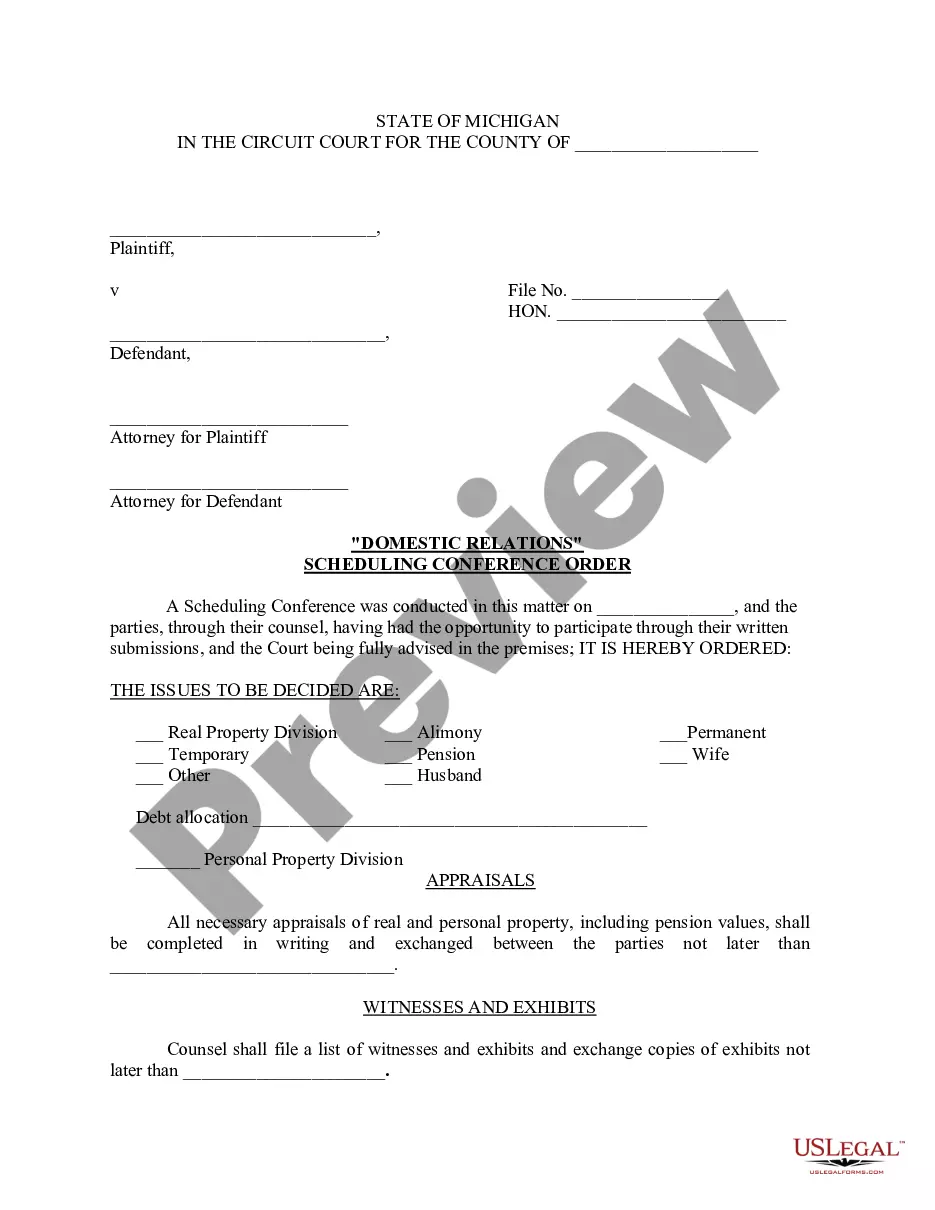
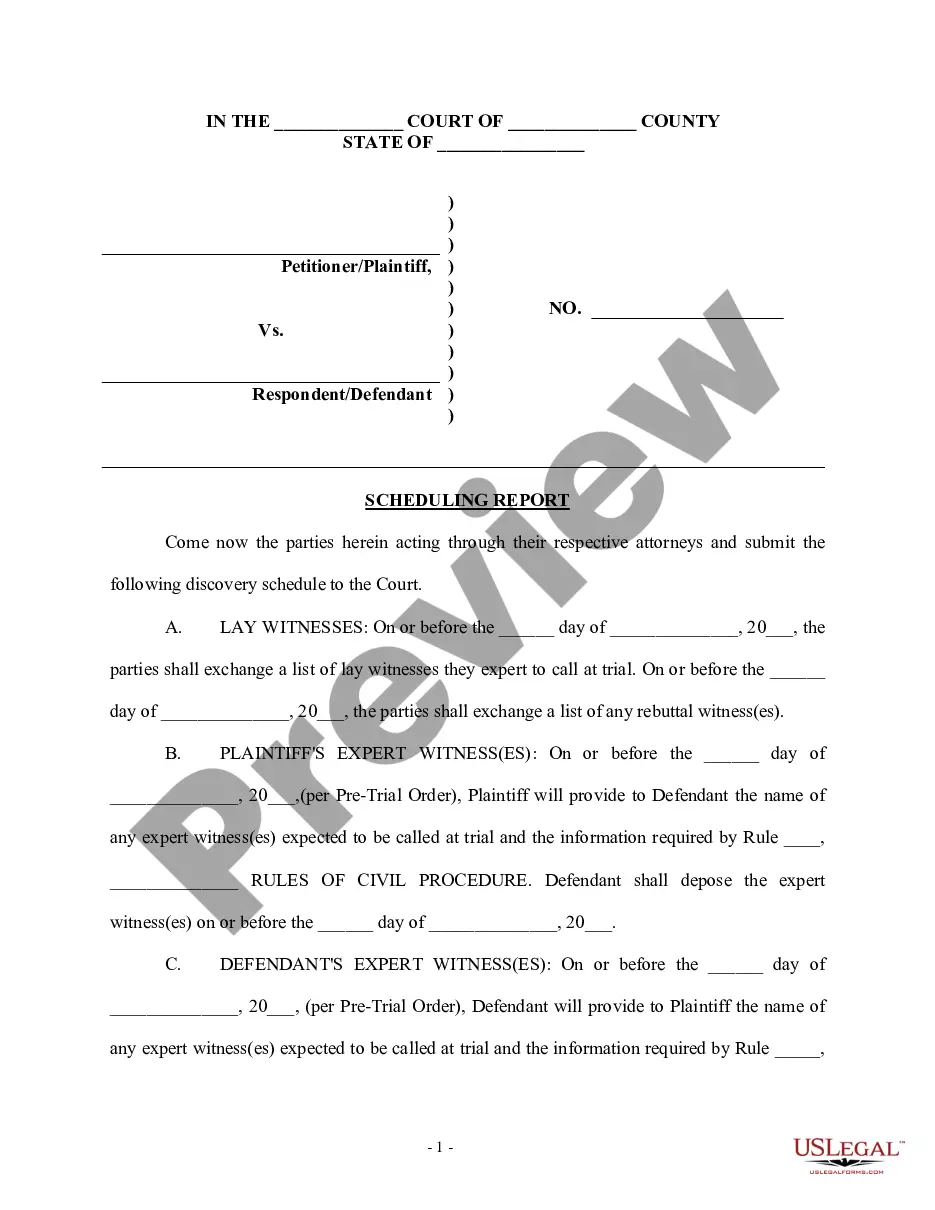
The Domestic Relations - Scheduling Conference Order is a legal document used in domestic relations cases to outline the matters to be addressed during a scheduling conference. This form identifies critical issues such as marital property division and custody arrangements, along with deadlines for discovery and witness listing. It serves as a roadmap for the proceedings and helps facilitate communication between parties and the court.
Key parts of this document
- Identification of the parties involved in the case.
- Listing of issues to be resolved, including property division and alimony.
- Deadlines for discovery, witness submissions, and evidence exchange.
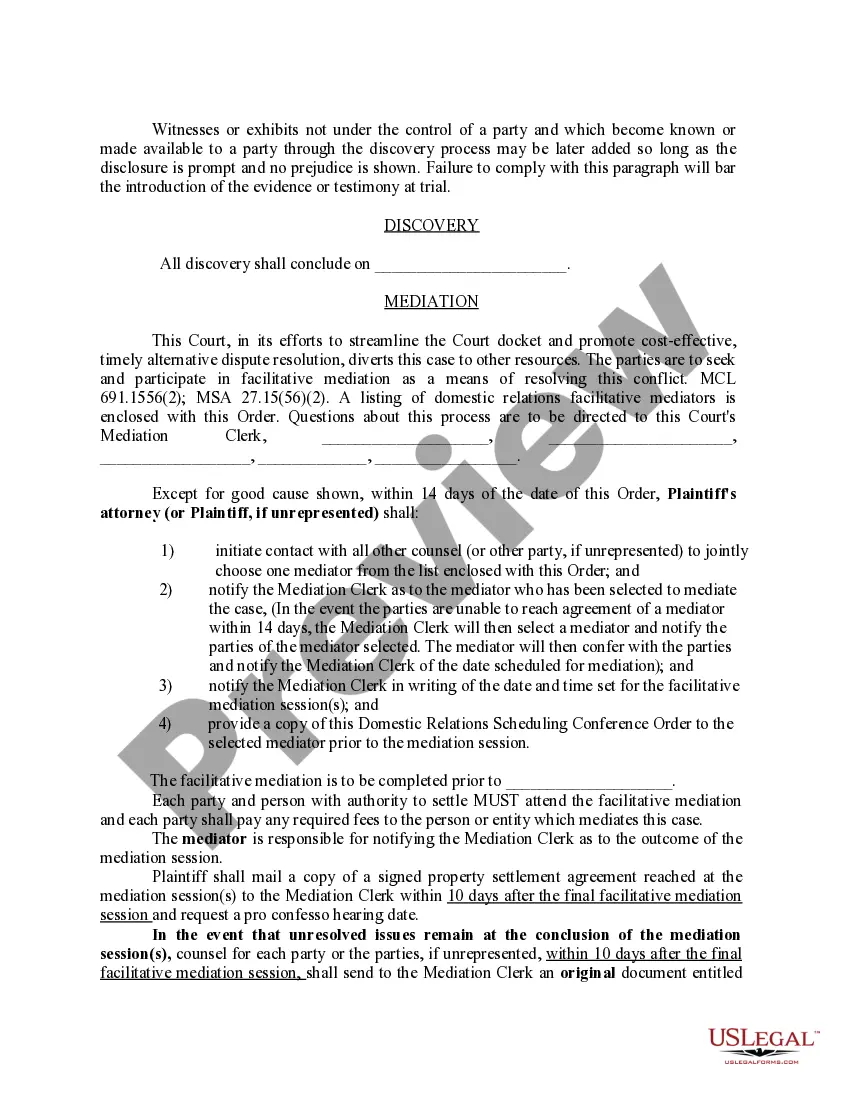
- Instructions for mediation, including mediator selection and attendance requirements.
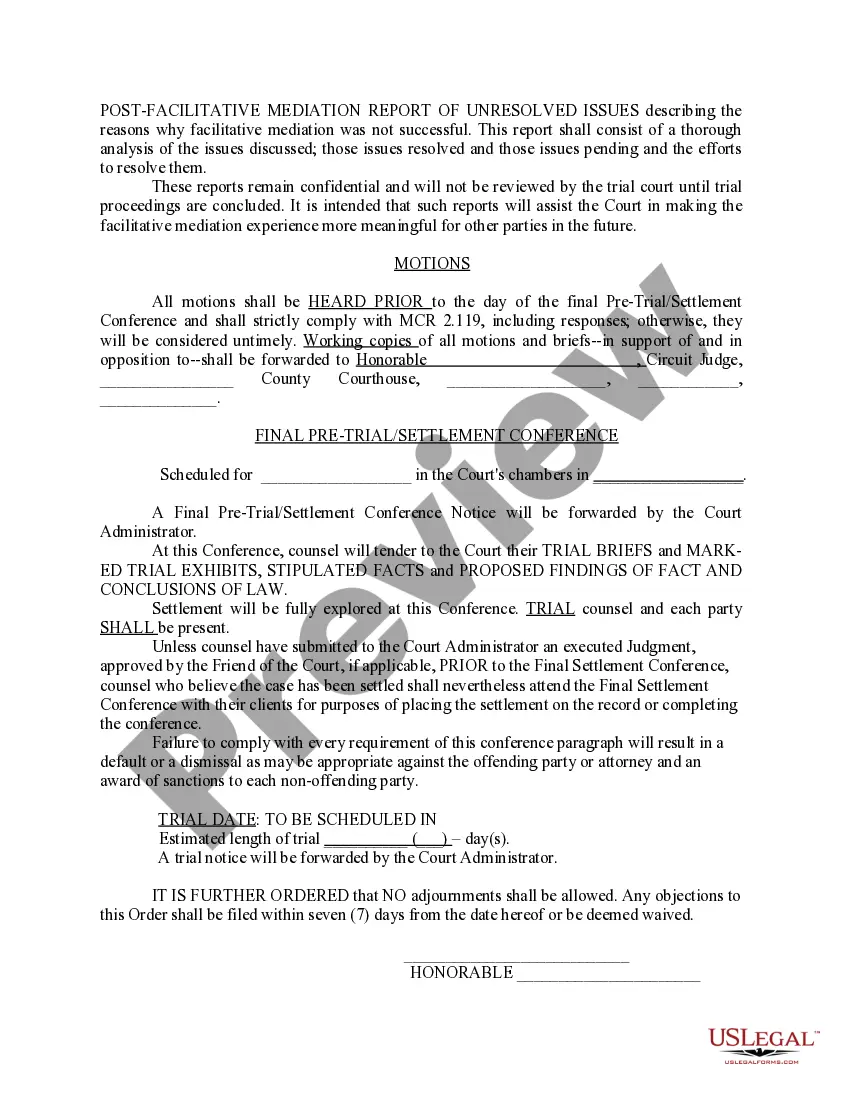
- Provisions for a final pre-trial or settlement conference.
- Trial date scheduling and necessary court motions.

Common use cases
This form is essential when parties involved in a domestic relations dispute are preparing for a scheduling conference. It should be used when there are unresolved issues such as child custody, alimony, or division of property that need to be outlined and organized for court proceedings. This helps ensure all necessary information is available for a smooth legal process.
Who this form is for
This form is designed for:
- Individuals involved in a domestic relations case, such as divorce or custody disputes.
- Attorneys representing clients in domestic relations matters.
- Parties seeking to manage the logistics of their court proceedings effectively.
Steps to complete this form
- Fill in the names of the plaintiff and defendant as well as their attorneys.
- Specify the date of the scheduling conference conducted.
- Identify the issues to be decided and check the relevant boxes.
- Enter deadlines for appraisals, exchanges of evidence, and discovery completion.
- Indicate the final pre-trial or settlement conference date.
- Sign and date the document in the appropriate space provided.
Does this form need to be notarized?
In most cases, this form does not require notarization. However, some jurisdictions or signing circumstances might. US Legal Forms offers online notarization powered by Notarize, accessible 24/7 for a quick, remote process.
Get your form ready online
Our built-in tools help you complete, sign, share, and store your documents in one place.
Make edits, fill in missing information, and update formatting in US Legal Forms—just like you would in MS Word.
Download a copy, print it, send it by email, or mail it via USPS—whatever works best for your next step.
Sign and collect signatures with our SignNow integration. Send to multiple recipients, set reminders, and more. Go Premium to unlock E-Sign.
If this form requires notarization, complete it online through a secure video call—no need to meet a notary in person or wait for an appointment.
We protect your documents and personal data by following strict security and privacy standards.

Make edits, fill in missing information, and update formatting in US Legal Forms—just like you would in MS Word.

Download a copy, print it, send it by email, or mail it via USPS—whatever works best for your next step.

Sign and collect signatures with our SignNow integration. Send to multiple recipients, set reminders, and more. Go Premium to unlock E-Sign.

If this form requires notarization, complete it online through a secure video call—no need to meet a notary in person or wait for an appointment.

We protect your documents and personal data by following strict security and privacy standards.
Mistakes to watch out for
- Failing to complete all required sections, which can lead to delays.
- Missing deadlines for evidence and witness disclosure.
- Not attending the scheduled mediation session or failing to notify the mediation clerk.
- Overlooking the necessity of signatures from all parties involved.
Why use this form online
- Convenience of downloading and editing the form from home.
- Access to legal templates drafted by licensed attorneys, ensuring accuracy.
- Time-saving in preparing necessary documents for court proceedings.
Quick recap
- The Domestic Relations - Scheduling Conference Order is vital for managing domestic disputes in court.
- Filling this form correctly helps in planning for critical court dates and activities.
- Adhering to deadlines and attendance requirements is crucial for successful mediation and trial preparation.
Looking for another form?

Form popularity
FAQ
A scheduling order is a court order designed to manage the flow of a case from the date it is entered through the beginning of trial. The court may enter the order on its own motion, or either party may seek one by motion.
Parties introduce themselves through counsel. Court explains the purpose of the scheduling conference.The defendants lawyer presents the defendants case in brief. Court establishes whether there have been efforts to settle/ Parties are given Opportunity to settle through ADR.
At the Scheduling Conference, the parties shall be prepared to discuss all aspects of the Adversary Proceeding and the Joint Report including, among other things: a. formulating and simplifying the issues, and eliminating frivolous claims and defenses; b. amending the pleadings if necessary or desirable; c.
At the Scheduling Conference, the Judge or Magistrate may order you to participate in one or more programs offered by or through the Circuit Court. Each step in the development of your case has been designed to offer information, counseling and support to make your own decisions.
The Scheduling Conference is the Court's way to begin tracking their divorce, property, custody and/or child support case, and to schedule the steps in their case's development. Typically, a Master will conduct the Scheduling Conference.
WHAT IS THE SCHEDULING CONFERENCE? The Scheduling Conference may be the first of a number of court dates which you will have before the trial date on your domestic case. It is the court's way to begin tracking your case, and to schedule the steps in your case's development.
Under the law, a Scheduling conference is mandatory i.e Court cannot hear a Civil case unless both sides have carried out a Scheduling Conference. 5. One advantage of a Scheduling Conference is that it saves Court's time so Court can only focus on issues of disagreement or points of contention.
The Scheduling Conference is the Court's way to begin tracking their divorce, property, custody and/or child support case, and to schedule the steps in their case's development. Typically, a Master will conduct the Scheduling Conference.