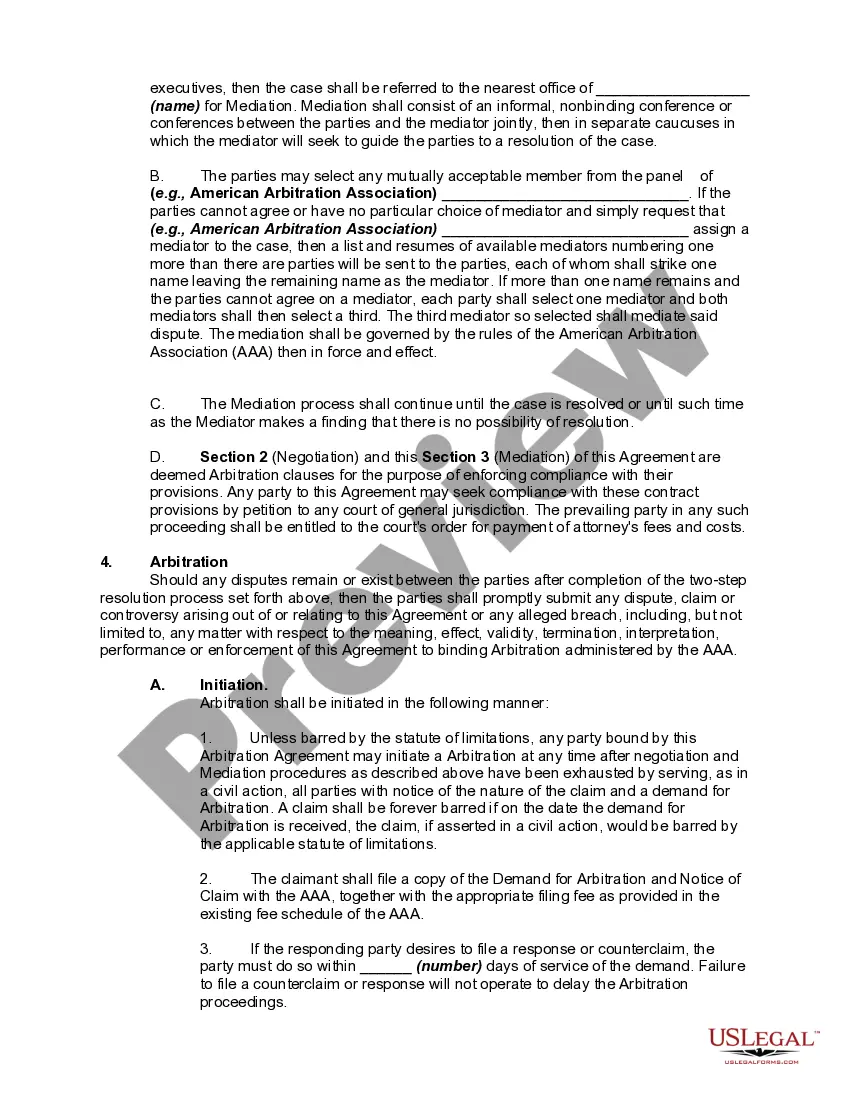
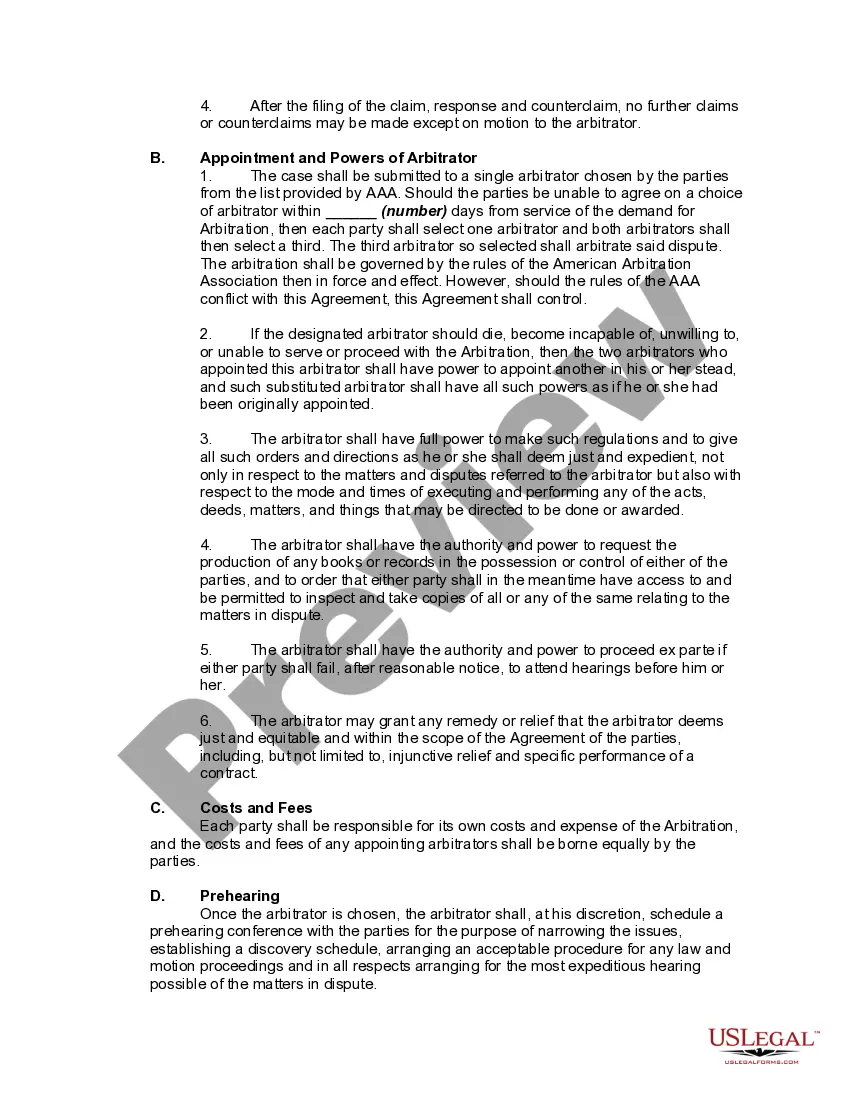
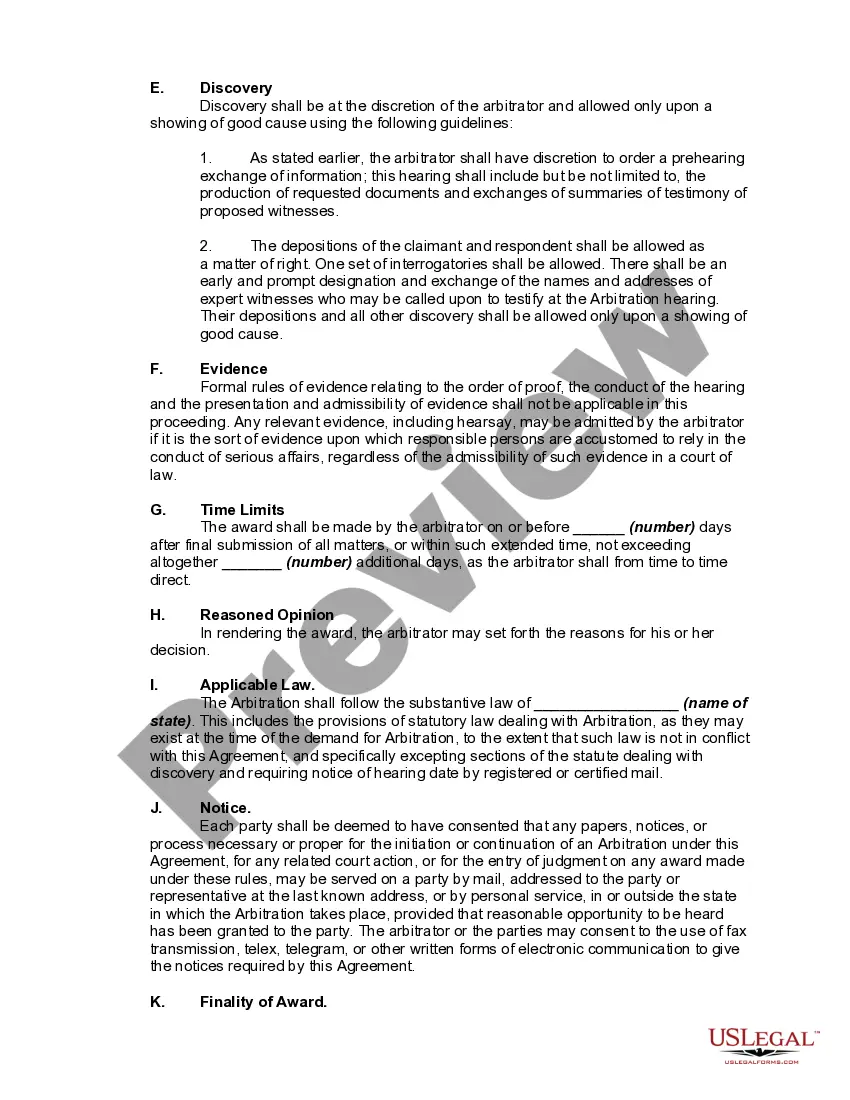
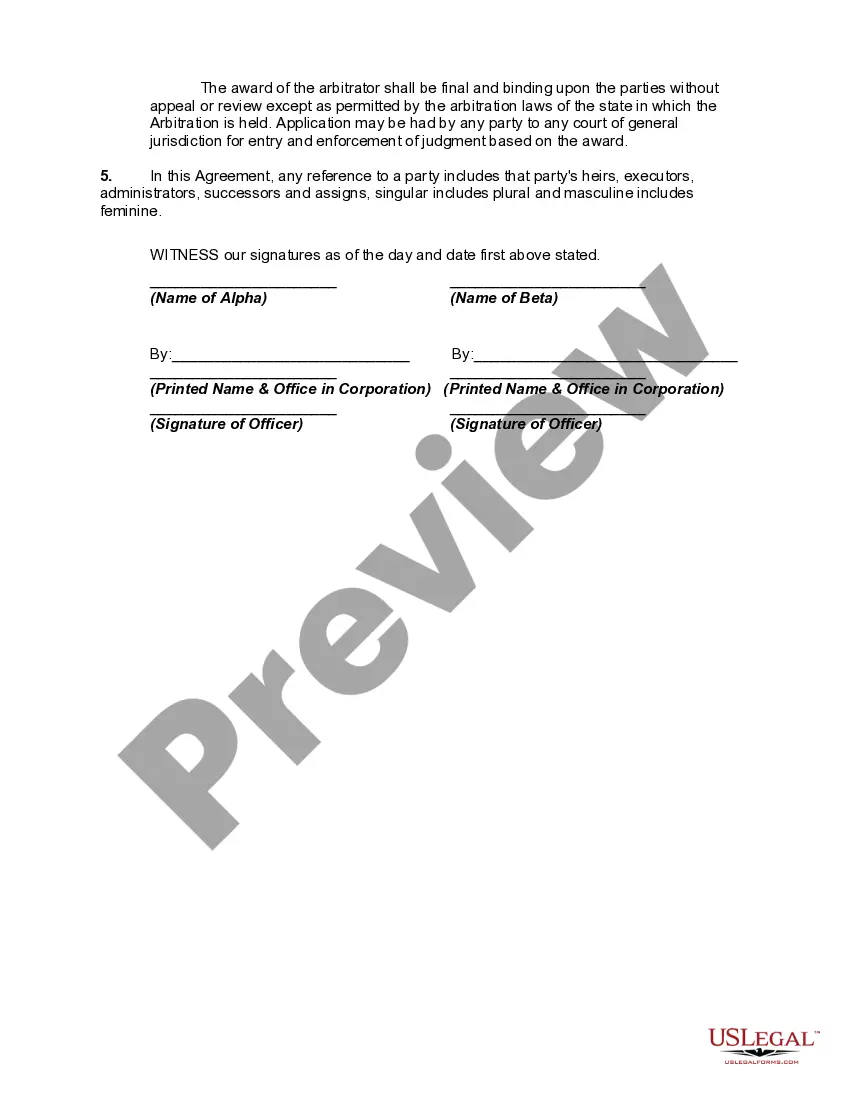
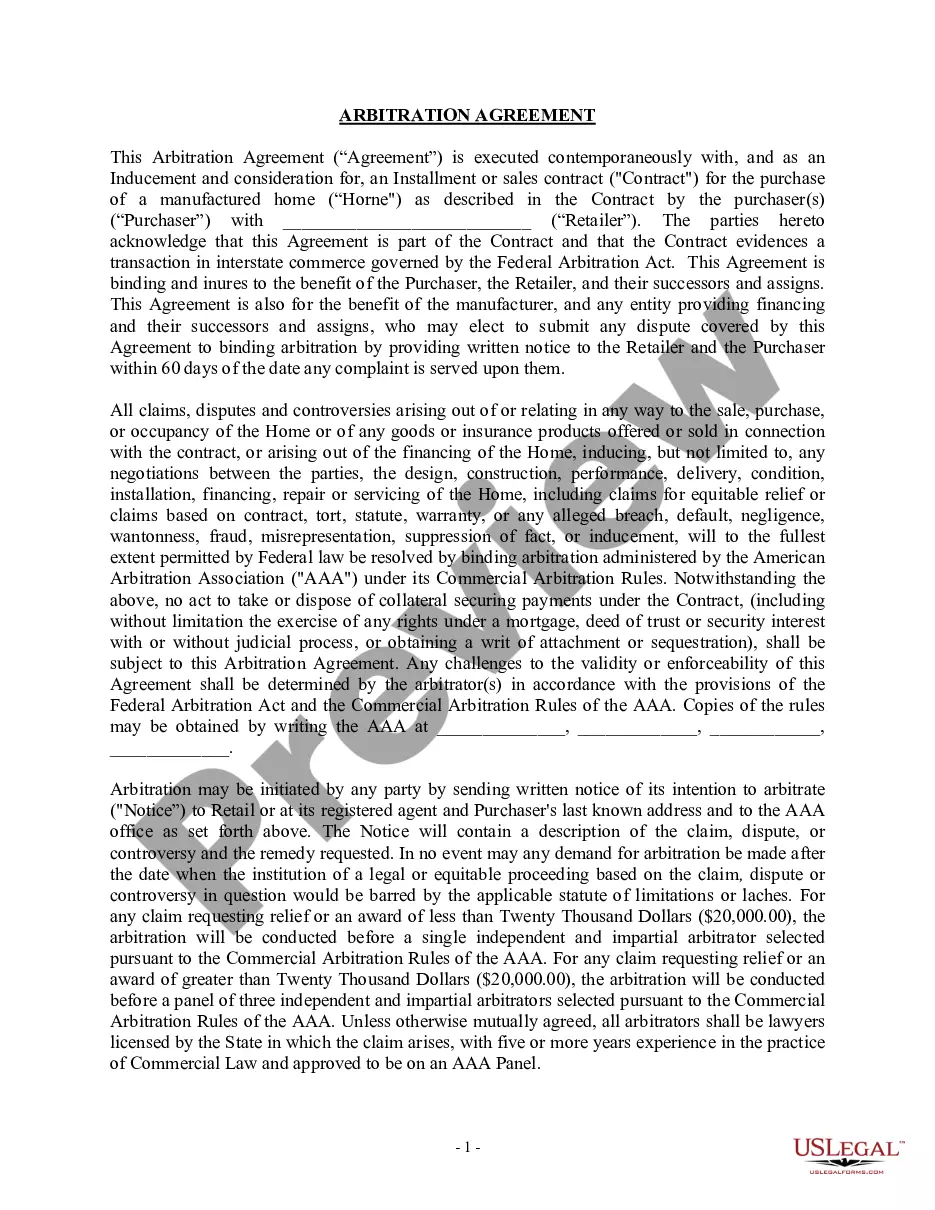
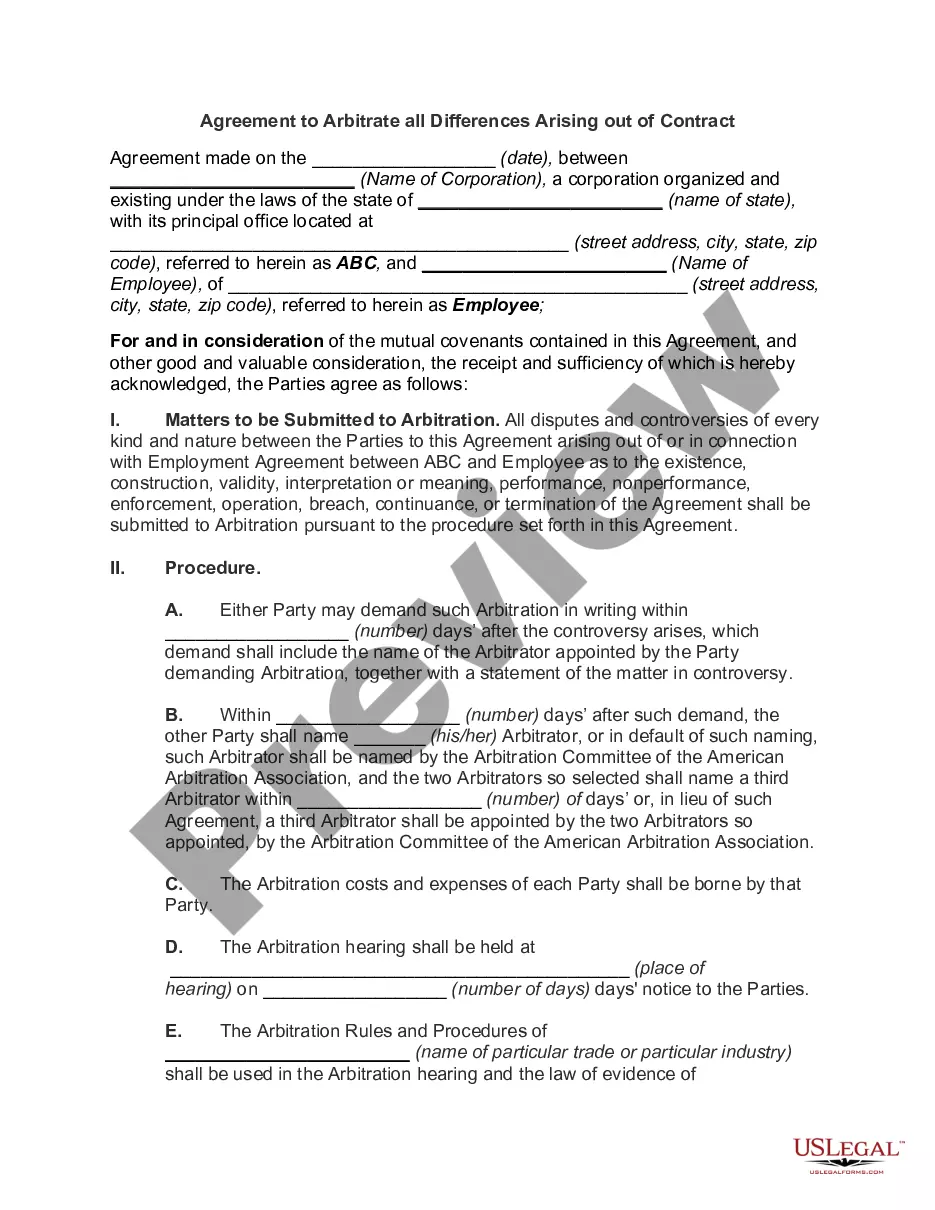
Arbitration is an alternative means of settling a dispute by impartial persons without proceeding to a court trial. It is sometimes preferred as a means of settling a matter in order to avoid the expense, delay, and acrimony of litigation. Discovery is with the discretion of the Arbitrator and there are simplified rules of evidence in arbitration.
Mediation is a non-adversarial method of alternative dispute resolution (ADR) in which a neutral third party helps resolve a dispute. The mediator does not have the power to render a decision on the matter or order an outcome. If a satisfactory resolution cannot be reached, the parties can pursue a lawsuit or arbitration.
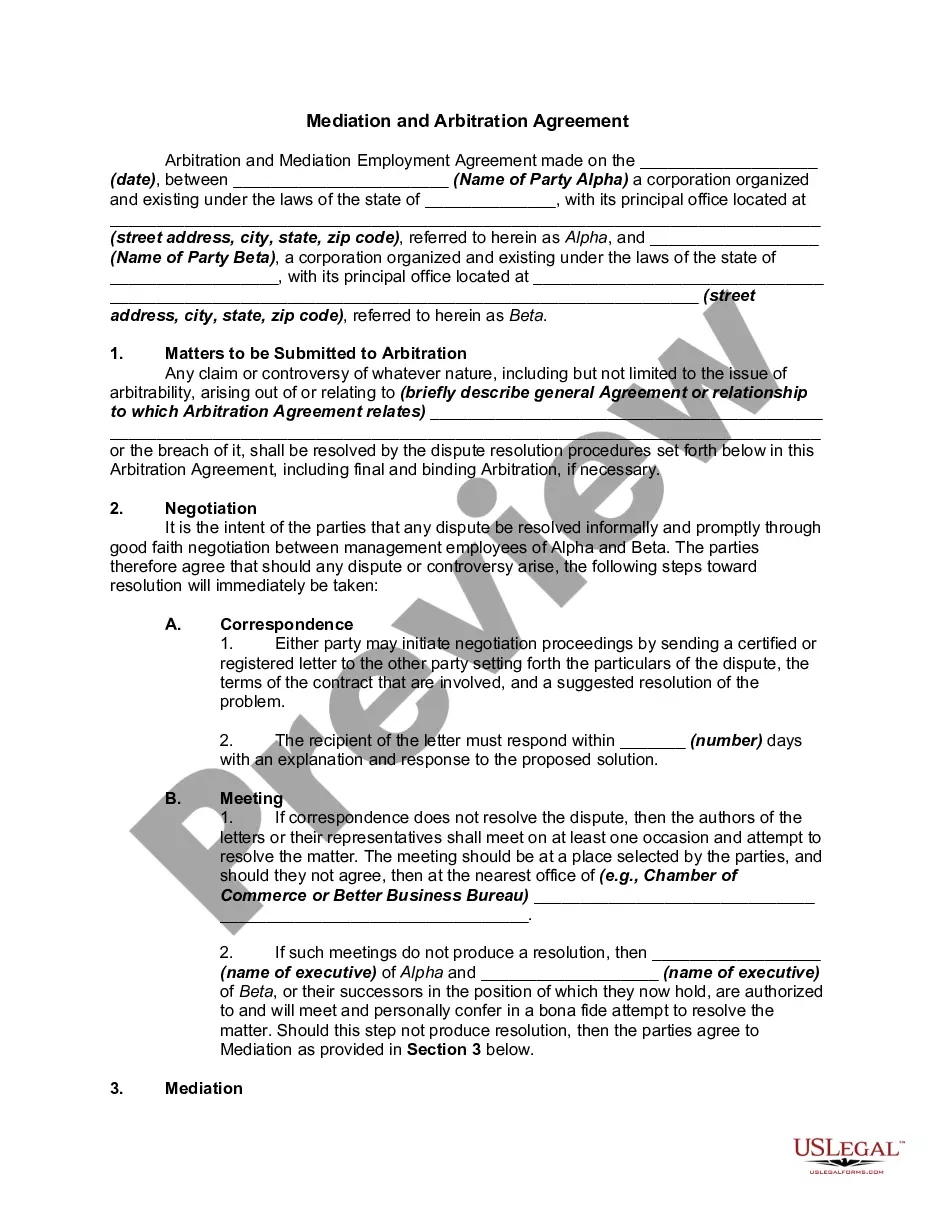
This form provides for negotiation, then mediation if the negotiation fails to resolve the issues. If both negotiation and mediation fail to resolve the issues, the parties arbitrate the dispute.
Maine Mediation and Arbitration Agreement
Category:
State:
Multi-State
Control #:
US-02980BG
Format:
Word;
Rich Text
Instant download
Description
Free preview




How to fill out Mediation And Arbitration Agreement?
You can spend time online searching for the legal document template that meets the federal and state requirements you will need.
US Legal Forms provides a vast selection of legal documents that have been reviewed by experts.
You can easily access or create the Maine Mediation and Arbitration Agreement from the service.
Once you’ve located the template you need, click Get now to proceed. Choose the pricing plan you prefer, enter your details, and register for a US Legal Forms account. Complete the transaction. You can use your credit card or PayPal account to pay for the legal document. Choose the file format of the document and download it to your system. Make modifications to the document if necessary. You can complete, edit, sign, and create the Maine Mediation and Arbitration Agreement. Access and create a vast number of document templates using the US Legal Forms website, which offers the largest variety of legal forms. Utilize professional and state-specific templates to address your business or personal needs.
- If you have a US Legal Forms account, you can Log In and click the Obtain button.
- After that, you can complete, modify, create, or sign the Maine Mediation and Arbitration Agreement.
- Each legal document template you purchase belongs to you indefinitely.
- To obtain an additional copy of any purchased form, visit the My documents tab and click the corresponding button.
- If you are using the US Legal Forms website for the first time, follow the easy instructions below.
- First, ensure that you have selected the correct document template for the area/location of your choice.
- Review the form description to confirm you have chosen the right form.
Form popularity
FAQ
While mediation and arbitration offer many benefits, there are some disadvantages to consider. Mediation may not be suitable when parties refuse to cooperate, and arbitration can limit your rights to appeal decisions. Additionally, the costs associated with both processes may still be significant. Understanding the terms of a Maine Mediation and Arbitration Agreement can help you navigate these challenges effectively.
A mediation and arbitration agreement is a legal document that outlines the process for resolving disputes through mediation, followed by arbitration if necessary. This agreement encourages parties to resolve their issues amicably and efficiently before escalating to arbitration for a binding outcome. By using a Maine Mediation and Arbitration Agreement, you can ensure clarity and fairness in the resolution process.
Yes, you can proceed to arbitration after mediation. If mediation does not yield a resolution, parties may choose to enter arbitration to reach a binding decision. This approach can often lead to a quicker resolution than traditional litigation. Consider a Maine Mediation and Arbitration Agreement to outline the terms of both processes.
In most cases, mediation comes before arbitration. Parties often attempt mediation as a first step to settle disputes amicably before resorting to arbitration. This approach aligns with the Maine Mediation and Arbitration Agreement framework, promoting collaboration and harmony before pursuing a more formal adjudication.
After arbitration, the next step typically involves implementing the arbitrator's decision. Parties may need to fulfill their obligations as dictated in the ruling, which is binding and enforceable. If either party feels aggrieved, they might consider discussing options or next steps as stipulated in the Maine Mediation and Arbitration Agreement.
One reason someone might choose arbitration over mediation is the need for a binding decision, which arbitration provides. Unlike mediation, where parties come to a mutual agreement, arbitration involves a neutral arbitrator who makes a final ruling. This can be advantageous when parties need certainty in their outcomes, especially in situations covered by a Maine Mediation and Arbitration Agreement.
A mediation agreement should include essential elements like the names of the parties involved, a clear description of the disputes, and the confidentiality terms. Additionally, include the mediation process details and the expected outcomes, as it sets the framework for effective communication. When drafting your agreement, ensure it aligns with the Maine Mediation and Arbitration Agreement to ensure all parties understand their commitments.
Typically, mediation is a quicker process than arbitration. Mediation involves open discussions and negotiations between parties, allowing them to resolve issues promptly. Conversely, arbitration can be a lengthier process, involving formal procedures, hearings, and possibly legal representation. Thus, if you seek a faster resolution, consider the Maine Mediation and Arbitration Agreement to explore mediation.
Yes, you can utilize both mediation and arbitration under the Maine Mediation and Arbitration Agreement. This dual approach offers flexibility and allows for tailored dispute resolution strategies. You might first attempt mediation to resolve your issues amicably. If that does not succeed, you can then move on to arbitration for a definitive resolution.
In most cases, mediation occurs before arbitration as part of the Maine Mediation and Arbitration Agreement process. Mediation provides an opportunity for both parties to resolve disputes without formal arbitration. If mediation fails to produce a resolution, then the case may proceed to arbitration, where a neutral arbitrator will make a binding decision. This sequence often helps conserve time and resources for both parties.