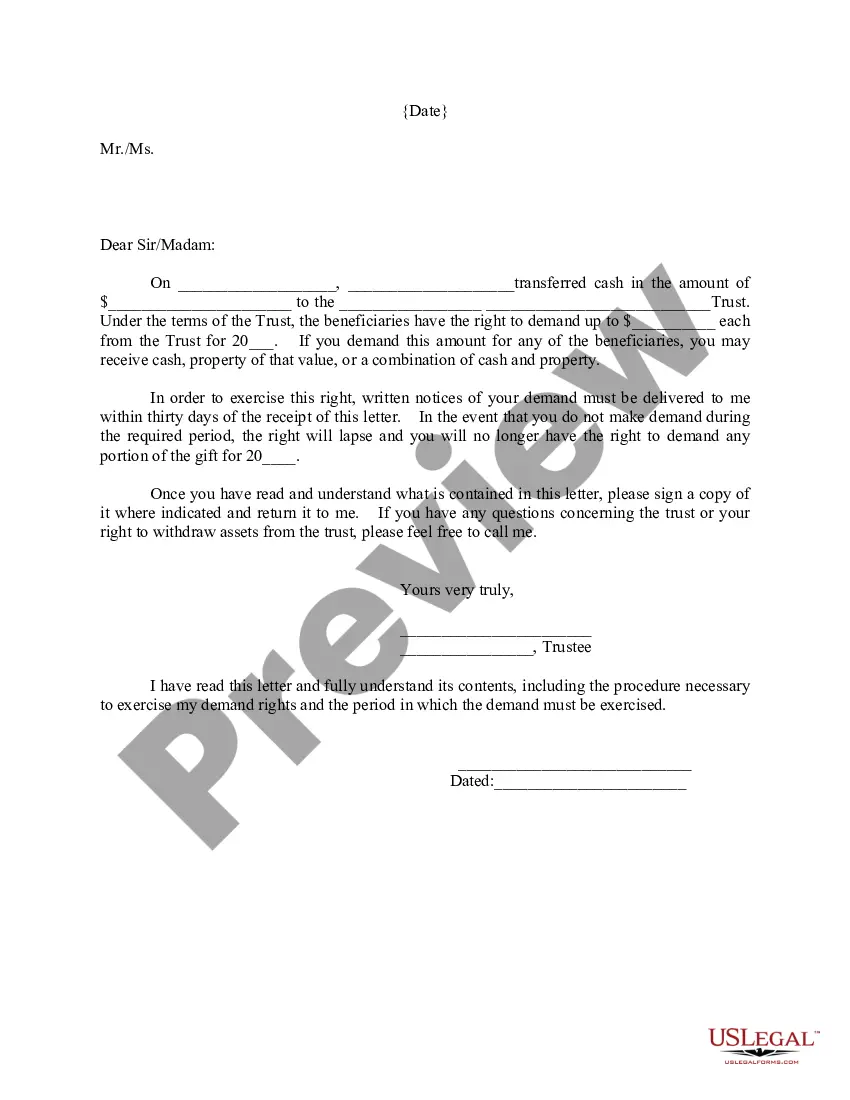
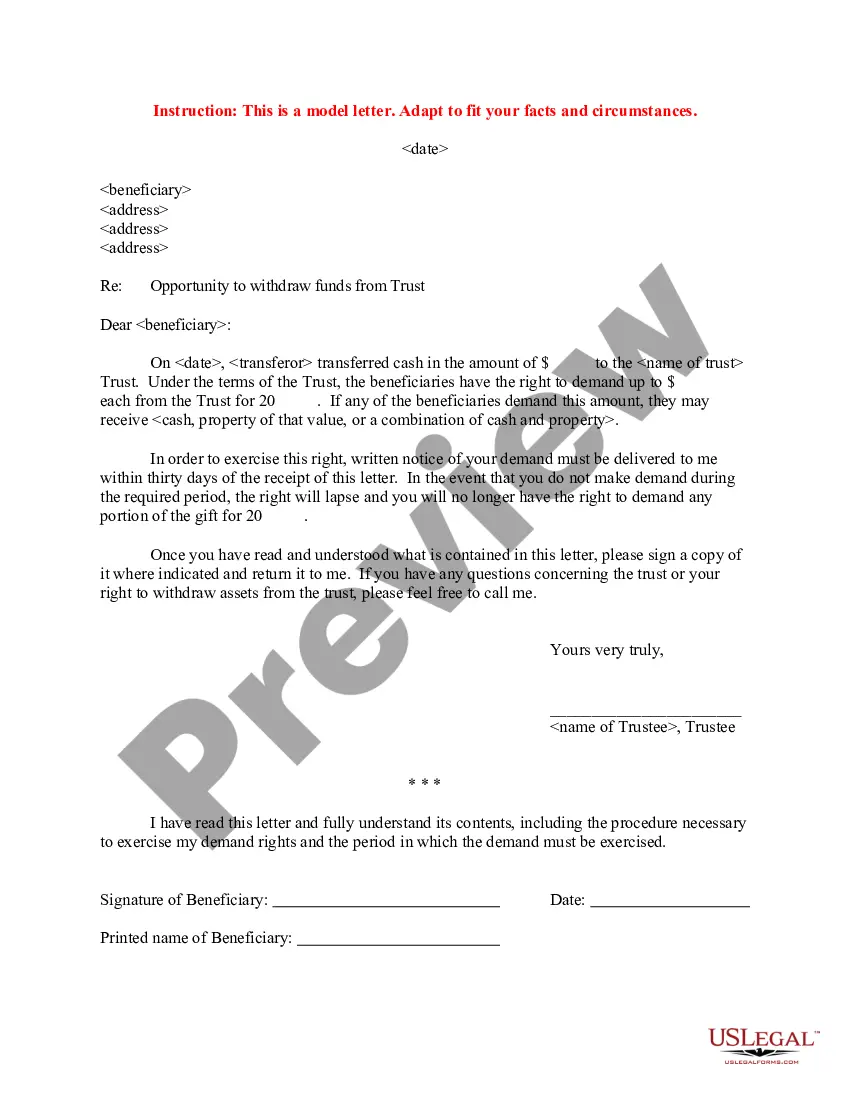
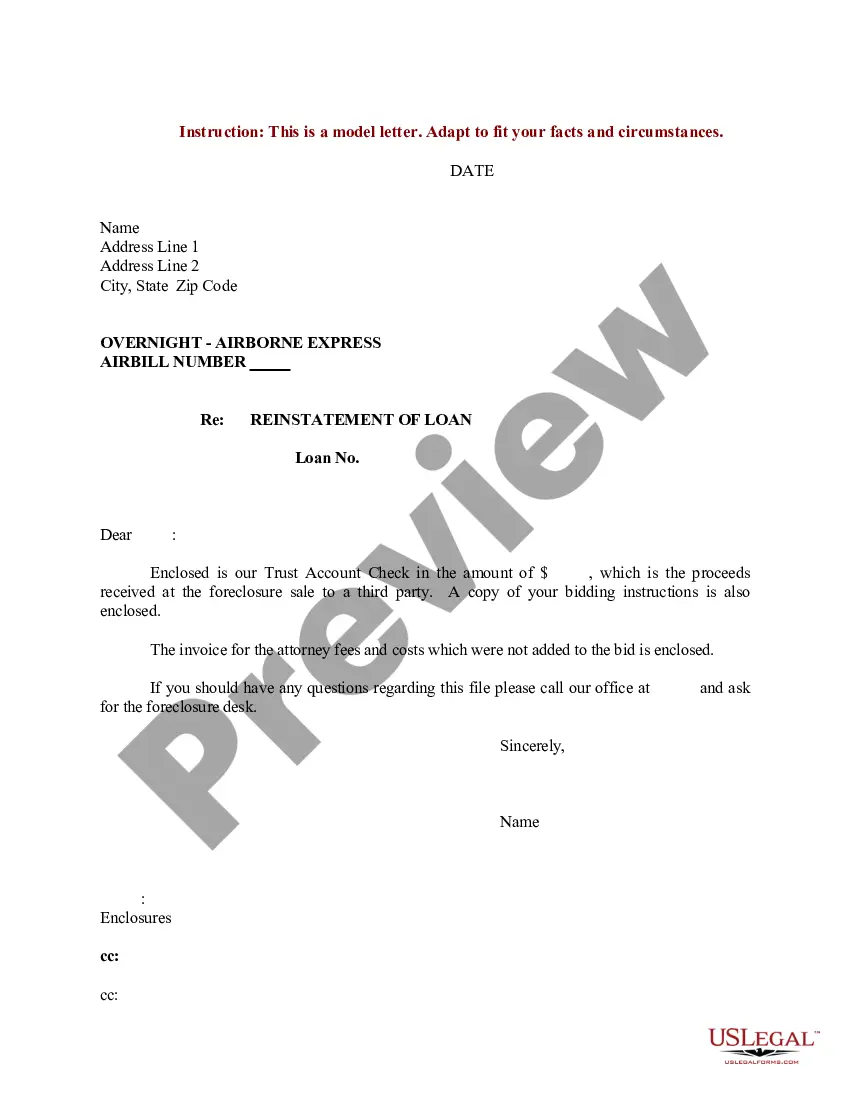
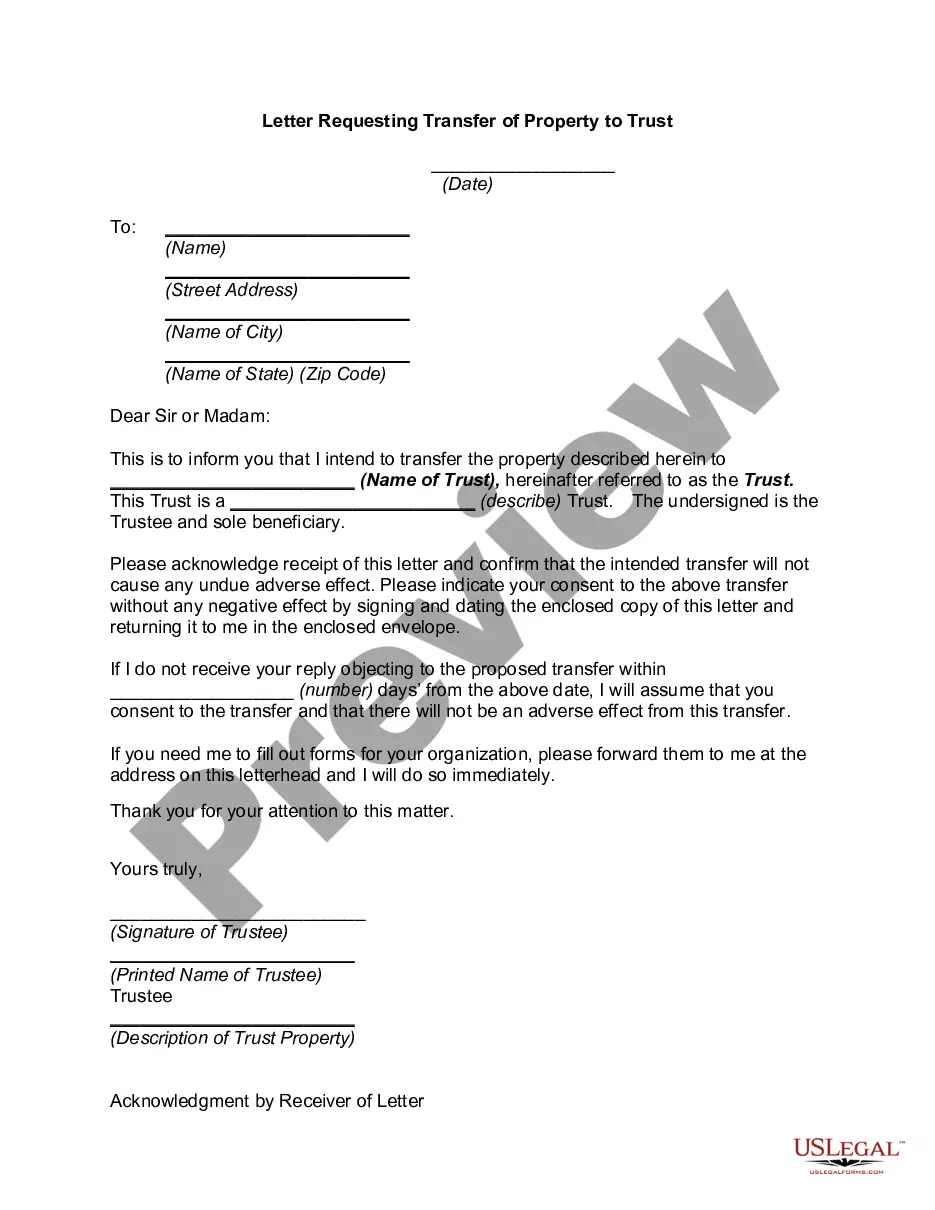
Trustee informs the trustor that he/she has the right to demand a certain amount of funds from the trust during the year. If the trustor demands a withdrawal for any of the beneficiaries, he/she may receive cash, property of that value, or a combination of cash and property.
Maine Letter regarding trust money
Instant download
Description
Get your form ready online
Our built-in tools help you complete, sign, share, and store your documents in one place.
Built-in online Word editor
Make edits, fill in missing information, and update formatting in US Legal Forms—just like you would in MS Word.
Export easily
Download a copy, print it, send it by email, or mail it via USPS—whatever works best for your next step.
E-sign your document
Sign and collect signatures with our SignNow integration. Send to multiple recipients, set reminders, and more. Go Premium to unlock E-Sign.
Notarize online 24/7
If this form requires notarization, complete it online through a secure video call—no need to meet a notary in person or wait for an appointment.
Store your document securely
We protect your documents and personal data by following strict security and privacy standards.

Make edits, fill in missing information, and update formatting in US Legal Forms—just like you would in MS Word.

Download a copy, print it, send it by email, or mail it via USPS—whatever works best for your next step.

Sign and collect signatures with our SignNow integration. Send to multiple recipients, set reminders, and more. Go Premium to unlock E-Sign.

If this form requires notarization, complete it online through a secure video call—no need to meet a notary in person or wait for an appointment.

We protect your documents and personal data by following strict security and privacy standards.
Looking for another form?



How to fill out Letter Regarding Trust Money?
Are you located in a situation where you require documentation for both business or personal purposes almost all the time.
There are numerous legal document templates accessible online, yet locating ones you can rely on is challenging.
US Legal Forms offers a plethora of form templates, including the Maine Letter concerning trust funds, which can be designed to meet federal and state requirements.
Once you find the appropriate form, just click Get now.
Choose the pricing plan you prefer, fill in the necessary information to create your account, and complete your order using your PayPal or credit card.
- If you are already familiar with the US Legal Forms site and possess an account, simply Log In.
- Then, you can download the Maine Letter concerning trust funds format.
- If you do not have an account and want to start using US Legal Forms, follow these instructions.
- Obtain the form you need and ensure it corresponds to the correct city/region.
- Utilize the Review button to examine the form.
- Read the description to confirm you have selected the correct form.
- If the form is not what you are looking for, use the Lookup field to find the form that satisfies your needs.
Form popularity
FAQ
Proof of funds for a trust refers to documentation that verifies the financial status of the trust. This may include account statements or a formal letter from the trustee confirming the assets held in the trust. If you require assistance in drafting this information, consider using uslegalforms for resources and templates that are compliant with Maine regulations.
For trusts, distributions are taxable to the beneficiary, and the trust must file a Schedule K-1 for each beneficiary paid. The beneficiary will then report the income on their tax return. The trust must also generate a Form 1041 to report the total amount of income the trust earned from the grantor's date of death.
Trusts: allocating income to beneficiaries but taxed to trust. The basic rules are as follows: If any of the trust's income is payable in a taxation year to a beneficiary, that amount is deductible in computing the trust's income for year. The amount payable is then included in the beneficiary's income.
Key Takeaways. A trust fund is designed to hold and manage assets on someone else's behalf, with the help of a neutral third party. Trust funds include a grantor, beneficiary, and trustee. The grantor of a trust fund can set terms for the way assets are to be held, gathered, or distributed.
Putting money in a trust lets you pass property to someone in a structured way, where you can impose rules. For example, you might say that your beneficiary can't use these funds to pay off debt. Or, you might impose rules on how old the beneficiary needs to be before she gains control over the money.
Interest in possession trust the beneficiary can get income from the trust straight away, but doesn't have a right to the cash, property or investments that generate that income. The beneficiary will need to pay Income Tax on the income received.
In some cases, Trust Funds can even be used to designate funds for certain purposes, such as healthcare or educational costs. If you are the beneficiary of a Trust Fund, the biggest benefit is likely the financial support you will receive.
One example would be a monthly payout from the trust for the rest of your life. Often times, trustees are able to distribute trust assets to beneficiaries for general well-being. One distribution method is so common it is often referred to as HEMS, which stands for: health, education, maintenance, and support.
The trust can pay out a lump sum or percentage of the funds, make incremental payments throughout the years, or even make distributions based on the trustee's assessments. Whatever the grantor decides, their distribution method must be included in the trust agreement drawn up when they first set up the trust.
The trust can pay out a lump sum or percentage of the funds, make incremental payments throughout the years, or even make distributions based on the trustee's assessments. Whatever the grantor decides, their distribution method must be included in the trust agreement drawn up when they first set up the trust.