Maine Testing Procedures and Failure to Conduct Certain Tests
Understanding this form
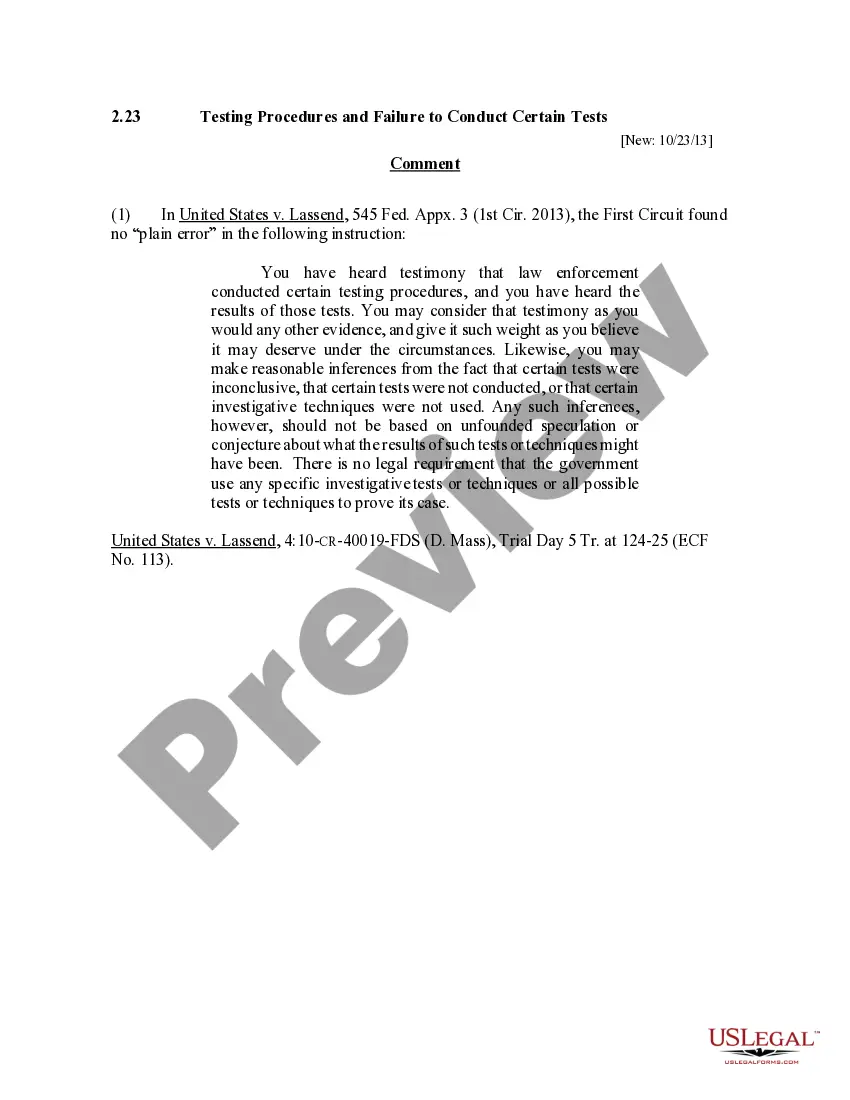
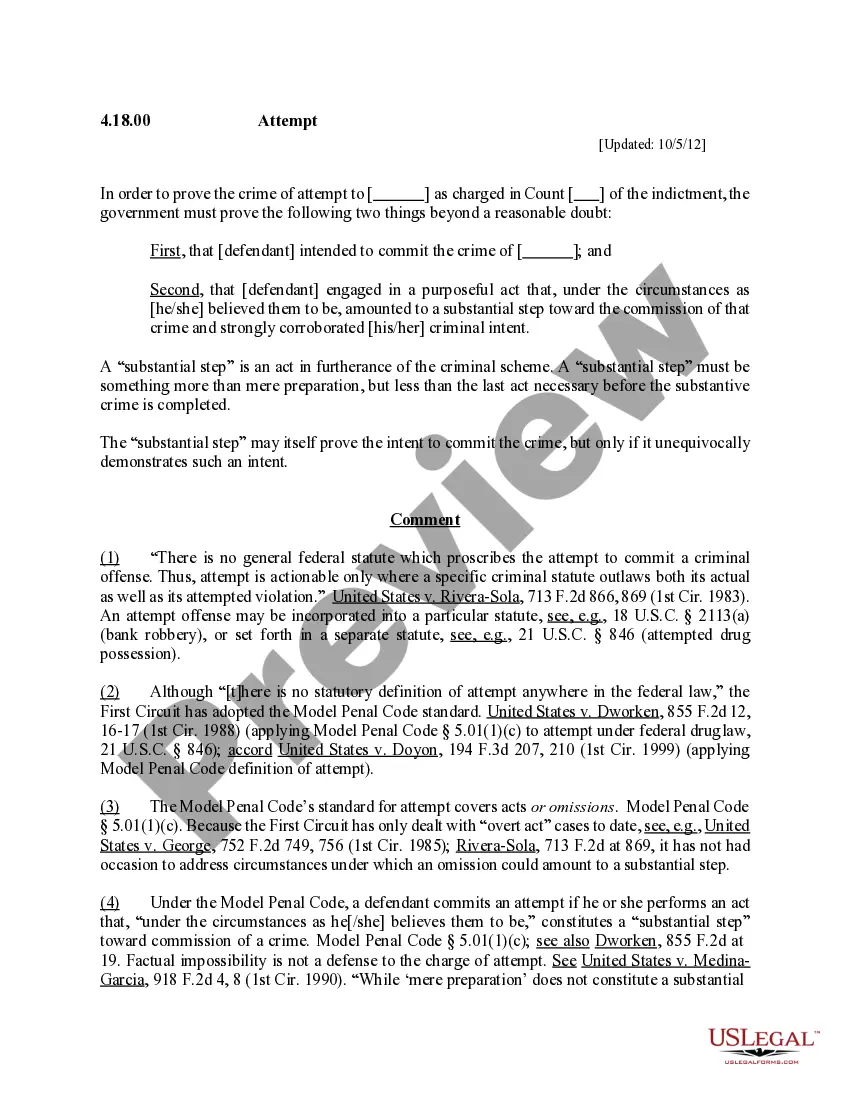
The Testing Procedures and Failure to Conduct Certain Tests form is an official pattern jury instruction used in criminal cases in federal district courts in Maine. This form offers guidance on how jurors should evaluate the evidence presented regarding testing procedures and the implications of tests not conducted. It is designed for use in legal contexts where understanding the limitations and expectations surrounding law enforcement testing is critical.
Key parts of this document
- Juror instructions on evaluating law enforcement testing procedures.
- Guidance on interpreting inconclusive or absent test results.
- Advisory on drawing reasonable inferences without speculation.
- Clarification that no specific investigative tests are legally required for the prosecution.
Situations where this form applies
This form is used in jury trials focusing on criminal cases, particularly where there is an issue regarding the adequacy of testing procedures employed by law enforcement. It is applicable in cases where the defense argues a failure to conduct certain tests, and jurors need guidance on how such failures may affect their interpretation of guilt or innocence.
Who needs this form
- Judges presiding over criminal trials to provide jurors with appropriate legal instructions.
- Attorneys representing the defense or prosecution needing to understand jury instruction content.
- Jurors seeking clarification on how to consider evidence related to testing procedures.
How to complete this form
- Review the legal context of the case to understand relevant testing procedures.
- Provide jurors with clear instructions regarding how to weigh the evidence of conducted tests.
- Include specific guidance on making reasonable inferences based on the available evidence.
Notarization requirements for this form
This form usually doesn’t need to be notarized. However, local laws or specific transactions may require it. Our online notarization service, powered by Notarize, lets you complete it remotely through a secure video session, available 24/7.
Get your form ready online
Our built-in tools help you complete, sign, share, and store your documents in one place.
Make edits, fill in missing information, and update formatting in US Legal Forms—just like you would in MS Word.
Download a copy, print it, send it by email, or mail it via USPS—whatever works best for your next step.
Sign and collect signatures with our SignNow integration. Send to multiple recipients, set reminders, and more. Go Premium to unlock E-Sign.
If this form requires notarization, complete it online through a secure video call—no need to meet a notary in person or wait for an appointment.
We protect your documents and personal data by following strict security and privacy standards.

Make edits, fill in missing information, and update formatting in US Legal Forms—just like you would in MS Word.

Download a copy, print it, send it by email, or mail it via USPS—whatever works best for your next step.

Sign and collect signatures with our SignNow integration. Send to multiple recipients, set reminders, and more. Go Premium to unlock E-Sign.

If this form requires notarization, complete it online through a secure video call—no need to meet a notary in person or wait for an appointment.

We protect your documents and personal data by following strict security and privacy standards.
Common mistakes
- Assuming all tests must be conducted in every case.
- Misinterpreting the implications of inconclusive test results.
- Failing to consider the context of omitted tests in deliberations.
Advantages of online completion
- Accessible formatting allows for easy downloading and printing.
- Customizable content to suit specific case needs or courtroom requirements.
- Reliable legal information drafted by licensed attorneys ensures accuracy.
Legal use & context
- This form is utilized to clarify the legal standards surrounding investigative techniques in criminal trials.
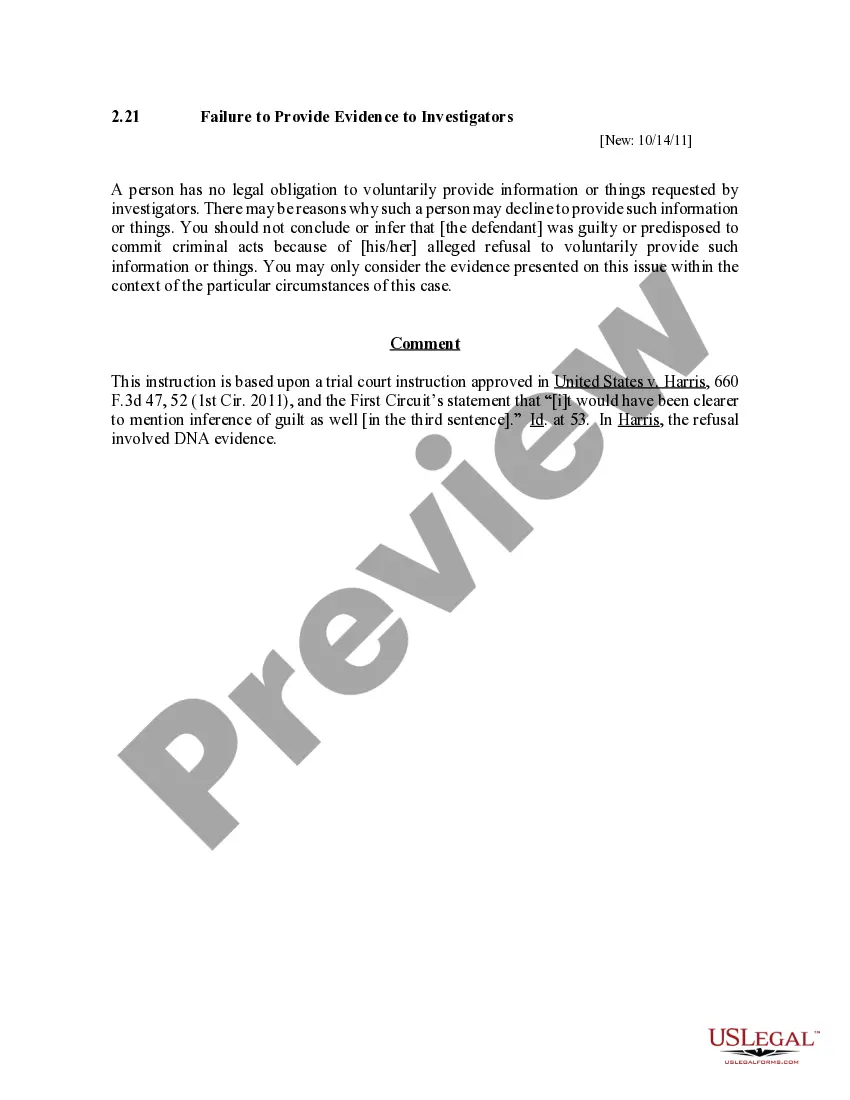
- It reinforces the principle that jurors should not speculate on outcomes of potential tests not conducted by law enforcement.
- The instructions aim to ensure a fair and unbiased evaluation of the evidence presented during a trial.
Key takeaways
- The form provides a framework for jurors on interpreting evidence related to law enforcement testing.
- No specific investigative techniques are mandated for proving a case.
- Usage of this form supports fair trial principles by guiding juror reasoning processes.
Looking for another form?
Form popularity
FAQ
However, if the specimen is extremely dilute (creatinine of 2-5mg/dl) the employer must retest under direct observation4. If the second specimen test result is also returned as dilute, then that is considered a final result and no further tests are performed.
Failure to appear. A defendant who has been admitted to either preconviction or postconviction bail and who, in fact, fails to appear as required is guilty of: A. A Class E crime if the underlying crime was punishable by a maximum period of imprisonment of less than one year; or PL 2003, c.
1. A law enforcement officer who has probable cause to believe a crime has been or is being committed by a person may issue or have delivered a written summons to that person directing that person to appear in the appropriate trial court to answer the allegation that the person has committed the crime.
Except as provided in subsection 4, a person is guilty of cultivating marijuana if: A. The person intentionally or knowingly grows or cultivates marijuana. Violation of this paragraph is a Class E crime; or PL 2009, c.
1. A person is guilty of aggravated criminal mischief if that person: A. Intentionally, knowingly or recklessly damages or destroys property of another in an amount exceeding $2,000 in value, having no reasonable ground to believe that the person has a right to do so; PL 2005, c.
If an employee leaves before fully attempting to provide a specimen in the 3 hours allotted or before being excused by the collector, this is a refusal to test.
A person is guilty of assault if: A. The person intentionally, knowingly or recklessly causes bodily injury or offensive physical contact to another person. Violation of this paragraph is a Class D crime; or PL 2001, c.
Class A offenses are the most serious crimes under Maine law. For that reason, they carry the stiffest penalties as well. Class A offenses include rape, murder, and aggravated trafficking of drugs.