Maine Impeachment by Prior Inconsistent Statement
About this form
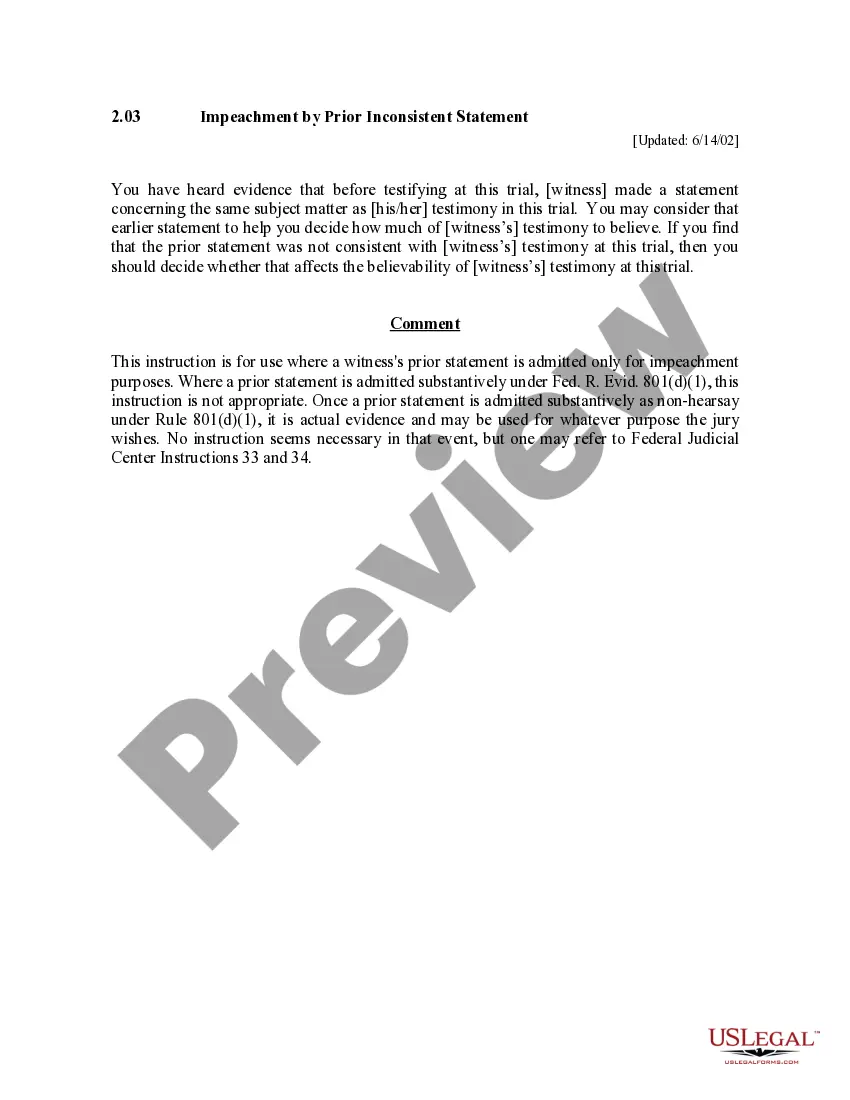
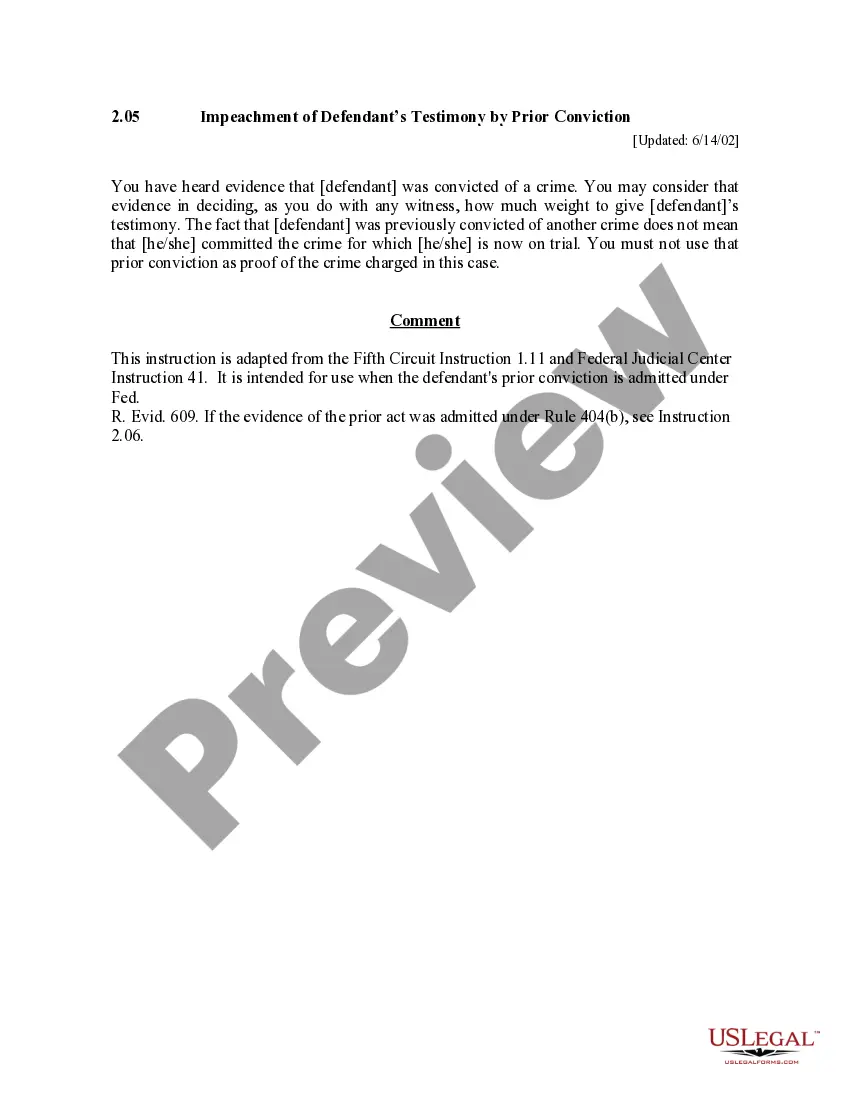
The Impeachment by Prior Inconsistent Statement form is a legal instruction used in criminal trials to evaluate the credibility of a witness's testimony. Specifically, it allows jurors to consider earlier statements made by a witness that may contradict their current testimony. This form differs from other evidentiary instructions as it focuses solely on discrediting the witness rather than establishing the truth of the statement itself. Understanding this form is vital for any legal professional involved in federal criminal cases, particularly in the Federal District Court of Maine.
Main sections of this form
- Identification of the witness whose prior statement is being evaluated.
- Clarification that the earlier statement helps determine the believability of the witness's current testimony.
- Directions on deciding the impact of inconsistencies on the witness's credibility.
- Specific points related to when prior statements may not be used solely for impeachment purposes.
Common use cases
This form is necessary in situations where a witness has provided conflicting statements about the same subject matter before and during a trial. It is relevant in criminal cases where the integrity of witness testimony is critical to the case outcome. Legal professionals can use this instruction to guide jurors on how to assess the reliability of a witness's current statements in light of prior inconsistencies.
Who should use this form
- Judges presiding over federal criminal trials who need to instruct juries on evaluating witness credibility.
- Attorneys representing clients in criminal cases where witness testimony is a crucial component of the case.
- Legal aides or paralegals involved in preparing jury instructions and related documentation.
How to prepare this document
- Identify the witness and clearly state their name in the provided section.
- Summarize the witness's prior statement relevant to the case.
- Document the inconsistencies between the prior statement and the current testimony.
- Consider the implications of these inconsistencies on the jury's assessment of the witness's credibility.
- Ensure the instruction aligns with federal rules regarding hearsay and admissibility.
Notarization guidance
This form usually doesn’t need to be notarized. However, local laws or specific transactions may require it. Our online notarization service, powered by Notarize, lets you complete it remotely through a secure video session, available 24/7.
Get your form ready online
Our built-in tools help you complete, sign, share, and store your documents in one place.
Make edits, fill in missing information, and update formatting in US Legal Forms—just like you would in MS Word.
Download a copy, print it, send it by email, or mail it via USPS—whatever works best for your next step.
Sign and collect signatures with our SignNow integration. Send to multiple recipients, set reminders, and more. Go Premium to unlock E-Sign.
If this form requires notarization, complete it online through a secure video call—no need to meet a notary in person or wait for an appointment.
We protect your documents and personal data by following strict security and privacy standards.

Make edits, fill in missing information, and update formatting in US Legal Forms—just like you would in MS Word.

Download a copy, print it, send it by email, or mail it via USPS—whatever works best for your next step.

Sign and collect signatures with our SignNow integration. Send to multiple recipients, set reminders, and more. Go Premium to unlock E-Sign.

If this form requires notarization, complete it online through a secure video call—no need to meet a notary in person or wait for an appointment.

We protect your documents and personal data by following strict security and privacy standards.
Common mistakes to avoid
- Failing to accurately quote prior inconsistent statements, leading to confusion.
- Overlooking the specific guidelines that govern hearsay implications in federal court.
- Neglecting to explain the relevance of the prior statement to the jury's considerations.
Benefits of using this form online
- Convenience of accessing and downloading the form from any location without the need for physical copies.
- Editability allows legal professionals to easily customize the form to fit specific cases.
- Reliability of information provided, as the form is drafted by licensed attorneys.
Legal use & context
- Impeachment by prior inconsistent statement is a legal standard recognized under federal evidence rules.
- This instruction is crucial to ensure jurors have guidance on evaluating conflicting testimony.
- Using this form correctly can significantly impact the verdict in a criminal trial.
Looking for another form?
Form popularity
FAQ
?In order to lay the proper predicate for impeachment by prior inconsistent statement, the witness must be advised of the substance of the prior inconsistent statement, the time and place the statement was made, and the person to whom the statement was made.? See Kimble v. State, 537 So.
You cannot effectively impeach unless the witness repeats a fact they said during the current hearing that clearly contradicts a prior statement. While this seems simple enough, you can easily run into trouble by tipping off the witness that you are about to impeach them.
613(b) in that extrinsic evidence of a prior inconsistent statement is not admissible unless the statement is shown or disclosed to the witness during the witness's examination. Paragraph (b) is intended to give the witness and the party a fair opportunity to explain or deny the allegation.
613(b) in that extrinsic evidence of a prior inconsistent statement is not admissible unless the statement is shown or disclosed to the witness during the witness's examination. Paragraph (b) is intended to give the witness and the party a fair opportunity to explain or deny the allegation.
Impeachment by prior inconsistent statement is used when a witness remembers a fact, but previously made a different statement about that fact.
Rule 613(b) allows a party to use a prior inconsistent statement to impeach a witness, but if the witness is called to the stand for sole purpose of impeaching him, the ?impeachment? is really a subterfuge for admitting the hearsay.
Prior inconsistent statements are always admissible to impeach a witness, so long as they're in fact inconsistent. Prior inconsistent statements are admissible for their truth only if given under oath at a trial, hearing, or other proceeding.