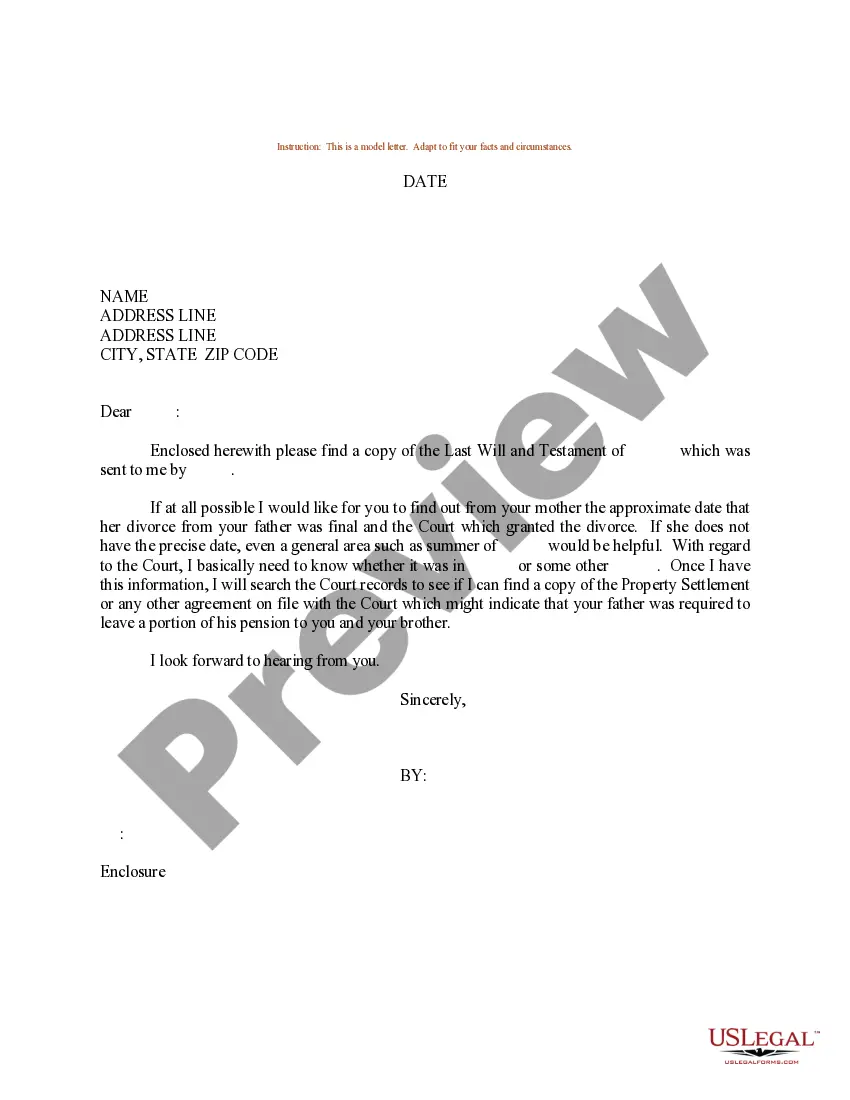
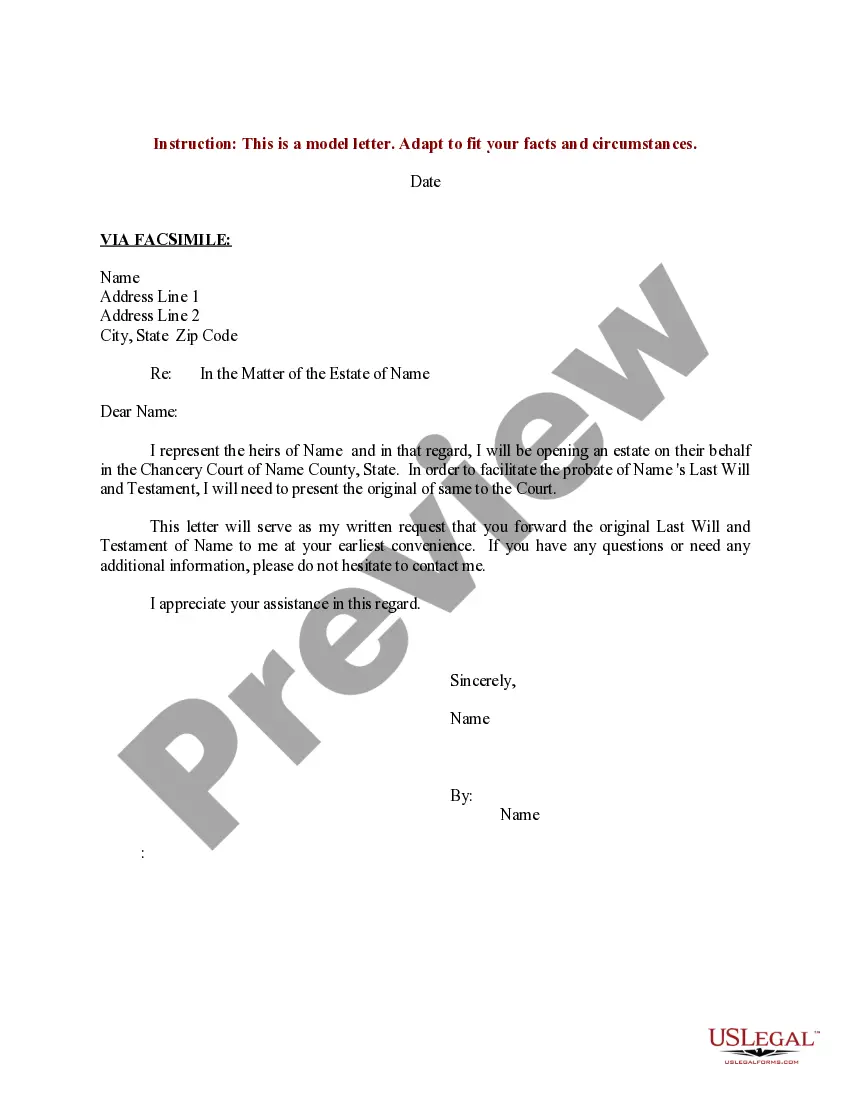
Maryland Sample Letter transmitting Last Will and Testament of Decedent
Description
Get your form ready online
Our built-in tools help you complete, sign, share, and store your documents in one place.
Make edits, fill in missing information, and update formatting in US Legal Forms—just like you would in MS Word.
Download a copy, print it, send it by email, or mail it via USPS—whatever works best for your next step.
Sign and collect signatures with our SignNow integration. Send to multiple recipients, set reminders, and more. Go Premium to unlock E-Sign.
If this form requires notarization, complete it online through a secure video call—no need to meet a notary in person or wait for an appointment.
We protect your documents and personal data by following strict security and privacy standards.

Make edits, fill in missing information, and update formatting in US Legal Forms—just like you would in MS Word.

Download a copy, print it, send it by email, or mail it via USPS—whatever works best for your next step.

Sign and collect signatures with our SignNow integration. Send to multiple recipients, set reminders, and more. Go Premium to unlock E-Sign.

If this form requires notarization, complete it online through a secure video call—no need to meet a notary in person or wait for an appointment.

We protect your documents and personal data by following strict security and privacy standards.
Looking for another form?





How to fill out Sample Letter Transmitting Last Will And Testament Of Decedent?
It is feasible to allocate time on the Internet searching for the legal document format that meets the federal and state requirements you will need. US Legal Forms offers a vast selection of legal templates that have been reviewed by experts.
You can indeed download or create the Maryland Sample Letter conveying Last Will and Testament of Decedent from my service. If you already have a US Legal Forms account, you may Log In and click the Download button. Subsequently, you can complete, modify, print, or sign the Maryland Sample Letter conveying Last Will and Testament of Decedent.
Each legal document format you obtain is yours indefinitely. To acquire another copy of any purchased form, visit the My documents section and click the corresponding button. If you are accessing the US Legal Forms website for the first time, follow these straightforward instructions: First, ensure you have selected the correct format for the area/city of your choice. Review the document details to confirm you have chosen the appropriate form. If available, utilize the Preview button to examine the format as well.
Download and print numerous document templates using the US Legal Forms website, which provides the largest assortment of legal templates. Utilize professional and state-specific templates to address your business or personal needs.
- To find another version of the form, use the Search field to locate the format that meets your needs.
- Once you have discovered the format you wish for, click on Buy now to proceed.
- Select the pricing plan you prefer, enter your details, and register for an account on US Legal Forms.
- Complete the transaction. You can use your credit card or PayPal account to pay for the legal document.
- Choose the format from the document and download it to your device.
- Make modifications to your document if necessary.
- You can complete, edit, and sign and print the Maryland Sample Letter conveying Last Will and Testament of Decedent.
Form popularity
FAQ
Yes, in Maryland, wills must be filed with the court for probate after the death of the individual. This legal requirement ensures that the decedent's wishes are honored and that the estate is administered properly. Utilizing resources like USLegalForms can help you prepare the necessary documents, including the Maryland Sample Letter transmitting Last Will and Testament of Decedent, to streamline this process. Filing the will with the court provides transparency and protects the rights of all interested parties.
No, the last will and testament does not need to be notarized in Maryland to be valid. However, notarization can help in proving the authenticity of the document and may prevent future challenges. If you're preparing a Maryland Sample Letter transmitting Last Will and Testament of Decedent, consider having it notarized for added assurance.
To make a will legal in Maryland, it must include the testator's name, a declaration that it is their last will, signatures of the testator and witnesses, and clear instructions for asset distribution. It is important to be specific about beneficiaries and any conditions attached to gifts. When creating a Maryland Sample Letter transmitting Last Will and Testament of Decedent, ensure that all these elements are included.
Banks typically do not notarize wills because they are not legally responsible for the contents of the document. Notarizing a will requires a specialized understanding of estate law and the specific wishes of the decedent. When using a Maryland Sample Letter transmitting Last Will and Testament of Decedent, it is wise to seek notarization from a qualified professional, such as an attorney.
An alternative to a letter of testamentary is a letter of administration. This document is issued when an individual dies without a will, granting someone the authority to manage the estate. If you are dealing with a Maryland Sample Letter transmitting Last Will and Testament of Decedent, be aware of these options to ensure proper estate management.
For a will to be valid in Maryland, it must be in writing, signed by the testator, and witnessed by at least two individuals. These witnesses must be present when the testator signs the will or acknowledges their signature. When drafting a Maryland Sample Letter transmitting Last Will and Testament of Decedent, ensure these requirements are met for legal compliance.
In Maryland, notarization is not required for a will to be valid. However, having a will notarized can provide additional legal protection and help avoid disputes. If you're preparing a Maryland Sample Letter transmitting Last Will and Testament of Decedent, consider including a notarization to strengthen its validity and acceptance.
No, a letter of testamentary is not the same as a will. The letter of testamentary is a legal document issued by a court that gives the executor the authority to act on behalf of the deceased's estate. In contrast, the will outlines the decedent's wishes regarding the distribution of their assets. For anyone needing to create a Maryland Sample Letter transmitting Last Will and Testament of Decedent, understanding these distinctions is essential.
To obtain a letter of administration, you typically need the decedent's death certificate, identification, and any relevant documents, including the Maryland Sample Letter transmitting Last Will and Testament of Decedent. You must file a petition with the Register of Wills and may need to provide additional information about the estate. Having all your documents ready ensures a more efficient process, allowing you to fulfill your role as administrator effectively.
Yes, wills are generally considered public records in Maryland once they are filed with the Register of Wills. This means that anyone can access them, including the Maryland Sample Letter transmitting Last Will and Testament of Decedent, if it has been submitted. Public access to wills ensures transparency in the probate process and allows beneficiaries to verify the terms of the decedent's estate. Understanding this can help you navigate any related inquiries.