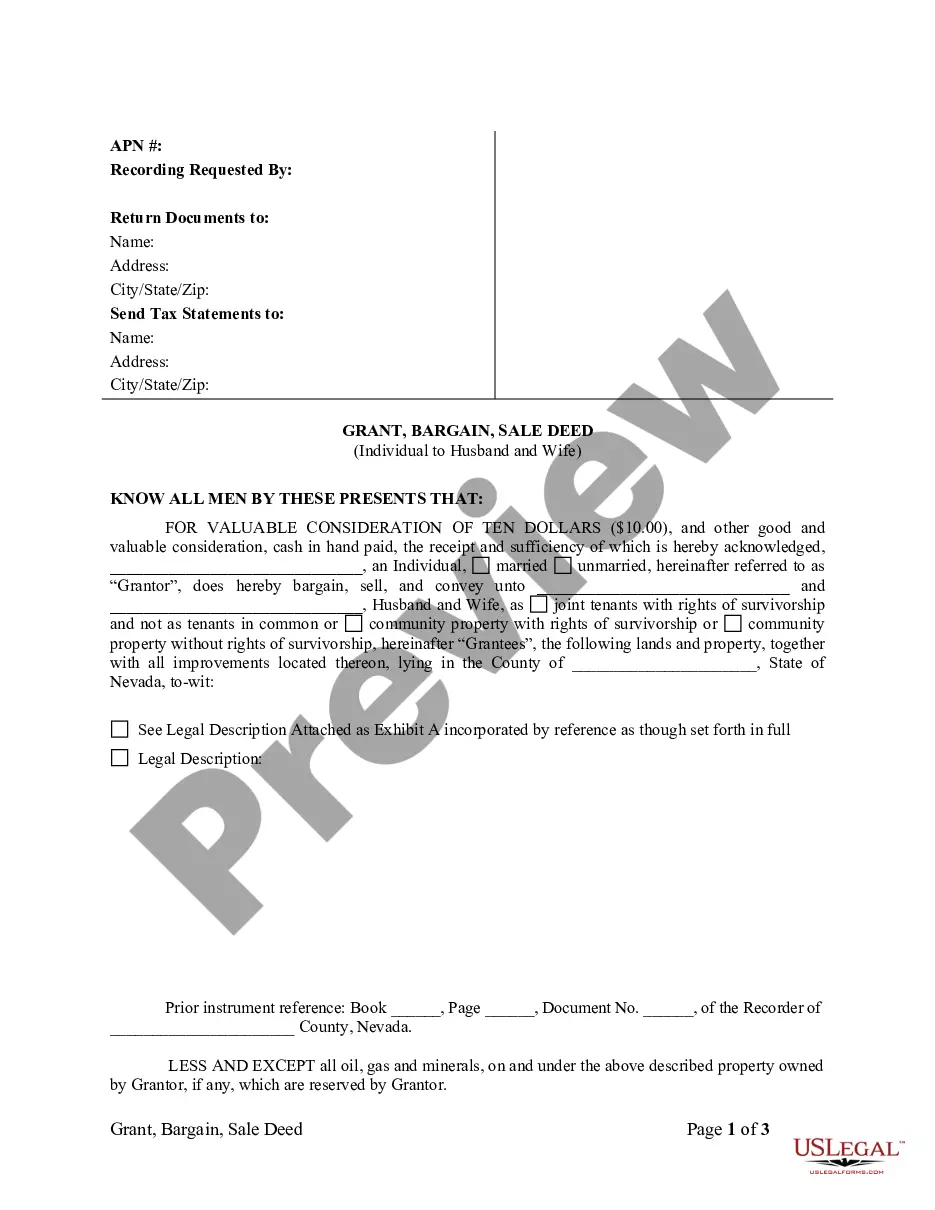
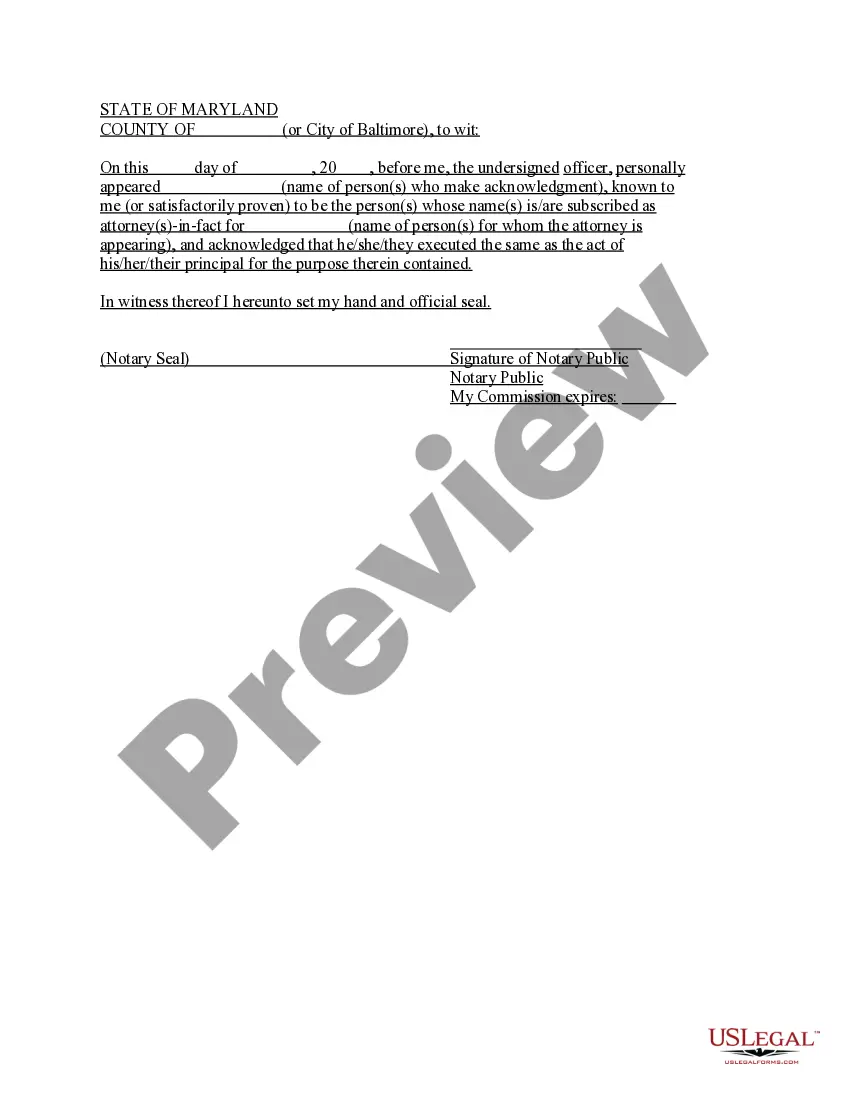
Maryland Acknowledgment of Attorney-in-Fact
What is this form?
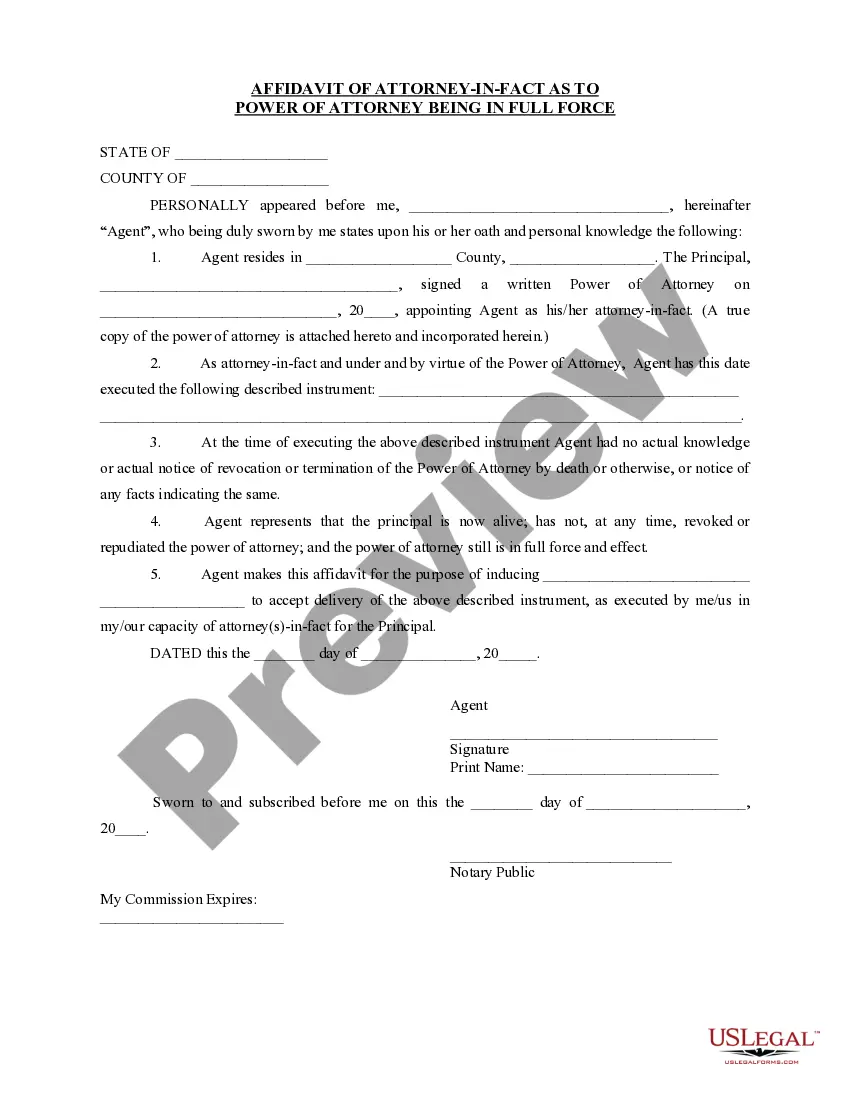
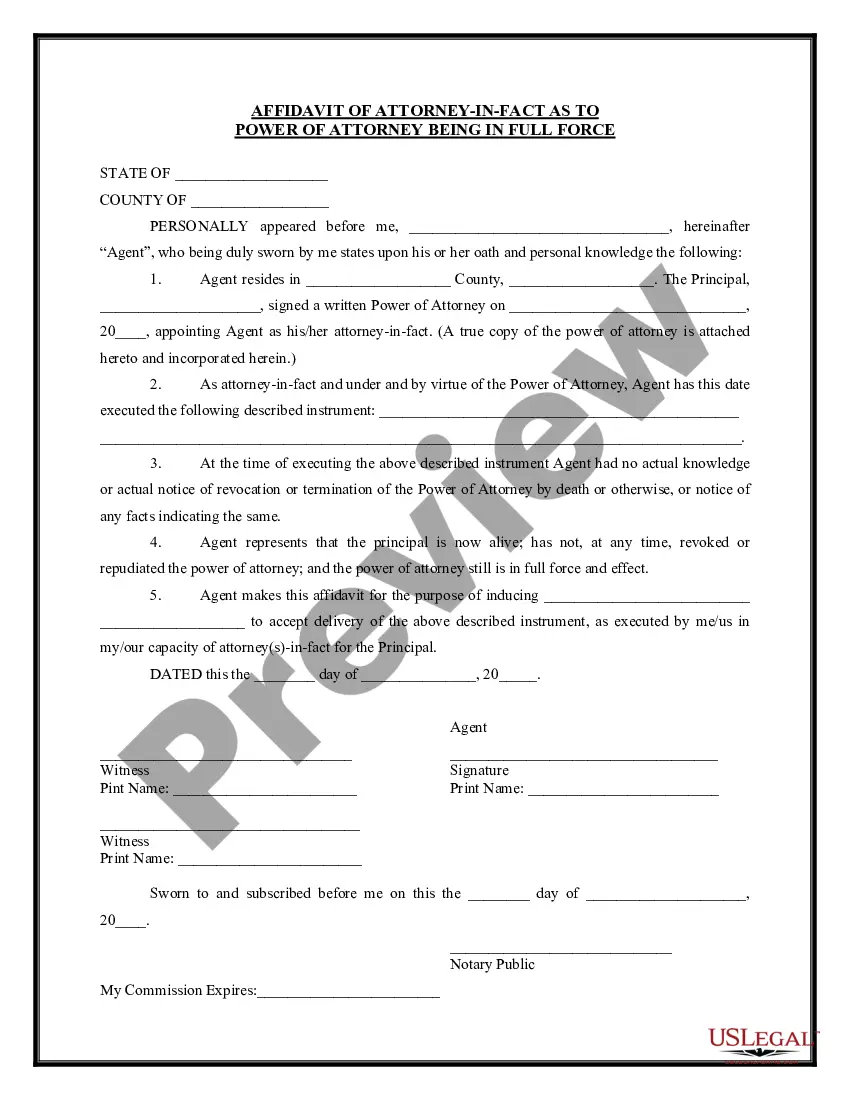
The Acknowledgment of Attorney-in-Fact is a legal form used to affirm that an individual has the authority to act on behalf of another person in legal or financial matters. This document serves as proof of representation, allowing the designated individual (the attorney-in-fact) to perform acts specified in a power of attorney. It is crucial to note that this form differs from a general Power of Attorney, as it specifically acknowledges the authority granted to the attorney-in-fact.
Key parts of this document
- Date of execution: Indicates when the acknowledgment is being made.
- Names of the parties: Includes the full names of both the principal (the person granting authority) and the attorney-in-fact.
- Notarization section: Contains a space for the notary public to sign and seal the document, affirming its authenticity.
- Purpose statement: A declaration that the attorney-in-fact has executed the form as an act of the principal.

When this form is needed
This form is used when a person has delegated authority to another individual to make decisions or act on their behalf, particularly in situations like managing financial transactions, signing legal documents, or handling real estate matters. It becomes essential when formal acknowledgment is needed to validate the attorney-in-factâs role, especially in legal or banking situations.
Who can use this document
Individuals who should consider using this form include:
- Anyone granting authority to another person to handle specific tasks.
- Individuals involved in legal proceedings where representation is necessary.
- Those who require validation of their attorney-in-fact's authority for financial institutions or governmental bodies.
How to prepare this document
To complete the Acknowledgment of Attorney-in-Fact form, follow these steps:
- Identify the parties: Enter the full names of the principal and the attorney-in-fact.
- Specify the date: Write the date when the acknowledgment is being executed.
- Complete the purpose statement: Confirm the act being performed by the attorney-in-fact.
- Notarization: Ensure that a notary public signs and seals the document for validity.
Does this form need to be notarized?
Yes, this form must be notarized to be legally valid. Notarization provides an additional layer of authenticity and helps prevent fraud. US Legal Forms offers integrated online notarization services, available 24/7, allowing you to complete this process via a secure video call without the need to travel.
Get your form ready online
Our built-in tools help you complete, sign, share, and store your documents in one place.
Make edits, fill in missing information, and update formatting in US Legal Forms—just like you would in MS Word.
Download a copy, print it, send it by email, or mail it via USPS—whatever works best for your next step.
Sign and collect signatures with our SignNow integration. Send to multiple recipients, set reminders, and more. Go Premium to unlock E-Sign.
If this form requires notarization, complete it online through a secure video call—no need to meet a notary in person or wait for an appointment.
We protect your documents and personal data by following strict security and privacy standards.

Make edits, fill in missing information, and update formatting in US Legal Forms—just like you would in MS Word.

Download a copy, print it, send it by email, or mail it via USPS—whatever works best for your next step.

Sign and collect signatures with our SignNow integration. Send to multiple recipients, set reminders, and more. Go Premium to unlock E-Sign.

If this form requires notarization, complete it online through a secure video call—no need to meet a notary in person or wait for an appointment.

We protect your documents and personal data by following strict security and privacy standards.
Avoid these common issues
- Failing to notarize the form when required, which can result in the document being deemed invalid.
- Leaving out important details like the names of the parties or the effective date of the authority.
- Not ensuring that the person signing as the attorney-in-fact is present during notarization.
Why complete this form online
- Convenience of downloading and completing the form from home.
- Editable format allows users to fill in information accurately before printing.
- Quick access to legal acknowledgment, making it easier to manage responsibilities promptly.
Looking for another form?
Form popularity
FAQ
An acknowledgment for a notary in Maryland is a formal declaration by a person who signs a document, verified by a notary public. In this context, the notary confirms that the signer acknowledges their signature and understands the purpose of the document, such as a Maryland Acknowledgment of Attorney-in-Fact. This process is crucial as it solidifies the document's legality and can prevent future disputes.
To fill out a notary acknowledgment in Maryland, start by completing the document that requires the acknowledgment. Next, take this document to a notary public, who will verify your identity and witness your signature. Finally, the notary will complete the acknowledgment form, ensuring it complies with the Maryland Acknowledgment of Attorney-in-Fact requirements.
An attorney-in-fact is a person you appoint through a legal document to act on your behalf in specified matters. This designation grants them the authority to make decisions and sign documents, which is essential for effective management of your affairs. Understanding this role is vital when dealing with the Maryland Acknowledgment of Attorney-in-Fact.
An example of an acknowledgment for a notary involves a statement attesting that the signer is indeed who they claim to be. The notary public will often fill out a form that includes details like the date, signer's name, and a description of the document. This process is essential for the Maryland Acknowledgment of Attorney-in-Fact to confirm the validity of the signer’s intent and capacity.
Most states offer simple forms to help you create a power of attorney for finances. Generally, the document must be signed, witnessed and notarized by an adult. If your agent will have to deal with real estate assets, some states require you to put the document on file in the local land records office.
The power of attorney form must be notarized.Powers of attorney, advance directives, and wills require signatures from two witnesses. During the state of emergency these documents may be witnessed remotely when supervised by a Maryland lawyer.
3 attorney answers Sign his name and then add underneath "by your name, attorney in fact".
An attorney in fact is a person authorized to sign documents on someone else's behalf, but is not necessarily a practicing lawyer.When an attorney in fact signs a document, the signature should include the name of the principal he or she represents.
When the document goes into effect, you become that person's attorney in fact, which means you act as their agent. Generally, to sign documents in this capacity, you will sign the principal's name first, then your name with the designation "attorney in fact" or "power of attorney."
After the principal's name, write by and then sign your own name. Under or after the signature line, indicate your status as POA by including any of the following identifiers: as POA, as Agent, as Attorney in Fact or as Power of Attorney.