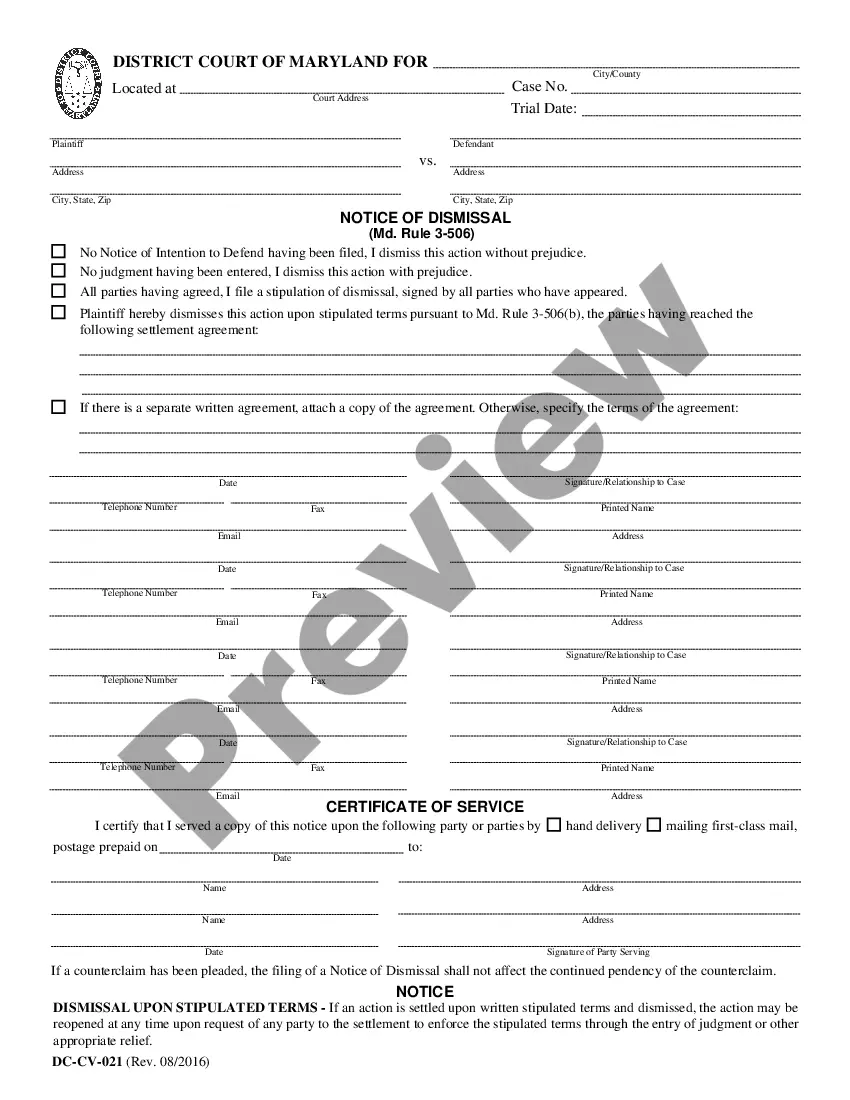
Maryland Notice of Dismissal
Notarization guidance
Notarization is generally not required for this form. However, certain states or situations might demand it. You can complete notarization online through US Legal Forms, powered by Notarize, using a verified video call available anytime.
Get your form ready online
Our built-in tools help you complete, sign, share, and store your documents in one place.
Make edits, fill in missing information, and update formatting in US Legal Forms—just like you would in MS Word.
Download a copy, print it, send it by email, or mail it via USPS—whatever works best for your next step.
Sign and collect signatures with our SignNow integration. Send to multiple recipients, set reminders, and more. Go Premium to unlock E-Sign.
If this form requires notarization, complete it online through a secure video call—no need to meet a notary in person or wait for an appointment.
We protect your documents and personal data by following strict security and privacy standards.

Make edits, fill in missing information, and update formatting in US Legal Forms—just like you would in MS Word.

Download a copy, print it, send it by email, or mail it via USPS—whatever works best for your next step.

Sign and collect signatures with our SignNow integration. Send to multiple recipients, set reminders, and more. Go Premium to unlock E-Sign.

If this form requires notarization, complete it online through a secure video call—no need to meet a notary in person or wait for an appointment.

We protect your documents and personal data by following strict security and privacy standards.
Looking for another form?
Form popularity
FAQ
Dismissal with prejudice is a final judgment and the case becomes res judicata on the claims that were or could have been brought in it; dismissal without prejudice is not.
What to Do If You Receive a Writ of Summons. As the defendant, after receiving a writ, you must then decide if you wish to contest the claim. If you choose not to contest the claim, the plaintiff can apply for a judgment without trial.Subsequent to your appearance, you must then serve your defence on the plaintiff.
A stipulated dismissal is always a voluntary agreement between the parties. After the court makes a determination of how much the defendant should pay, the parties can enter into the agreement and have it entered as an order by the judge.
Defend yourself in court; File a cross claim, counter claim or third party claim; Assert that the Writ of Summons was not served properly; or. Simply ignore the debt collection case.
Fill out your court forms. Fill out a Request for Dismissal (Form CIV-110 ). File your forms at the courthouse where you filed your case. Serve the other side with a copy of the dismissal papers. File the Notice of Entry of Dismissal and Proof of Service (Form CIV-120)
Once the court has accepted your complaint, a "Writ of Summons" will be issued and you must be sure the defendant is notified of the case through a legal procedure called service of process. The Writ of Summons has an expiration date, so pay close attention to the date by which you must have the defendant served.
Don't ignore it. If you do this, the court will simply rule in the issuer or debt collector's favor. Try to work things out. Answer the summons. Consult an attorney. Go to court. Respond to the ruling.
Read the summons and make sure you know the date you must answer by. Read the complaint carefully. Write your answer. Sign and date the answer. Make copies for the plaintiff and yourself. Mail a copy to the plaintiff. File your answer with the court by the date on the summons.
In the formal legal world, a court case that is dismissed with prejudice means that it is dismissed permanently. A case dismissed with prejudice is over and done with, once and for all, and can't be brought back to court. A case dismissed without prejudice means the opposite.