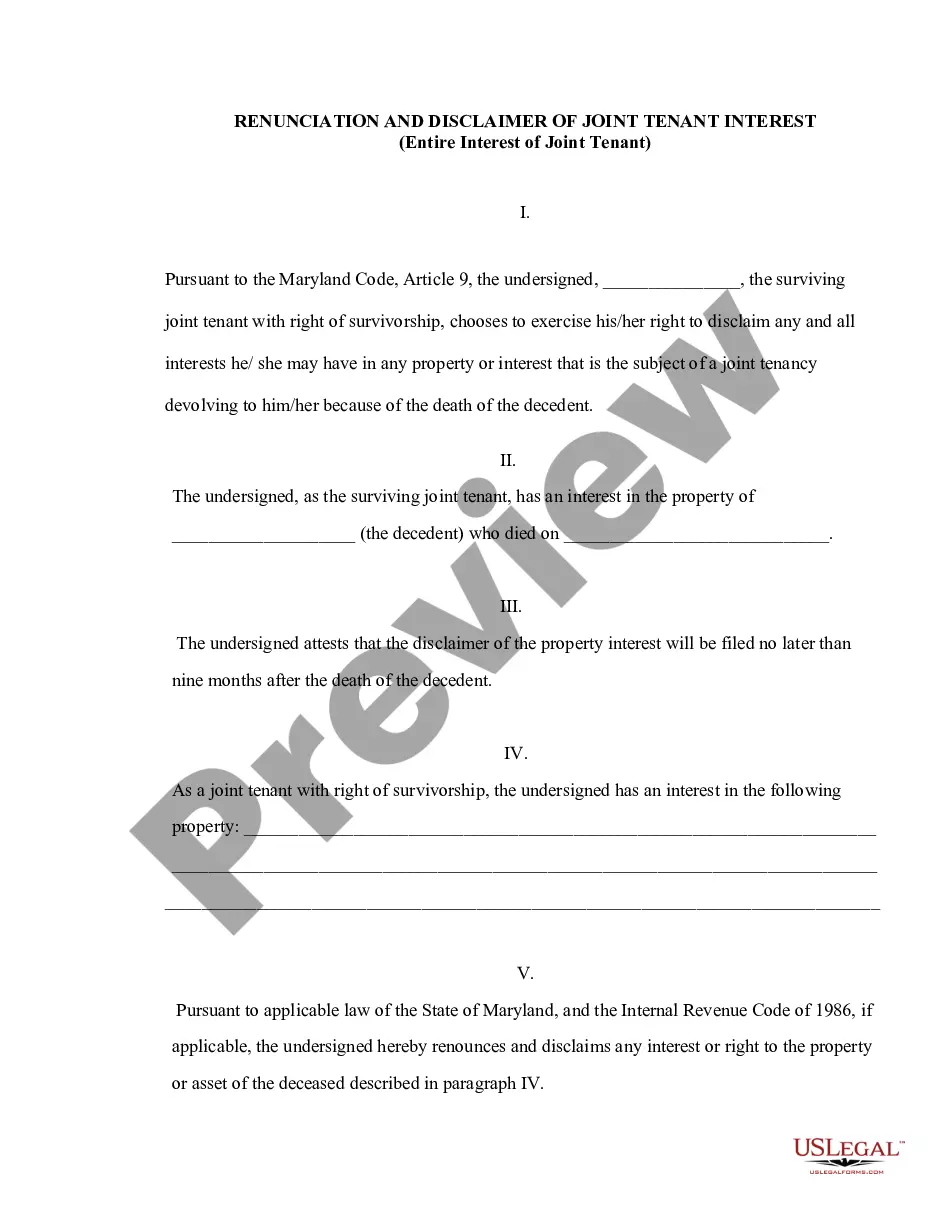
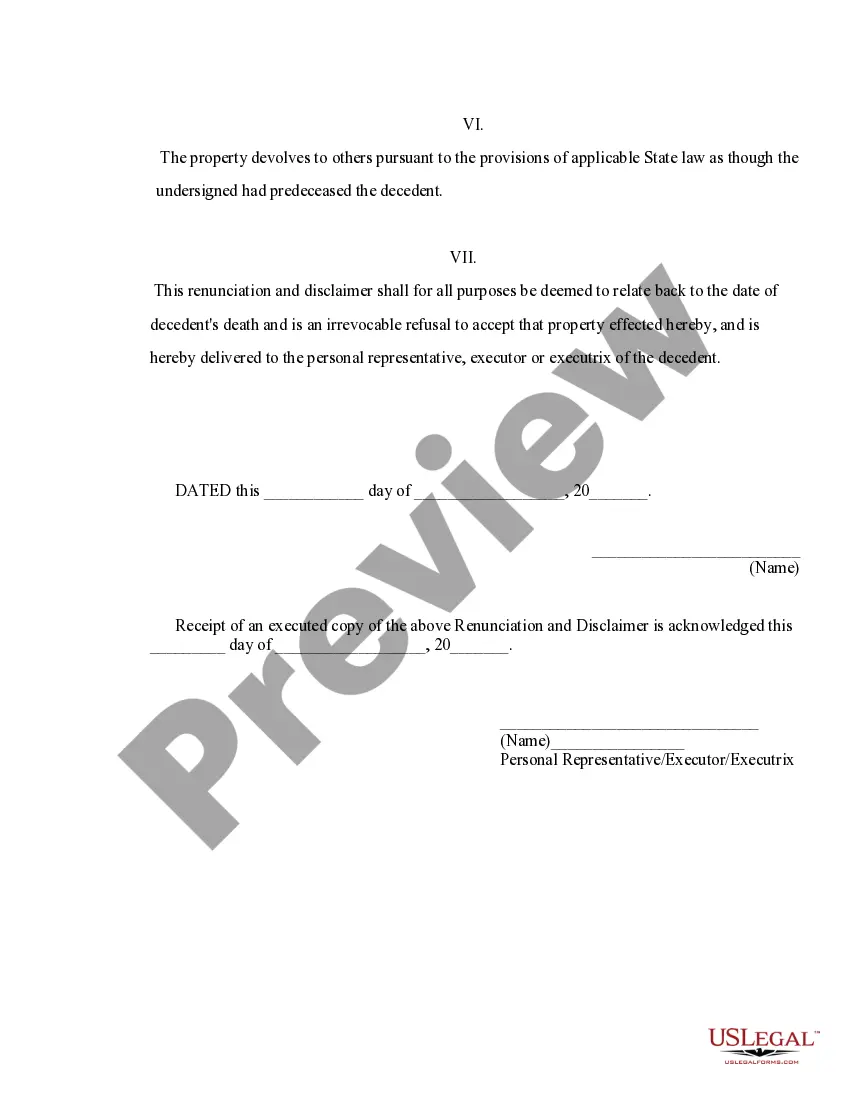
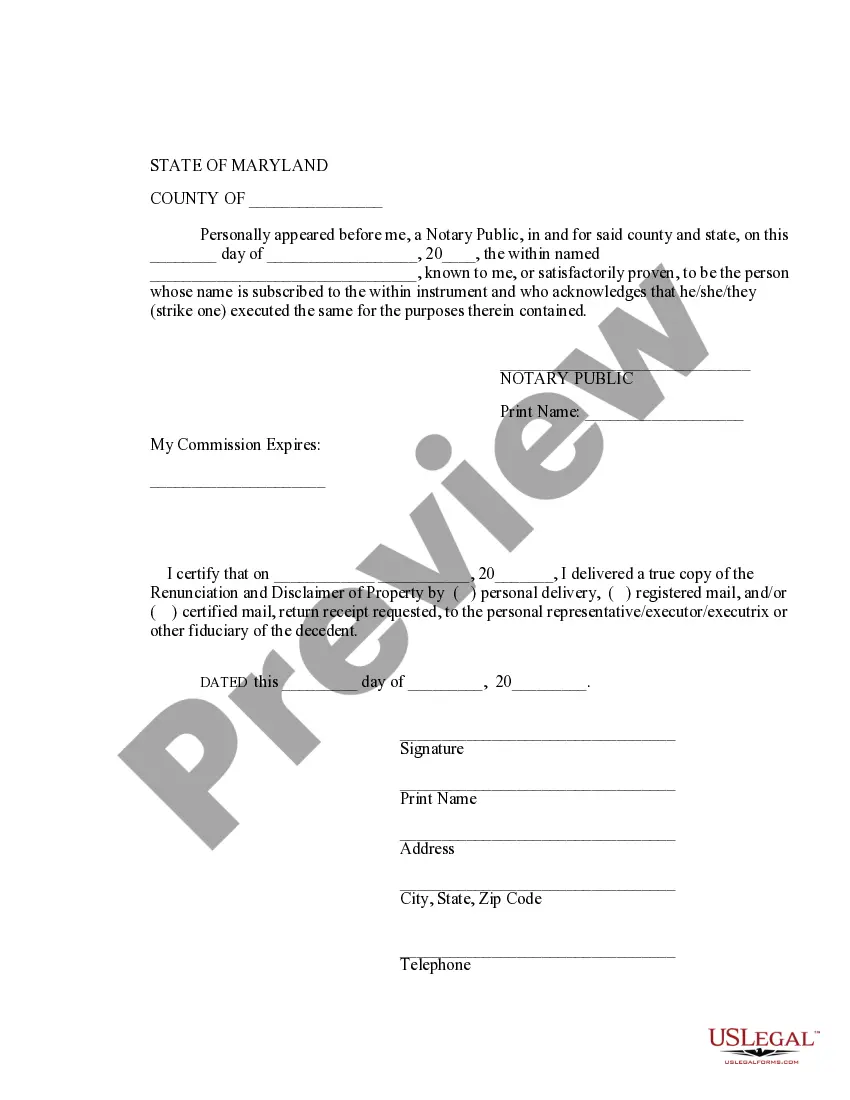
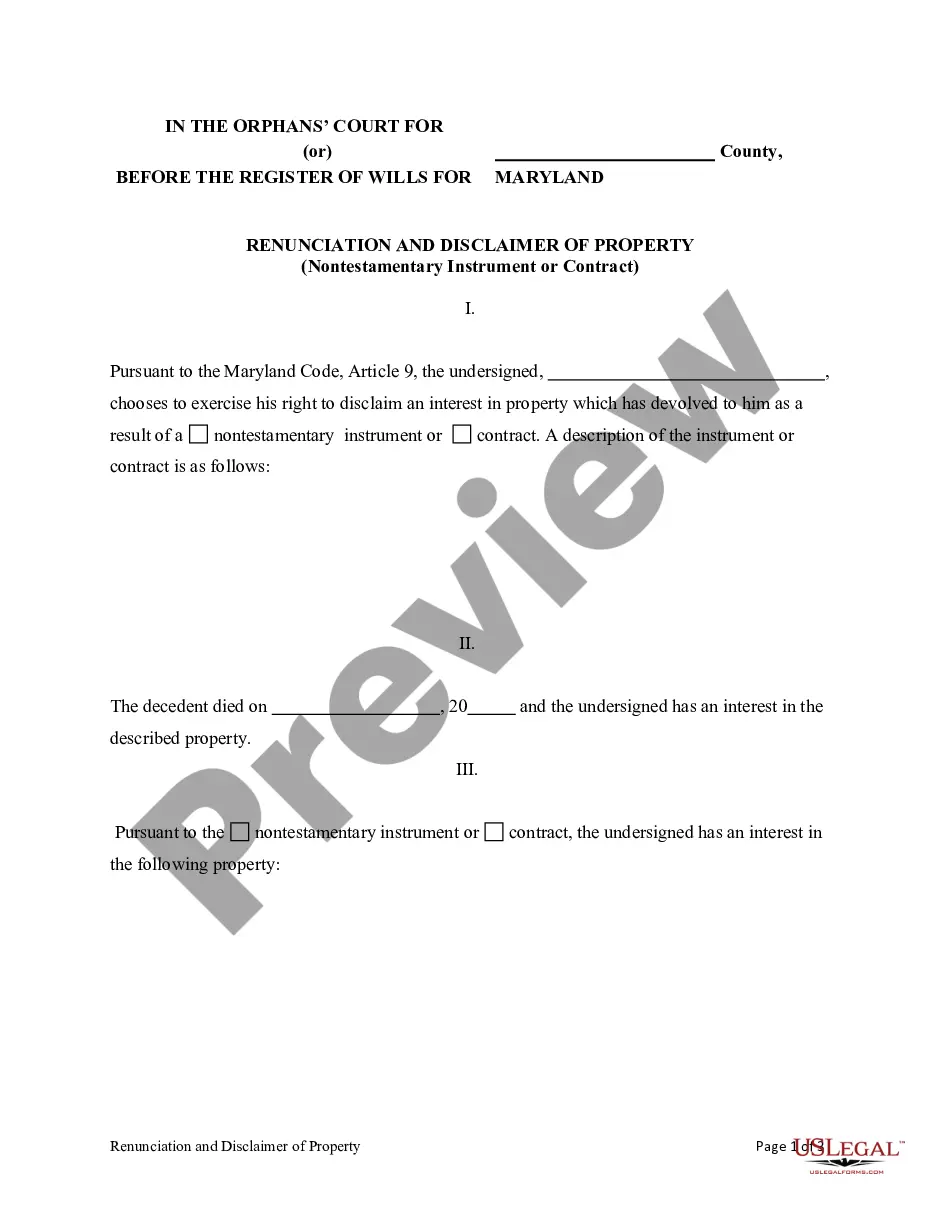
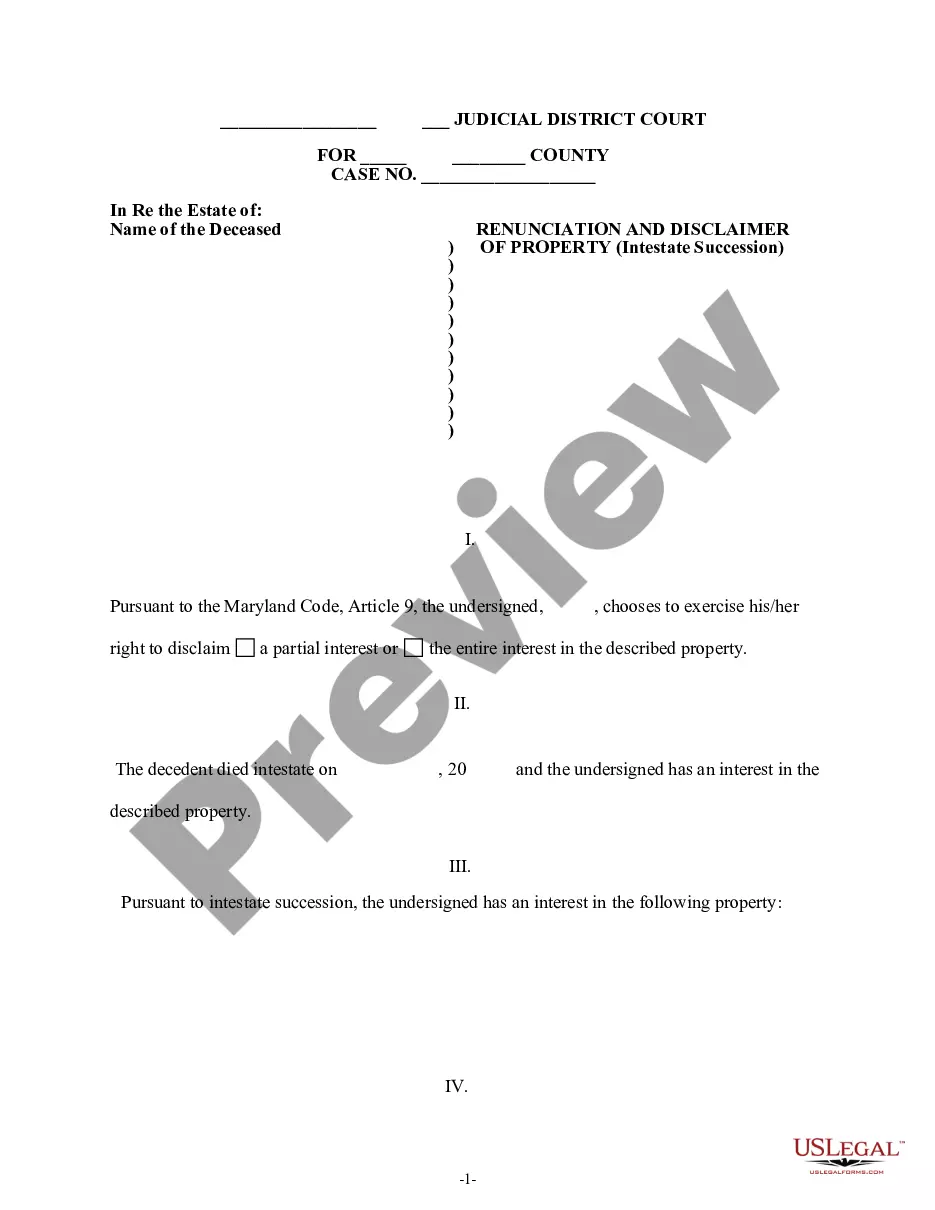
Maryland Renunciation and Disclaimer of Joint Tenant or Tenancy Interest
Maryland Code
Article 9 Estates and Trusts
(a) A person who is an heir, next of kin, devisee, legatee,
person succeeding to a disclaimed interest, beneficiary under a testamentary
instrument, or appointee under a power of appointment exercised by a testamentary
instrument, may disclaim in whole or in part the right of succession to
any property or interest in any property, including a future interest,
by filing a disclaimer under this subtitle.
(b) A person who is a grantee, donee, joint tenant, tenant by the
entireties, person succeeding to a disclaimed interest, beneficiary under
a nontestamentary instrument or contract, or appointee under a power of
appointment exercised by a nontestamentary instrument, may disclaim in
whole or in part the right of transfer to the person of any property or
interest in any property, including a future interest, by delivering or
filing a disclaimer under this subtitle. A joint tenant or tenant by the
entireties may disclaim the entire interest in any property that is the
subject of a joint tenancy or tenancy by the entireties if the disclaimant
did not join in creating the joint tenancy or tenancy by the entireties
and if the disclaimant has not accepted a benefit under the joint tenancy
or tenancy by the entireties. A surviving joint tenant may disclaim as
a separate interest any property or interest in any property devolving
to the disclaimant by right of survivorship. A surviving tenant by the
entireties may disclaim as a separate interest any property or interest
in any property devolving to the disclaimant by right of survivorship.
(c) Thirty days after delivering or mailing written notice to all
interested persons, the attorney-in-fact of a person, or the personal representative
of a deceased person, or the guardian of the property of a minor or disabled
person, may disclaim on behalf of that person, in whole or in part, the
right of succession or transfer to that person of any property or interest
in any property. The circuit court, without appointing a guardian, may
authorize or direct a disclaimer on behalf of a minor or disabled person
pursuant to § 13-204 of this article. In the case of a deceased person,
interested persons are those defined in § 1-101 of this article. In
all other cases, interested persons are those defined in § 13-101
of this article.
(d) For purposes of this subtitle, a power with respect to property,
or any possible future right to take as an appointee of an unexercised
power of appointment, or any right to take as a beneficiary of a discretionary
power to distribute income or principal, shall be treated as an interest
in property.
Article 9, § 9-201.
(a) If the property or interest has devolved to the disclaimant
under a testamentary instrument or by the laws of intestacy, the disclaimer
shall be filed, if of a present interest, or an entire interest in a joint
tenancy or tenancy by the entireties, not later than nine months after
the death of the deceased owner or deceased donee of a power of appointment
and, if of a future interest, not later than nine months after the event
determining that the taker of the property or interest is finally ascertained
and that his right to possess or enjoy his interest is indefeasibly vested.
Any disclaimer as a separate interest of an interest which otherwise would
devolve by right of survivorship made by a joint tenant or tenant by the
entireties shall be filed not later than nine months after the death of
the deceased joint tenant or deceased tenant by the entireties which determines
the disclaimant's right to possess or enjoy that separate interest. The
disclaimer shall be filed with the register of the county in which proceedings
have been commenced for the administration of the estate of the deceased
owner or deceased donee of the power or, if they have not been commenced,
in which they could be commenced. A copy of the disclaimer shall be delivered
in person or mailed by registered or certified mail to any personal representative
or other fiduciary of the deceased owner or deceased donee of the power
and to the trustee or other person who has legal title to the property
or interest disclaimed.
(b) If the property or interest has devolved to the disclaimant
under a nontestamentary instrument or contract, the disclaimer shall
be delivered or filed, if of a present interest, or an entire interest
in a joint tenancy or tenancy by the entireties, not later than nine months
after the effective date of the nontestamentary instrument or contract
and, if of a future interest, not later than nine months after the event
determining that the taker of the property or interest is finally ascertained
and that the right of the taker of the property or interest to possess
or enjoy the interest is indefeasibly vested. The effective date of a revocable
instrument or contract is the date on which the maker no longer has power
to revoke it or to transfer to the maker of the revocable instrument or
contract or another the entire legal and equitable ownership of the interest.
Any disclaimer as a separate interest of an interest devolving by right
of survivorship made by a surviving joint tenant or surviving tenant by
the entireties shall be delivered or filed not later than nine months after
the death of the deceased joint tenant or deceased tenant by the entireties
which determines the disclaimant's right to possess or enjoy the separate
interest. The disclaimer or a copy of it shall be delivered in person or
mailed by registered or certified mail to the trustee or other person who
has legal title to the property or interest disclaimed, or to the transferor
of the property or interest disclaimed or the legal representative of the
transferor of the property or interest.
(c) If real property or an interest in real property is disclaimed,
a copy of the disclaimer shall be recorded among the land records of the
county in which the real property is located.
Article 9, § 9-202.
The disclaimer shall be in writing and shall
(1) describe the property or interest disclaimed, (2) declare the disclaimer
and its extent, and (3) be signed by the disclaimant.
Article 9, § 9-203.
(a) If property or an interest in it devolved to a disclaimant
under a testamentary instrument, under a power of appointment exercised
by a testamentary instrument, or under the laws of intestacy, unless the
deceased owner or deceased donee of a power of appointment has provided
otherwise:
(1) Where devolution to the disclaimant is expressly conditioned
on the disclaimant's survival of the deceased owner or the deceased donee
of the power of appointment, the property or interest disclaimed devolves
as if the disclaimant had died immediately before the deceased owner or
the deceased donee of the power. Except where devolution to the disclaimant
is conditioned expressly on the disclaimant's survival of the deceased
owner or the deceased donee of the power of appointment, the property or
interest disclaimed devolves directly to those persons who would have taken
the property or interest if the disclaimant had died, intestate, domiciled
in the State of Maryland, owning the property or interest, immediately
before the deceased owner or the deceased donee of the power.
(2) A future interest that takes effect in possession or enjoyment
at or after the termination of the estate or interest disclaimed takes
effect as if the disclaimant had died immediately before the deceased owner
or the deceased donee of the power.
(b) If property or an interest in it devolved to a disclaimant under
a nontestamentary instrument or contract, or under a power of appointment
exercised by a nontestamentary instrument, unless the instrument or contract
has provided otherwise:
(1) Where devolution to the disclaimant is expressly conditioned
on the disclaimant's survival to the effective date of the instrument or
contract, the property or interest disclaimed devolves as if the disclaimant
had died immediately before the effective date of the instrument or contract.
Except where devolution to the disclaimant is conditioned expressly on
the disclaimant's survival to the effective date of the instrument or contract,
the property or interest disclaimed devolves directly to those persons
who would have taken the property or interest if the disclaimant had died,
intestate, domiciled in the State of Maryland, owning the property or interest,
immediately before the effective date of the instrument or contract.
(2) A future interest that takes effect in possession or enjoyment
at or after the termination of the estate or interest disclaimed takes
effect as if the disclaimant had died immediately before the effective
date of the instrument or contract.
(c) If the property or interest disclaimed is or, immediately prior
to the death of a joint tenant or tenant by the entireties, was subject
to a joint tenancy or tenancy by the entireties, the property or interest
disclaimed devolves as if the disclaimant had predeceased the other joint
tenant or tenant by the entireties. If the property or interest disclaimed
is subject to a joint tenancy involving multiple surviving joint tenants
and if all surviving joint tenants disclaim, the property or interest disclaimed
devolves as if all the disclaimants had predeceased the deceased joint
tenant.
(d) A disclaimer of a power with respect to property extinguishes
the power as to the disclaimant.
(e) A disclaimer relates back for all purposes to the date of death
of the deceased owner or the deceased donee of the power, or to the effective
date of the nontestamentary instrument or contract.
(f) The disclaimer is binding upon the disclaimant and all persons
claiming through or under him. Creditors of the disclaimant have no interest
in the property or interest disclaimed, whether their claims are based
on contract, tort, tax obligations, or otherwise.
(g) A disclaimer made under this subtitle is irrevocable.
Article 9, § 9-204.
(a) The right to disclaim property or an interest in it
is barred by (1) an assignment, conveyance, voluntary encumbrance, pledge,
or transfer of the property or interest, or a contract for any of those,
(2) a written waiver of the right to disclaim, (3) an acceptance of the
property or interest or a benefit thereunder, or (4) a sale of the property
or interest under judicial sale made before the disclaimer is effected.
(b) The right to disclaim exists notwithstanding any limitation
on the interest of the disclaimant in the nature of a spendthrift provision
or similar restriction.
Article 9, § 9-205.
This subtitle does not abridge the right of a
person to waive, release, disclaim or renounce property or an interest
in property under any other statute.
Article 9, § 9-206.
An interest in property that exists on July 1,
1978 as to which the time for filing a disclaimer under this subtitle has
not expired may be disclaimed within the time provided in § 9-202
or before April 1, 1979, whichever period is greater.
Article 9, § 9-207.
This subtitle shall be applied and construed
to effectuate its general purpose to make uniform the law with respect
to the subject of this subtitle among the states enacting it.
Article 9, § 9-208.
This subtitle may be cited as the "Maryland Uniform
Disclaimer of Property Interests Act".
Article 9, § 9-209.