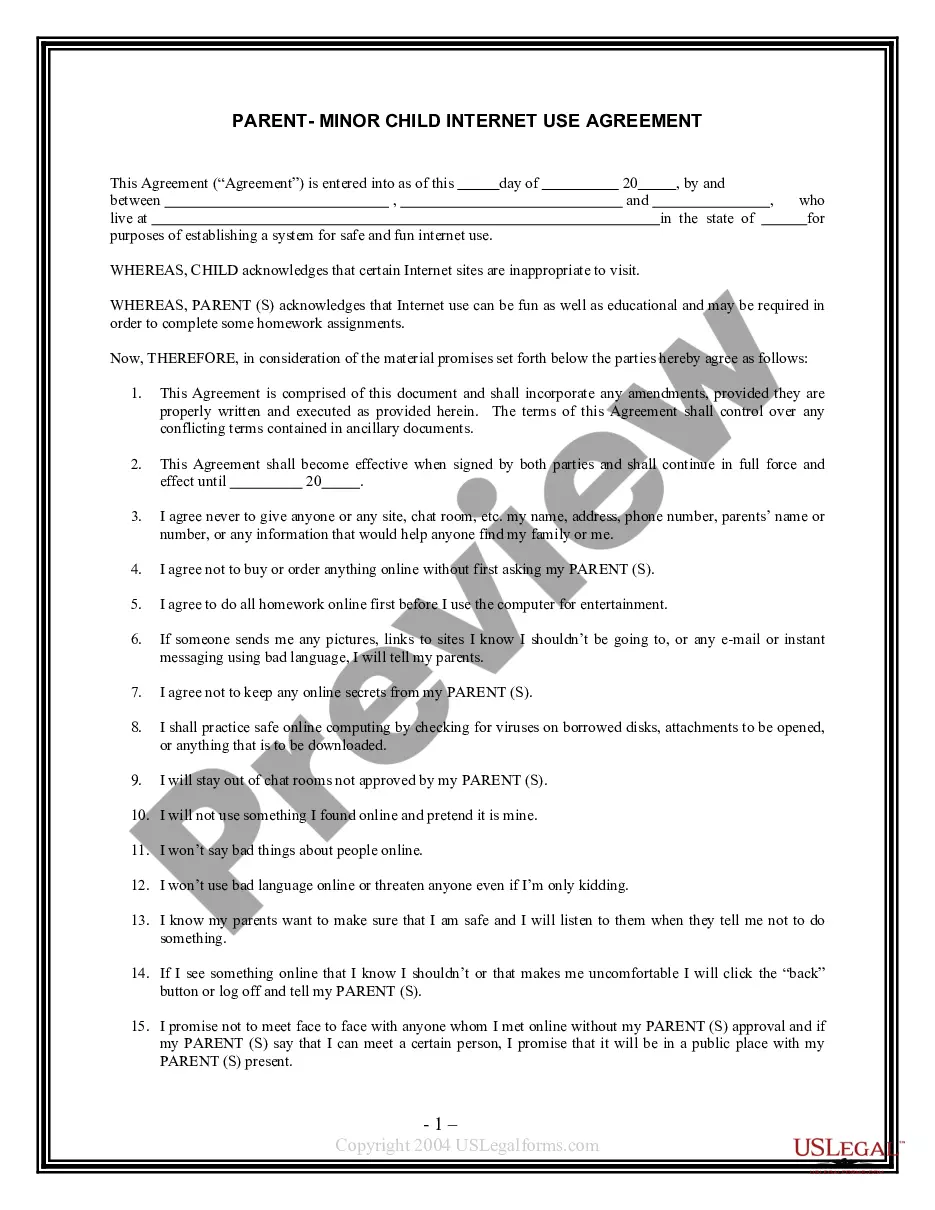
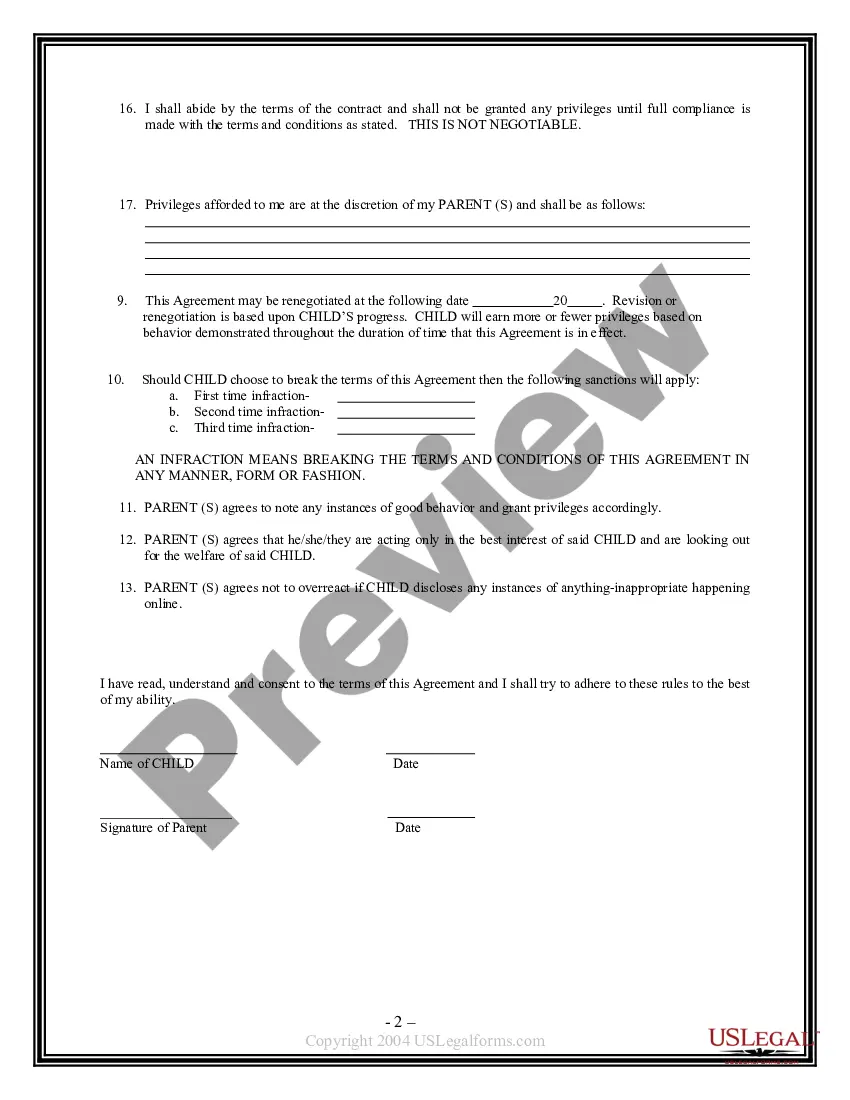
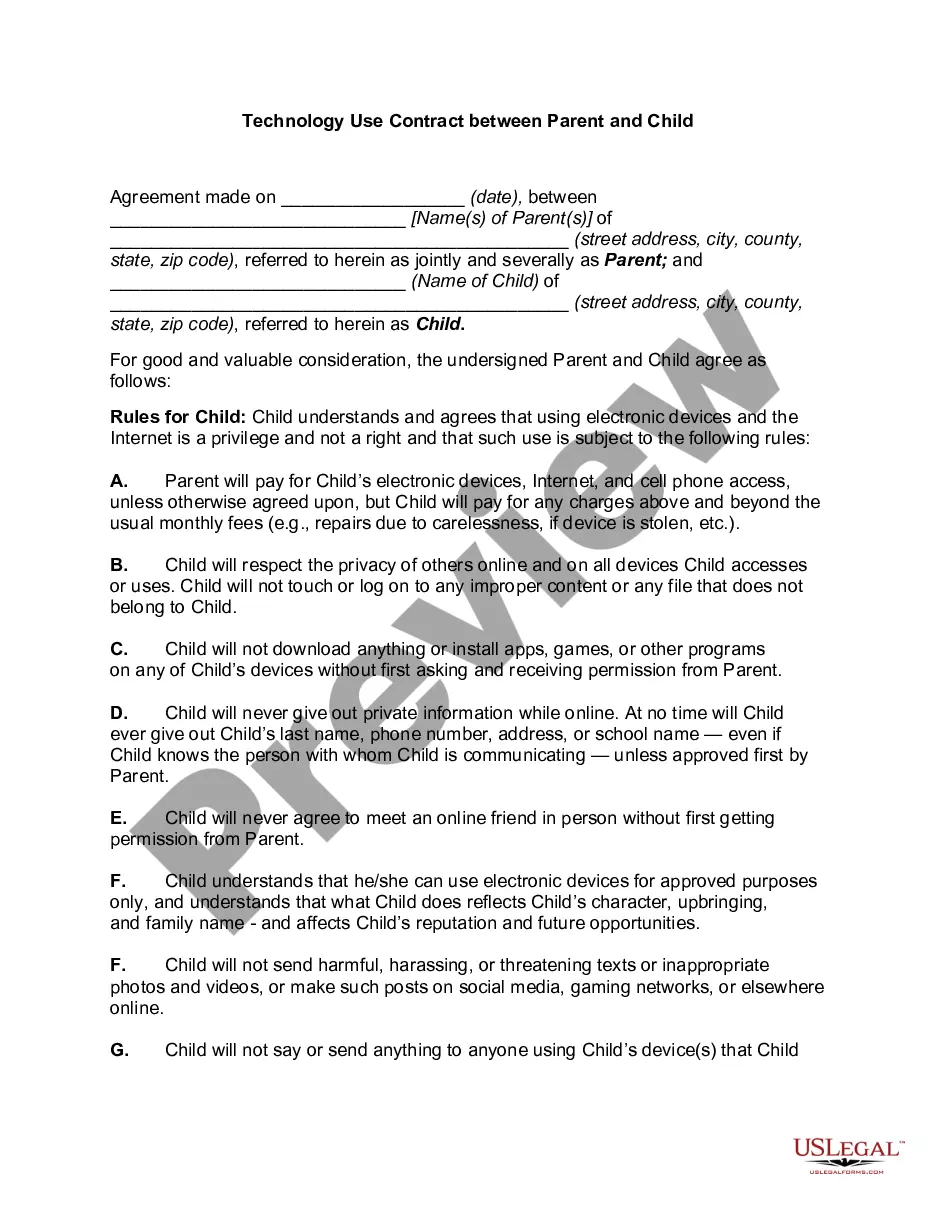
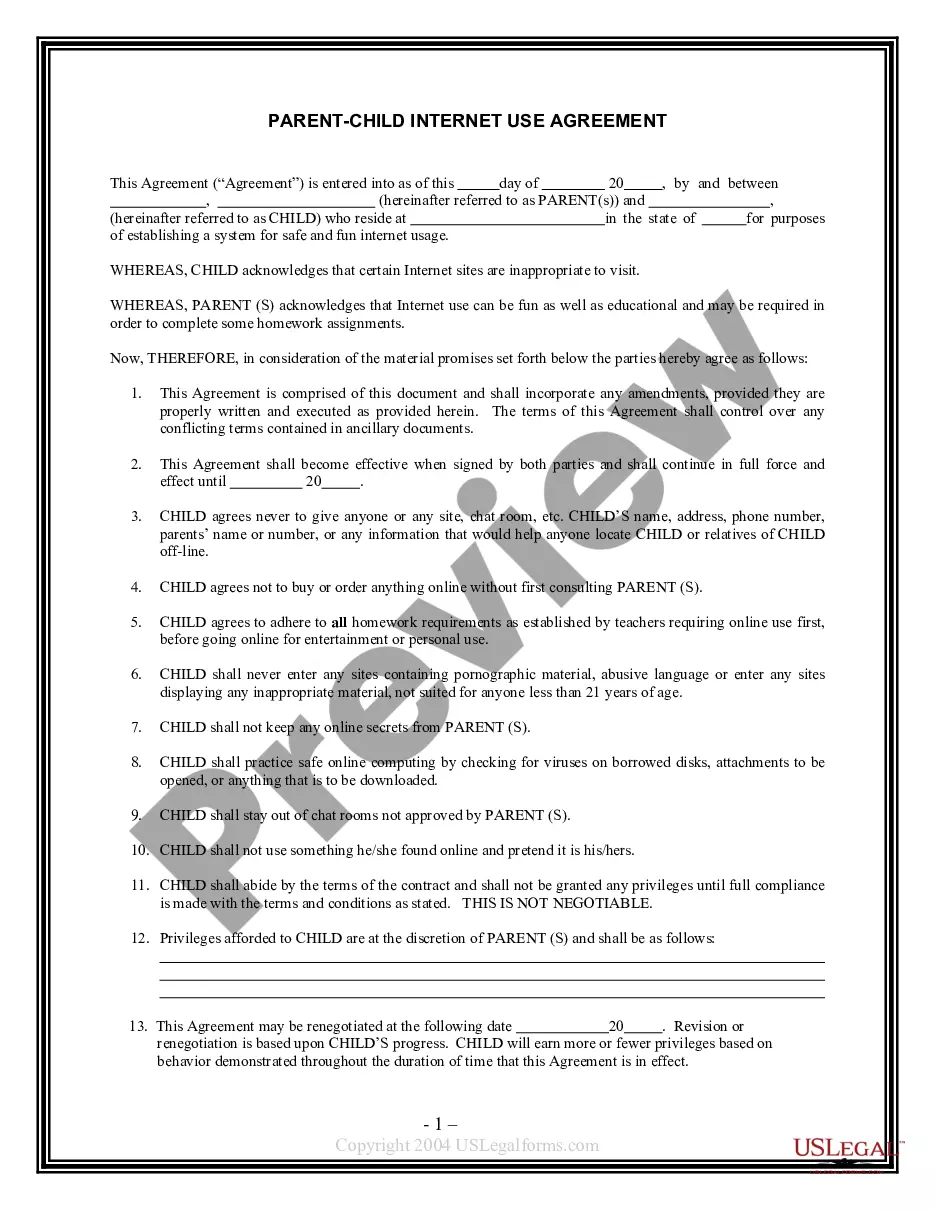
This is a contract between parent(s) and a younger child introducing child to Internet safety by describing what types of sites child should not contact and other general rules for Internet use.
Massachusetts Parent - Minor Child Internet Use Agreement
Category:
State:
Multi-State
Control #:
US-PC10
Format:
Word;
Rich Text
Instant download
Description
Free preview
Get your form ready online
Our built-in tools help you complete, sign, share, and store your documents in one place.
Built-in online Word editor
Make edits, fill in missing information, and update formatting in US Legal Forms—just like you would in MS Word.
Export easily
Download a copy, print it, send it by email, or mail it via USPS—whatever works best for your next step.
E-sign your document
Sign and collect signatures with our SignNow integration. Send to multiple recipients, set reminders, and more. Go Premium to unlock E-Sign.
Notarize online 24/7
If this form requires notarization, complete it online through a secure video call—no need to meet a notary in person or wait for an appointment.
Store your document securely
We protect your documents and personal data by following strict security and privacy standards.

Make edits, fill in missing information, and update formatting in US Legal Forms—just like you would in MS Word.

Download a copy, print it, send it by email, or mail it via USPS—whatever works best for your next step.

Sign and collect signatures with our SignNow integration. Send to multiple recipients, set reminders, and more. Go Premium to unlock E-Sign.

If this form requires notarization, complete it online through a secure video call—no need to meet a notary in person or wait for an appointment.

We protect your documents and personal data by following strict security and privacy standards.
Looking for another form?


How to fill out Parent - Minor Child Internet Use Agreement?
If you want to be thorough, download, or print legal document templates, utilize US Legal Forms, the largest collection of legal forms available online. Take advantage of the site's simple and user-friendly search to find the documents you need. Various templates for business and personal purposes are categorized by types and jurisdictions, or keywords. Use US Legal Forms to obtain the Massachusetts Parent - Minor Child Internet Use Agreement in just a few clicks.
If you are already a US Legal Forms customer, Log In to your account and click the Download button to locate the Massachusetts Parent - Minor Child Internet Use Agreement. You can also access forms you previously downloaded in the My documents section of your account.
If you are using US Legal Forms for the first time, follow the steps below: Step 1. Ensure you have selected the form for the correct city/state. Step 2. Use the Preview option to review the form's details. Don't forget to read through the information. Step 3. If you are not satisfied with the form, use the Search field at the top of the screen to find alternative versions of the legal document template. Step 4. Once you have found the form you need, click on the Acquire now button. Choose the payment plan you prefer and provide your details to register for an account. Step 5. Complete the transaction. You can use your Visa or Mastercard or PayPal account to finalize the transaction. Step 6. Select the format of your legal form and download it to your device. Step 7. Fill out, modify, and print or sign the Massachusetts Parent - Minor Child Internet Use Agreement.
- Every legal document template you acquire is yours forever.
- You will have access to every form you downloaded within your account.
- Visit the My documents section and select a form to print or download again.
- Stay competitive and download, and print the Massachusetts Parent - Minor Child Internet Use Agreement with US Legal Forms.
- There are thousands of professional and state-specific forms you can use for your business or personal needs.
Form popularity
FAQ
While there is no legal age specified for internet use in Massachusetts, many experts recommend that children should be at least 8 to 10 years old. It is crucial for parents to monitor usage and educate their children about online safety. Establishing a Massachusetts Parent - Minor Child Internet Use Agreement can help guide responsible internet habits from a young age.
In Massachusetts, siblings can share a room for as long as the parents deem appropriate. While there are no legal limitations, parents should consider the children’s ages and privacy needs. A Massachusetts Parent - Minor Child Internet Use Agreement can also set guidelines for internet usage in shared spaces.
There are no legal restrictions in Massachusetts regarding how long a child can share a room with their parents. However, as children grow, their need for privacy and personal space increases. Using a Massachusetts Parent - Minor Child Internet Use Agreement can help establish boundaries, even in shared living spaces.
Massachusetts does not have a specific law that sets a minimum age for staying home alone. Generally, parents should assess their child's maturity and ability to handle emergencies when making this decision. As part of ensuring safety, a Massachusetts Parent - Minor Child Internet Use Agreement can outline rules regarding internet use when a child is home alone.
In Massachusetts, there is no specific legal age at which a child must have their own room. However, housing regulations may require adequate space for children, particularly as they grow older. Parents often consider the benefits of creating a Massachusetts Parent - Minor Child Internet Use Agreement in a private space to foster healthy online habits.
In Massachusetts, a 16 year old has several rights, including the ability to work with restrictions, apply for a driver’s license, and consent to certain medical treatments. However, parents or guardians retain authority over major decisions. Understanding these rights is important, especially if you're drafting a Massachusetts Parent - Minor Child Internet Use Agreement to ensure safe internet practices.
Your partner cannot legally stop you from having access to your child unless continued access will be of detriment to your child's welfare. Until a court order is arranged, one parent may attempt to prevent a relationship with the other. If this happens, your main priority should be the welfare of your child.
If the child is at least 12 years old, courts will usually give the child's preference some weight. Courts don't have to follow a child's custodial preference. The court decides how much weight to give each child's opinion by considering the rationale behind the child's preference.
Generally speaking, child support continues until the age of 18 and. Under certain circumstances, the court may order payments to continue to age 21 if the child lives with a parent and is principally dependent on them for support.
A general rule of thumb may be that a child who is at least 10 years old may be considered mature enough to make this decision, but some older children may not be mature enough to voice their preference clearly or make the court see why they would like to live with one parent over the other.