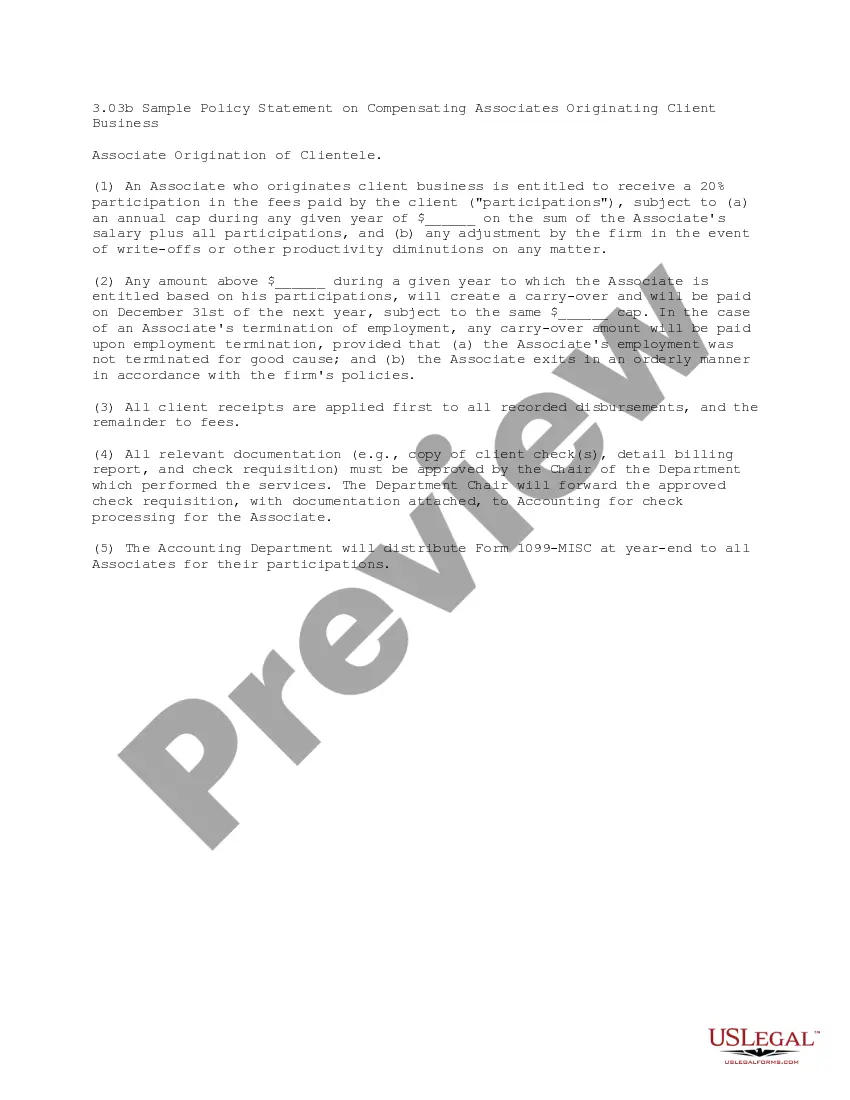
This document is a policy statement that defines the way an associate will be compensated for originating client business for the firm. It provides the percentage of fees paid to the associate, along with a "cap" amount in any given year. It also addresses carry-over amounts to the next calendar year and the issue of the associate leaving the firm.
Massachusetts Policy Statement on Compensating Associates Originating Client Business
Category:
State:
Multi-State
Control #:
US-L0303B
Format:
Word;
PDF;
Rich Text
Instant download
Description
Get your form ready online
Our built-in tools help you complete, sign, share, and store your documents in one place.
Built-in online Word editor
Make edits, fill in missing information, and update formatting in US Legal Forms—just like you would in MS Word.
Export easily
Download a copy, print it, send it by email, or mail it via USPS—whatever works best for your next step.
E-sign your document
Sign and collect signatures with our SignNow integration. Send to multiple recipients, set reminders, and more. Go Premium to unlock E-Sign.
Notarize online 24/7
If this form requires notarization, complete it online through a secure video call—no need to meet a notary in person or wait for an appointment.
Store your document securely
We protect your documents and personal data by following strict security and privacy standards.

Make edits, fill in missing information, and update formatting in US Legal Forms—just like you would in MS Word.

Download a copy, print it, send it by email, or mail it via USPS—whatever works best for your next step.

Sign and collect signatures with our SignNow integration. Send to multiple recipients, set reminders, and more. Go Premium to unlock E-Sign.

If this form requires notarization, complete it online through a secure video call—no need to meet a notary in person or wait for an appointment.

We protect your documents and personal data by following strict security and privacy standards.
Looking for another form?






How to fill out Policy Statement On Compensating Associates Originating Client Business?
Selecting the optimal legal document template can be a challenge. Obviously, there are numerous designs accessible online, but how do you find the legal document you need? Utilize the US Legal Forms website. This service offers a vast array of templates, including the Massachusetts Policy Statement on Compensating Associates Originating Client Business, suitable for both business and personal purposes. All forms are reviewed by experts and comply with federal and state regulations.
If you are already registered, Log In to your account and click the Download button to obtain the Massachusetts Policy Statement on Compensating Associates Originating Client Business. Use your account to access the legal forms you have previously purchased. Go to the My documents section of your account to get another copy of the document you need.
If you are a new user of US Legal Forms, here are simple steps for you to follow: First, ensure you have selected the correct form for your city/state. You can browse the document using the Preview button and review the document outline to confirm it is suitable for you. If the form does not meet your requirements, utilize the Search field to find the appropriate form. Once you are confident that the document is right, click the Get now button to download the form. Choose the payment plan you desire and input the necessary information. Create your account and pay for your order using your PayPal account or credit card. Select the document format and download the legal document template to your device. Complete, edit, print, and sign the obtained Massachusetts Policy Statement on Compensating Associates Originating Client Business. US Legal Forms is the largest repository of legal forms where you can find various document templates. Use the service to download properly crafted documents that adhere to state requirements.
Use the service to download properly crafted documents that adhere to state requirements.
- Selecting the optimal legal document template can be a challenge.
- If you are already registered, Log In to your account.
- If you are a new user of US Legal Forms, here are simple steps for you to follow.
- Ensure you have selected the correct form for your city/state.
- Utilize the Search field to find the appropriate form.
- Create your account and pay for your order using your PayPal account or credit card.
Form popularity
FAQ
Rule 1.7 B refers to specific scenarios where a conflict of interest may arise. It outlines conditions under which a lawyer may represent multiple clients, provided they obtain informed consent. This understanding is particularly relevant when discussing the Massachusetts Policy Statement on Compensating Associates Originating Client Business, ensuring that compensation practices adhere to ethical standards while managing client expectations.
The rule 1.7 professional responsibility involves maintaining loyalty to clients and avoiding conflicts of interest. Legal professionals must assess relationships and potential conflicts before proceeding with representation. This principle is vital in the context of the Massachusetts Policy Statement on Compensating Associates Originating Client Business, as it ensures that compensation does not compromise the integrity of client relationships.
Rule 1.7 of the Massachusetts Rules of Professional Conduct focuses on conflict of interest in legal representation. It dictates that a lawyer cannot represent clients whose interests conflict unless there is informed consent from all parties involved. Familiarity with this rule is essential when navigating the Massachusetts Policy Statement on Compensating Associates Originating Client Business to ensure that compensation practices remain fair and compliant.
Massachusetts does not have a law specifically labeled as a 'homewrecker law'. However, it does recognize the tort of alienation of affection, which allows a spouse to sue a third party for interference in their marital relationship. This aspect of Massachusetts law may intersect with issues related to the Massachusetts Policy Statement on Compensating Associates Originating Client Business, particularly when considering ethical boundaries in client relationships.
Rule 1.7 in Massachusetts addresses conflicts of interest among attorneys. It emphasizes the importance of loyalty to clients and outlines circumstances under which a lawyer may represent clients with potentially conflicting interests. Understanding this rule is crucial, especially when considering the Massachusetts Policy Statement on Compensating Associates Originating Client Business, as it helps ensure compliance while fostering client trust.
The number of exemptions you should claim in Massachusetts depends on your financial situation and the specific investments you are considering. It is vital to evaluate each exemption thoroughly to ensure compliance with state laws. Consulting resources like USLegalForms can provide clarity and help you navigate the complexities related to the Massachusetts Policy Statement on Compensating Associates Originating Client Business.
A Massachusetts Power of Attorney (POA) is legally valid when it is signed by the principal in the presence of a notary public or witnesses, adhering to the state's requirements. It should clearly outline the powers granted and must comply with the specific guidelines provided by Massachusetts law. Ensuring your POA meets these criteria is important, especially in relation to the Massachusetts Policy Statement on Compensating Associates Originating Client Business.
Blue sky exemptions refer to specific circumstances under which certain securities offerings do not require registration. These exemptions can include private offerings, intrastate offerings, and transactions by certain non-profit organizations. Knowing about these exemptions is crucial for compliance and can enhance your understanding of the Massachusetts Policy Statement on Compensating Associates Originating Client Business.
Blue sky laws in Massachusetts regulate the sale of securities within the state to protect investors from fraud. These laws require the registration of most securities offerings and the licensing of brokers and dealers. Familiarizing yourself with these regulations is essential, particularly when considering the Massachusetts Policy Statement on Compensating Associates Originating Client Business, as it impacts how client business is compensated.
In Massachusetts, the exemptions for blue sky laws primarily include offerings that qualify as private placements, certain government securities, and transactions involving accredited investors. These exemptions aim to simplify compliance for those who are not engaging in public offerings. Understanding these exemptions can significantly impact how you approach your investments, especially in light of the Massachusetts Policy Statement on Compensating Associates Originating Client Business.