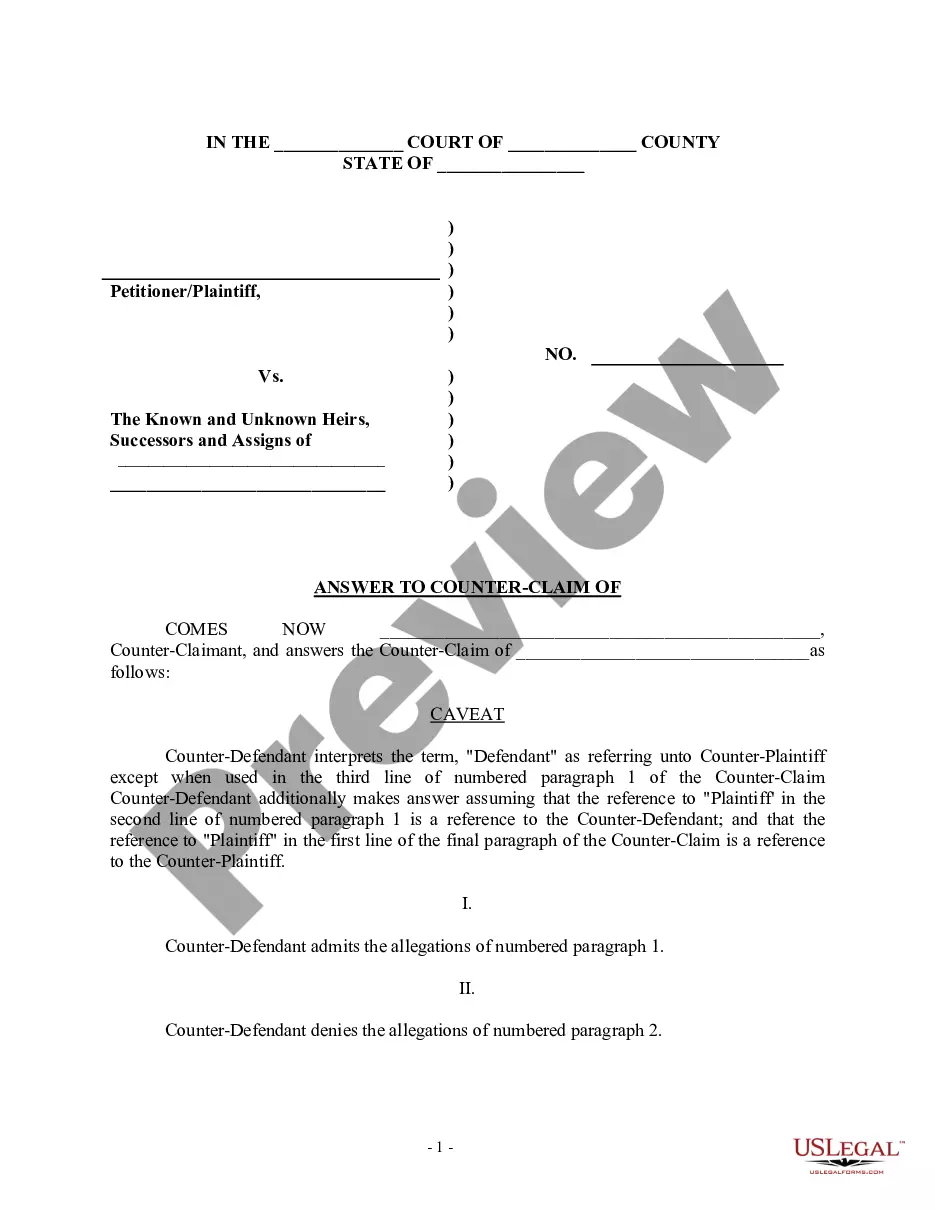
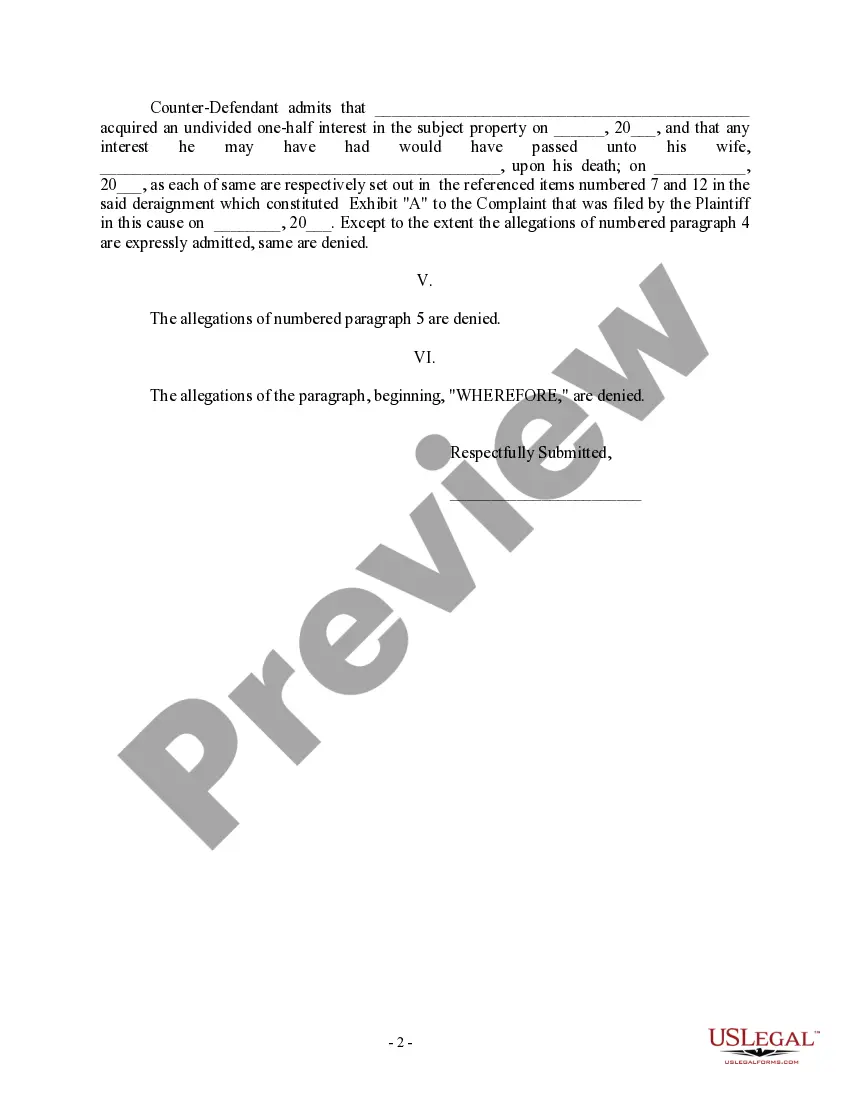
This form is an Answer to a Counter-Claim. The counter-claimant admits and denies certain allegations contained in the document.
Massachusetts Answer to Counterclaim
State:
Multi-State
Control #:
US-01591
Format:
Word;
Rich Text
142 downloads
Description
Free preview
Get your form ready online
Our built-in tools help you complete, sign, share, and store your documents in one place.
Built-in online Word editor
Make edits, fill in missing information, and update formatting in US Legal Forms—just like you would in MS Word.
Export easily
Download a copy, print it, send it by email, or mail it via USPS—whatever works best for your next step.
E-sign your document
Sign and collect signatures with our SignNow integration. Send to multiple recipients, set reminders, and more. Go Premium to unlock E-Sign.
Notarize online 24/7
If this form requires notarization, complete it online through a secure video call—no need to meet a notary in person or wait for an appointment.
Store your document securely
We protect your documents and personal data by following strict security and privacy standards.

Make edits, fill in missing information, and update formatting in US Legal Forms—just like you would in MS Word.

Download a copy, print it, send it by email, or mail it via USPS—whatever works best for your next step.

Sign and collect signatures with our SignNow integration. Send to multiple recipients, set reminders, and more. Go Premium to unlock E-Sign.

If this form requires notarization, complete it online through a secure video call—no need to meet a notary in person or wait for an appointment.

We protect your documents and personal data by following strict security and privacy standards.
Looking for another form?

How to fill out Answer To Counterclaim?
If you need to thoroughly review, download, or print legal document templates, utilize US Legal Forms, the largest collection of legal forms available online. Take advantage of the site's user-friendly and efficient search tool to obtain the documents you require. Various templates for business and personal purposes are organized by categories and states, or keywords. Use US Legal Forms to acquire the Massachusetts Answer to Counterclaim in just a few clicks.
If you are already a US Legal Forms user, sign in to your account and click the Download button to locate the Massachusetts Answer to Counterclaim. You can also access forms you previously downloaded within the My documents section of your account.
If you are using US Legal Forms for the first time, follow the instructions below: Step 1. Ensure you have selected the form for the appropriate area/state. Step 2. Utilize the Review option to browse through the form's content. Be sure to read the description. Step 3. If you are not satisfied with the document, use the Search field at the top of the screen to find alternative versions of the legal form template. Step 4. Once you have found the form you need, click the Get now button. Choose the pricing plan you prefer and enter your details to register for an account. Step 5. Complete the transaction. You can use your credit card or PayPal account to finalize the purchase. Step 6. Select the format of your legal document and download it to your device. Step 7. Fill out, edit, and print or sign the Massachusetts Answer to Counterclaim.
Avoid altering or removing any HTML tags. Only synonymize plain text outside of the HTML tags.
- Every legal document template you obtain is yours permanently.
- You will have access to every form you downloaded within your account.
- Check the My documents section and select a form to print or download again.
- Stay competitive and download, and print the Massachusetts Answer to Counterclaim with US Legal Forms.
- There are thousands of professional and state-specific forms you can utilize for your business or personal needs.
Form popularity
FAQ
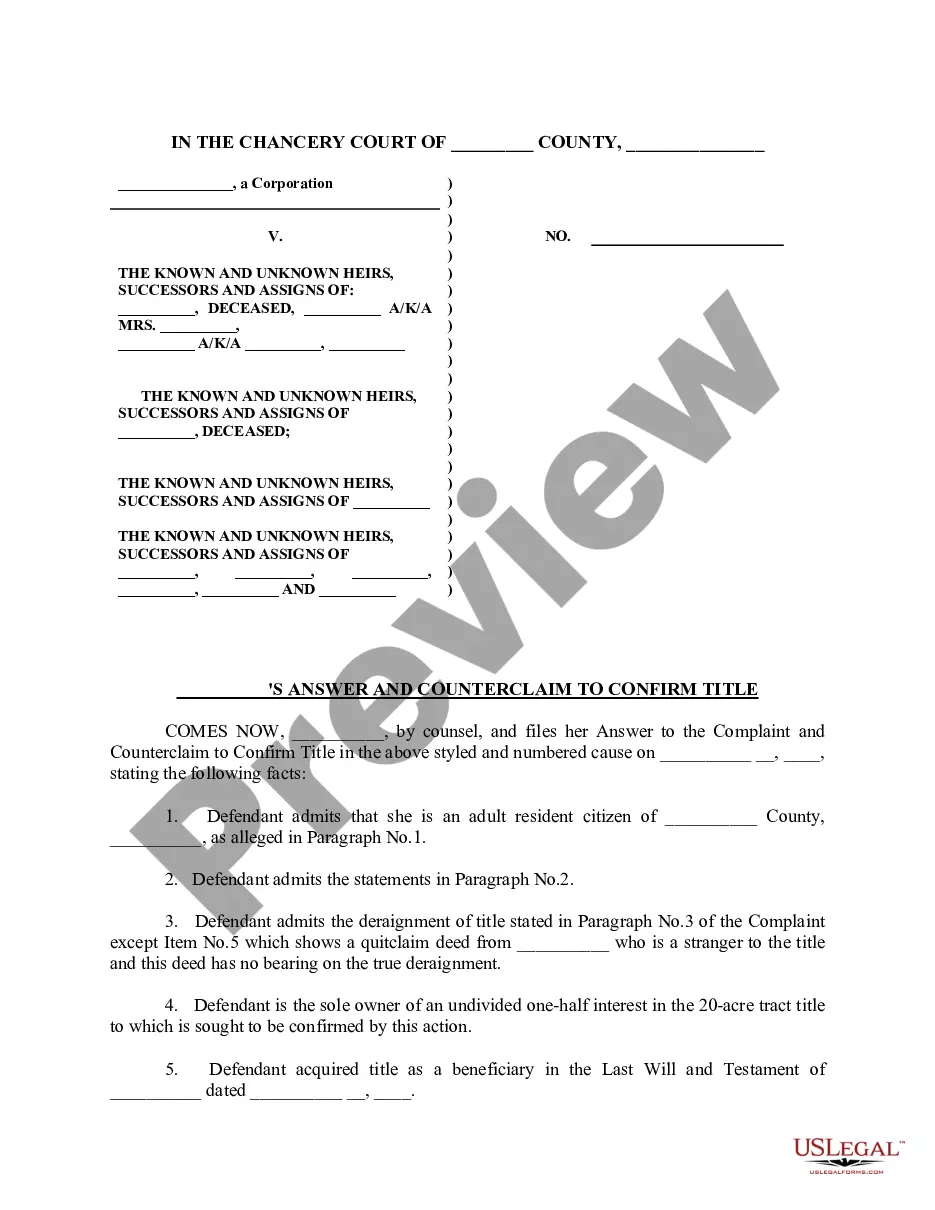
Mostly, an answer includes the defendant's counterclaims (allegations or claims against the plaintiff) and/or affirmative defenses (legal defenses that can defeat the plaintiff's claim).
Rebutting the Counterclaim A rebuttal is a statement or paragraph that undermines or challenges an opposing claim. Without a rebuttal, a counterclaim in writing won't serve the argument. Writers should rebut counterclaims directly after introducing them.
You should respond to the counterclaim as though it were a Statement of Claim and you were drafting a Defence: respond to every paragraph ? you can do this paragraph by paragraph if necessary; deny any allegations of fact that you do not admit ? you will be deemed to admit facts that you forget to plead to; and.
Rule 12(f) indicates explicitly that although the court may, sua sponte, clean up the pleadings (literally and figuratively) at any time, it may strike an insufficient defense only if the plaintiff takes the initiative.
The defence to a counterclaim must deal with every allegation made by the defendant in the counterclaim by either admission, denial or making no admission. The counterclaim is drafted following the same rules as the defence, for details on drafting the defence - please see our previous Article in this series.
After making your counterclaim, you need to finish by providing a rebuttal. This is when you provide evidence to show why the counterclaim is wrong, or at least why it doesn't make your argument wrong.
Mostly, an answer includes the defendant's counterclaims (allegations or claims against the plaintiff) and/or affirmative defenses (legal defenses that can defeat the plaintiff's claim).
An answer to a counterclaim is a written response by a Plaintiff to a Defendant's counterclaim. The answer to counterclaim must also state defenses to each of the Defendant's counterclaims in short, plain statements.