Massachusetts Jurat Acknowledgment
Overview of this form
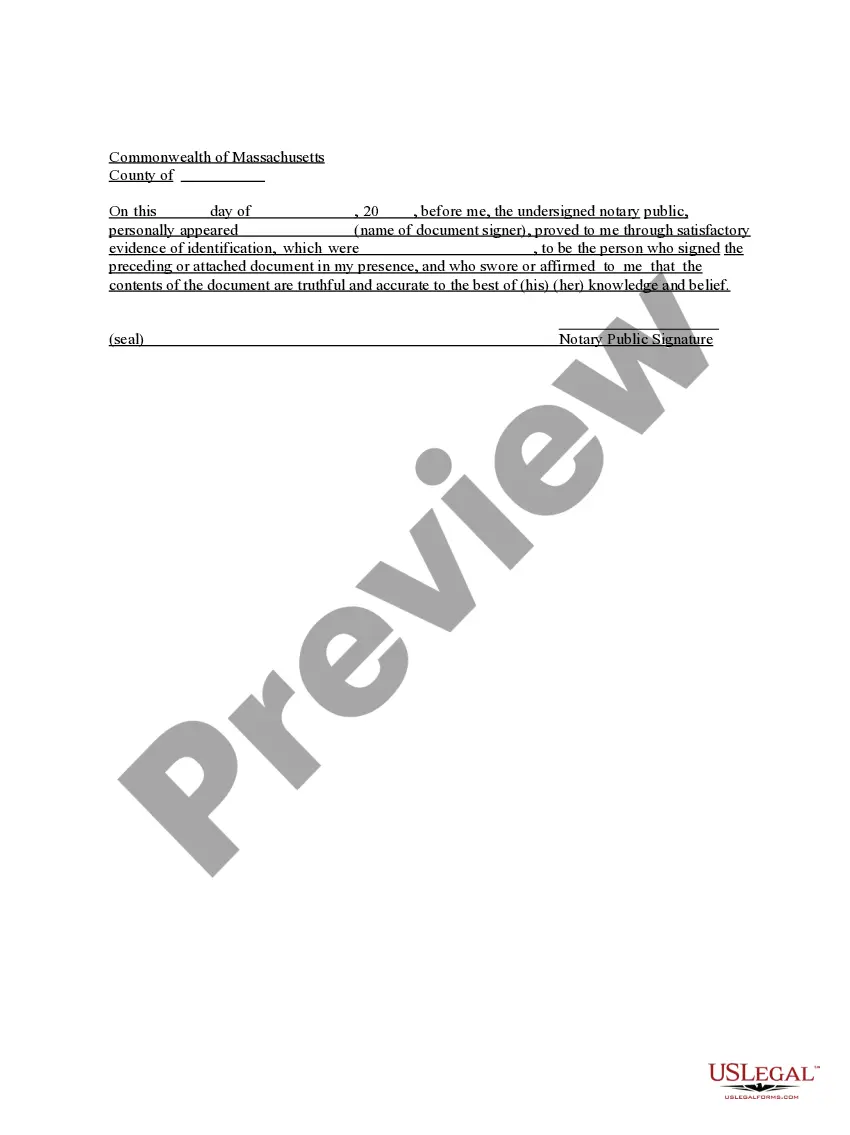
The Jurat Acknowledgment is a legal document used by notaries to certify that a signer has sworn or affirmed the truthfulness of the contents of a document. It serves as a verification tool, ensuring that the individual presenting the document was properly identified and is affirming its accuracy. This form is distinct from other notarial acts, such as acknowledgments, because it specifically includes a sworn statement from the signer regarding the document's contents.
Key components of this form
- Parties involved: Includes the name of the document signer and the notary public.
- Verification of identity: The notary confirms the identity of the signer through satisfactory evidence.
- Affirmation statement: The signer declares that the information in the document is true to the best of their knowledge.
- Notary seal and signature: Required for the document to have legal validity.
- Date and location: Specifies when and where the acknowledgment is made.

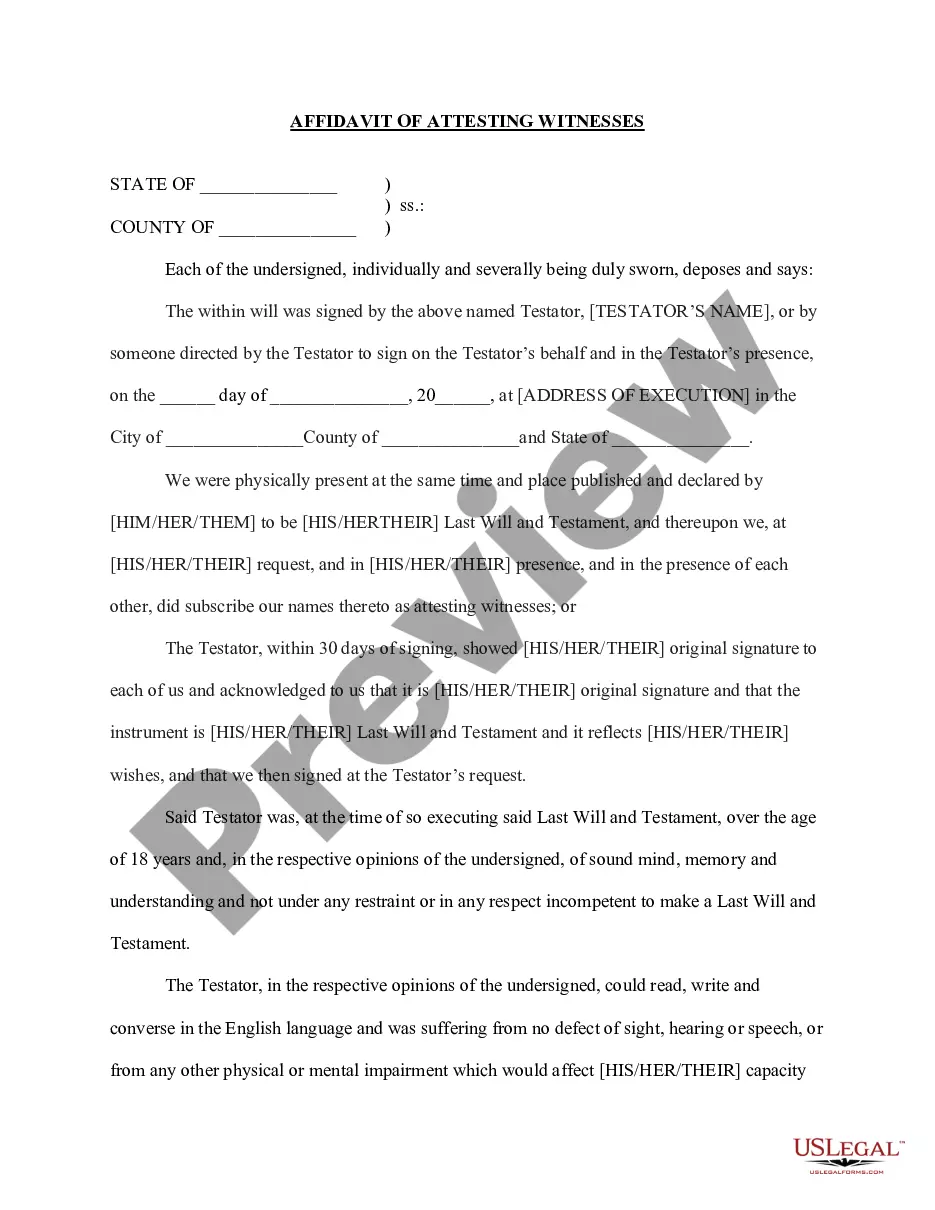
When to use this document
This form is needed when a person needs to confirm under oath that the information provided in a legal document is accurate. Common scenarios include signing affidavits, declarations, or other documents that require a formal acknowledgment of truthfulness. It is often used in court-related matters, real estate transactions, or other legal interactions where sworn statements are necessary.
Intended users of this form
- Individuals signing documents that require a sworn statement.
- Notaries public responsible for witnessing and affirming the signatures of document signers.
- Attorneys or legal professionals who prepare legal documents requiring notarization.
Instructions for completing this form
- Identify the parties involved, including the document signer and the notary public.
- Enter the date and location where the acknowledgment is being made.
- Have the signer present a form of identification to the notary to verify their identity.
- Ensure the signer states the contents of the document are truthful, and sign in the presence of the notary.
- Finally, the notary should complete the form by adding their seal and signature for validation.
Notarization guidance
Notarization is required for this form to take effect. Our online notarization service, powered by Notarize, lets you verify and sign documents remotely through an encrypted video session, available 24/7.
Get your form ready online
Our built-in tools help you complete, sign, share, and store your documents in one place.
Make edits, fill in missing information, and update formatting in US Legal Forms—just like you would in MS Word.
Download a copy, print it, send it by email, or mail it via USPS—whatever works best for your next step.
Sign and collect signatures with our SignNow integration. Send to multiple recipients, set reminders, and more. Go Premium to unlock E-Sign.
If this form requires notarization, complete it online through a secure video call—no need to meet a notary in person or wait for an appointment.
We protect your documents and personal data by following strict security and privacy standards.

Make edits, fill in missing information, and update formatting in US Legal Forms—just like you would in MS Word.

Download a copy, print it, send it by email, or mail it via USPS—whatever works best for your next step.

Sign and collect signatures with our SignNow integration. Send to multiple recipients, set reminders, and more. Go Premium to unlock E-Sign.

If this form requires notarization, complete it online through a secure video call—no need to meet a notary in person or wait for an appointment.

We protect your documents and personal data by following strict security and privacy standards.
Common mistakes to avoid
- Failing to verify the identity of the signer properly before notarization.
- Leaving the date or location blank on the acknowledgment.
- Using the form without a notary seal or signature, which invalidates it.
Advantages of online completion
- Convenient access to legal forms without the need for in-person visits.
- Easy editing capabilities to customize the form for specific needs.
- Access to forms drafted by licensed attorneys, ensuring legal compliance.
Legal use & context
- The Jurat Acknowledgment is often used in legal proceedings where affirmation of truthfulness is required.
- This form ensures that documents are legally recognized when submitted to courts or other government entities.
- Understanding the specific requirements and implications of signing a Jurat can help safeguard against legal repercussions.
Main things to remember
- The Jurat Acknowledgment certifies that a signer has sworn to the truthfulness of a document.
- It is distinct from acknowledgments and is specifically used for sworn statements.
- Ensure proper identification and completion to avoid legal issues.
Looking for another form?
Form popularity
FAQ
To perform a notary acknowledgment in Massachusetts, you need to confirm the identity of the signer. Presenting a valid photo ID helps, such as a driver's license or passport. Additionally, you should prepare to complete the necessary notarial certificate, including the Massachusetts Jurat Acknowledgment if required. This thorough preparation ensures a smooth notarization process.
Jurat is used for affidavits (such as affidavit of death) or to swear that certain facts are true. The signer needs to appear in front of the notary to take the oath.
For an oath: "Do you solemnly state that the evidence you shall give in this issue (or matter) shall be the truth, the whole truth, and nothing but the truth, so help you God?"
It depends. You may notarize a document that does not have pre-printed notarial wording as long as the signer tells you what type of notarization is needed.As nonattorneys, Notaries cannot decide the type of notarization to perform on a document because the choice can have important legal ramifications.
Yes, you may notarize a signature on a document that includes handwritten paragraphs. A document can be typed or handwritten. If the notarial certificate under the signature is not included, be sure to attach a loose certificate chosen by your customer.
The appropriate verbal wording for an oath for a jurat is as follows: Do you solemnly swear that the statements in this document are true to the best of your knowledge and belief, so help you God?
As nouns the difference between oath and jurat is that oath is a solemn pledge or promise to a god, king, or another person, to attest to the truth of a statement or contract while jurat is (legal) the written statement by a notary public that he or she has administered and witnessed an oath or affirmation.
The purpose of an acknowledgment is for a signer, whose identity has been verified, to declare to a Notary or notarial officer that he or she has willingly signed a document.The signer may either sign the document before appearing before you, or in your presence.
An oath is a solemn promise about your behavior or your actions. Often, when you take an oath, the promise invokes a divine being. For example, you might swear to God that something is true or swear on the Bible that something is true.
They key difference is that for a signature witnessing, the signer must always sign the document in the Notary's presence.An acknowledgment, on the other hand, does not require the Notary to witness the signature in most states (one exception is Maryland).