Massachusetts Quitclaim Deed from Two Individuals, One who is deceased, to Two Individuals

What is this form?
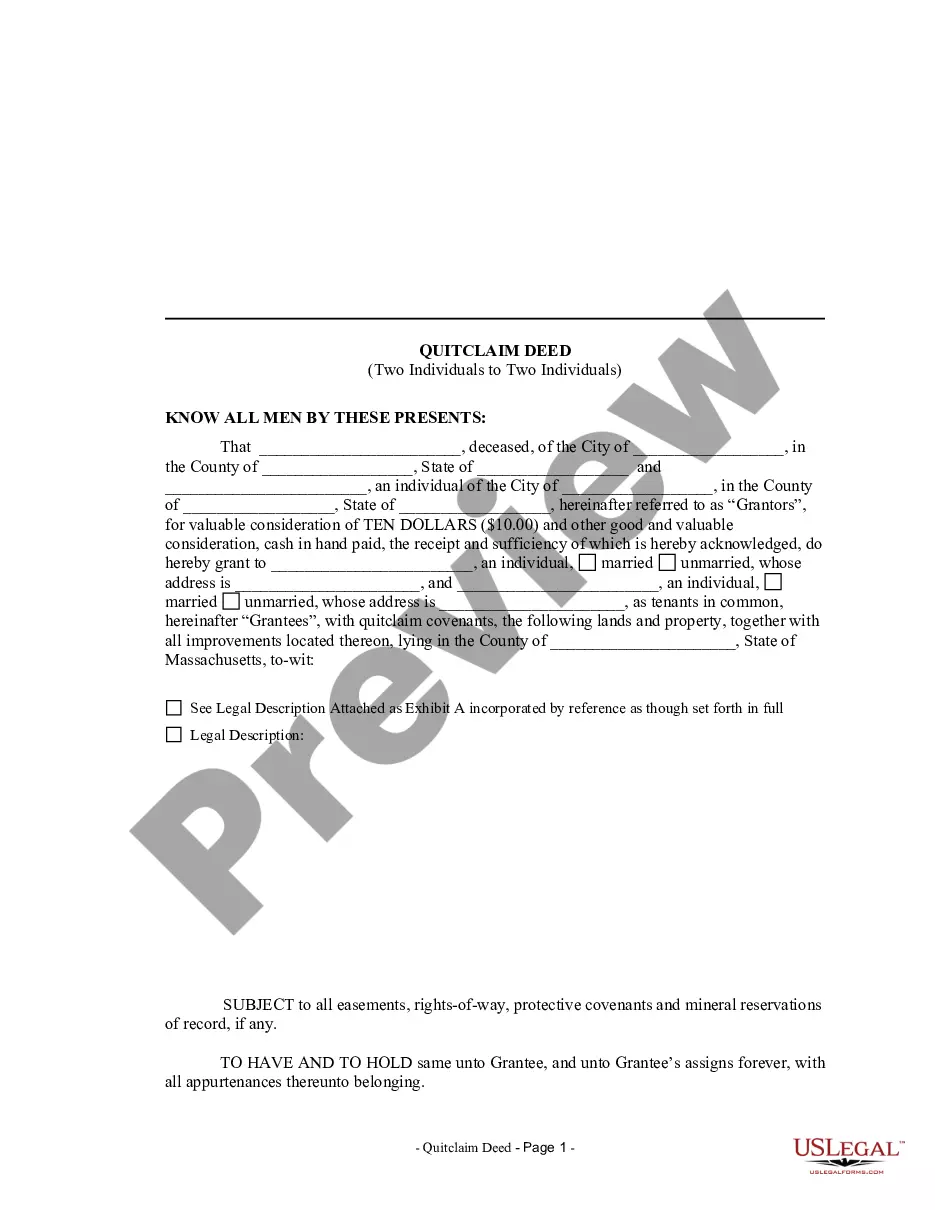
The Quitclaim Deed from Two Individuals, One who is Deceased, to Two Individuals is a legal document used to transfer ownership of property. In this case, it involves two living grantors, one of whom is deceased, transferring property to two grantees. Unlike other deed types, such as warranty deeds, a quitclaim deed offers no guarantees or warranties regarding the property title. Instead, it simply conveys whatever interest the grantors may have in the property, making it important to use this form with an understanding of its implications.
Key components of this form
- Identification of grantors and grantees, including the deceased individual.
- Description of the property being transferred.
- Statement of any easements, rights-of-way, or covenants impacting the property.
- Claims and quitclaims made by the grantors.
- Signatures of the grantors and a notary public to validate the deed.





When this form is needed
This quitclaim deed is commonly used in situations where one owner has passed away, and the remaining owners wish to affirm their ownership. It may also be employed to clarify property rights between family members or in estate settlements. Examples include transferring property after a divorce, clarifying ownership among heirs, or fulfilling terms of a will.
Who this form is for
This form is intended for:
- Property owners needing to clarify or transfer title among themselves.
- Heirs or beneficiaries managing property after a person's death.
- Individuals involved in estate planning or division of property.
How to prepare this document
- Identify the living grantors and include the name of the deceased individual.
- Clearly describe the property being transferred, including its location.
- Specify any easements, rights-of-way, or covenants in effect on the property.
- Have all grantors sign the deed in front of a notary public.
- Complete the date section with the appropriate signing date.
Is notarization required?
Yes, this form must be notarized to be legally valid. Proper notarization ensures that the identities of the grantors are verified and that the deed can be recorded with the appropriate authorities. US Legal Forms offers integrated online notarization, allowing you to certify documents through secure video calls at any time, eliminating the need for travel.
Get your form ready online
Our built-in tools help you complete, sign, share, and store your documents in one place.
Make edits, fill in missing information, and update formatting in US Legal Forms—just like you would in MS Word.
Download a copy, print it, send it by email, or mail it via USPS—whatever works best for your next step.
Sign and collect signatures with our SignNow integration. Send to multiple recipients, set reminders, and more. Go Premium to unlock E-Sign.
If this form requires notarization, complete it online through a secure video call—no need to meet a notary in person or wait for an appointment.
We protect your documents and personal data by following strict security and privacy standards.

Make edits, fill in missing information, and update formatting in US Legal Forms—just like you would in MS Word.

Download a copy, print it, send it by email, or mail it via USPS—whatever works best for your next step.

Sign and collect signatures with our SignNow integration. Send to multiple recipients, set reminders, and more. Go Premium to unlock E-Sign.

If this form requires notarization, complete it online through a secure video call—no need to meet a notary in person or wait for an appointment.

We protect your documents and personal data by following strict security and privacy standards.
Typical mistakes to avoid
- Failing to include the full name and details of the deceased grantor.
- Not adequately describing the property being transferred.
- Forgetting to have the document notarized, if required.
- Leaving out signatures from all necessary grantors.
Why use this form online
- Convenience of downloading templates from anywhere.
- Ability to edit the form to suit specific needs.
- Access to forms prepared by licensed attorneys, ensuring legal compliance.
Legal use & context
- This quitclaim deed is legally binding once completed and notarized, transferring property rights as stated.
- It is essential to ensure that all parties are aware that a quitclaim deed does not guarantee the quality of the title.
- Utilizing this form can expedite property transfers during estate settlements or family arrangements.
Quick recap
- The Quitclaim Deed is used to transfer property among individuals, especially when one is deceased.
- The form must be completed accurately, including notarization for legality.
- This document helps clarify ownership, particularly in estate matters.
Looking for another form?

Form popularity
FAQ
In most cases, the surviving owner or heir obtains the title to the home, the former owner's death certificate, a notarized affidavit of death, and a preliminary change of ownership report form. When all these are gathered, the transfer gets recorded, the fees are paid, and the county issues a new title deed.
If it was inherited, succession law comes into play. Once the beneficiaries and their shares, rights and liabilities are decided, the property has to be transferred in their names. For this you need to apply for property transfer at the sub-registrar's office.
File a petition in probate court. The first step to transferring the property to the rightful new owners is to open up a case in probate court. Petition the court for sale and convey the property to the purchaser. Next, you must petition the court to sell the property.
If the deceased was sole owner, or co-owned the property without right of survivorship, title passes according to his will. Whoever the will names as the beneficiary to the house inherits it, which requires filing a new deed confirming her title. If the deceased died intestate -- without a will -- state law takes over.
So long as the quitclaim deed is valid (properly notarized, etc.) it can be recorded even after the grantor's death, so property owned by the deceased which has been deeded in that quitclaim deed should not need to pass through probate.
A quitclaim deed is sometimes used to avoid probate court by transferring an interest in real property before someone's death. The property is transferred by deed during their life, instead of being transferred by a will after the grantor's death.
When someone who owns real property dies, the property goes into probate or it automatically passes, by operation of law, to surviving co-owners. Often, surviving co-owners do nothing with the title for as long as they own the property. Yet the best practice is to remove the deceased owner's name from the title.
If one co-owner dies, their interest in the property automatically passes to the surviving co-owner(s), whether or not they have a will. As tenants in common, co-owners own specific shares of the property. Each owner can leave their share of the property to whoever they choose.
Joint tenancy avoids probate. 2. Title to real property can be cleared after a death by filing an affidavit of death of joint tenant. The surviving joint tenant then owns the property with no further proceedings or paperwork required.