Louisiana Sentencing Recommendation
What is this form?
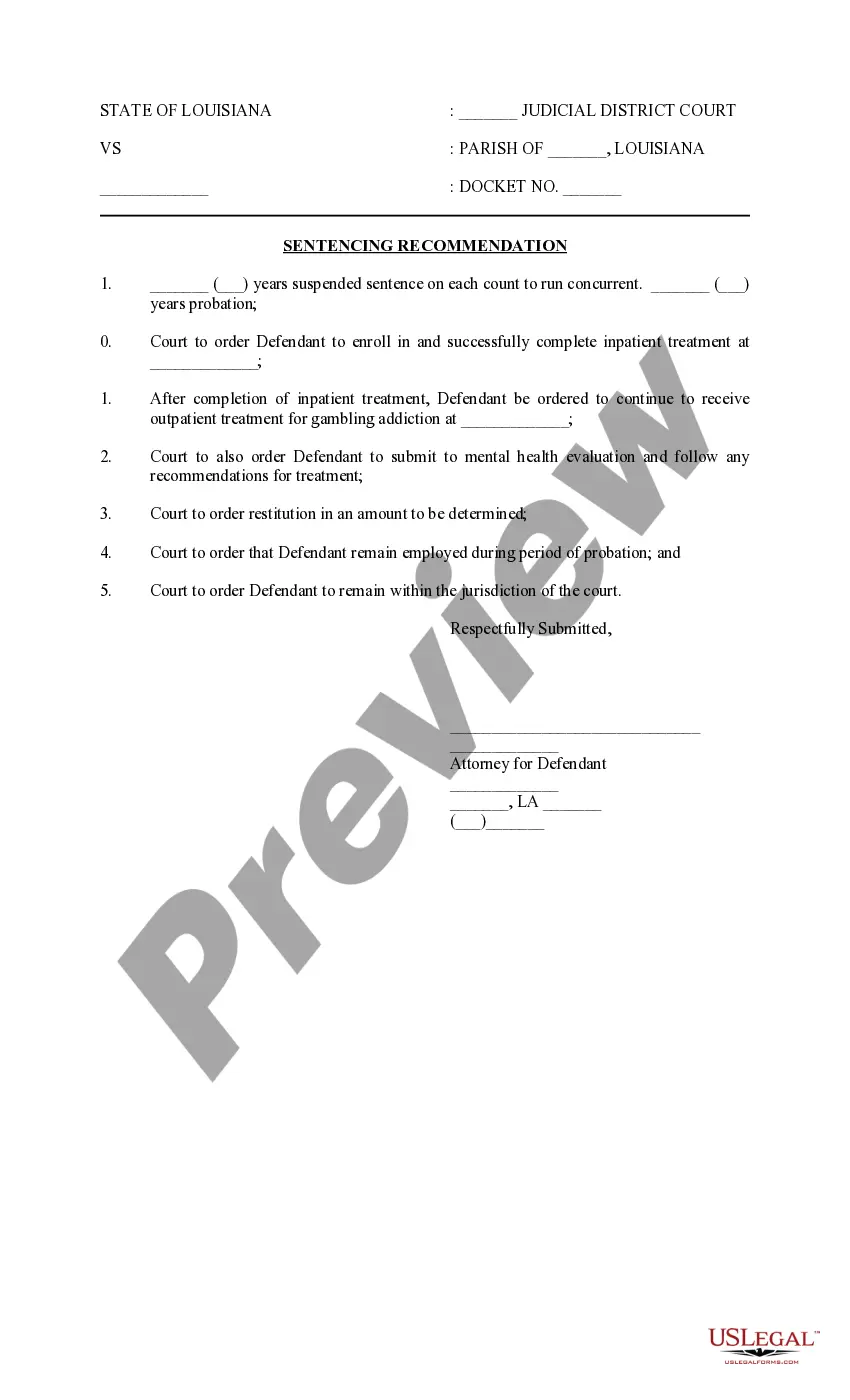
The Sentencing Recommendation form is a legal document used by defense counsel to present recommendations to the court regarding the sentencing of a convicted individual. It outlines potential alternatives to incarceration, such as probation, treatment programs, and restitution. This form is distinct from other sentencing documents because it focuses specifically on suggesting a course of action that promotes rehabilitation rather than simply serving time in prison.
Key parts of this document
- Proposed lengths of suspended sentence and probation terms.
- Requirements for inpatient and outpatient treatment programs.
- Recommendations for mental health evaluations and follow-up care.
- Details about restitution, including the process for determining amounts.
- Conditions for employment and jurisdictional requirements during probation.
Common use cases
This form should be used when a defendant has been convicted of a crime and the defense counsel wishes to recommend specific sentencing terms to the court. It is particularly applicable in cases where rehabilitation is a viable option, and the defense seeks to advocate for alternatives to imprisonment, thereby promoting the defendant's reintegration into the community.
Who can use this document
- Defense attorneys representing convicted clients.
- Individuals involved in the sentencing phase of a criminal trial.
- Legal advocates aiming to propose rehabilitation-focused sentencing options.
How to prepare this document
- Fill in the defendant's name and the court's docket number at the top of the form.
- Specify the proposed length of the suspended sentence for each count.
- Outline terms for probation, including required enrollment in specified treatment programs.
- Detail recommendations for mental health evaluations and any required follow-up treatment.
- Indicate the restitution amount to be determined, along with any employment conditions during probation.
- Sign and date the form as the attorney for the defendant.
Notarization guidance
Notarization is not commonly needed for this form. However, certain documents or local rules may make it necessary. Our notarization service, powered by Notarize, allows you to finalize it securely online anytime, day or night.
Get your form ready online
Our built-in tools help you complete, sign, share, and store your documents in one place.
Make edits, fill in missing information, and update formatting in US Legal Forms—just like you would in MS Word.
Download a copy, print it, send it by email, or mail it via USPS—whatever works best for your next step.
Sign and collect signatures with our SignNow integration. Send to multiple recipients, set reminders, and more. Go Premium to unlock E-Sign.
If this form requires notarization, complete it online through a secure video call—no need to meet a notary in person or wait for an appointment.
We protect your documents and personal data by following strict security and privacy standards.

Make edits, fill in missing information, and update formatting in US Legal Forms—just like you would in MS Word.

Download a copy, print it, send it by email, or mail it via USPS—whatever works best for your next step.

Sign and collect signatures with our SignNow integration. Send to multiple recipients, set reminders, and more. Go Premium to unlock E-Sign.

If this form requires notarization, complete it online through a secure video call—no need to meet a notary in person or wait for an appointment.

We protect your documents and personal data by following strict security and privacy standards.
Common mistakes to avoid
- Failing to specify the exact lengths of the suspended sentence and probation.
- Neglecting to outline all recommended treatments and evaluations.
- Omitting signature and date sections, which can cause delays in processing.
Why complete this form online
- Instant access to legal form templates created by licensed attorneys.
- Convenient download and editing options to ensure accuracy.
- Secure storage of legal documents for easy retrieval and submission.
Legal use & context
The Sentencing Recommendation form serves as a guideline for the court but is not binding. The final decision on sentencing remains at the court's discretion. Proper usage and completion of this form can aid in facilitating a more lenient and rehabilitative approach to post-conviction sentencing.
What to keep in mind
- The form provides structured recommendations for the sentencing of a convicted individual.
- It is useful primarily for attorneys representing clients in criminal cases.
- Specific to Louisiana, it must follow local legal standards and court procedures.
- Accurate completion is essential to avoid common errors that could affect outcomes.
Looking for another form?
Form popularity
FAQ
Judges also use the Federal Sentencing Guidelines Manual. As its name suggests, the manual guides judges toward a sentence based on the facts that led to the conviction. Unlike mandatory minimums, the sentencing guidelines are advisory, not mandatory.
A judge must impose a sentence that is sufficient, but not greater than necessary, to: reflect the seriousness of the offense; promote respect for the law; provide just punishment for the offense; adequately deter criminal conduct; protect the public from further crimes by the defendant; and provide the defendant with
If the defendant is convicted in a criminal case, the judge will set a date for sentencing. Before that time, a pre-sentence investigation will take place to help the judge determine the appropriate sentence from the range of possible sentences set out in the statutes.
At the moment there are 63 prisoners serving whole life sentences in prison. If murderers are released, they still have to serve their sentence 'on licence' for the rest of their lives. This means they are placed under the supervision of probation officers and must stick to certain conditions for good behaviour.
Inmates don't usually serve the entire sentence handed down by a court. Most can and do have their time shortened by as much as a third. Of those released last year and eligible for that 33 percent time off, more than 59 percent received the full reduction.
For groups of non-violent felony offenses, allow parole after 25 percent of the sentence is served. For the least serious class, allow early release from prison for "good time" at 35 percent of the sentence served. >> For some violent offenses, allow parole once 55 percent of the sentence is served.
Rather, judges can take a number of factors into account when deciding on an appropriate punishment. For instance, judges may typically consider factors that include the following: the defendant's past criminal record, age, and sophistication. the circumstances under which the crime was committed, and.
Under the most recent legislation, an inmate gets credited 13 days credit for every seven days they serve incarcerated; this reduces their annual sentence by 130 days.The Louisiana Department of Corrections is the final arbitrator of a person's sentence.