Louisiana Motion to Appoint Special Process Server
About this form
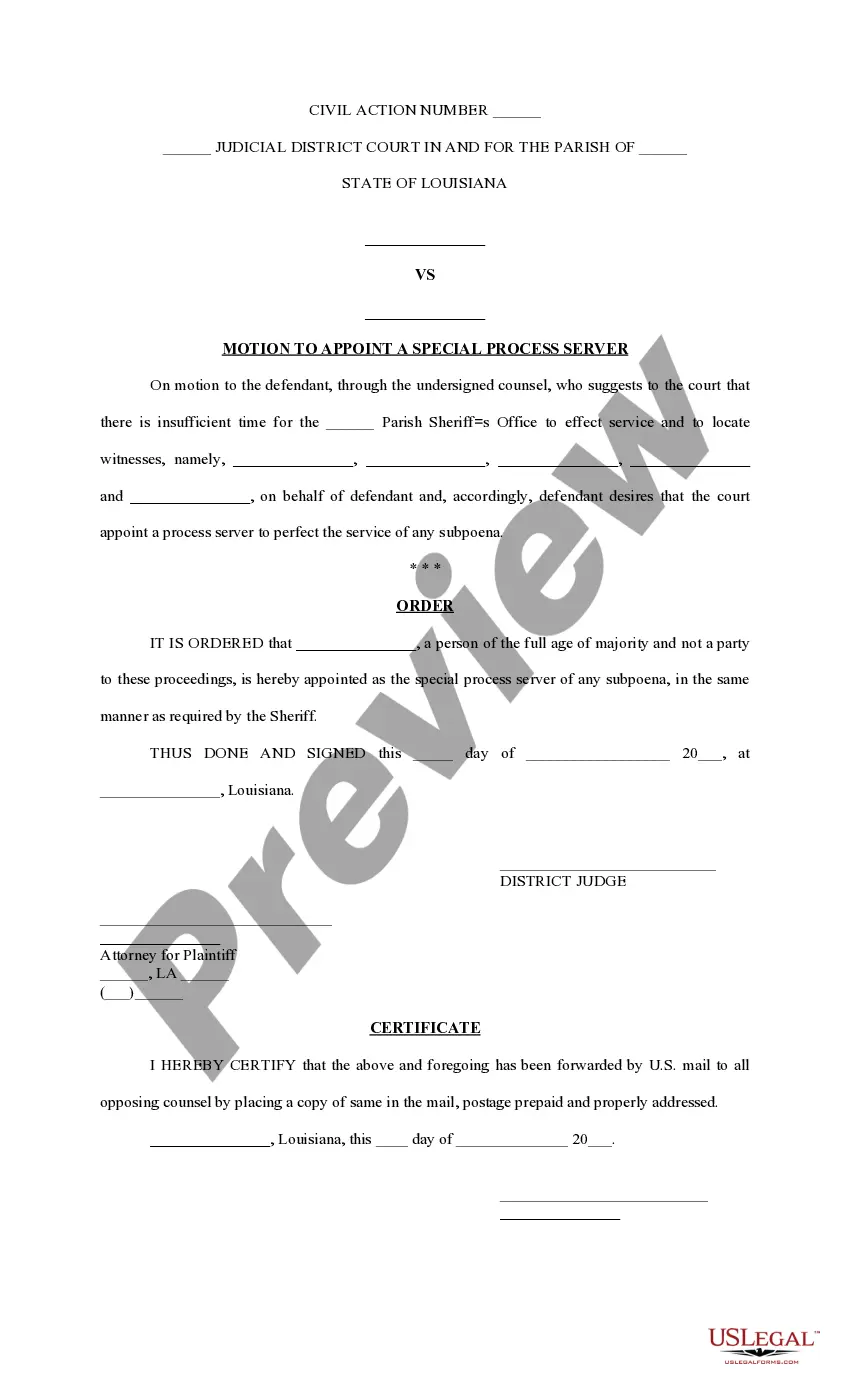
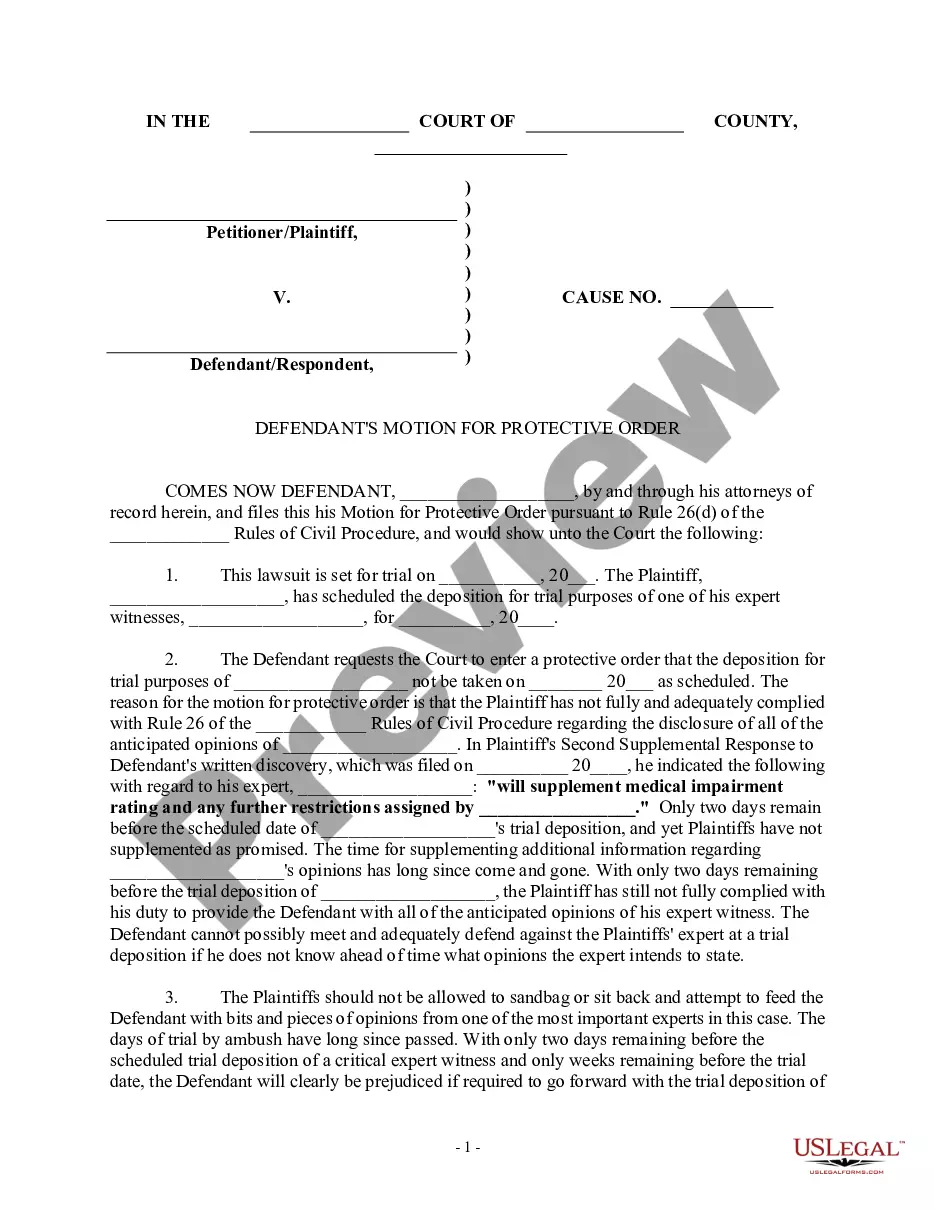
The Motion to Appoint Special Process Server is a legal document that allows a defendant to request the court to appoint a special process server to serve subpoenas. This motion is used when there is not enough time for the Sheriff's Office to locate and serve necessary witnesses for the defense. By utilizing this form, parties can ensure timely legal proceedings without relying solely on traditional service methods.
Key parts of this document
- Defendant's motion to appoint a special process server.
- List of witnesses to be served with subpoenas.
- Order section appointing the special process server.
- Signature lines for the District Judge and attorney for the plaintiff.
- Certificate of mailing to notify opposing counsel.
Situations where this form applies
This form should be used when a defendant needs to ensure that specific witnesses are served subpoenas without delay. Situations that may warrant using this form include time-sensitive cases, last-minute changes in witness availability, or circumstances where the Sheriffâs Office is unable to fulfill the service requirements in a timely manner.
Who this form is for
- Defendants in civil or criminal cases who require specific witnesses to testify.
- Attorneys representing defendants looking for expedited service of subpoenas.
- Legal representatives who need to ensure compliance with court-ordered witness appearances.
How to complete this form
- Identify the judicial district and parish in which the motion is being filed.
- Fill in the names of the witnesses to be served with subpoenas.
- Specify the name of the individual requested to be appointed as the special process server.
- Include the date and location where the motion is being signed.
- Obtain the necessary signatures from the District Judge and the attorney for the plaintiff.
Notarization requirements for this form
This form does not typically require notarization unless specified by local law.
Get your form ready online
Our built-in tools help you complete, sign, share, and store your documents in one place.
Make edits, fill in missing information, and update formatting in US Legal Forms—just like you would in MS Word.
Download a copy, print it, send it by email, or mail it via USPS—whatever works best for your next step.
Sign and collect signatures with our SignNow integration. Send to multiple recipients, set reminders, and more. Go Premium to unlock E-Sign.
If this form requires notarization, complete it online through a secure video call—no need to meet a notary in person or wait for an appointment.
We protect your documents and personal data by following strict security and privacy standards.

Make edits, fill in missing information, and update formatting in US Legal Forms—just like you would in MS Word.

Download a copy, print it, send it by email, or mail it via USPS—whatever works best for your next step.

Sign and collect signatures with our SignNow integration. Send to multiple recipients, set reminders, and more. Go Premium to unlock E-Sign.

If this form requires notarization, complete it online through a secure video call—no need to meet a notary in person or wait for an appointment.

We protect your documents and personal data by following strict security and privacy standards.
Typical mistakes to avoid
- Failing to provide an accurate list of witnesses needing subpoenas.
- Omitting the signature of the District Judge.
- Not including the jurisdiction-specific information correctly.
Why complete this form online
- Convenience of downloading and filling out the form at your own pace.
- Editability allows for quick corrections and changes as needed.
- Access to a reliable legal document drafted by licensed attorneys.
Looking for another form?







Form popularity
FAQ
Can Someone Refuse to Be Served Papers? No, in California a person cannot refuse to accept service. If we can identify a person on whom legal service can be made either personally or by sub-service and they refuse to accept the documents, we can absolutely still serve them.
You must allow Process Servers Zone 7 to 10 days from the time the Process Server receives the documents, for the documents to be served. If you require the documents to be served within 7 to 10 days you must select urgent service when paying and your documents will be given priority. What is Urgent Service?
It is not illegal to avoid service of process. In most cases, however, service is inevitable. As Mr. Alexander notes, if you avoid service long enough, the plaintiff may still serve you by publication in most cases.
On average on-boarding takes 3-5 days which includes filling out paperwork, taking our process server orientation course and submitting a background check.
Generally, process servers make at least three attempts to serve somebody. These attempts are normally made at different times of day and on different days to maximize our chance of serving the papers.
Can Someone Refuse to Be Served Papers? No, in California a person cannot refuse to accept service. If we can identify a person on whom legal service can be made either personally or by sub-service and they refuse to accept the documents, we can absolutely still serve them.
What Can a Judge Do if I Avoid Being Served? If they are avoiding a process server, a judge may allow the papers to be left at their home or business with any competent person over the age of 18. A judge may also allow the summons to be mailed to their home or business address via certified mail.
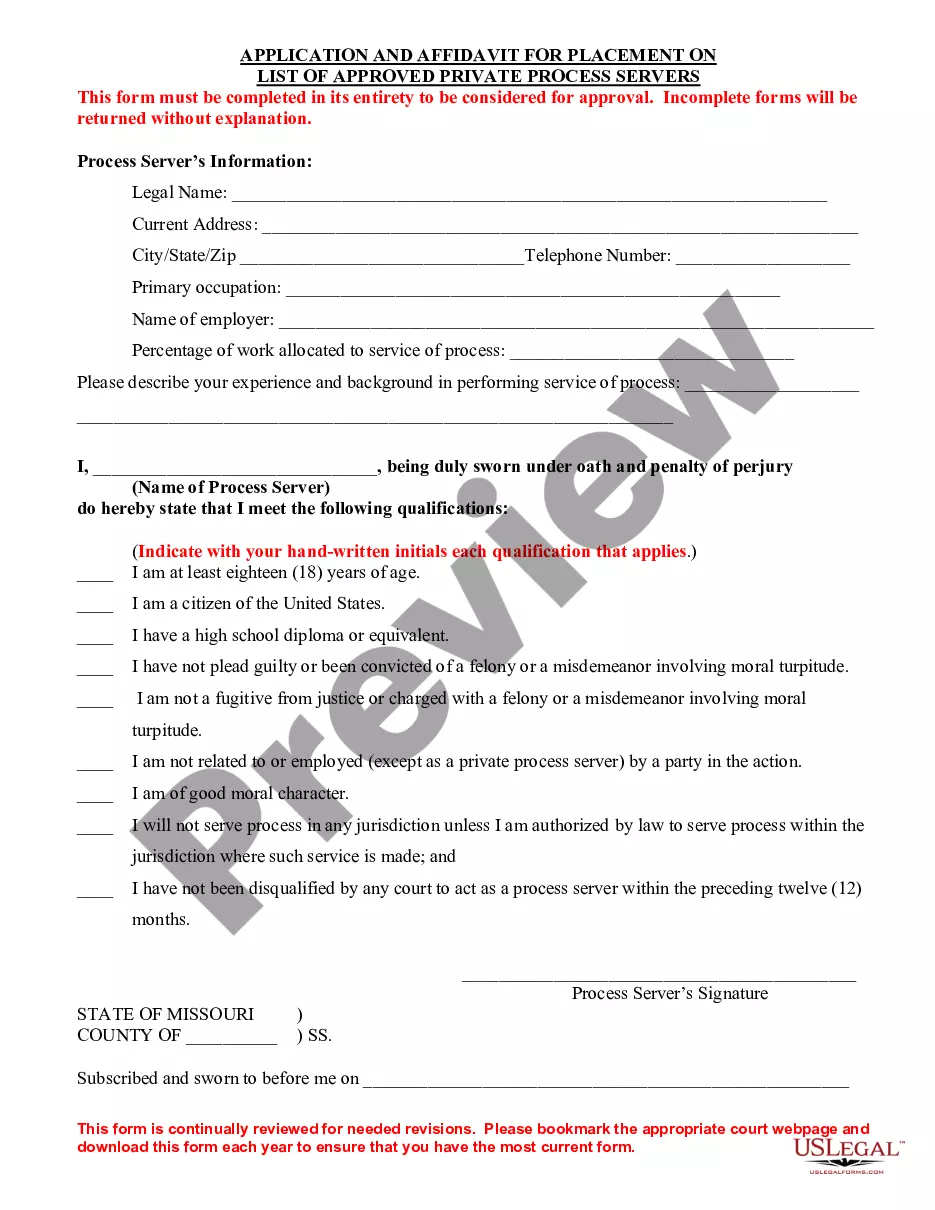
Louisiana doesn't license private process servers, but you may require court appointment to become a process server in Louisiana. In most cases, service is made by the local sheriff's office, or any private individual appointed by the court.