Louisiana Letter to Opposing Counsel regarding Community Property Settlement Offer
Overview of this form
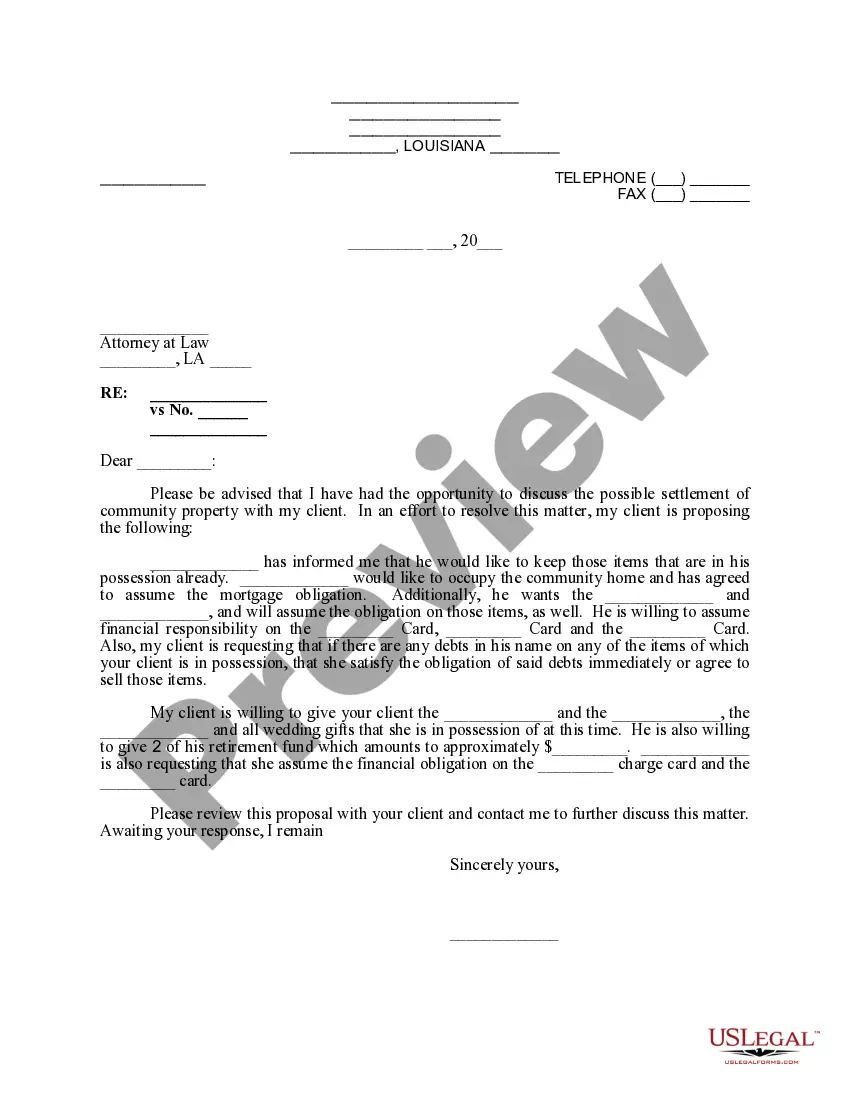
This form is a Letter to Opposing Counsel regarding a Community Property Settlement Offer. It facilitates communication between attorneys during divorce proceedings concerning the division of community property, such as homes, financial obligations, assets, and personal property. This letter specifically outlines the proposed settlement terms and requests the opposing counsel to review with their client, making it distinct from other legal correspondence in divorce matters.
Key parts of this document
- Header section with attorney's and recipient's details
- Introduction stating the purpose of the letter
- Proposed division of community property and financial obligations
- Specific requests regarding the assets and debts
- Closing statement prompting further discussion



When to use this form
This form is used in divorce cases when one party is seeking to propose a settlement regarding community property. It is particularly useful when both parties have assets and liabilities that need to be divided and when attorneys are negotiating on behalf of their clients to reach an amicable agreement.
Who needs this form
- Divorce attorneys representing clients in community property disputes
- Clients in the process of negotiating a settlement regarding shared assets
- Individuals seeking to formalize a proposal to opposing counsel
How to prepare this document
- Fill in your contact information at the top, including your name, address, and phone number.
- Input the recipient's details, including their name and address, along with the case number.
- Clearly state the proposed division of assets, detailing what each party will retain.
- Specify any financial obligations that each party will assume.
- Conclude by requesting the opposing counsel contact you to discuss the proposal further.
Notarization requirements for this form
Notarization is not commonly needed for this form. However, certain documents or local rules may make it necessary. Our notarization service, powered by Notarize, allows you to finalize it securely online anytime, day or night.
Get your form ready online
Our built-in tools help you complete, sign, share, and store your documents in one place.
Make edits, fill in missing information, and update formatting in US Legal Forms—just like you would in MS Word.
Download a copy, print it, send it by email, or mail it via USPS—whatever works best for your next step.
Sign and collect signatures with our SignNow integration. Send to multiple recipients, set reminders, and more. Go Premium to unlock E-Sign.
If this form requires notarization, complete it online through a secure video call—no need to meet a notary in person or wait for an appointment.
We protect your documents and personal data by following strict security and privacy standards.

Make edits, fill in missing information, and update formatting in US Legal Forms—just like you would in MS Word.

Download a copy, print it, send it by email, or mail it via USPS—whatever works best for your next step.

Sign and collect signatures with our SignNow integration. Send to multiple recipients, set reminders, and more. Go Premium to unlock E-Sign.

If this form requires notarization, complete it online through a secure video call—no need to meet a notary in person or wait for an appointment.

We protect your documents and personal data by following strict security and privacy standards.
Typical mistakes to avoid
- Failing to provide complete contact information.
- Not specifying clear terms for property and debt division.
- Omitting the case number or relevant details that link to the divorce proceedings.
- Neglecting to proofread for clarity and professionalism before sending.
Why complete this form online
- Convenient access to legal templates that can be customized.
- Ability to easily edit the form to match your specific situation.
- Documents drafted by licensed attorneys, ensuring legal compliance.
- Time-saving as you can download and print the form instantly.
Looking for another form?

Form popularity
FAQ
The general principle in family law matters is that each party is required to pay their own legal costs regardless of whether they win or lose. Courts do, however, have the power to make an order for one party to pay the other party's legal costs if they deem it appropriate.
After settlement, your lender will draw down on your loan. This means that they'll debit the amount they've paid at settlement from your loan account. You're then responsible for paying land transfer duty or stamp duty. It's usually paid on the settlement date.
How does the Family Court determine property settlement matters? Following the breakdown of a de facto relationship or marriage, it may be necessary to determine how assets, liabilities and even superannuation entitlements are divided between the parties; in other words, how property settlement will be calculated.
Make a list of assets and liabilities. Assess the initial contributions of each party. Consider the length of the relationship. Determine whether or not any assets or liabilities should go together or in separate pools. Deduct the liabilities from the assets to get the total property pool.
Property settlement lawyers' fees average about $700 an hour compared to a mediated settlement that can cost $243 for the family court filing fee or just $60 for people with a health care or student card.
Settlement: This fee is paid to the settlement agent or escrow holder.Title search: The fee to search the public records of the property you are purchasing. Document Preparation: This fee covers the cost of preparation of final legal papers, such as a mortgage, deed of trust, note or deed.
However, one rule of thumb for buyers is to figure that settlement costs will be about 3% of the price of your home. In some relatively high-tax areas of the country, 5% to 6% is more common.
A property settlement agreement (PSA), sometimes called a marital settlement agreement, is the document that itemizes what each spouse will receive when a divorce is final.It also outlines each spouse's financial responsibilities in a divorce such as paying shared debts or alimony obligations.
Some people wonder if they can save even more by money by writing their own settlement agreement and not seeking the help of a divorce attorney at all. While there is no legal requirement that you have a lawyer draft your settlement agreement, it is certainly a good idea to do so.