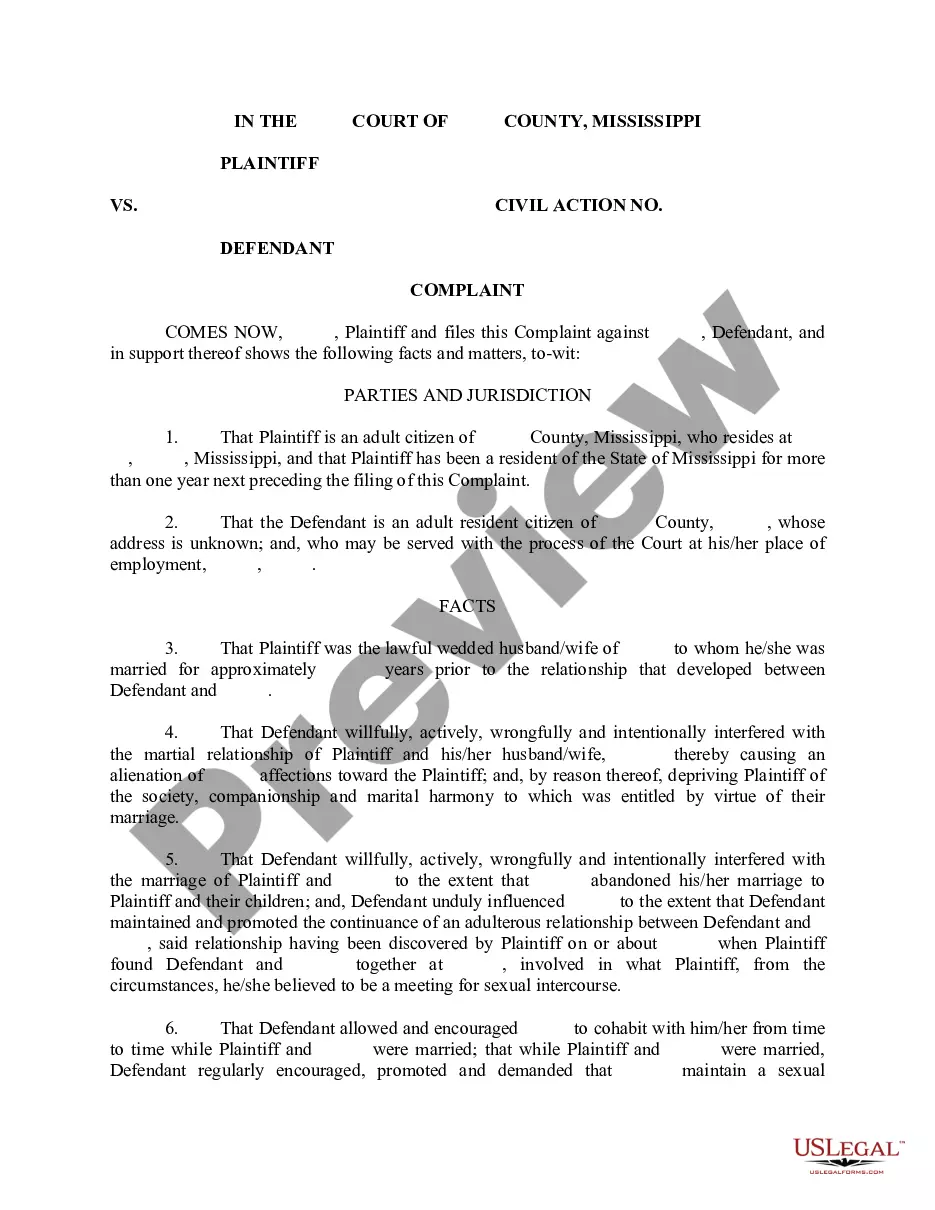
Louisiana Judgment Default of Community Property
About this form
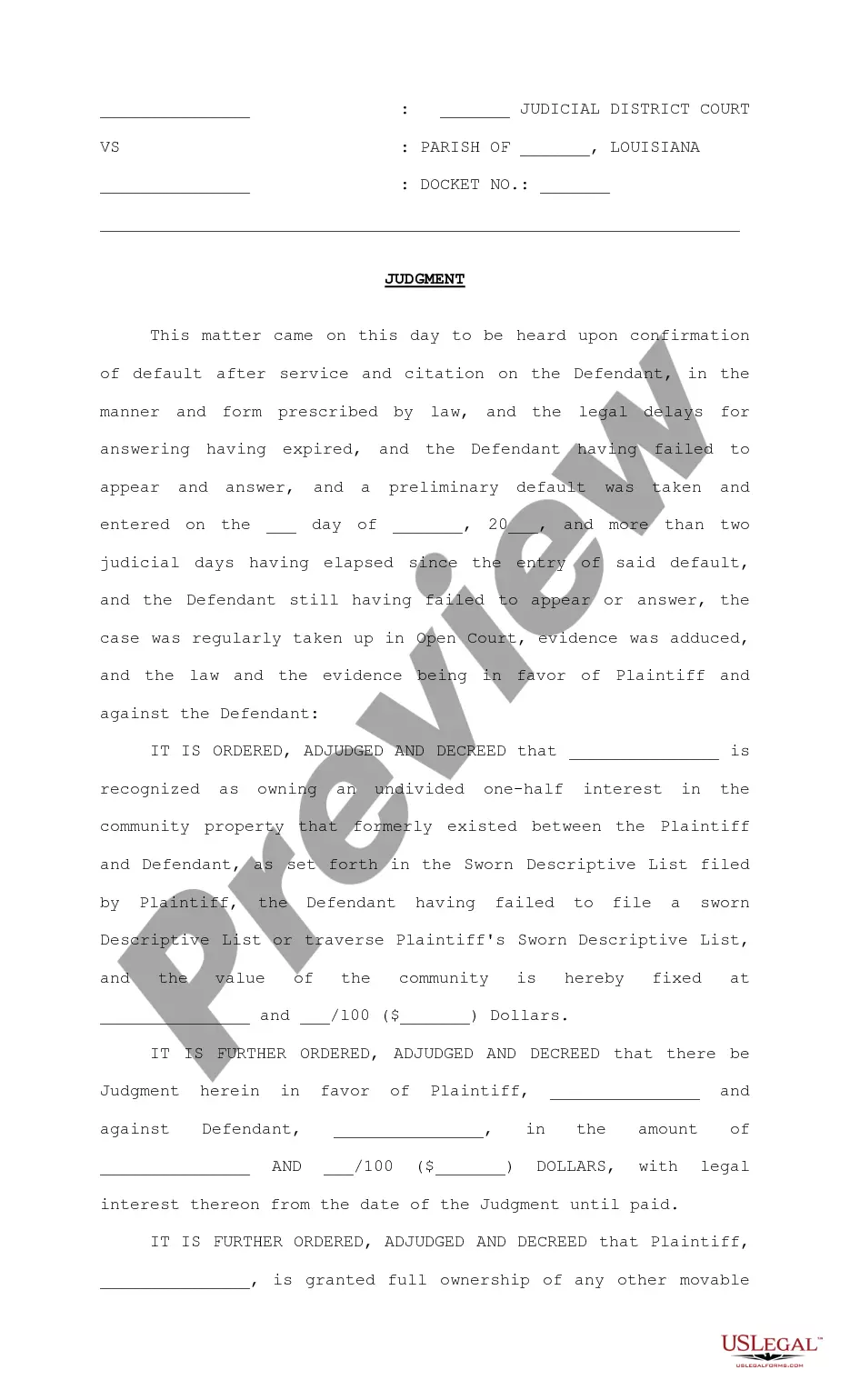
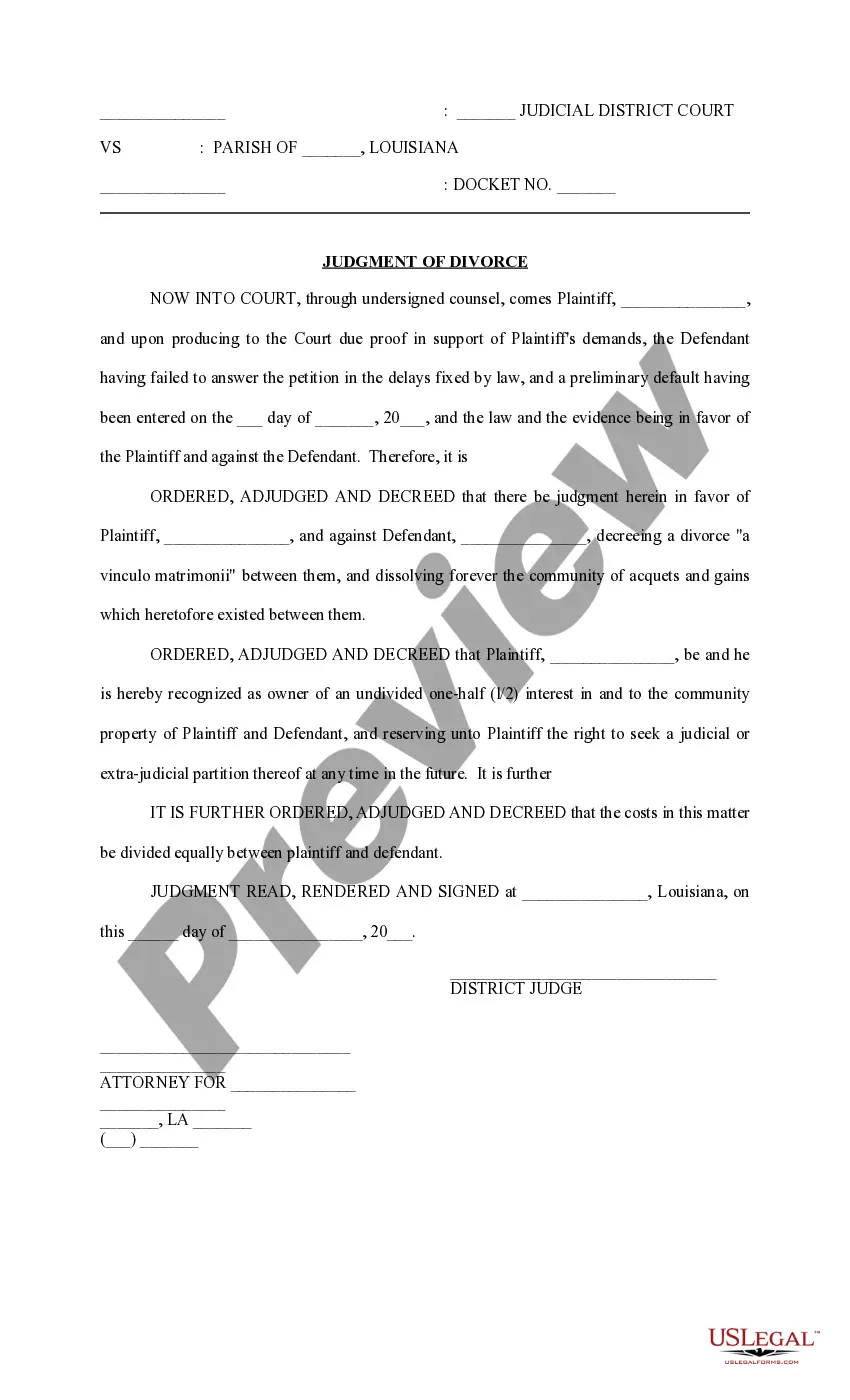
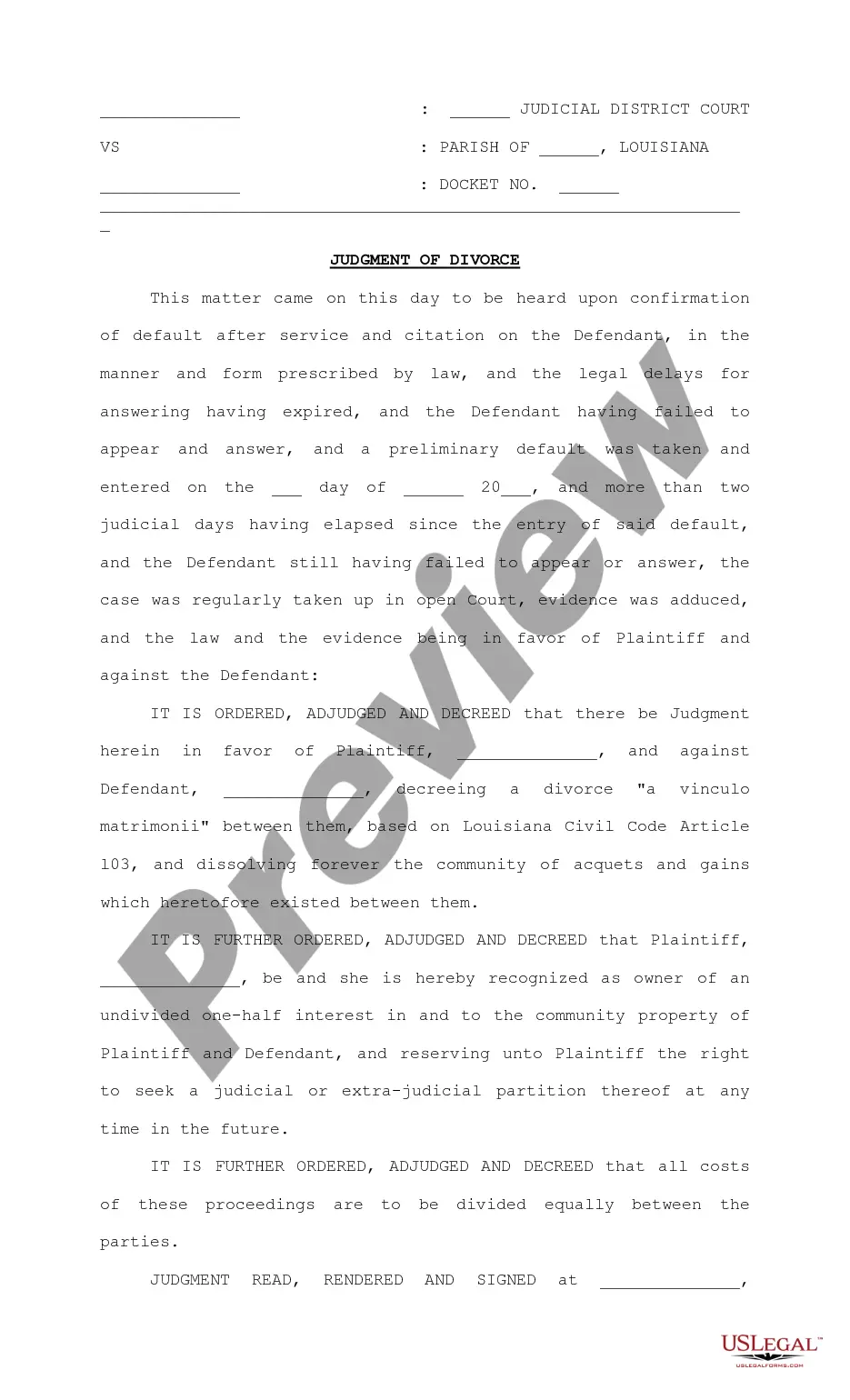
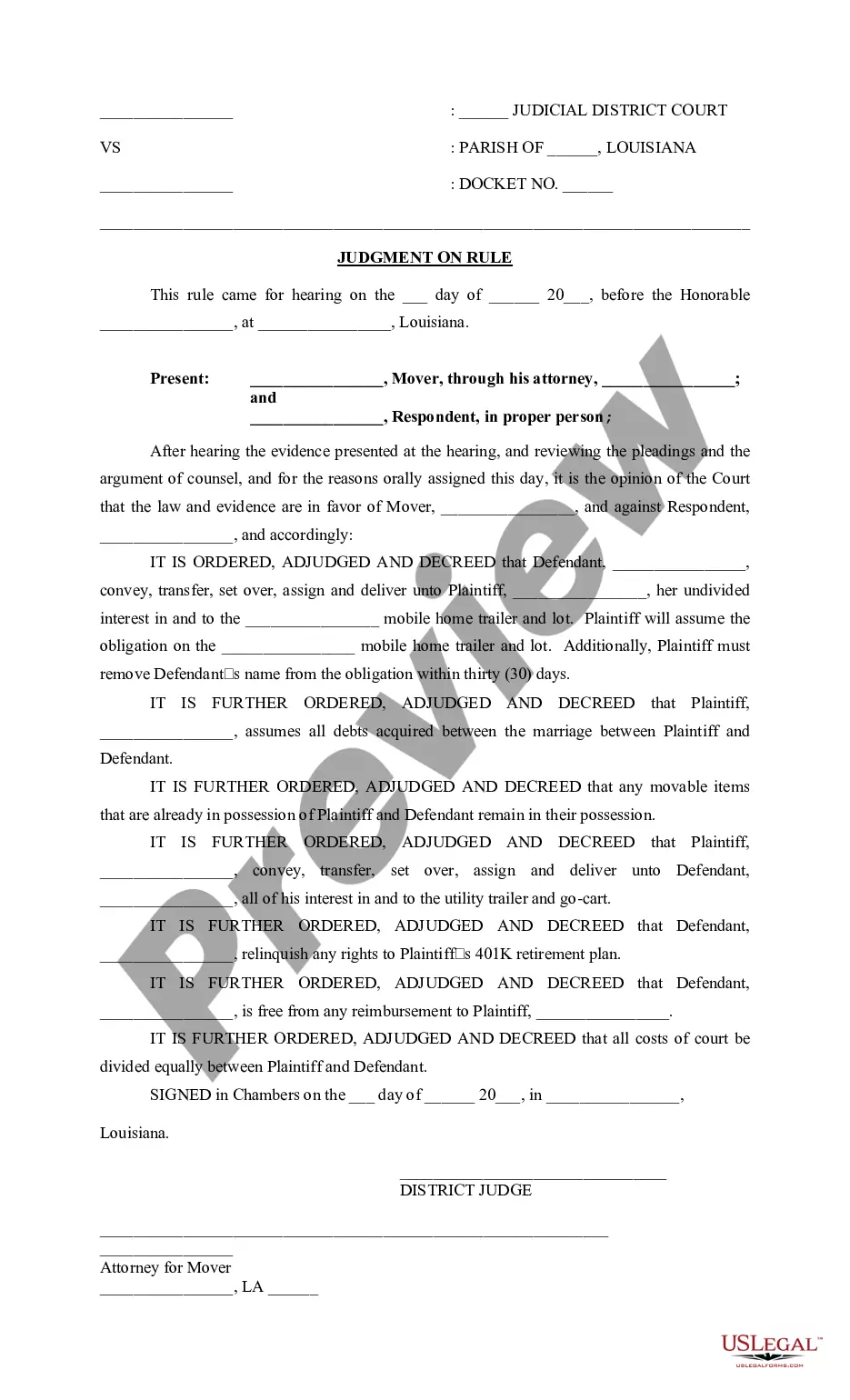
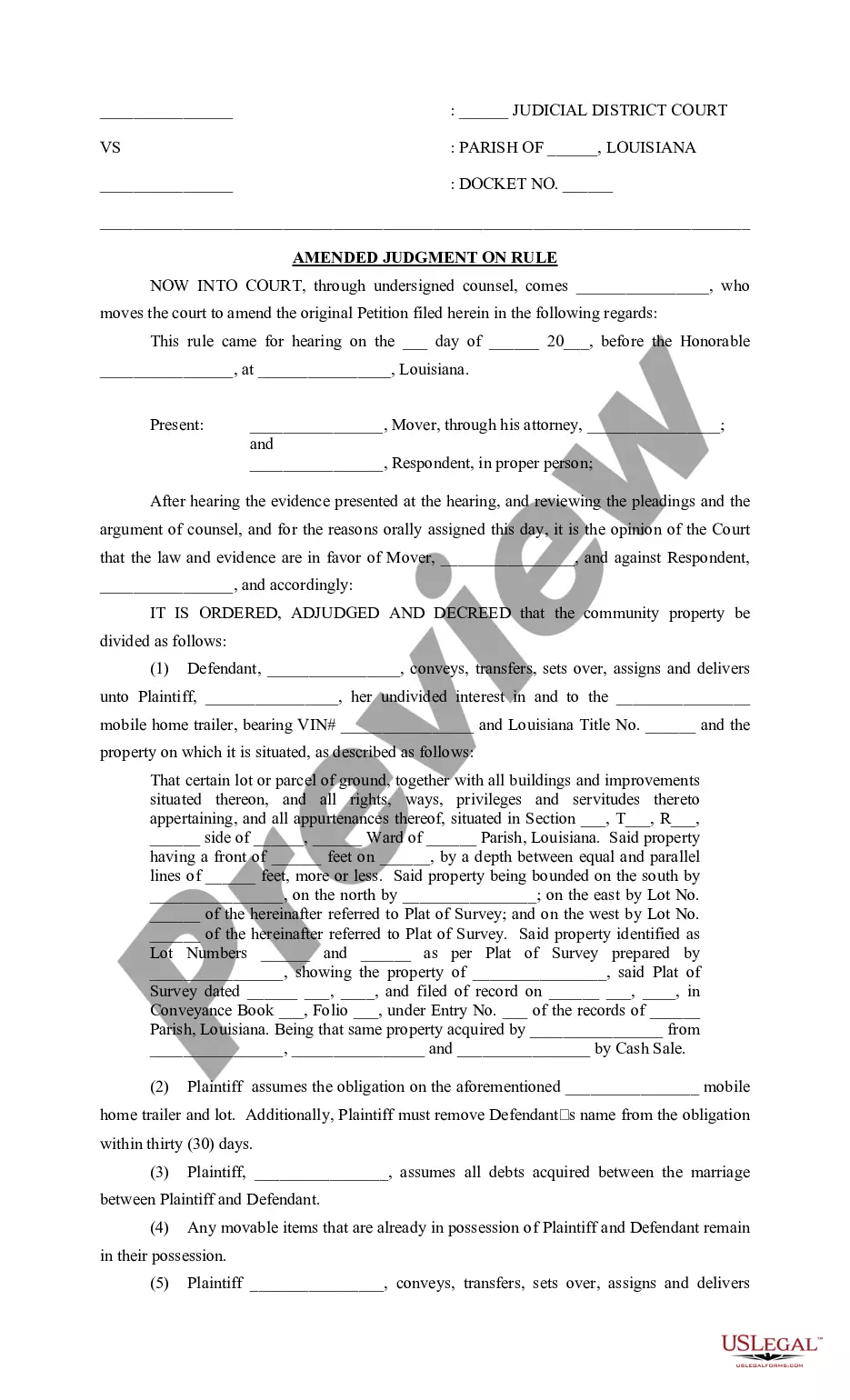
The Judgment Default of Community Property is a legal document used to secure a default judgment regarding the community property of a divorced couple. This form is utilized when one party, the defendant, fails to respond to a legal complaint within the specified timeframe. The judgment grants the plaintiff recognition of their ownership interest in community property and includes the assessment of property value and potential financial judgments against the defendant. This form differs from other divorce-related documents by focusing specifically on property rights and obligations following a divorce without active participation from one party.
Key parts of this document
- Identification of the parties involved (plaintiff and defendant).
- Recognition of ownership interests in the community property.
- Fixing the value of the community property.
- Financial judgment against the defendant.
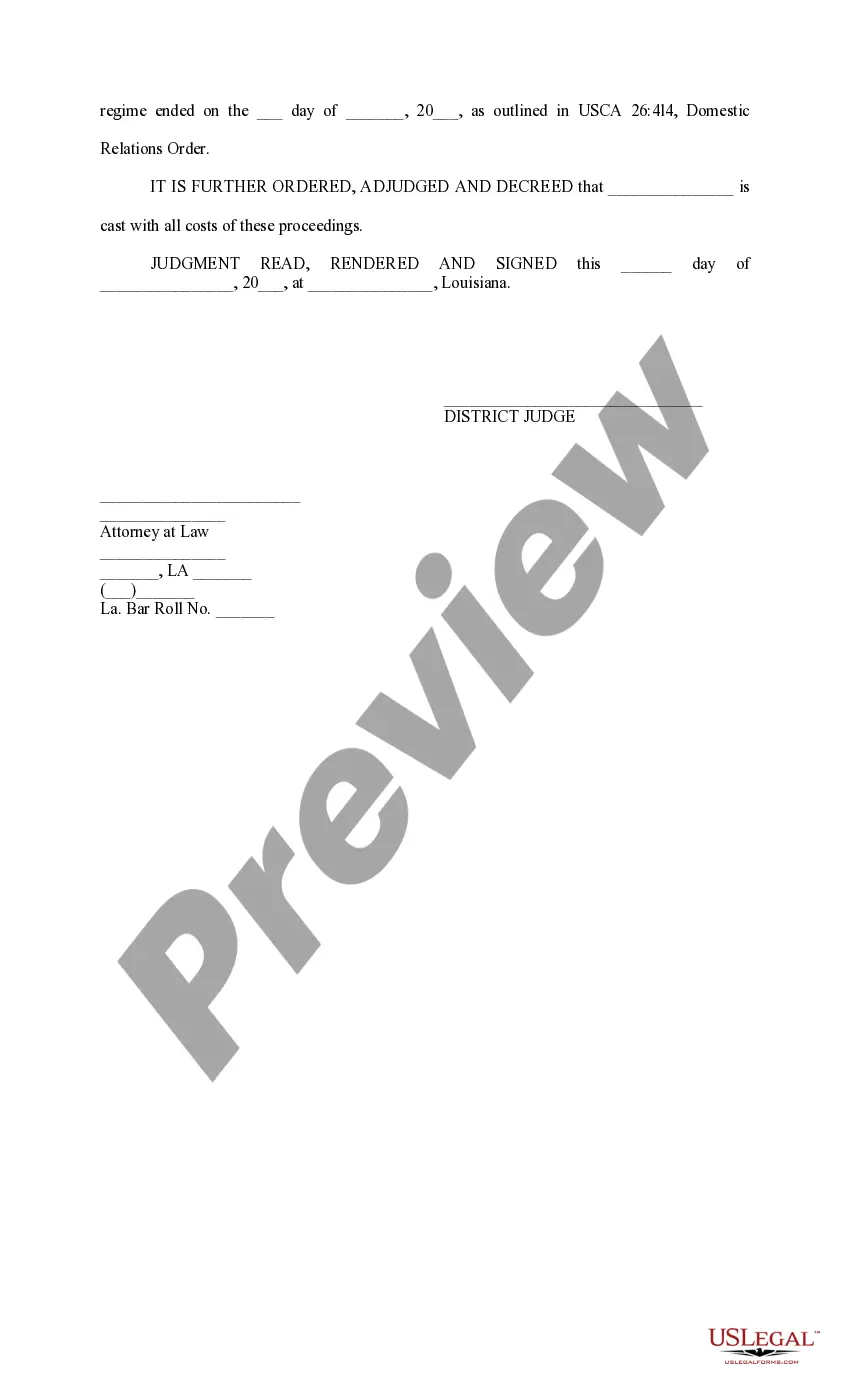
- Granting full ownership of movable property to the plaintiff.
- Recognition of an undivided interest in the defendant's pension plan.
When to use this document
This form is necessary in scenarios where a couple has divorced, and one spouse fails to appear or respond to the legal proceedings regarding the division of community property. It is particularly relevant when the plaintiff seeks to establish their rights to property and assets acquired during the marriage, especially after the defendant has defaulted on their response obligations.
Intended users of this form
This form is intended for:
- Individuals who have filed for divorce and need to obtain a judgment on community property rights.
- Plaintiffs in a divorce case who are seeking legal recognition of their ownership interests in shared property.
- Individuals who are requesting financial judgments against a spouse who has defaulted in a community property divorce proceeding.
How to prepare this document
- Identify the parties by filling in the names and addresses of the plaintiff and defendant.
- Specify the date and details of the preliminary default.
- List the property and its assessed value that is subject to the judgment.
- Detail the financial judgment amount against the defendant.
- Indicate personal property ownership details granted to the plaintiff.
- Sign and date the document before a judge.
Does this form need to be notarized?
Notarization is not commonly needed for this form. However, certain documents or local rules may make it necessary. Our notarization service, powered by Notarize, allows you to finalize it securely online anytime, day or night.
Get your form ready online
Our built-in tools help you complete, sign, share, and store your documents in one place.
Make edits, fill in missing information, and update formatting in US Legal Forms—just like you would in MS Word.
Download a copy, print it, send it by email, or mail it via USPS—whatever works best for your next step.
Sign and collect signatures with our SignNow integration. Send to multiple recipients, set reminders, and more. Go Premium to unlock E-Sign.
If this form requires notarization, complete it online through a secure video call—no need to meet a notary in person or wait for an appointment.
We protect your documents and personal data by following strict security and privacy standards.

Make edits, fill in missing information, and update formatting in US Legal Forms—just like you would in MS Word.

Download a copy, print it, send it by email, or mail it via USPS—whatever works best for your next step.

Sign and collect signatures with our SignNow integration. Send to multiple recipients, set reminders, and more. Go Premium to unlock E-Sign.

If this form requires notarization, complete it online through a secure video call—no need to meet a notary in person or wait for an appointment.

We protect your documents and personal data by following strict security and privacy standards.
Avoid these common issues
- Failing to properly identify all parties involved in the case.
- Omitting key details such as the date and nature of the preliminary default.
- Not including sufficient evidence to support property claims.
- Neglecting specific state requirements for filing the judgment.
Benefits of using this form online
- Convenient access to legal forms without the need to visit a lawyer's office.
- Editable format allows users to tailor the document to their specific situation.
- Reliable templates drafted by licensed attorneys ensure quality and compliance.
- Instant download means you can complete your legal documents at your own pace.
Looking for another form?
Form popularity
FAQ
Community property states as of 2020 include Arizona, California, Idaho, Louisiana, Nevada, New Mexico, Texas, Washington and Wisconsin.That means spouses can divide their property by community property standards, but they don't have to.
In order to change your matrimonial property regime from 'in community' to 'out of community', you and your spouse will need to apply to the high court for leave to sign a notarial contract which, after registration at the Deeds Office, will have the effect of an antenuptial contract which will regulate your new
California is a community property state.In fact, California law expressly prohibits a spouse from giving away community property for less than fair and reasonable value without the written consent of the other spouse. Failure to follow this rule can lead to complicated litigation after a spouse's death.
In order to change your matrimonial property regime from 'in community' to 'out of community', you and your spouse will need to apply to the high court for leave to sign a notarial contract which, after registration at the Deeds Office, will have the effect of an antenuptial contract which will regulate your new
Louisiana is a community property state. This means that spouses generally share equally in the assets, income and debt acquired by either spouse during the marriage. However, some income and some property may be separate income or separate property.
In an out of community of property marriage, there is no joining of the spouses' estates into one joint estate, meaning that each spouse retains full control and contractual capacity of their estate which includes all assets and liabilities acquired both before and during the marriage.
Yes, Louisiana is in the minority of states that follows community property laws. Most states adhere to equitable distribution principles, but Louisiana isn't one of them. Louisiana community property laws seek to divide a couple's property equally in a Louisiana divorce.
At divorce, community property is generally divided equally between the spouses, while each spouse keeps his or her separate property. Equitable distribution. In all other states, assets and earnings accumulated during marriage are divided equitably (fairly), but not necessarily equally.
There's no restriction on being married and filing jointly with different state residences. As long as you and your spouse are married on the last day of the year, the IRS counts you as married for all 12 months. If, say, your divorce becomes final December 31, you file as single for the entire year.