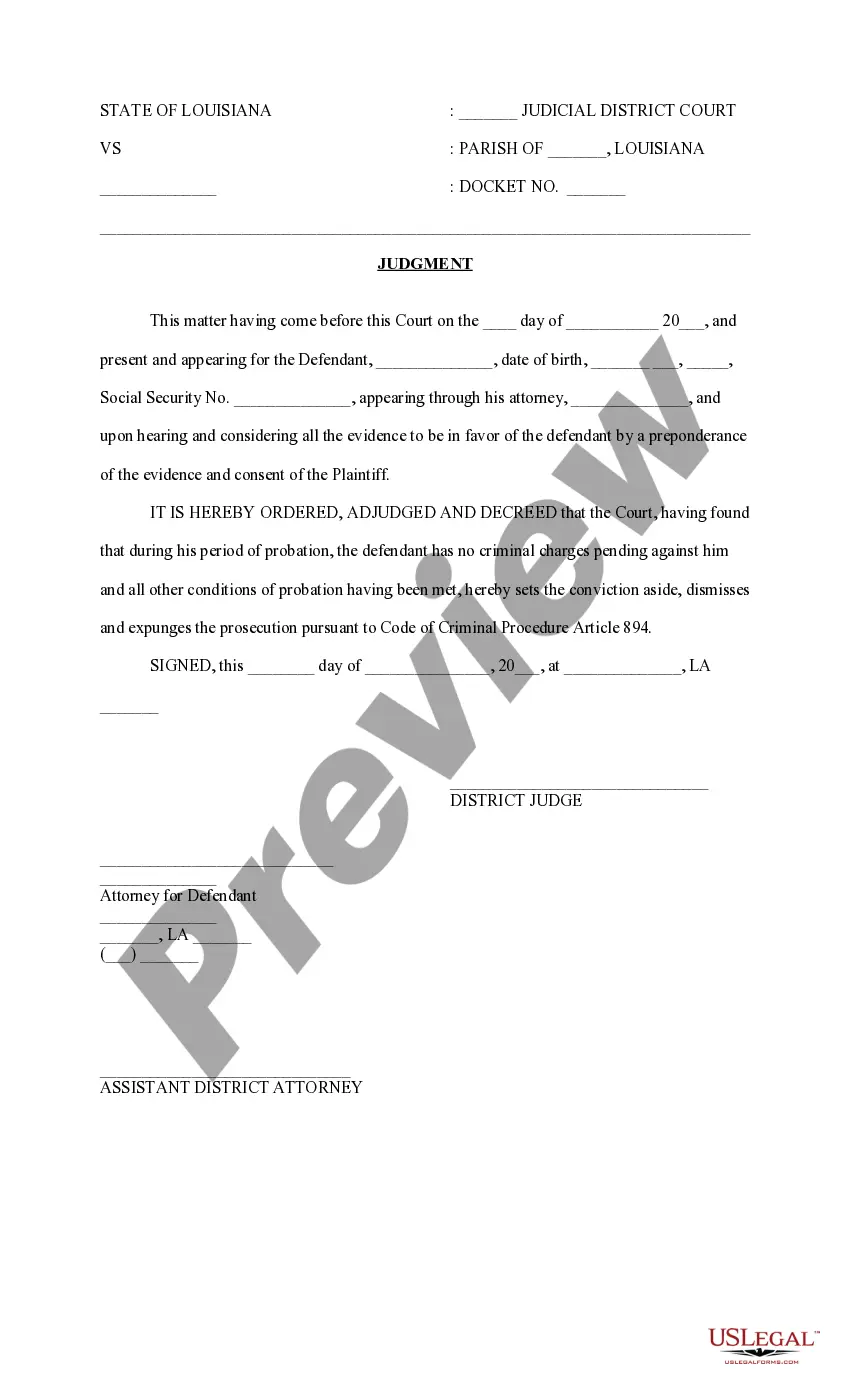
Louisiana Judgment to Set Aside Conviction, Dismiss and Expunge Prosecution
What this document covers
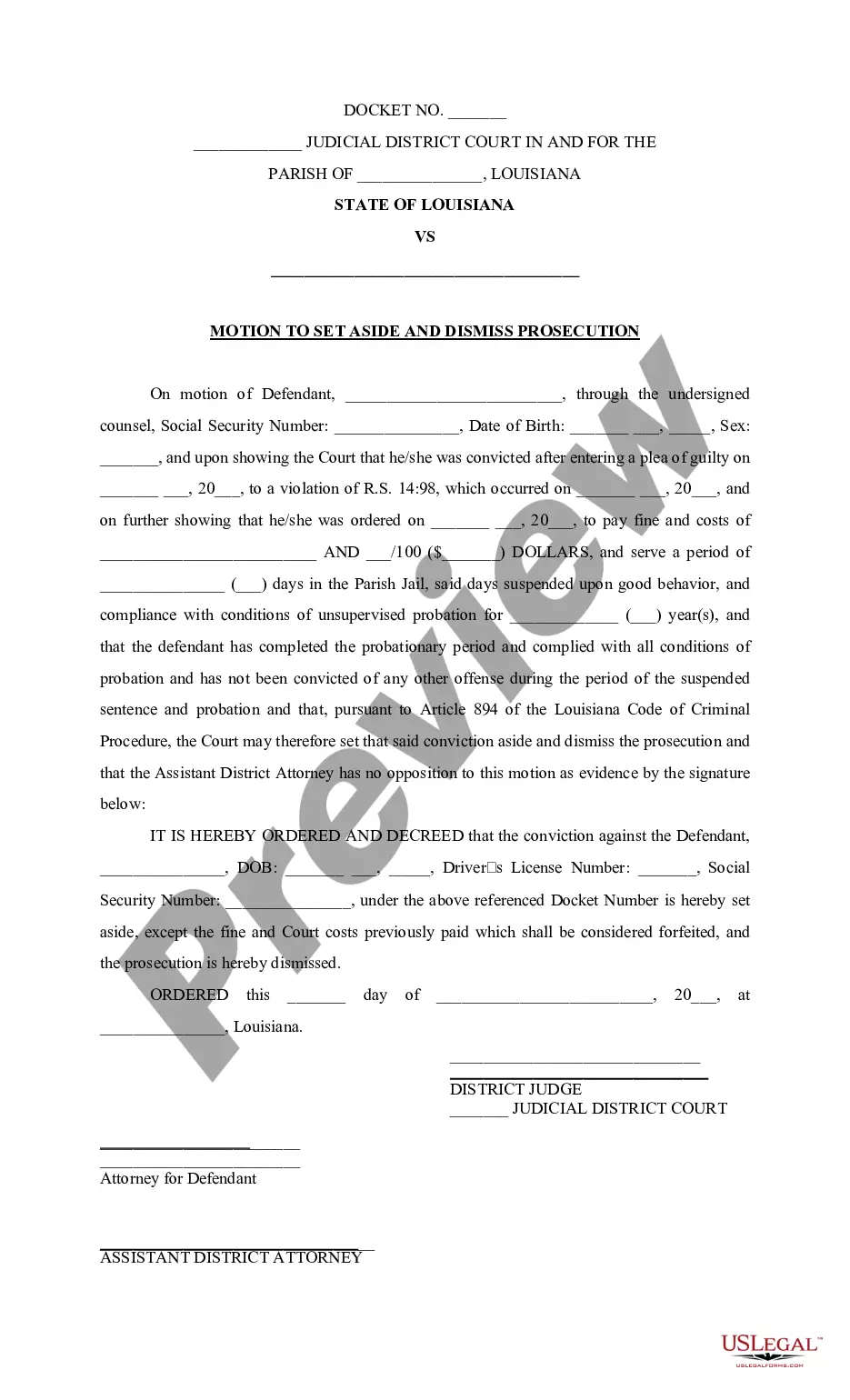
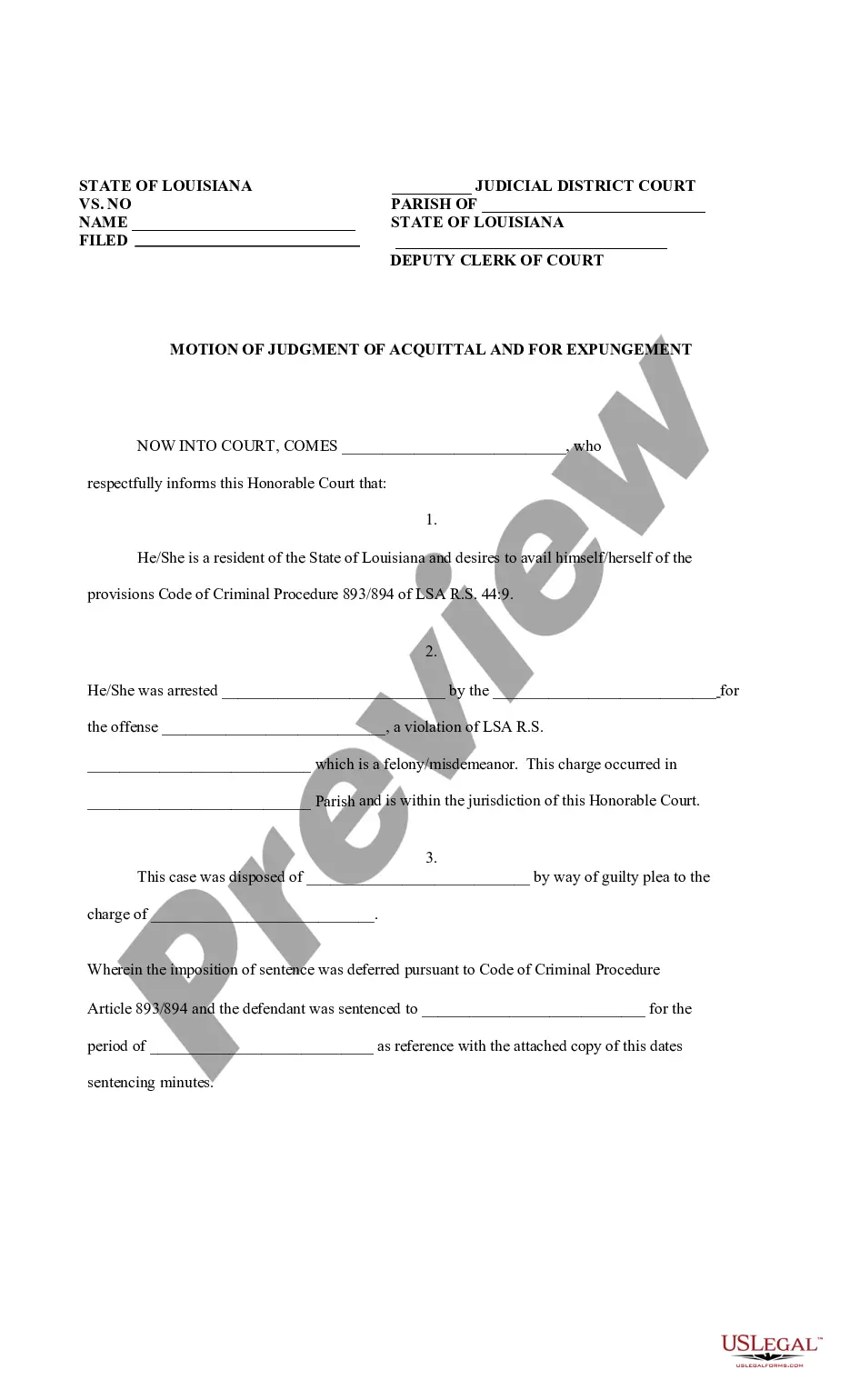
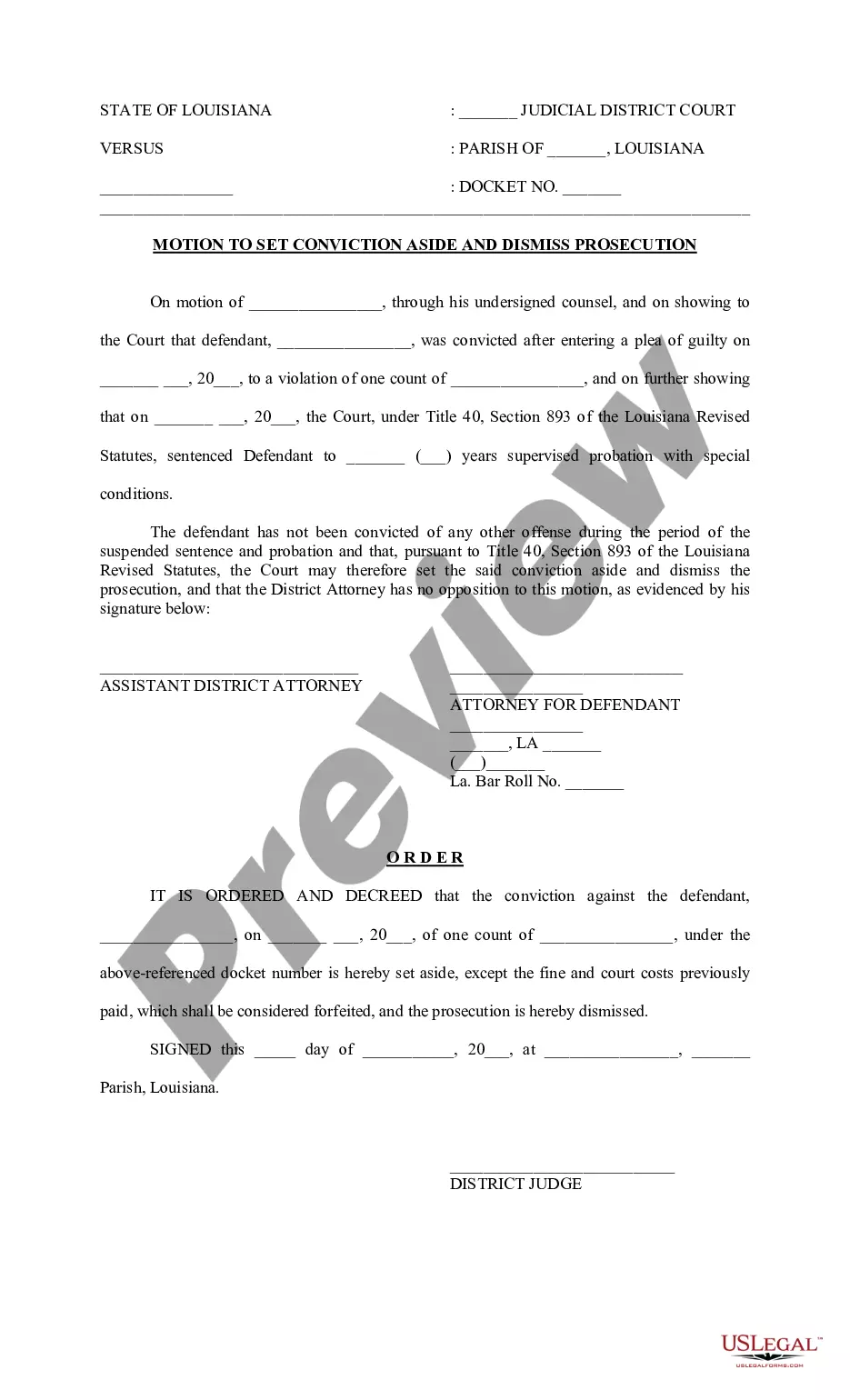
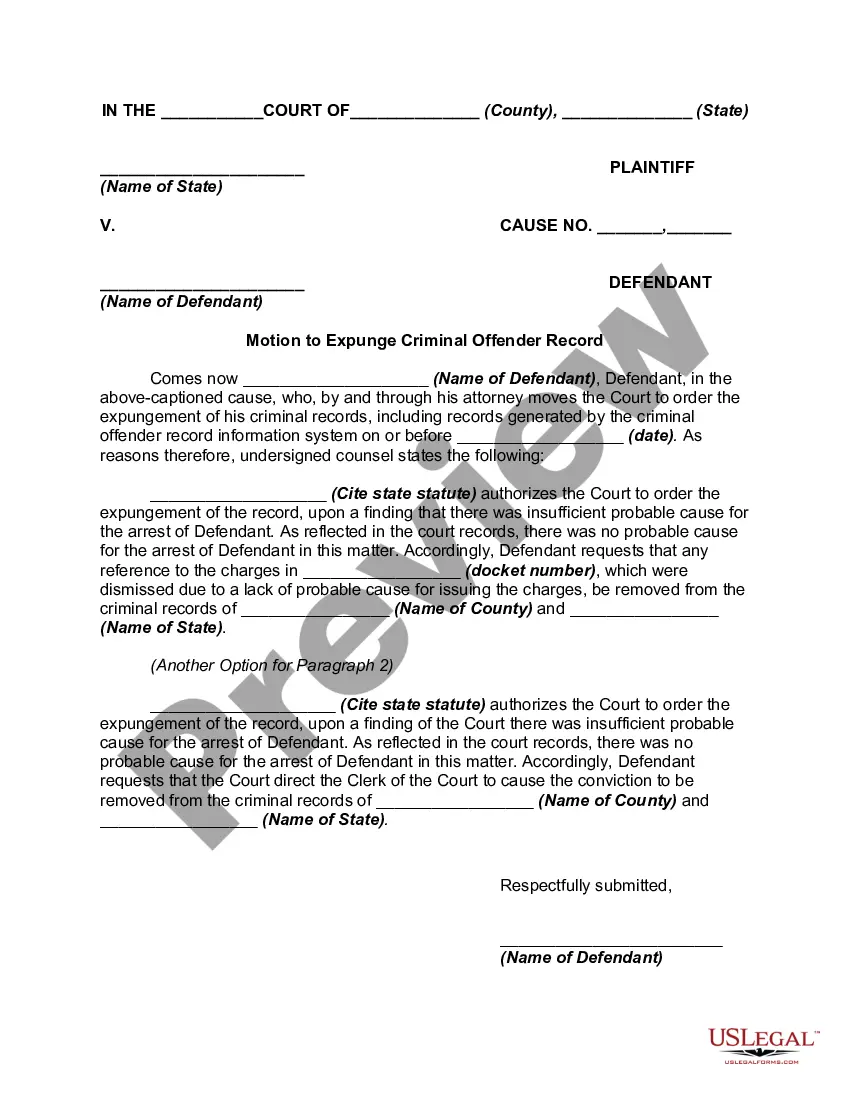
The Judgment to Set Aside Conviction, Dismiss and Expunge Prosecution is a legal document used in Louisiana to expunge a criminal conviction. This form is filed after a court hearing where it is determined that the defendant has met all probation conditions, with no pending criminal charges. The form serves to officially clear the defendant's record, providing a fresh start without the burden of past convictions.
Key parts of this document
- Identification of the court and docket number.
- Name and date of birth of the defendant.
- Consent of the plaintiff for expungement.
- A statement that the defendant has fulfilled probation requirements.
- Order from the judge to set aside the conviction and dismiss charges.
- Signatures of the district judge and attorney for the defendant.
When to use this form
This form is typically used when an individual who has completed their probation seeks to have their criminal conviction expunged from public records. It is relevant in scenarios where the individual has demonstrated rehabilitation by adhering to all conditions of their probation, and has no outstanding criminal charges. Filing this form helps the individual seek employment, housing, or other opportunities without the hindrance of a criminal record.
Intended users of this form
- Individuals who have completed a probationary period for a conviction.
- Defendants wishing to expunge their criminal record in Louisiana.
- Persons with no pending criminal charges who have satisfied all probation conditions.
- Individuals seeking a clean slate to improve employment or living conditions.
Steps to complete this form
- Identify the court jurisdiction and fill in the docket number.
- Provide the defendant's full name and date of birth.
- Include the Social Security number of the defendant for verification purposes.
- Document any consent from the plaintiff regarding the expungement.
- Obtain the signature of the district judge and the attorney for the defendant.
- Ensure that all fields are properly completed and accurate before submission.
Is notarization required?
Notarization is generally not required for this form. However, certain states or situations might demand it. You can complete notarization online through US Legal Forms, powered by Notarize, using a verified video call available anytime.
Get your form ready online
Our built-in tools help you complete, sign, share, and store your documents in one place.
Make edits, fill in missing information, and update formatting in US Legal Forms—just like you would in MS Word.
Download a copy, print it, send it by email, or mail it via USPS—whatever works best for your next step.
Sign and collect signatures with our SignNow integration. Send to multiple recipients, set reminders, and more. Go Premium to unlock E-Sign.
If this form requires notarization, complete it online through a secure video call—no need to meet a notary in person or wait for an appointment.
We protect your documents and personal data by following strict security and privacy standards.

Make edits, fill in missing information, and update formatting in US Legal Forms—just like you would in MS Word.

Download a copy, print it, send it by email, or mail it via USPS—whatever works best for your next step.

Sign and collect signatures with our SignNow integration. Send to multiple recipients, set reminders, and more. Go Premium to unlock E-Sign.

If this form requires notarization, complete it online through a secure video call—no need to meet a notary in person or wait for an appointment.

We protect your documents and personal data by following strict security and privacy standards.
Common mistakes
- Failing to include all required signatures on the form.
- Leaving out the docket number or court information.
- Not verifying that all probation conditions were met before filing.
- Ignoring specific state laws regarding the timeline for expungement.
- Providing incorrect personal information, such as the defendant's name or Social Security number.
Benefits of completing this form online
- Convenient access to gain a fresh start in legal affairs.
- Editable templates ensure that all necessary information can be completed accurately.
- Reliable forms drafted by licensed attorneys for legal compliance.
- Quick processing compared to traditional forms of filing.
Key takeaways
- The Judgment to Set Aside Conviction helps clear a criminal record in Louisiana.
- It is essential to have completed all probationary conditions before using this form.
- Accurate and complete information is crucial for the form's acceptance.
- Filing this form can significantly improve future opportunities.
Looking for another form?


Form popularity
FAQ
Certain serious offenses cannot be expunged in Louisiana. Crimes such as homicide, sexual offenses, and crimes against minors generally remain on your record. It's crucial to understand the limitations of expungement laws in relation to the Louisiana Judgment to Set Aside Conviction, Dismiss and Expunge Prosecution. For specific legal advice, consulting uslegalforms can provide clarity on which crimes can and cannot be expunged.
Check with your parish court clerk. File your petition for expungement with the court clerk. Include all the required documents and forms including your criminal record. You must get a copy of your criminal record from the state of Louisiana within 30 days of filing your expungement petition.
Sex Crimes. Any domestic abuse or domestic violence crime. A crime involving a minor who is under the age of 17. A crime of violence pursuant to Louisiana Revised Statute 14:2(B)
Online expungement is only available through Maryland expungement.com and not offered by a State or government website. This legal expungement service is particularly convenient for individuals who don't want to have to travel to the courthouse, obtain all the paperwork, drive home.
Expungement in Louisiana if You Were Convicted of a Crime. Misdemeanor offenses. If you were convicted of a misdemeanor, you may be able to expunge the related record. You can petition for expungement if it has been at least five years since the end of your sentence, deferred adjudication, probation, or parole.
The courts perform work on a first come, first serve basis. So the sooner a petition is filed, the sooner it will be reviewed. Since the timing of the process varies from state to state and by case, a general estimate of the time it takes to have a criminal record expunged can be anywhere from 2-6 months.
Always begin the letter with a formal greeting, such as "Dear Judge...", before composing the rest of the letter. Then, write the first paragraph of your letter by explaining why you are writing, what charge you wish to have expunged, and a short description of why you feel it should be expunged.
Always begin the letter with a formal greeting, such as "Dear Judge...", before composing the rest of the letter. Then, write the first paragraph of your letter by explaining why you are writing, what charge you wish to have expunged, and a short description of why you feel it should be expunged.
For legal purposes, if your conviction is dismissed, it is as though you never committed the crime. Your record will be changed to reflect the dismissal, and you usually do not have to disclose that you were convictedfor example, when applying for a job.
$250 to the Louisiana State Police, Bureau of Criminal Identification and Information; $200 to the clerk of court; $50 to the parish district attorney's office; and. $50 to the parish sheriff's office.