Louisiana Motion and Order to Dismiss for Failure to Prosecute Timely Order to Show Cause
What this document covers
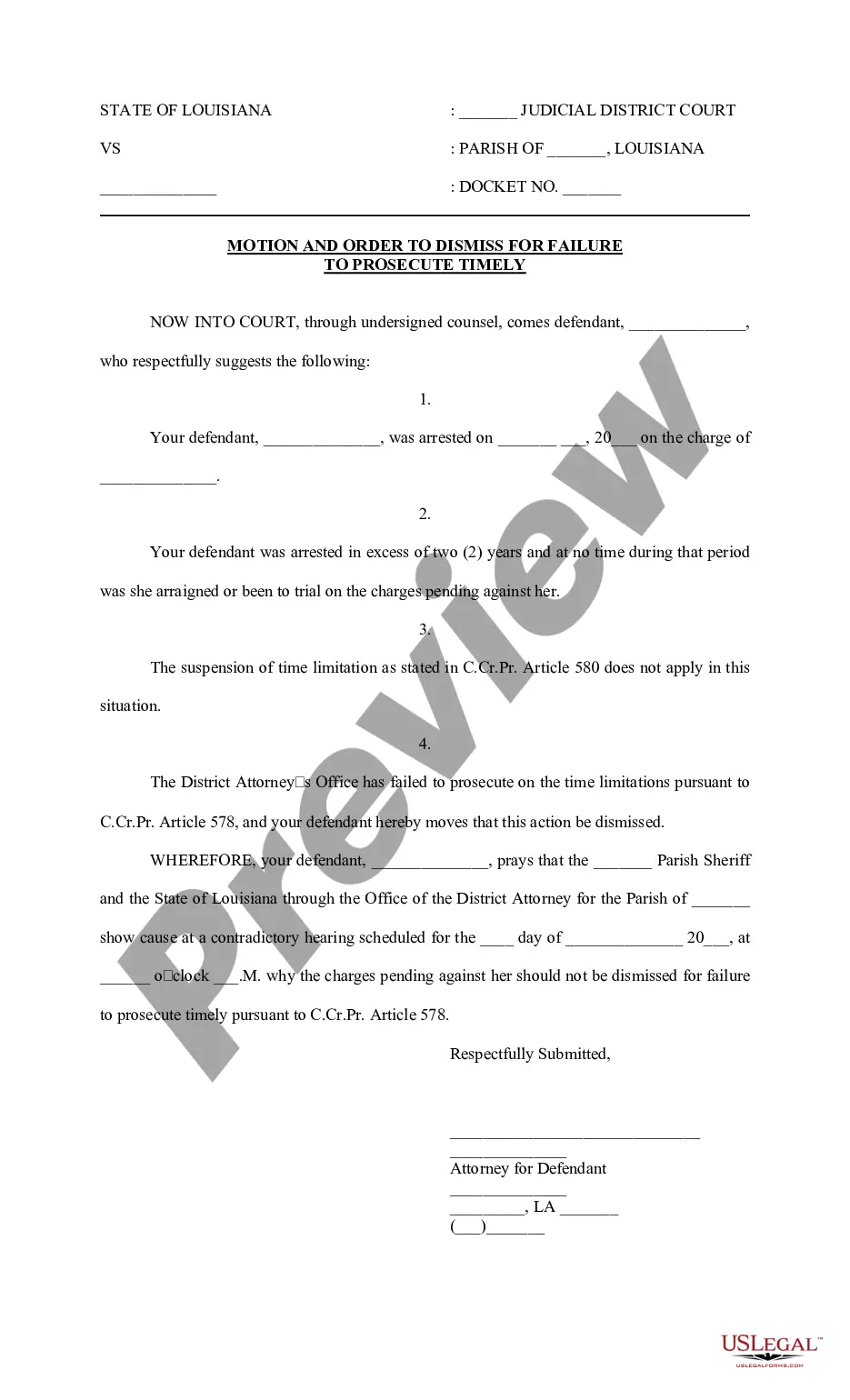
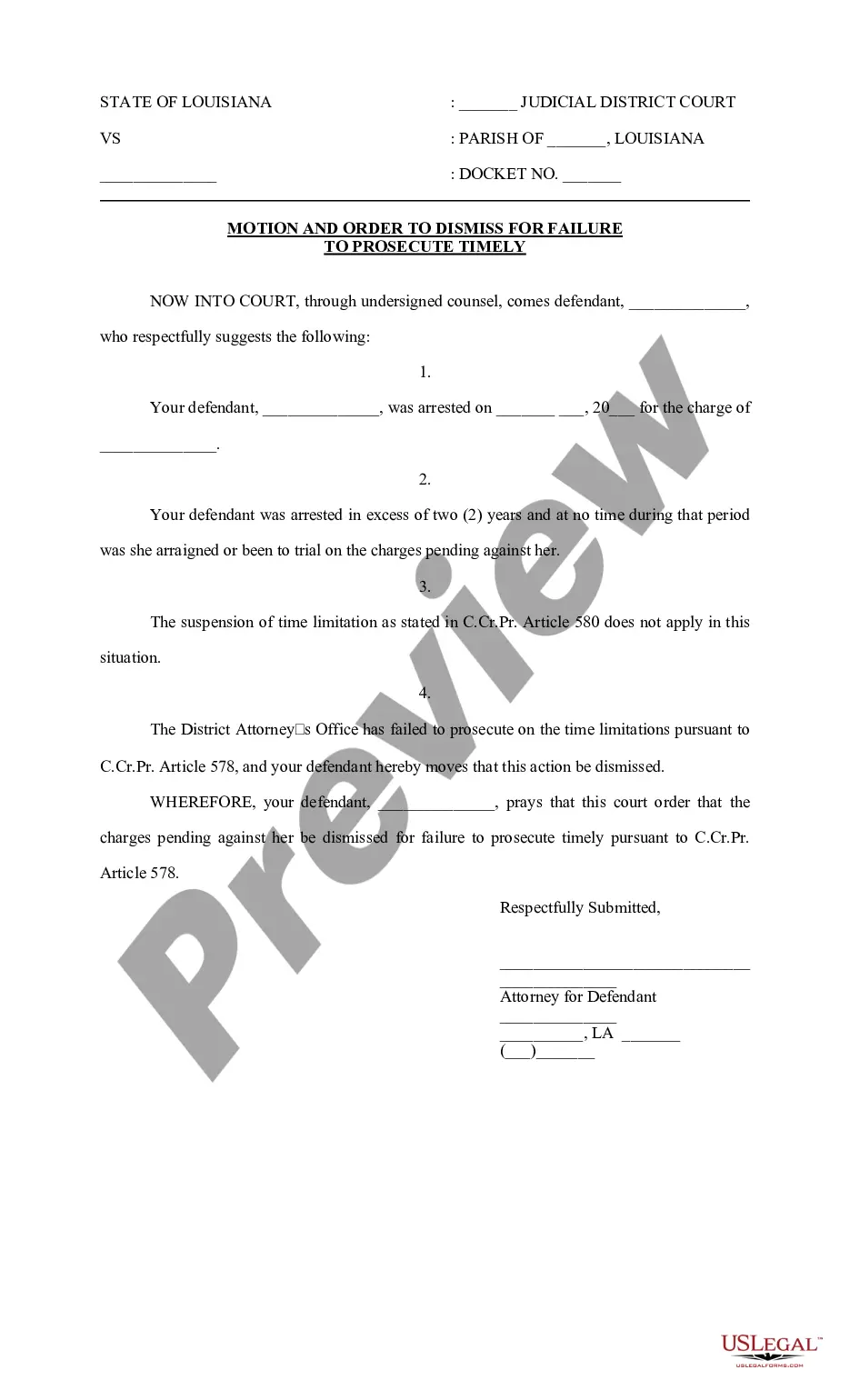
The Motion and Order to Dismiss for Failure to Prosecute Timely is a legal document that allows a defendant in a criminal matter to request dismissal of charges due to the prosecution's failure to act within the prescribed time limits. This motion is filed by the defense counsel and highlights that the relevant time suspension, as per Louisiana law, does not apply in this case. It is an essential tool for ensuring that cases do not remain unresolved indefinitely and emphasizes the defendant's right to a timely trial.
Main sections of this form
- Case title and docket number for identification
- Details of the defendant and the charges against them
- Grounds for dismissal based on failure to prosecute
- Request for a hearing to discuss the motion
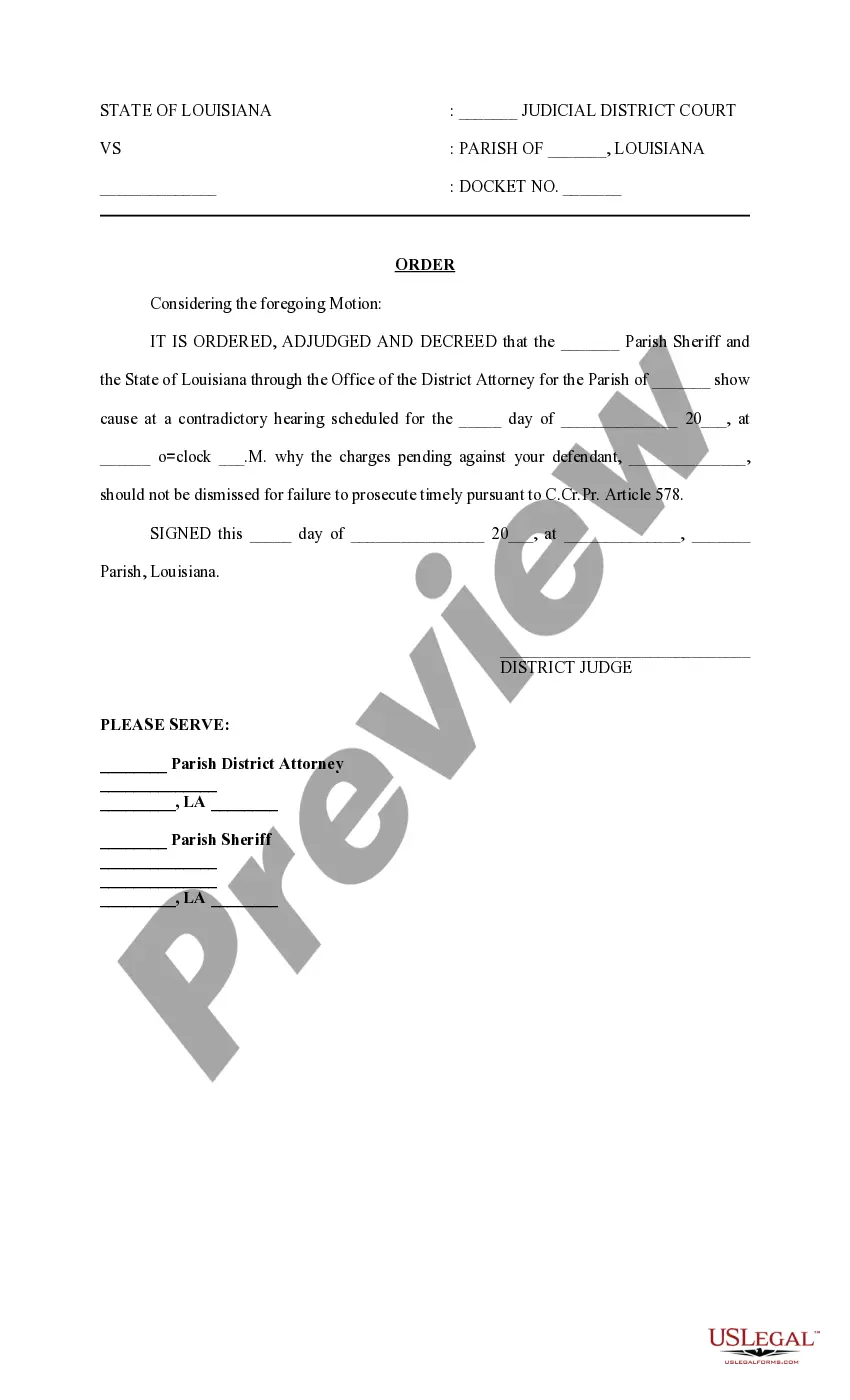
- Order for the sheriff and District Attorney to appear in court
Situations where this form applies
This form should be used when a defendant in a criminal case believes that the prosecution has not acted within the legal time limits to proceed with their case. It is particularly relevant in scenarios where a defendant has not been arraigned or put on trial within the required timeframe. This motion can expedite the dismissal of charges that may otherwise linger without resolution.
Intended users of this form
- Defendants in criminal cases who have been arrested but not prosecuted within the time limits.
- Defense attorneys looking to dismiss charges on behalf of their clients.
- Individuals seeking to understand their rights regarding timely prosecution.
Instructions for completing this form
- Enter the parish and court details where the motion is being filed.
- Provide the defendant's name, the arrest date, and the specific charge(s).
- State the reason for the motion, emphasizing the lack of timely prosecution.
- Specify the date and time of the hearing where the prosecution must show cause.
- Sign and date the motion as the attorney for the defendant.
Does this form need to be notarized?
This form does not typically require notarization unless specified by local law. However, it is essential to check specific requirements in your jurisdiction before filing.
Get your form ready online
Our built-in tools help you complete, sign, share, and store your documents in one place.
Make edits, fill in missing information, and update formatting in US Legal Forms—just like you would in MS Word.
Download a copy, print it, send it by email, or mail it via USPS—whatever works best for your next step.
Sign and collect signatures with our SignNow integration. Send to multiple recipients, set reminders, and more. Go Premium to unlock E-Sign.
If this form requires notarization, complete it online through a secure video call—no need to meet a notary in person or wait for an appointment.
We protect your documents and personal data by following strict security and privacy standards.

Make edits, fill in missing information, and update formatting in US Legal Forms—just like you would in MS Word.

Download a copy, print it, send it by email, or mail it via USPS—whatever works best for your next step.

Sign and collect signatures with our SignNow integration. Send to multiple recipients, set reminders, and more. Go Premium to unlock E-Sign.

If this form requires notarization, complete it online through a secure video call—no need to meet a notary in person or wait for an appointment.

We protect your documents and personal data by following strict security and privacy standards.
Typical mistakes to avoid
- Failing to provide accurate dates related to the case.
- Omitting required signatures from the motion.
- Submitting the motion without identifying the proper court or parish.
Benefits of using this form online
- Immediate access to an accurate legal document created by licensed attorneys.
- Ability to download and edit the form as needed before submission.
- Reduced risk of errors compared to hand-written forms.
Key takeaways
- The Motion and Order to Dismiss is necessary in cases of delayed prosecution.
- It is specific to Louisiana and should reference local laws accurately.
- Completing the form correctly is crucial to avoid delays and ensure the defendantâs rights are upheld.
Looking for another form?

Form popularity
FAQ
LOP stands for Lack of Prosecution. Generally Dismissal for lack of prosecution occurs when the court closes a case as nothing has been filed within a specified period of time.Usually the case is dismissed without prejudice so that the party can re-file the case.
You do not have to file a response. However, you would be wise to do so as a motion to dsmiss , if granted, could end your suit. Motions to dimiss for failure to state a claim are rarely granted.
You have 14 days to respond to a motion to dismiss. If you do not have an attorney, I strongly recommend that you retain one. Federal courts have many rules that must be strictly adhered to.
If a Motion to Dismiss a civil lawsuit is granted by the judge, the lawsuit is immediately ended.
Each court has different rules about how long you have to respond to this motion, but usually you will have at least two or three weeks to file an opposition to the defendant's motion to dismiss.
Fill out your court forms. Fill out a Request for Dismissal (Form CIV-110 ). File your forms at the courthouse where you filed your case. Serve the other side with a copy of the dismissal papers. File the Notice of Entry of Dismissal and Proof of Service (Form CIV-120)
Failure to prosecute occurs in a case when a claimant fails to continue to pursue an action but does not withdraw the claim.
The plaintiff must give you responses to your request for admissions within 30 days. You do not need to do anything if you do not get a response. The plaintiff has 30 days to deny or object to the statements.
Some states have a 90 day rule but there is really no set time for a judge to make a decision. If he needs more time it usually means that the case is a very close call and the last thing you want to do is to try to hurry the judge up and anger him. Sometimes judges can take a year or more to render a ruling.