Louisiana Consent Judgment on Mutual Restraining Orders
About this form
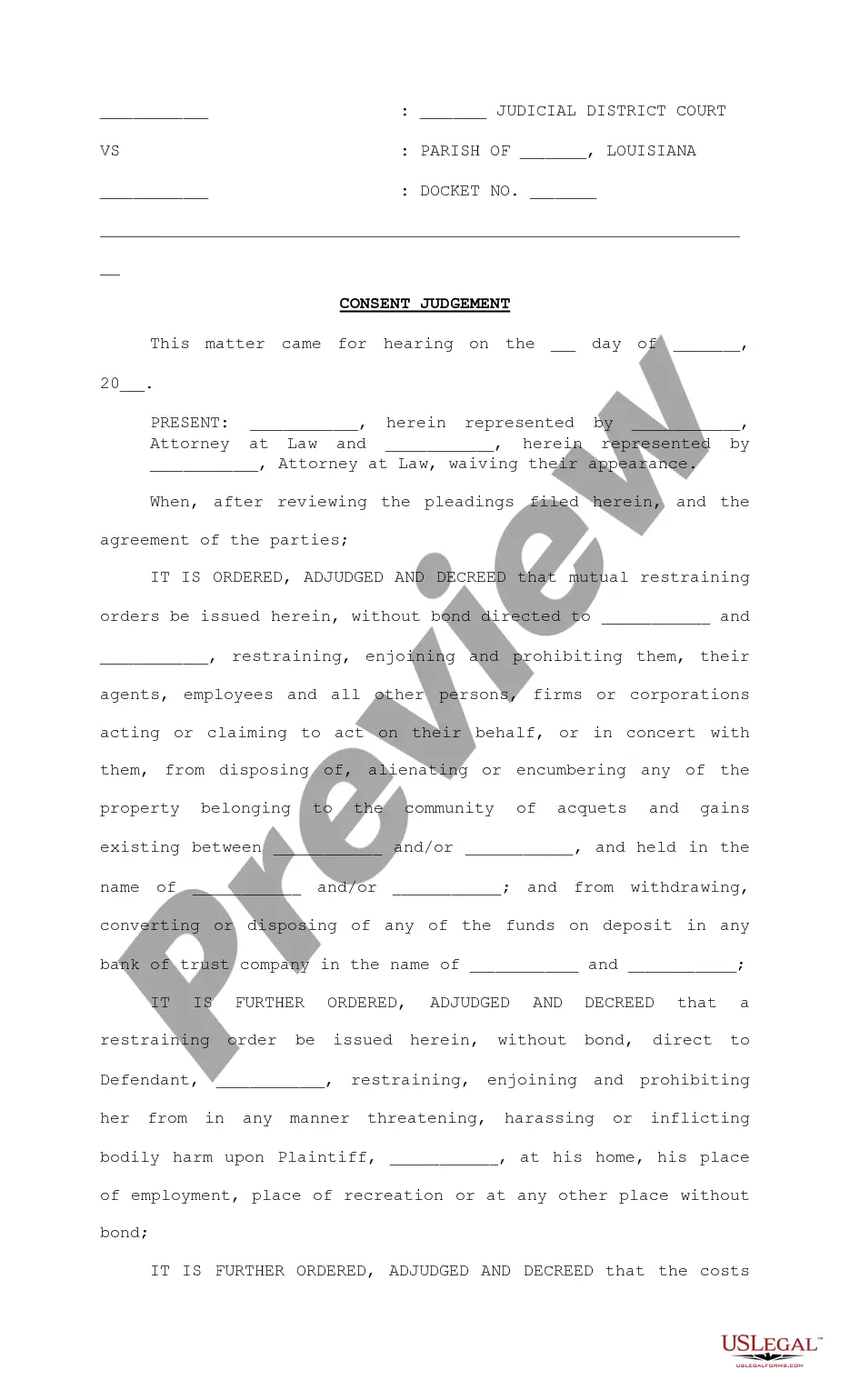
The Consent Judgment on Mutual Restraining Orders is a legal document used in divorce proceedings to establish mutual restraining orders. These orders prevent both parties from disposing of marital property and from engaging in harassment or harm against one another during the legal process. This form acts as a binding agreement between the parties and is approved by the court, ensuring that it holds the same authority as any other court judgment.
What’s included in this form
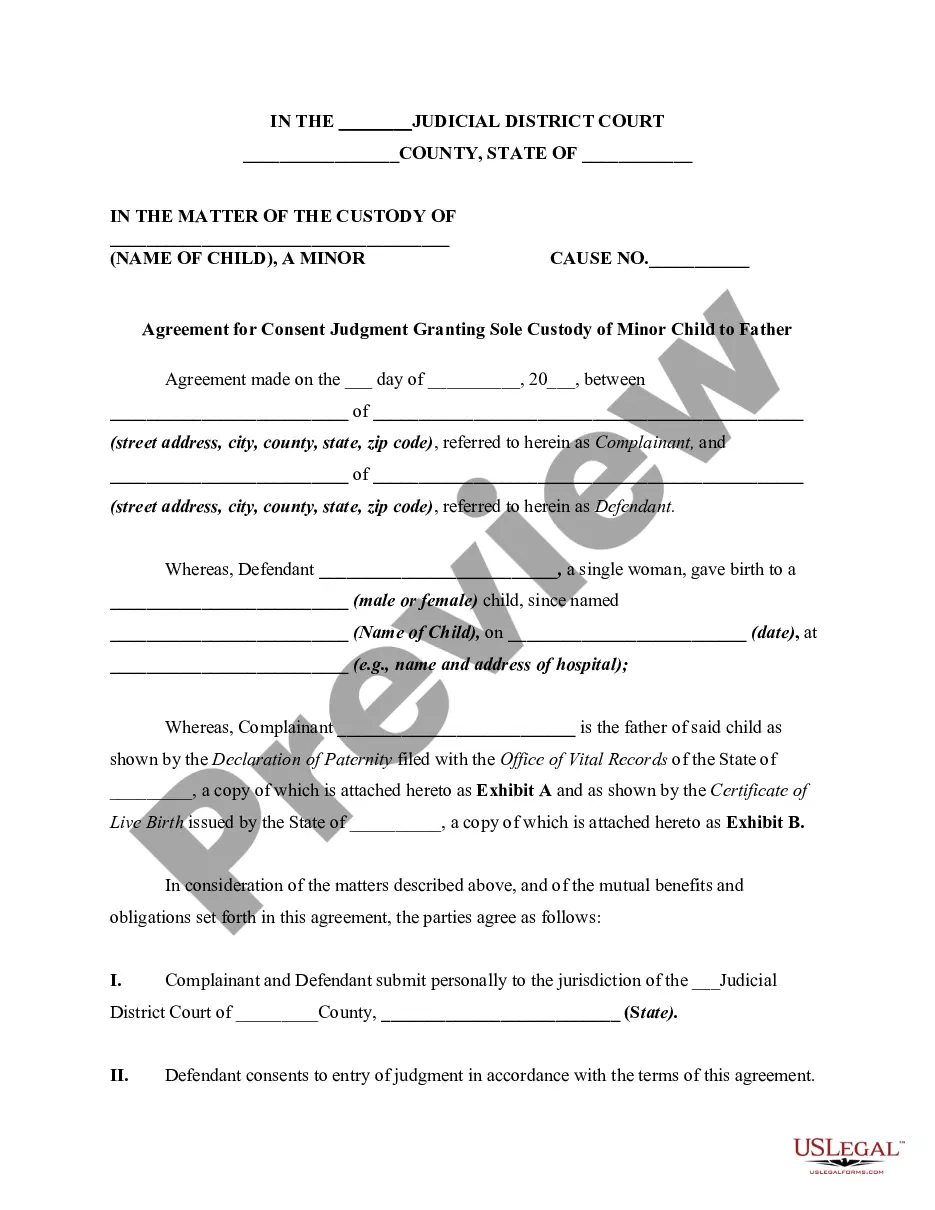
- Identification of parties involved in the divorce.
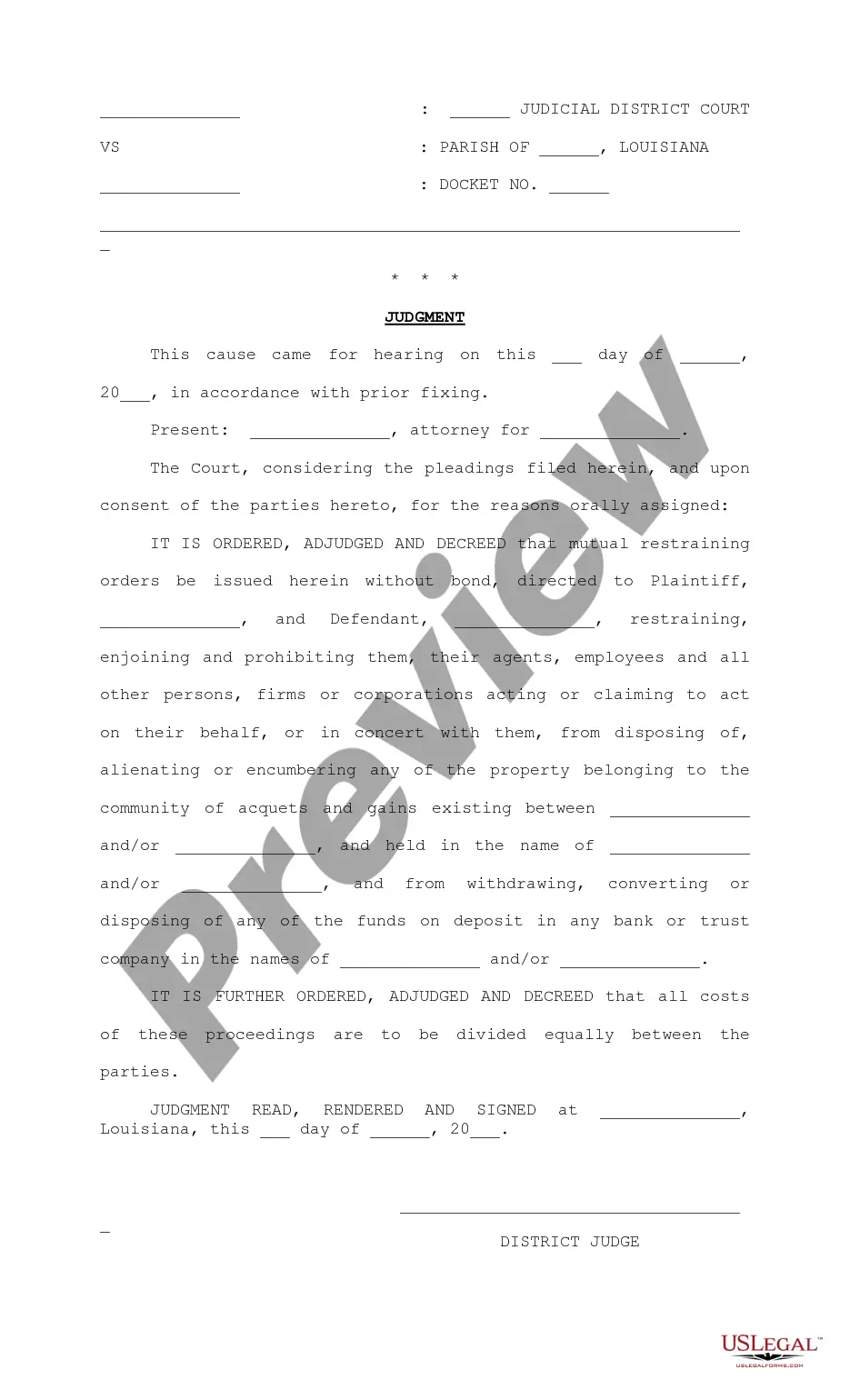
- Mutual restraining orders against disposal of marital property.
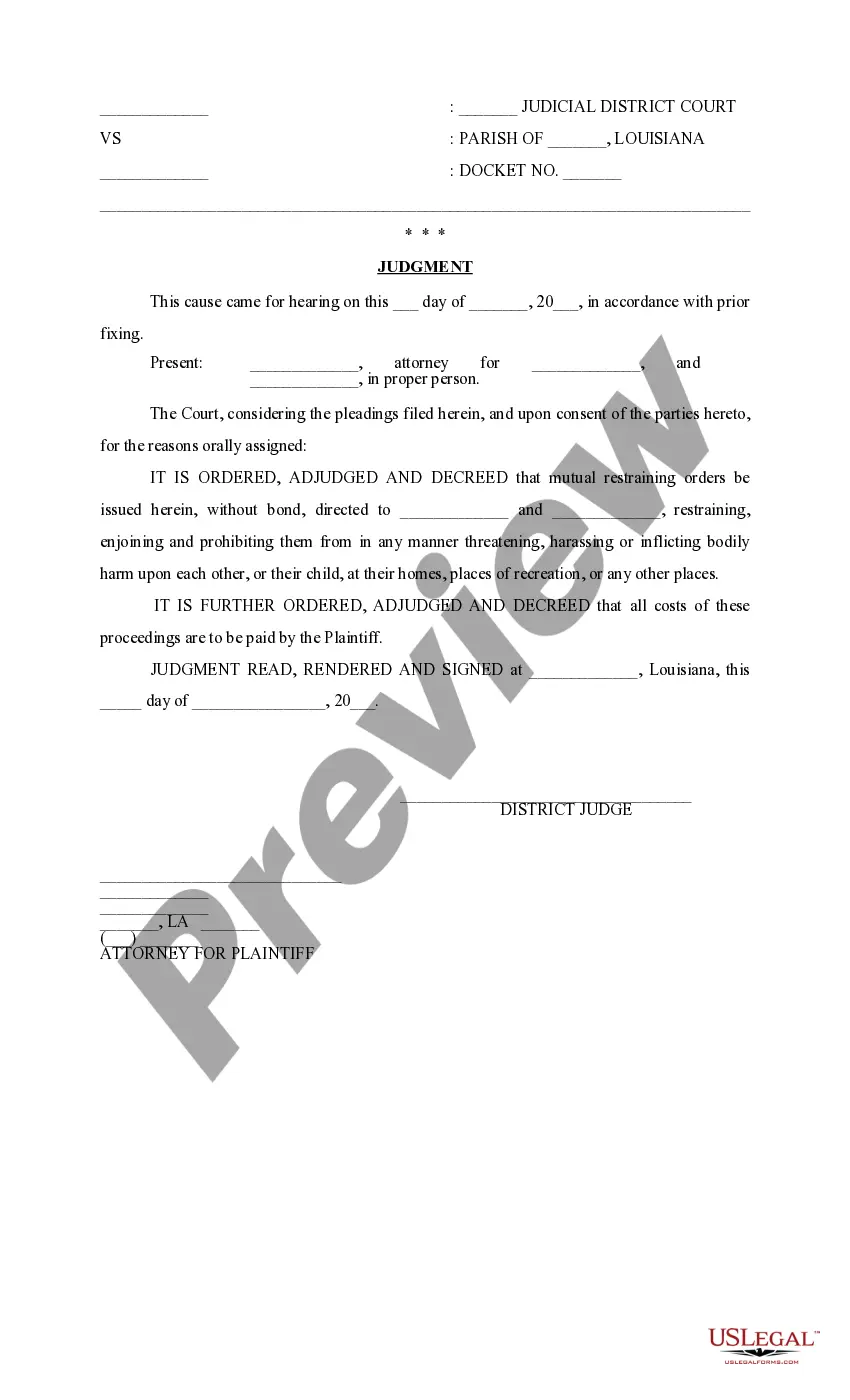
- Specific restraining order against harassment or harm by one party.
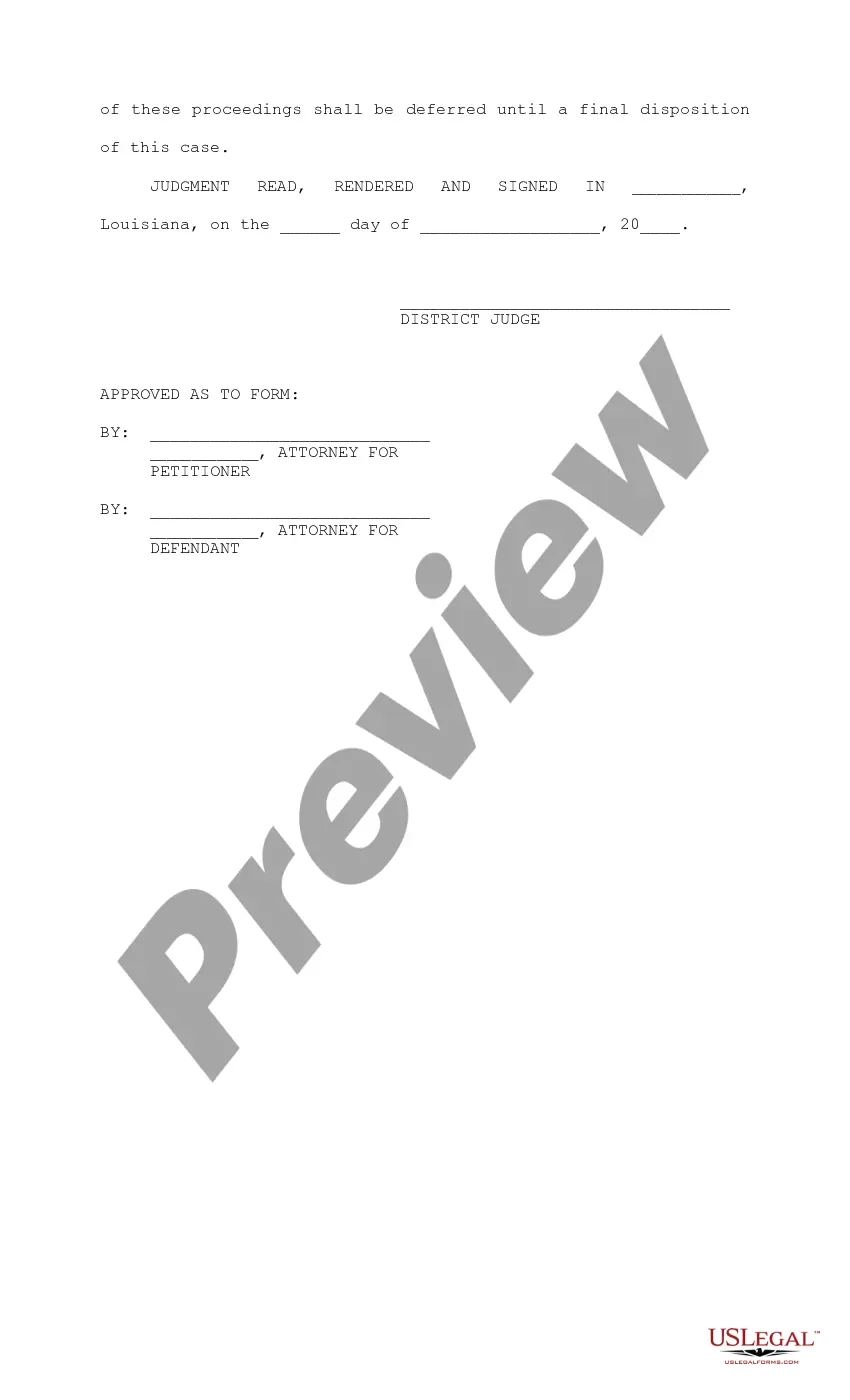
- Provisions for deferred court costs until case resolution.
- Formal judicial approval of the consent judgment.
When this form is needed
This form is applicable when both parties in a divorce case need to agree on restraining orders to protect their property and ensure personal safety. It is especially useful in situations where there is a risk of one party disposing of shared assets or threatening the other party during the divorce proceedings.
Who can use this document
- Individuals undergoing a divorce who have joint marital property.
- Parties seeking legal protection from harassment or harm during litigation.
- Couples who can mutually agree on terms regarding their property and conduct.
How to complete this form
- Identify the parties by listing their names and attorneys.
- Specify details regarding the mutual restraining orders being agreed upon.
- Enter the property that is part of the marital community affected by the restraining orders.
- Designate terms regarding conduct to avoid harassment or harm.
- Include date and judicial signatures upon completion.
Notarization guidance
Notarization is not commonly needed for this form. However, certain documents or local rules may make it necessary. Our notarization service, powered by Notarize, allows you to finalize it securely online anytime, day or night.
Get your form ready online
Our built-in tools help you complete, sign, share, and store your documents in one place.
Make edits, fill in missing information, and update formatting in US Legal Forms—just like you would in MS Word.
Download a copy, print it, send it by email, or mail it via USPS—whatever works best for your next step.
Sign and collect signatures with our SignNow integration. Send to multiple recipients, set reminders, and more. Go Premium to unlock E-Sign.
If this form requires notarization, complete it online through a secure video call—no need to meet a notary in person or wait for an appointment.
We protect your documents and personal data by following strict security and privacy standards.

Make edits, fill in missing information, and update formatting in US Legal Forms—just like you would in MS Word.

Download a copy, print it, send it by email, or mail it via USPS—whatever works best for your next step.

Sign and collect signatures with our SignNow integration. Send to multiple recipients, set reminders, and more. Go Premium to unlock E-Sign.

If this form requires notarization, complete it online through a secure video call—no need to meet a notary in person or wait for an appointment.

We protect your documents and personal data by following strict security and privacy standards.
Mistakes to watch out for
- Failure to include all necessary parties in the agreement.
- Not clearly specifying the marital property in question.
- Omitting details about how the restraining orders are defined and enforced.
- Forgetting to obtain proper judicial approval before finalization.
Benefits of using this form online
- Convenience of completing the form from home without legal fees for a lawyer.
- Editability allows for customization to fit specific cases easily.
- Access to attorney-reviewed templates ensures legal reliability.
Legal use & context
- A Consent Judgment is enforceable in a court of law once approved.
- This form provides essential protections during divorce proceedings concerning property and personal safety.
Summary of main points
- The Consent Judgment on Mutual Restraining Orders is critical for protecting assets and personal safety in divorce.
- Ensure clarity in detailing the terms to avoid future disputes.
- Judicial approval is mandatory to enforce the terms agreed upon by both parties.
Looking for another form?


Form popularity
FAQ
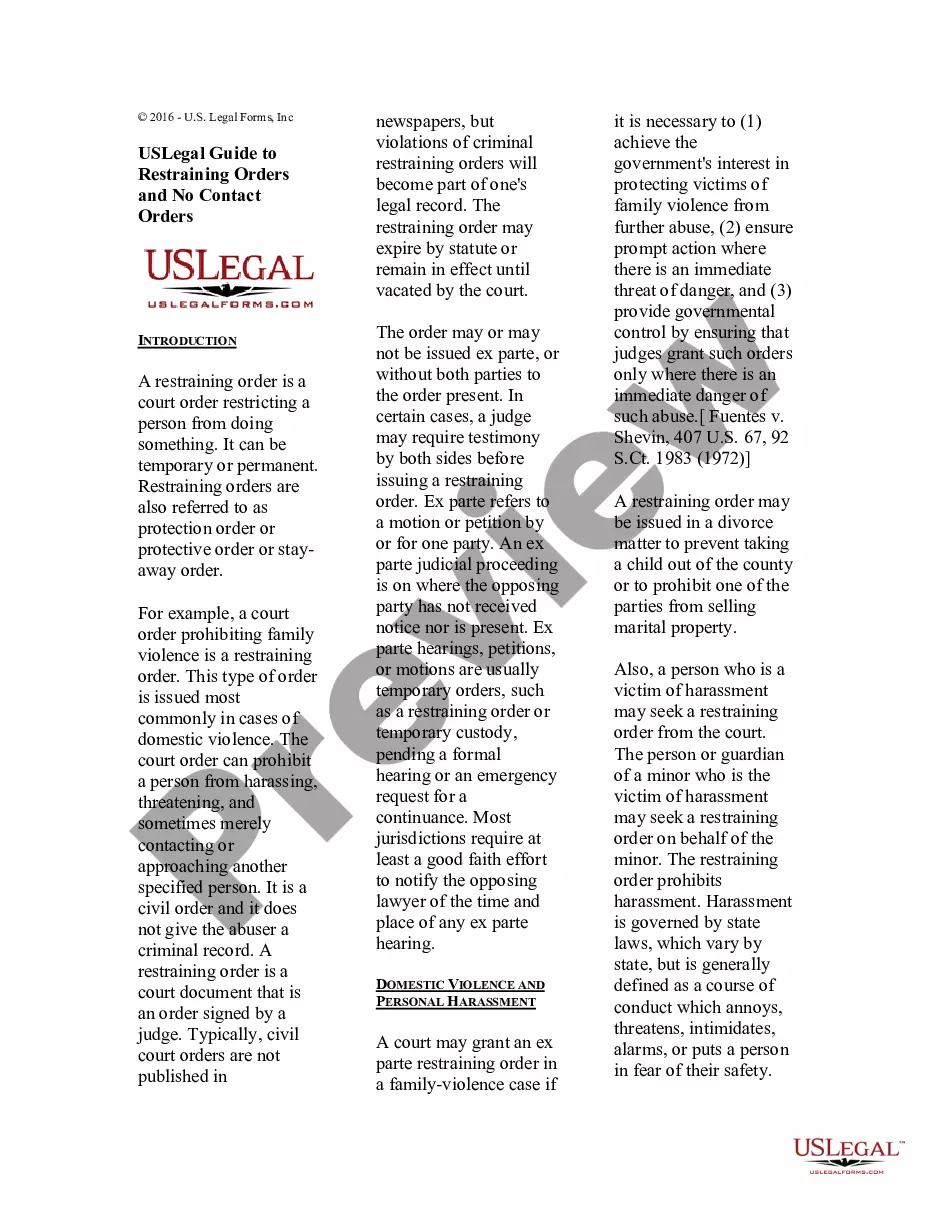
If a Judge hears from an individual about past cases of physical or emotional abuse without a good explanation from the other side, a restraining order can be granted.If the connection between the parties is something else, like neighbors, then the restraining order is a civil one, not domestic violence.
In situations where a court issued a restraining order that lack jurisdiction, that order is also invalidated. If this is proven during the trial, you are not bound by such an order. Falsely accused. In case you are falsely accused of violating a restraining order, a defense attorney can clear you of all the charges.
Emergency Temporary Restraining Orders: If you are in need of emergency protection outside of regular court hours, the court may grant you an emergency temporary restraining order if there is an immediate and present danger of abuse. The judge must consider any and all past history of abuse, or threats of abuse, in
If the court schedules a hearing and grants the motion, the protection order will become immediately void and unenforceable. A protection order can only be dissolved by the court.
Having to go into hiding is tiresome for the narcissist so they prefer to tweek their policy and procedures as they move in and out of different relationships to know what to avoid.Having a restraining order in place is nothing more but the narcissist trying to have power and control over you.
Yes. Restraining orders are constitutional.
The cost to file a request for restraining order is $148.50. If you are unable to pay the cost, you may fill out a Motion to Proceed In Forma Pauperis. You can obtain this form from the Civil Division Office in Room 251 or by calling 389-3017.
Yes. Restraining orders are constitutional.