Louisiana Answer to Plaintiff's Petition
About this form
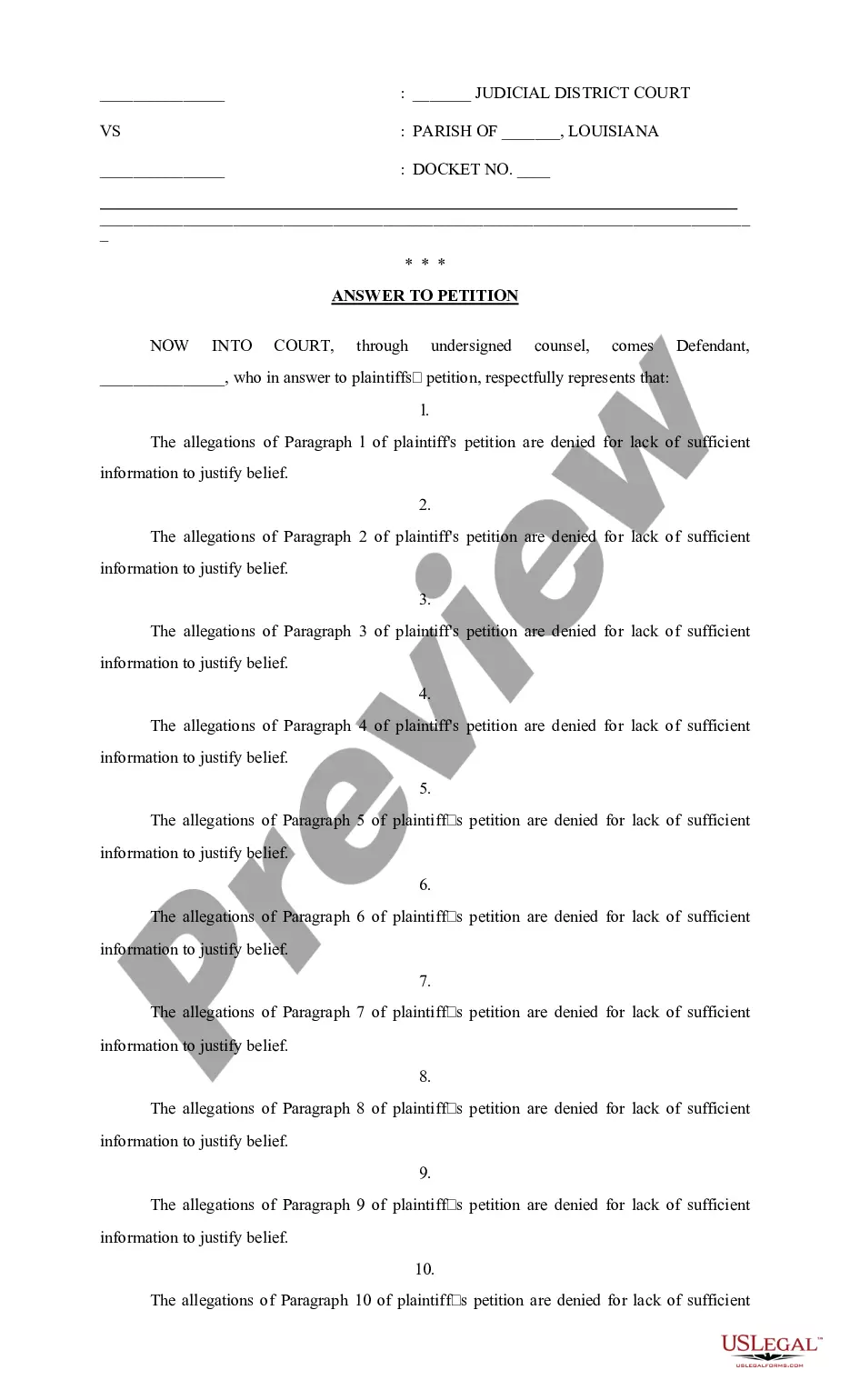
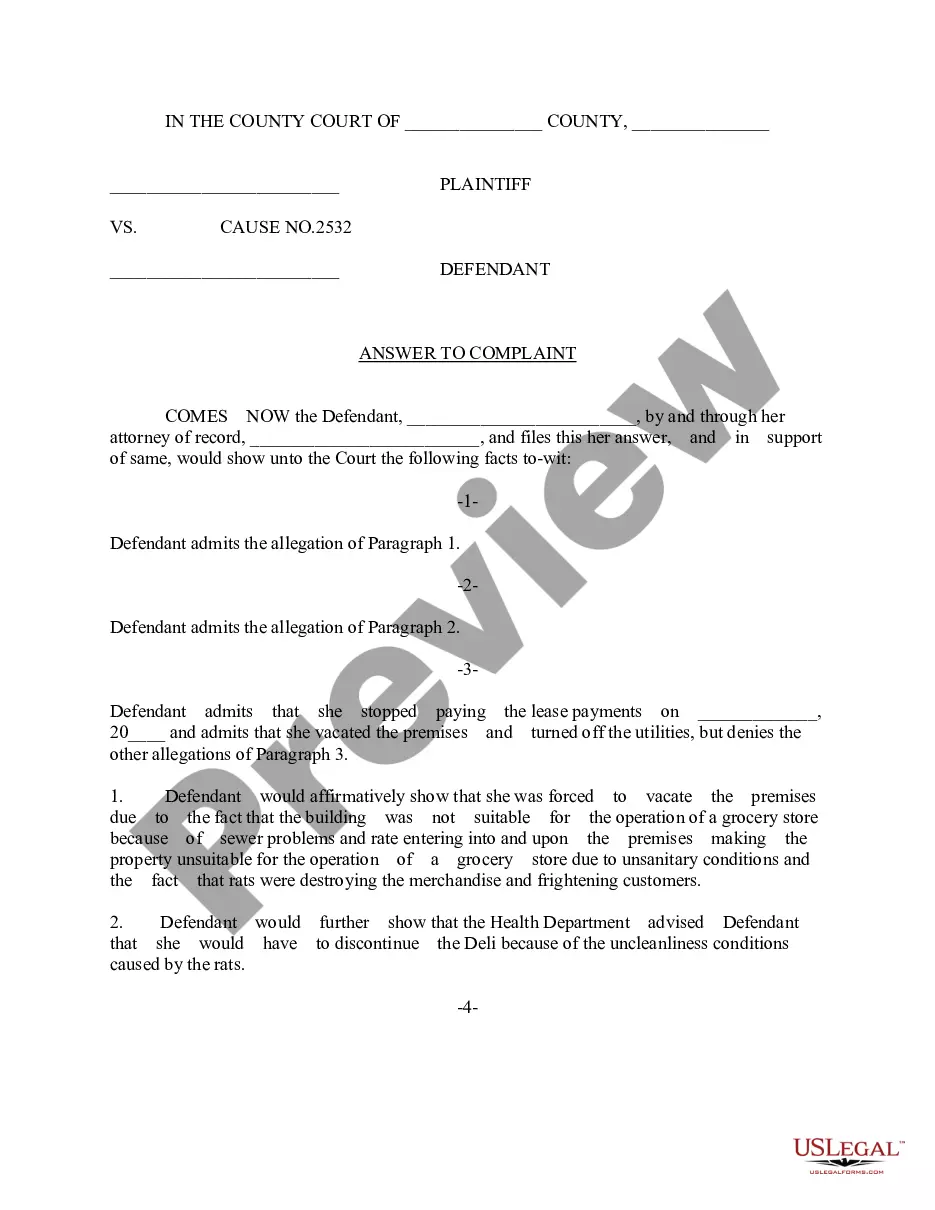
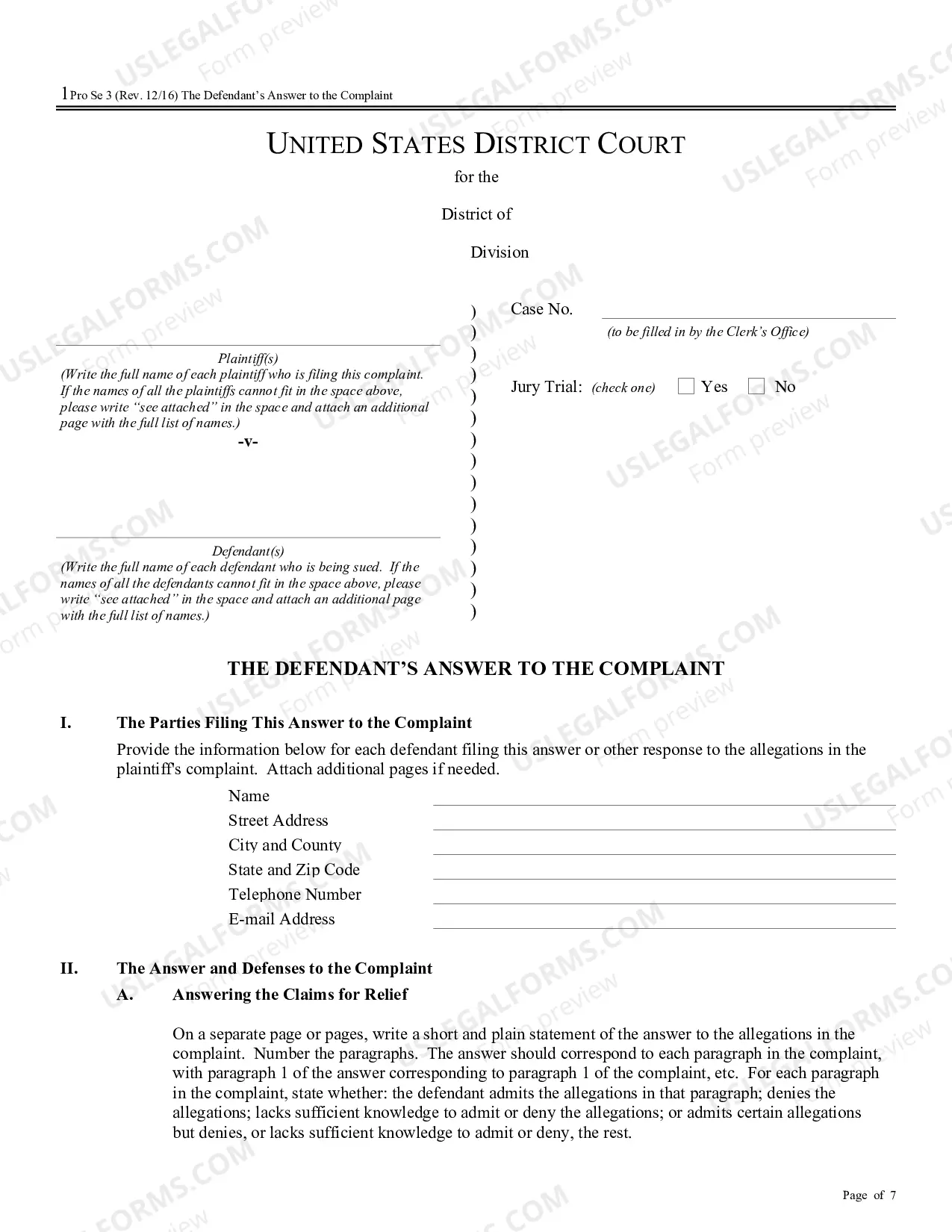
The Answer to Plaintiff's Petition is a legal document filed by a defendant in response to a plaintiff's petition, typically in a divorce case. This form allows the defendant to deny the allegations made by the plaintiff, asserting that there is insufficient information to support those claims. It is essential for clarifying the defendant's position and protecting their rights during legal proceedings.
Key parts of this document
- Heading: Includes case details such as parish, docket number, and defendant's name.
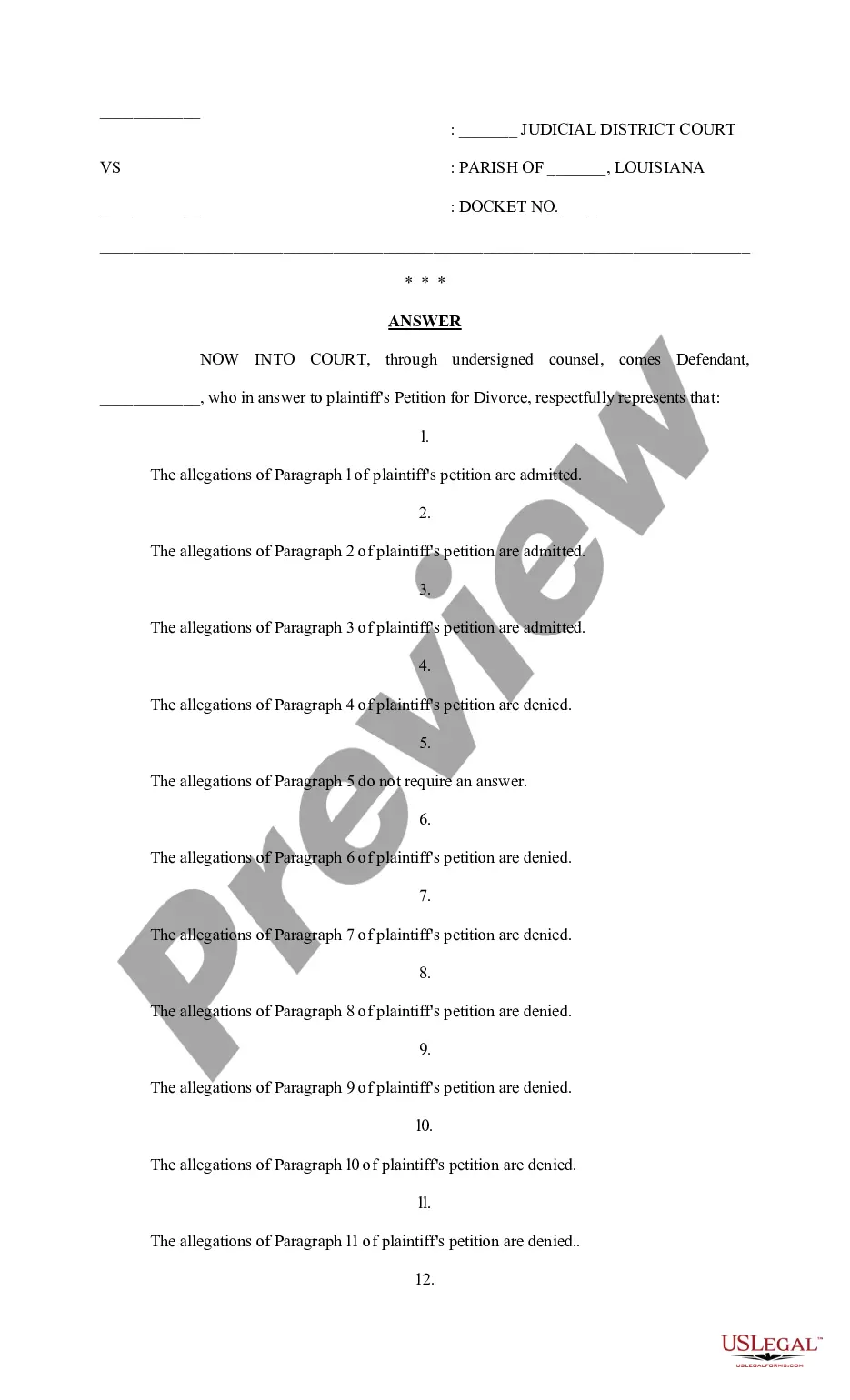
- Response paragraphs: Each paragraph corresponds to specific allegations made by the plaintiff, asserting denial.
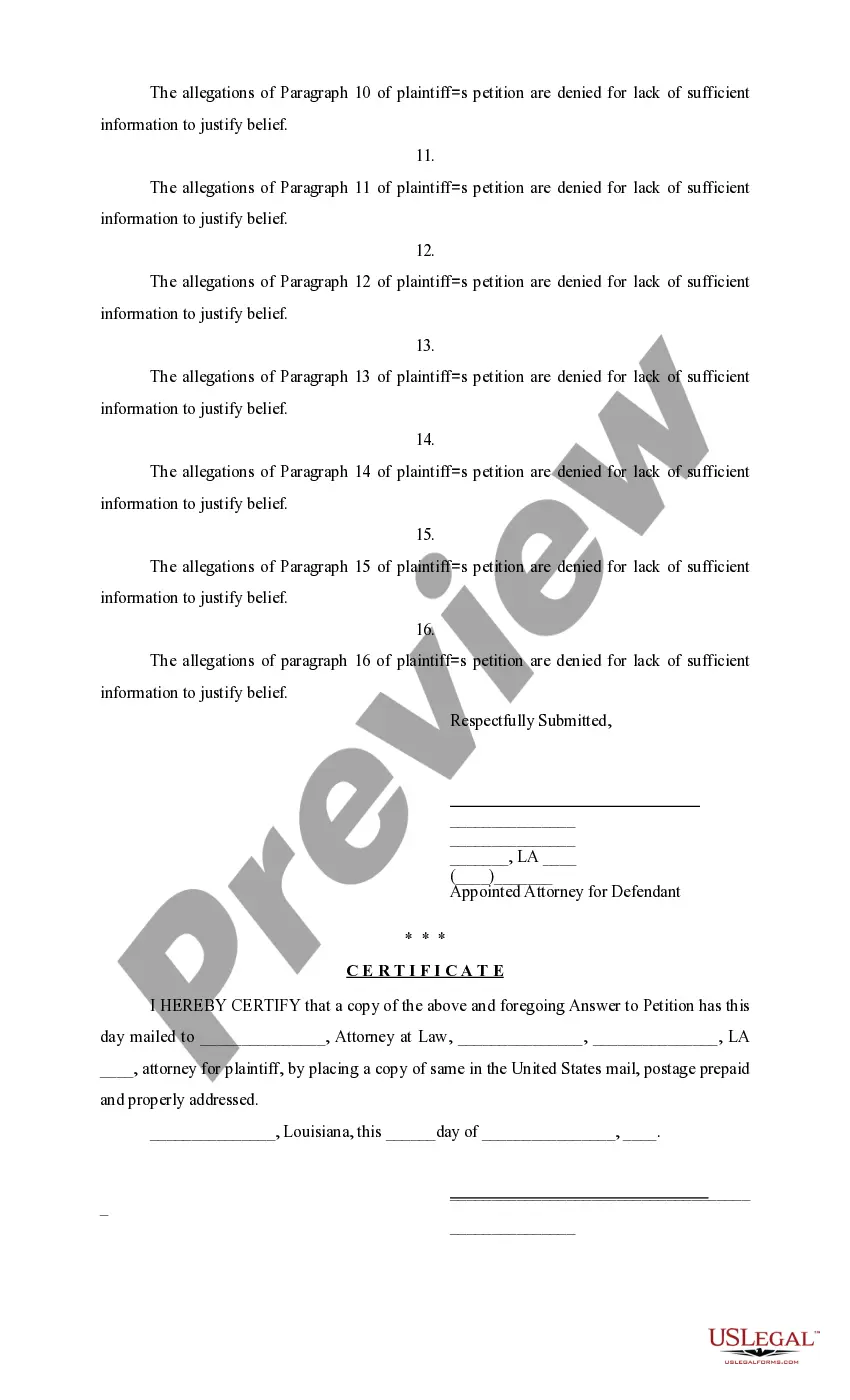
- Signature section: Space for the defendant's attorney to sign and provide their contact information.
- Certificate of service: A declaration of having sent a copy of the response to the plaintiff's attorney.
When this form is needed
This form should be used when a defendant receives a petition from a plaintiff in a divorce case and needs to formally respond to the allegations. It is important for the defendant to file this answer within the timeline specified by the jurisdiction to ensure their defense is heard in court.
Who can use this document
- Defendants in divorce cases who have received a petition from a plaintiff.
- Individuals representing themselves in court (pro se litigants).
- Attorneys representing defendants in family law disputes.
Steps to complete this form
- Identify the parties involved: Fill in the defendant's name and the plaintiff's name.
- Enter case details: Complete the heading with the parish and docket number.
- Respond to allegations: For each allegation, provide a clear denial stating lack of information.
- Sign the document: The defendant's attorney should sign and date the form at the designated section.
- Complete the certificate of service: Indicate that a copy has been sent to the plaintiff's attorney.
Does this form need to be notarized?
Notarization is not commonly needed for this form. However, certain documents or local rules may make it necessary. Our notarization service, powered by Notarize, allows you to finalize it securely online anytime, day or night.
Get your form ready online
Our built-in tools help you complete, sign, share, and store your documents in one place.
Make edits, fill in missing information, and update formatting in US Legal Forms—just like you would in MS Word.
Download a copy, print it, send it by email, or mail it via USPS—whatever works best for your next step.
Sign and collect signatures with our SignNow integration. Send to multiple recipients, set reminders, and more. Go Premium to unlock E-Sign.
If this form requires notarization, complete it online through a secure video call—no need to meet a notary in person or wait for an appointment.
We protect your documents and personal data by following strict security and privacy standards.

Make edits, fill in missing information, and update formatting in US Legal Forms—just like you would in MS Word.

Download a copy, print it, send it by email, or mail it via USPS—whatever works best for your next step.

Sign and collect signatures with our SignNow integration. Send to multiple recipients, set reminders, and more. Go Premium to unlock E-Sign.

If this form requires notarization, complete it online through a secure video call—no need to meet a notary in person or wait for an appointment.

We protect your documents and personal data by following strict security and privacy standards.
Common mistakes to avoid
- Failing to respond within the required time frame, which may lead to a default judgment.
- Not clearly denying each allegation, which can weaken the defendant's position.
- Omitting proper case details such as the docket number or names of the parties involved.
- Not signing the document or not having it signed by the attorney, making it invalid.
Why use this form online
- Immediate access to a professionally drafted template, ensuring compliance with legal standards.
- Convenience of downloading and completing forms from home, saving time and effort.
- Editability allows for customization to fit individual case details without needing legal expertise.
Legal use & context
- The Answer to Plaintiff's Petition is a vital legal document that plays a key role in divorce proceedings.
- It enables the defendant to formally present their defense and protect their interests in court.
- Failure to submit a timely answer may result in a default judgment against the defendant.
What to keep in mind
- The Answer to Plaintiff's Petition is crucial for defendants in divorce cases.
- This form allows for a formal response to each allegation in a plaintiff's petition.
- Ensure compliance with local laws and accurate completion to protect your rights.
Looking for another form?

Form popularity
FAQ
The Louisiana Answer to Plaintiff's Petition is the defendant's formal response to the plaintiff's petition in a Louisiana divorce case. It lets the defendant deny allegations or state there is insufficient information. The form helps clarify the defendant's position and protect rights and includes a heading, response paragraphs, signature, and a certificate of service.
If the plaintiff files an amended petition, file an updated or new Louisiana Answer to Plaintiff's Petition that addresses the new or changed allegations within the court’s deadlines. Use the same structure—deny specific allegations, respond to each paragraph, and include a signature and certificate of service—to ensure proper notice and a complete defense under Louisiana rules.
The form should be filed after you receive the plaintiff's petition, within the timeline specified by Louisiana courts, to ensure your defense is heard. It responds to the plaintiff's claims with paragraph-by-paragraph denials or statements, and must be accompanied by a signature and a certificate of service to show the plaintiff's attorney was served.
Defendants in divorce cases who have received a petition from the plaintiff should use this form. It is suitable for individuals representing themselves (pro se) and for attorneys representing defendants in family law disputes, enabling a formal, orderly response to the claims raised in the petition.
The signature section provides space for the defendant's attorney to sign and provide contact information. The certificate of service declares that a copy of the response was sent to the plaintiff's attorney, ensuring proper notice under court rules.
It is tailored to Louisiana divorce practice, not a generic form. It uses a parish-based heading, requires a defendant’s signature and attorney contact information, and includes a certificate of service to prove the plaintiff’s attorney was served. These Louisiana-specific elements ensure the document meets local filing and notice requirements.