Louisiana Answer to State's Petition for Forfeiture
What is this form?
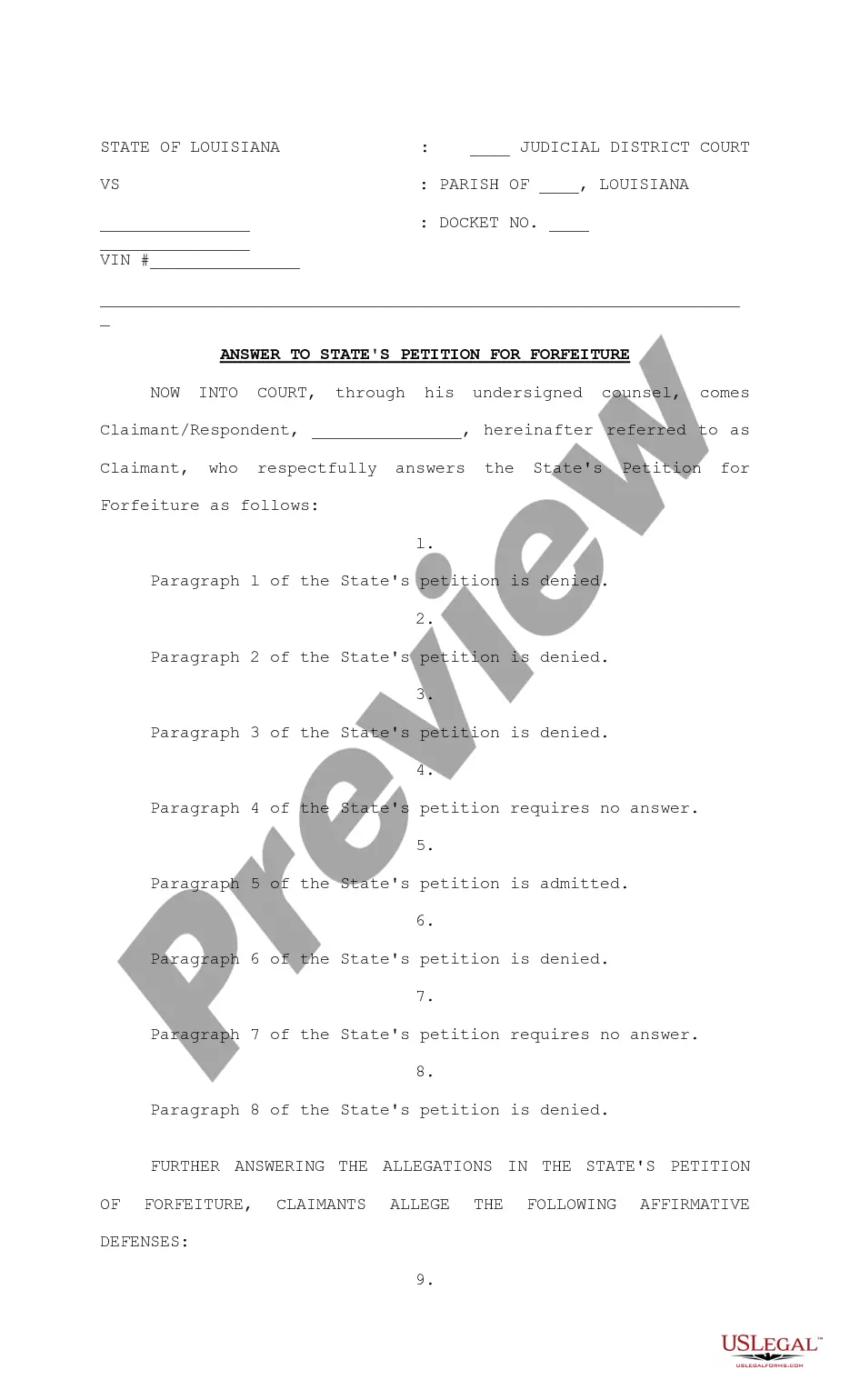
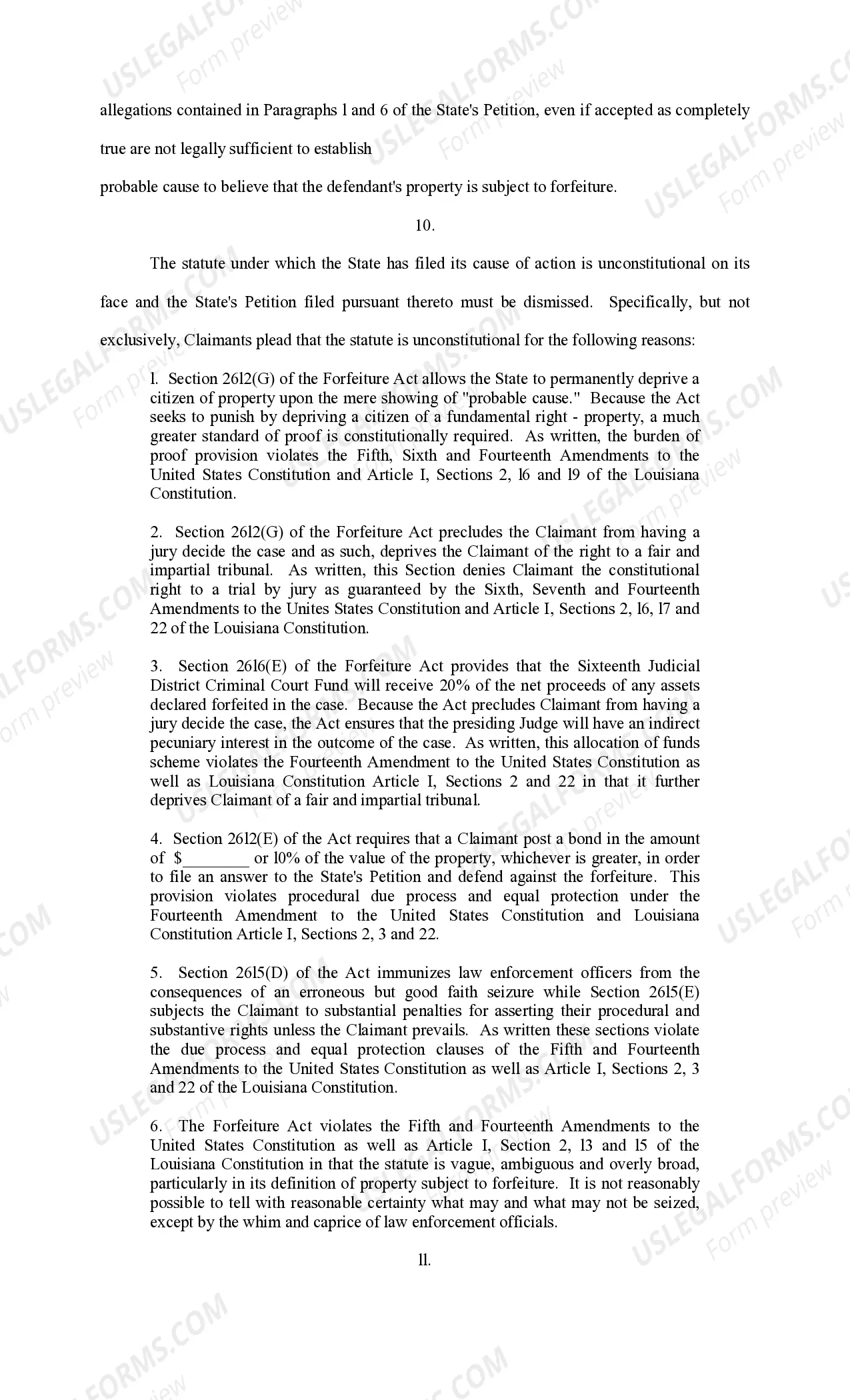
The Answer to State's Petition for Forfeiture is a legal document used by claimants or respondents to respond to allegations made by the state regarding the forfeiture of property. This form allows individuals to deny or accept specific charges and to present any affirmative defenses they believe justify the retention of their property. It differs from other legal forms by specifically addressing the conditions and constitutional concerns surrounding asset forfeiture cases.
Key parts of this document
- Identification of the claimant and respondent.
- Specific denials or admissions of each paragraph in the state's petition.
- Assertion of affirmative defenses against the forfeiture based on legal and constitutional grounds.
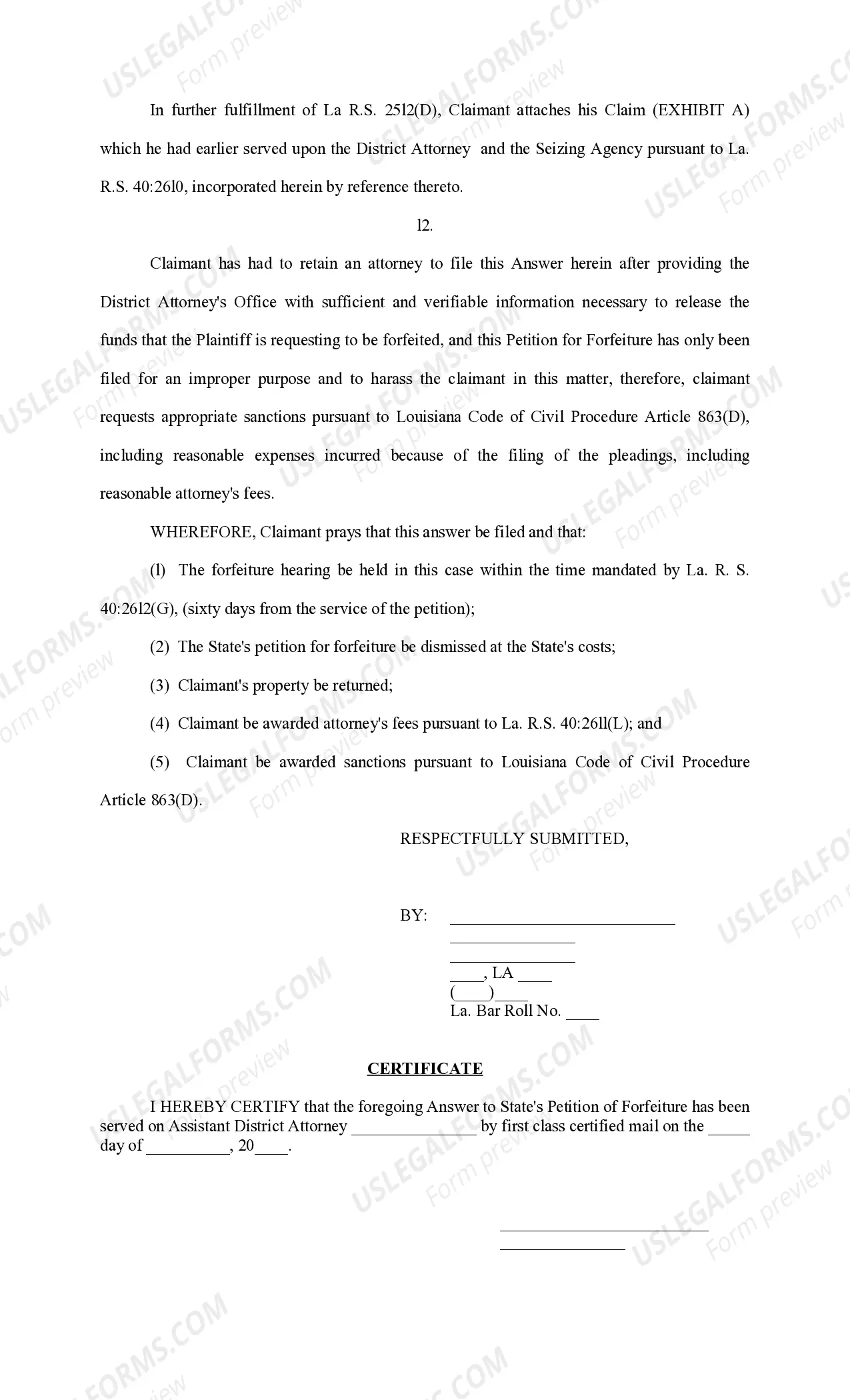
- Request for the court to dismiss the state's petition and return the claimant's property.
- Certification of service of the answer to the state's petition to the district attorney.
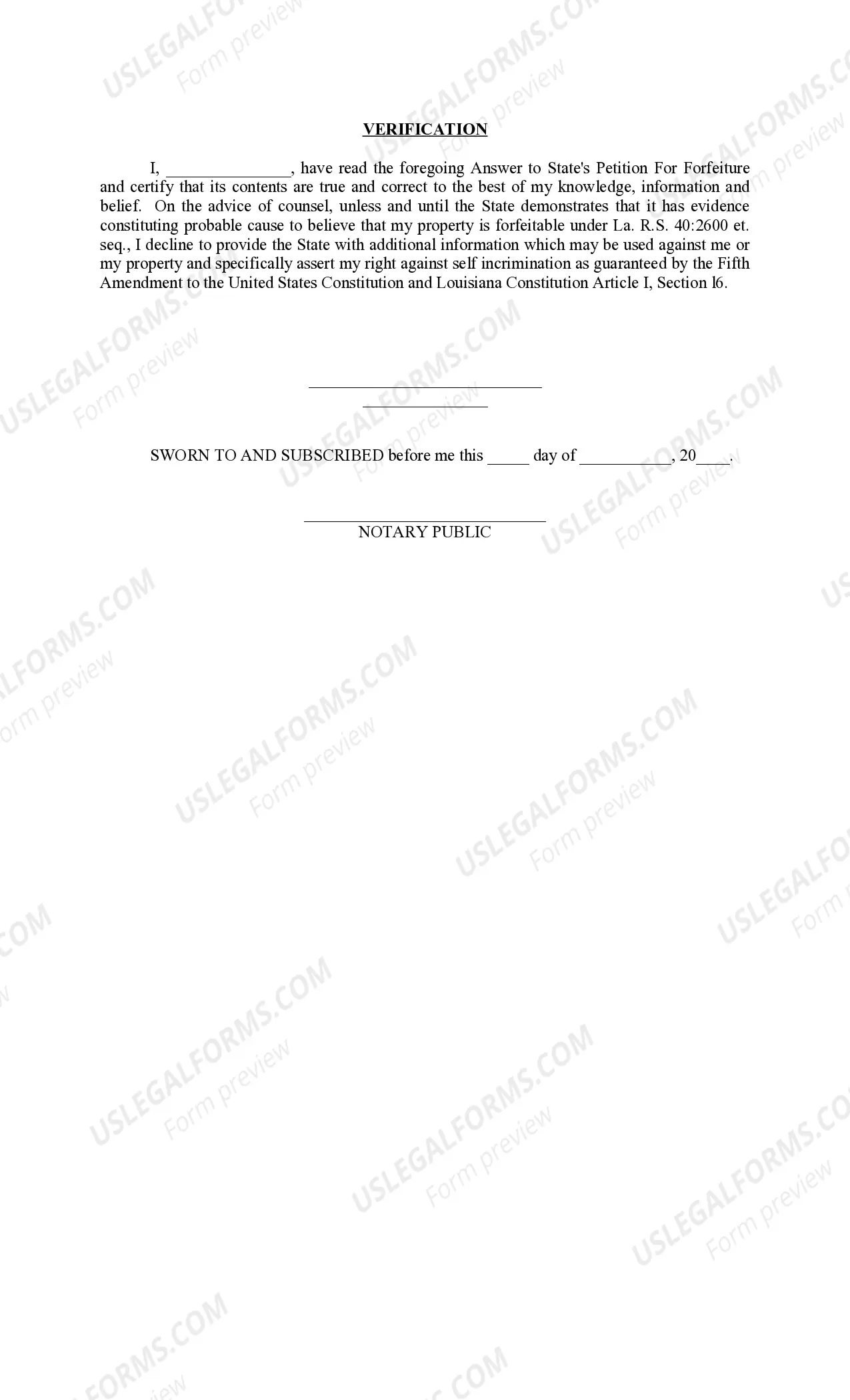
- Verification statement regarding the truthfulness of the provided information.
Situations where this form applies
This form should be used when you have been served with a State's Petition for Forfeiture concerning your property. It is necessary to formally respond to the allegations to protect your rights and ensure that your case is heard in court. Common scenarios include instances where law enforcement has seized property believed to be involved in criminal activity, and you wish to contest the forfeiture.
Who can use this document
This form is intended for:
- Individuals whose property has been seized by the state under a forfeiture claim.
- Claimants who wish to contest the validity of the stateâs allegations.
- Respondents seeking to establish their rights over their property in forfeiture cases.
Completing this form step by step
To complete this form, follow these steps:
- Identify yourself as the claimant and enter your full name and contact information at the top of the form.
- Carefully read the State's Petition for Forfeiture and respond to each allegation by denying or admitting the statements as appropriate.
- Clearly state any affirmative defenses you are asserting against the forfeiture and provide legal explanations for each defense.
- Include a request for dismissal of the stateâs petition, along with any sanctions you believe should apply.
- Sign the verification section to confirm the truth of the information provided and ensure that it is notarized if required by local rules.
Does this form need to be notarized?
This form does not typically require notarization unless specified by local law. Ensure to check if there are specific local requirements that may necessitate notarization for your case.
Get your form ready online
Our built-in tools help you complete, sign, share, and store your documents in one place.
Make edits, fill in missing information, and update formatting in US Legal Forms—just like you would in MS Word.
Download a copy, print it, send it by email, or mail it via USPS—whatever works best for your next step.
Sign and collect signatures with our SignNow integration. Send to multiple recipients, set reminders, and more. Go Premium to unlock E-Sign.
If this form requires notarization, complete it online through a secure video call—no need to meet a notary in person or wait for an appointment.
We protect your documents and personal data by following strict security and privacy standards.

Make edits, fill in missing information, and update formatting in US Legal Forms—just like you would in MS Word.

Download a copy, print it, send it by email, or mail it via USPS—whatever works best for your next step.

Sign and collect signatures with our SignNow integration. Send to multiple recipients, set reminders, and more. Go Premium to unlock E-Sign.

If this form requires notarization, complete it online through a secure video call—no need to meet a notary in person or wait for an appointment.

We protect your documents and personal data by following strict security and privacy standards.
Avoid these common issues
- Failing to respond within the permitted time frame.
- Not providing sufficient details in the affirmative defenses.
- Leaving out the verification or failing to sign the document.
- Ineffectively denying allegations without proper explanations.
- Neglecting to serve the answer to the appropriate legal parties.
Advantages of online completion
- You can download and customize the form easily without needing to draft from scratch.
- Access to legally reviewed templates ensures compliance with local laws.
- Convenient online access allows for quick completion and submission of the form.
- The form is legally enforceable as long as it is properly completed and filed within the required timeframe.
- It is crucial that the claims made within the form are truthful to avoid potential legal penalties.
- The information provided will be used by the court to establish the validity of your claims and defenses.
Quick recap
- The Answer to State's Petition for Forfeiture is essential to contest property seizure by the state.
- Understanding and asserting your legal rights can significantly impact the outcome of your case.
- Ensure to respond accurately and within the specified time limits.
Looking for another form?
Form popularity
FAQ
Criminal forfeiture is an action brought as a part of the criminal prosecution of a defendant.Civil judicial forfeiture is an in rem (against the property) action brought in court against the property. The property is the defendant and no criminal charge against the owner is necessary.
Whereas restitution is measured by the losses to victims and forfeiture is measured by the proceeds of a criminal offense, both amounts frequently turn out to be the same--especially in financial fraud cases.
Your Claim Opposing Forfeiture (MC-200) must be filed in the county where the property was seized. If you have received a notice, you can find the address of the court on that notice. Within 30 days after filing your claim, you must serve a copy on the District Attorney.
It is an in personam (against the person) action and requires that the government indict (charge) the property used or derived from the crime along with the defendant. If the jury finds the property forfeitable, the court issues an order of forfeiture.
Forfeiture refers to a loss of any property, money, or assets without consideration or compensation in return. A forfeiture generally occurs due to default in complying with repayment obligations under a contract. It can also be used as a penalty for an illegal way of conducting business.
A forfeiture clause in real estate is a seller's remedy that allows a seller to take back property purchased on a land installment contract if the buyer defaults on payments.
Letter of forfeiture means a notice in varied forms, sent to a bail bond agency/branch office, advising the agency/branch office that a defendant who has secured a bail bond with that agency has failed to appear on a given date in a given court in accordance with RCW 10.19. 090.
United States. There are two types of forfeiture (confiscation) cases, criminal and civil.