Petition for Forfeiture
Understanding this form
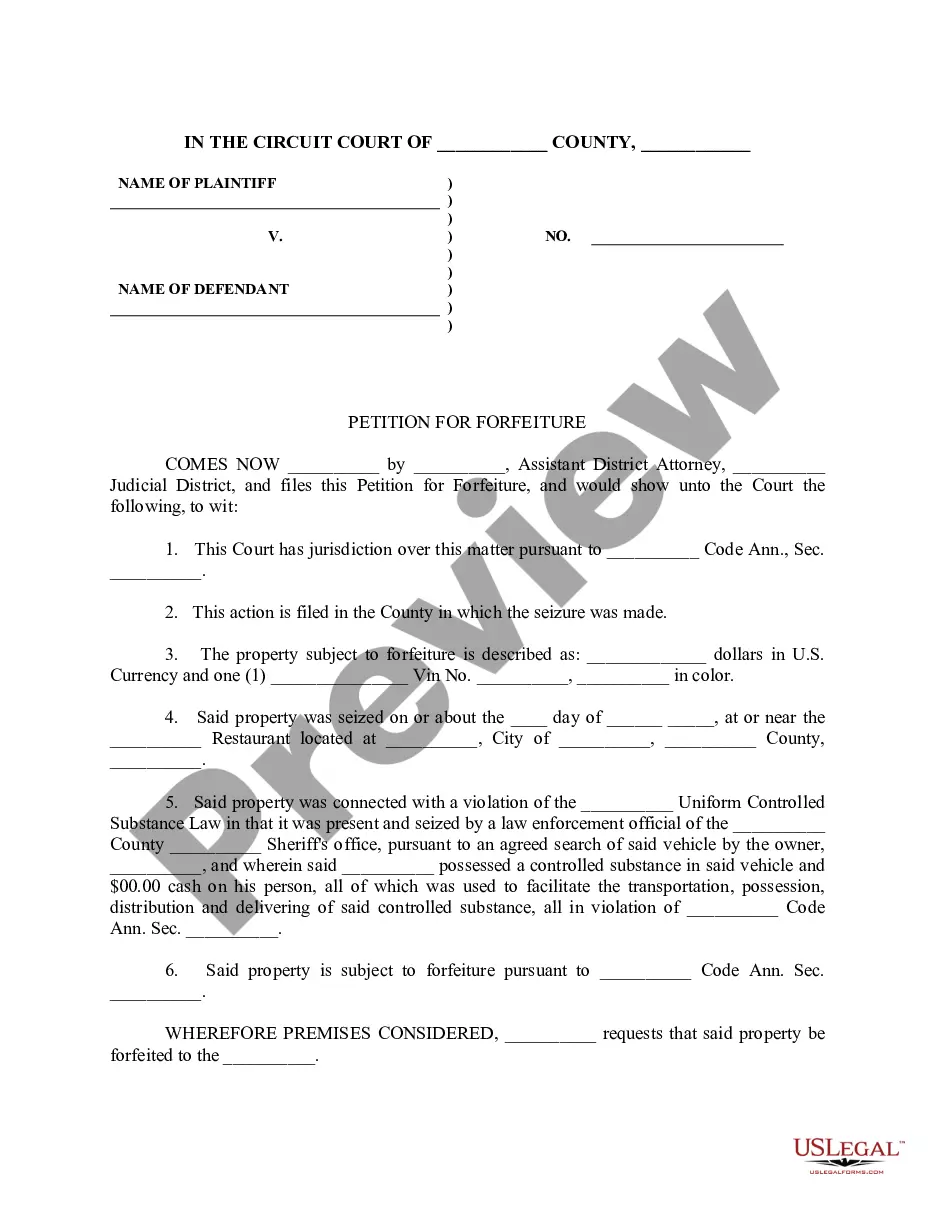
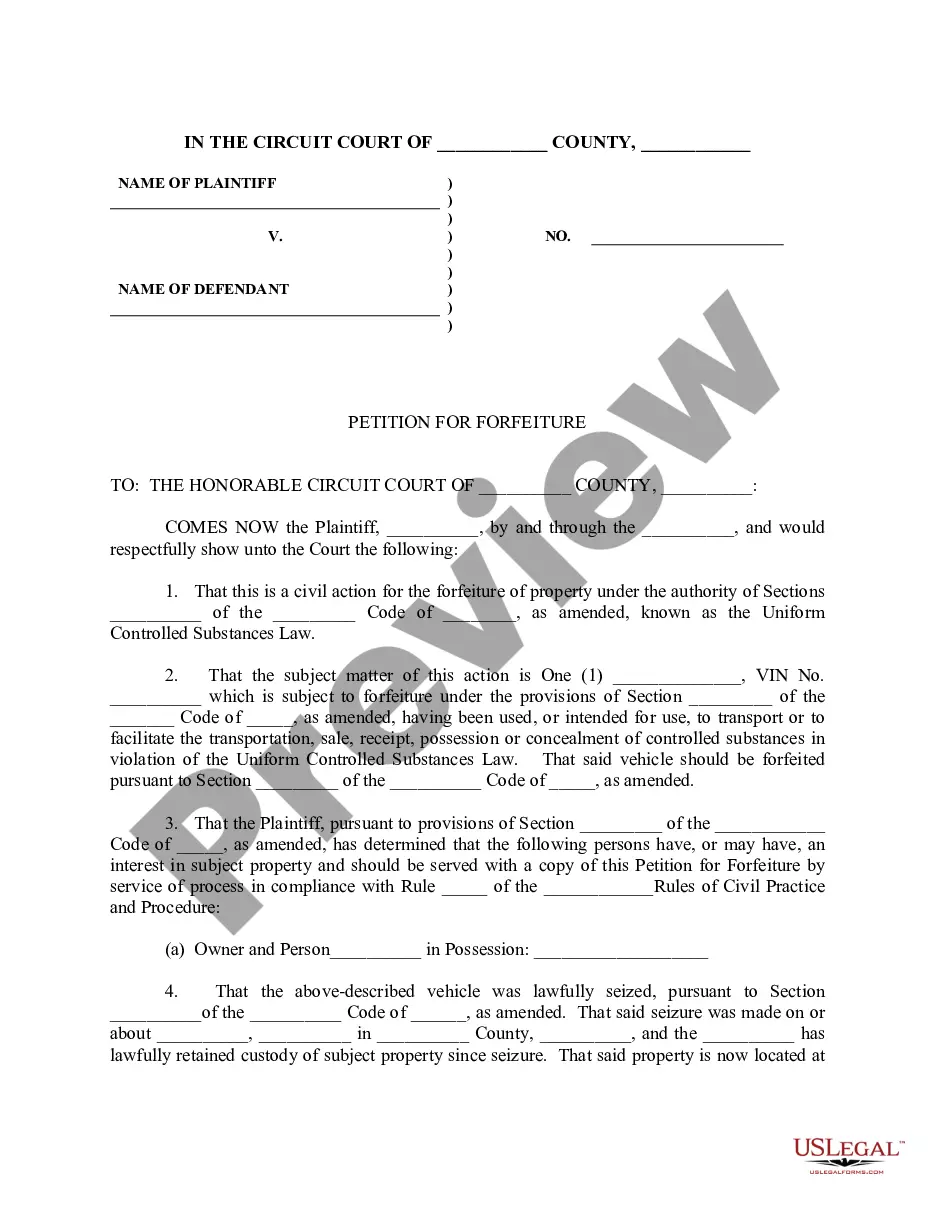
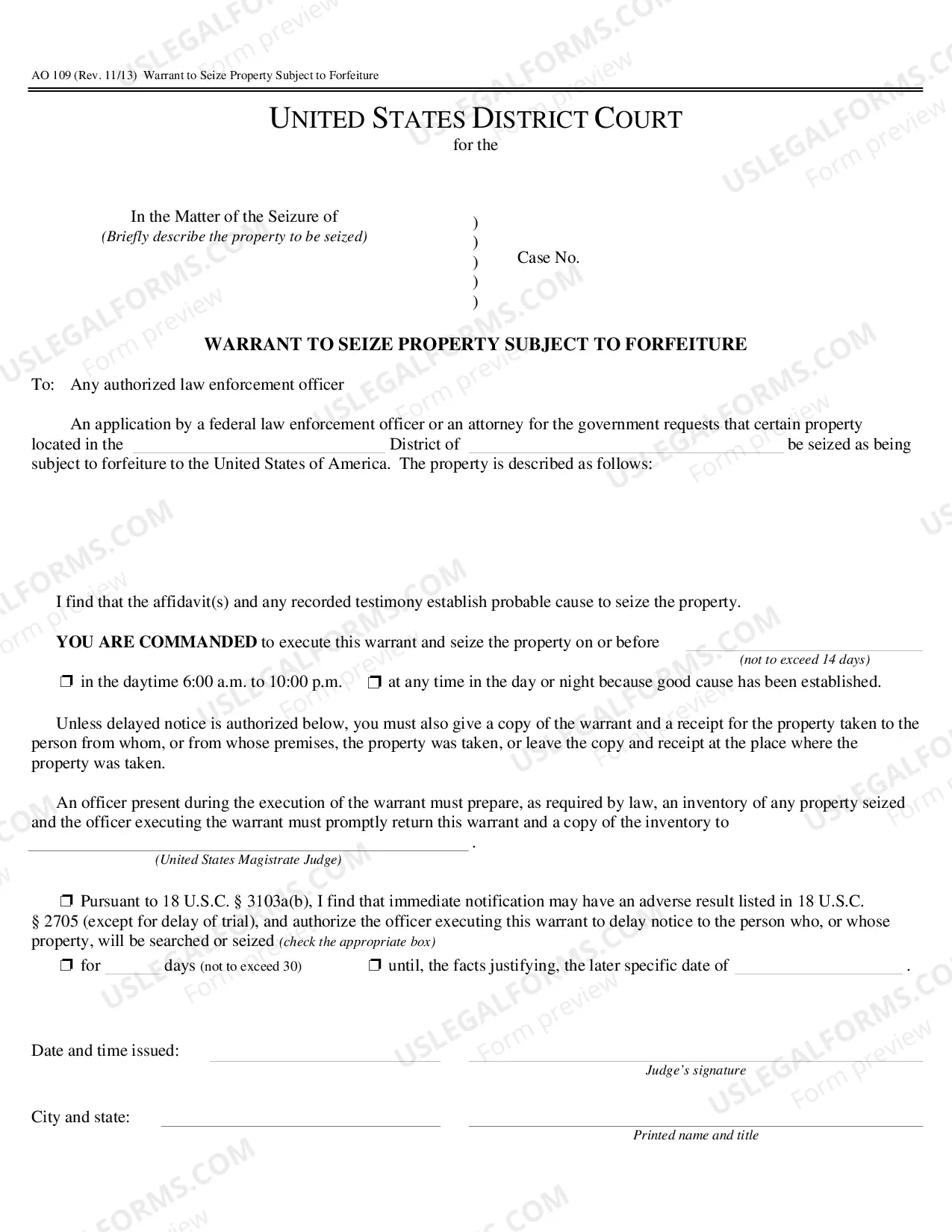
The Petition for Forfeiture is a legal document used by authorities to seek the seizure of property involved in drug-related or other criminal activity. This form is distinct from other legal documents in that it specifically addresses the forfeiture of property under laws related to criminal offenses, allowing the government to claim assets that were used in or obtained through illegal activities.
Main sections of this form
- Court jurisdiction statement citing relevant code sections.
- Description of the property subject to forfeiture, including value and identifiers.
- Details of the property seizure location and date.
- Connection of the property to a specific violation of drug laws.
- Request for forfeiture to the appropriate authority.

When to use this form
This form is needed when law enforcement agencies wish to initiate court proceedings to forfeit property believed to be connected with criminal activity, such as drug offenses. It is typically utilized following the seizure of the property and must be filed within a specific time frame as outlined by state laws.
Who should use this form
- Law enforcement officers seeking to forfeit seized property.
- Prosecutors involved in drug or criminal cases.
- Government agencies responsible for asset forfeiture.
How to prepare this document
- Identify the appropriate court having jurisdiction over the matter.
- Fill in the details regarding the property being forfeited, including its description and value.
- Enter the date and location of the property seizure.
- Clearly state the legal basis for the forfeiture under applicable drug laws.
- Complete the form by signing and dating it at the end.
Does this form need to be notarized?
In most cases, this form does not require notarization. However, some jurisdictions or signing circumstances might. US Legal Forms offers online notarization powered by Notarize, accessible 24/7 for a quick, remote process.
Get your form ready online
Our built-in tools help you complete, sign, share, and store your documents in one place.
Make edits, fill in missing information, and update formatting in US Legal Forms—just like you would in MS Word.
Download a copy, print it, send it by email, or mail it via USPS—whatever works best for your next step.
Sign and collect signatures with our SignNow integration. Send to multiple recipients, set reminders, and more. Go Premium to unlock E-Sign.
If this form requires notarization, complete it online through a secure video call—no need to meet a notary in person or wait for an appointment.
We protect your documents and personal data by following strict security and privacy standards.

Make edits, fill in missing information, and update formatting in US Legal Forms—just like you would in MS Word.

Download a copy, print it, send it by email, or mail it via USPS—whatever works best for your next step.

Sign and collect signatures with our SignNow integration. Send to multiple recipients, set reminders, and more. Go Premium to unlock E-Sign.

If this form requires notarization, complete it online through a secure video call—no need to meet a notary in person or wait for an appointment.

We protect your documents and personal data by following strict security and privacy standards.
Typical mistakes to avoid
- Failing to cite the correct code sections for jurisdiction.
- Inaccurately describing the seized property.
- Missing the deadline for filing the petition after the seizure.
- Not including sufficient evidence of the connection between the property and criminal activity.
Advantages of online completion
- Convenience of downloading and filling out the form from anywhere.
- Editable templates that allow customization to fit specific cases.
- Access to forms drafted by licensed attorneys, ensuring legal reliability.
Legal use & context
- This petition is a formal request to the court and must adhere to specific legal standards of proof.
- Failure to comply with required procedures may result in dismissal of the petition.
- The outcome of a forfeiture petition can have significant legal ramifications for the property owner.
Quick recap
- This form is essential for legally seizing property connected to criminal activities.
- Completing the form accurately is crucial to the success of forfeiture proceedings.
- Consult local laws to ensure compliance and verify any specific requirements.
Looking for another form?

Form popularity
FAQ
Petition for Forfeiture is a court filing authorities use to seek the seizure of property tied to criminal activity. It initiates forfeiture proceedings by setting out the court’s jurisdiction, a description of the property, seizure location and date, its connection to a violation, and a request that the property be forfeited to the government. It’s typically used after seizure within applicable state time limits.
Common reasons include property used in or obtained through illegal activity, such as drug offenses. The Petition for Forfeiture identifies the specific property, its value and identifiers, and links it to a criminal violation, supporting the government’s request for forfeiture.
In court, forfeiture means the judge considers the petition and may order the property to be forfeited to the government. The form requires a court jurisdiction statement, property description, seizure details, connection to the violation, and a request for forfeiture.
The consequence is that the government may lawfully claim the assets described in the petition, transferring ownership from the owner to the government. The proceeding is driven by the Petition for Forfeiture and its sections on jurisdiction, property description, seizure details, and connection to the crime.
No. Forfeiture is not a crime. It is the legal process by which assets connected to criminal activity may be seized and forfeited to the government after a court proceeding. The Petition for Forfeiture initiates that process, outlining the property, its connection to a violation, and requesting the court’s order.
The Petition for Forfeiture is a formal court filing that starts forfeiture proceedings, including a court jurisdiction statement, property description, seizure details, connection to the alleged crime, and a request for the court to order forfeiture to the government. A Notice of Forfeiture typically informs interested parties and does not itself initiate court action.