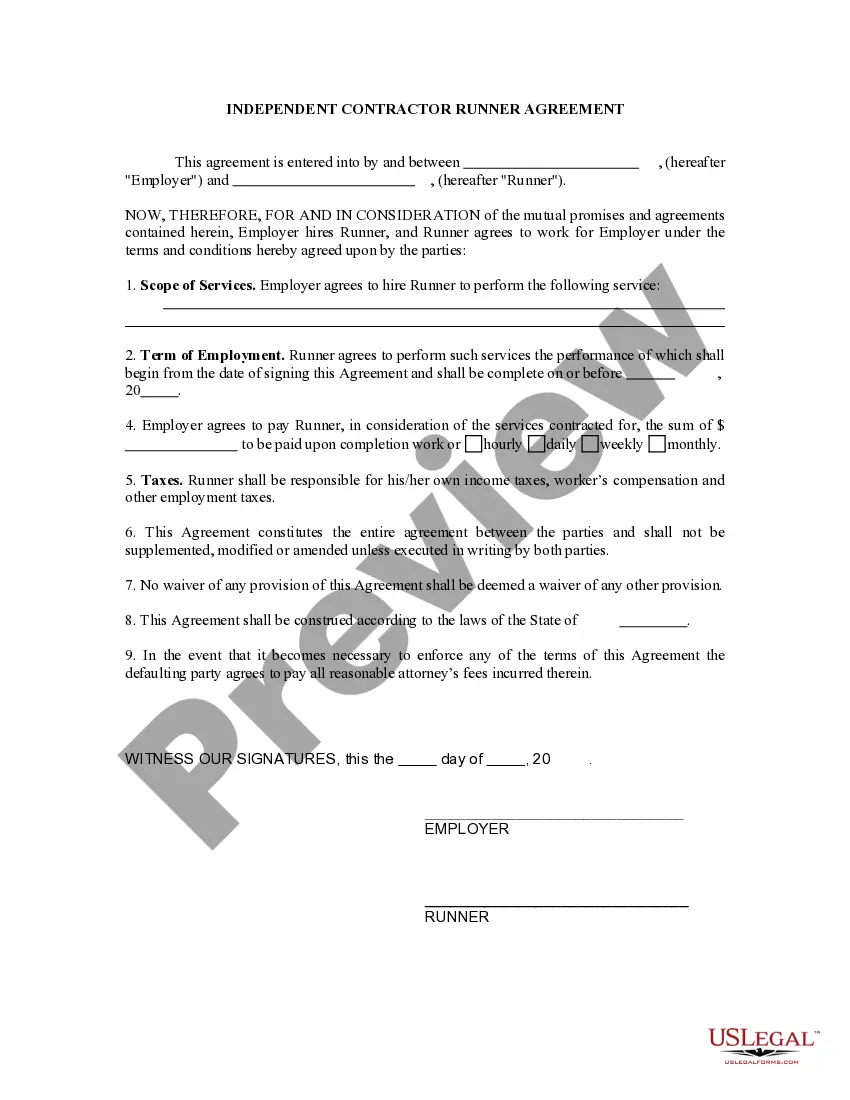
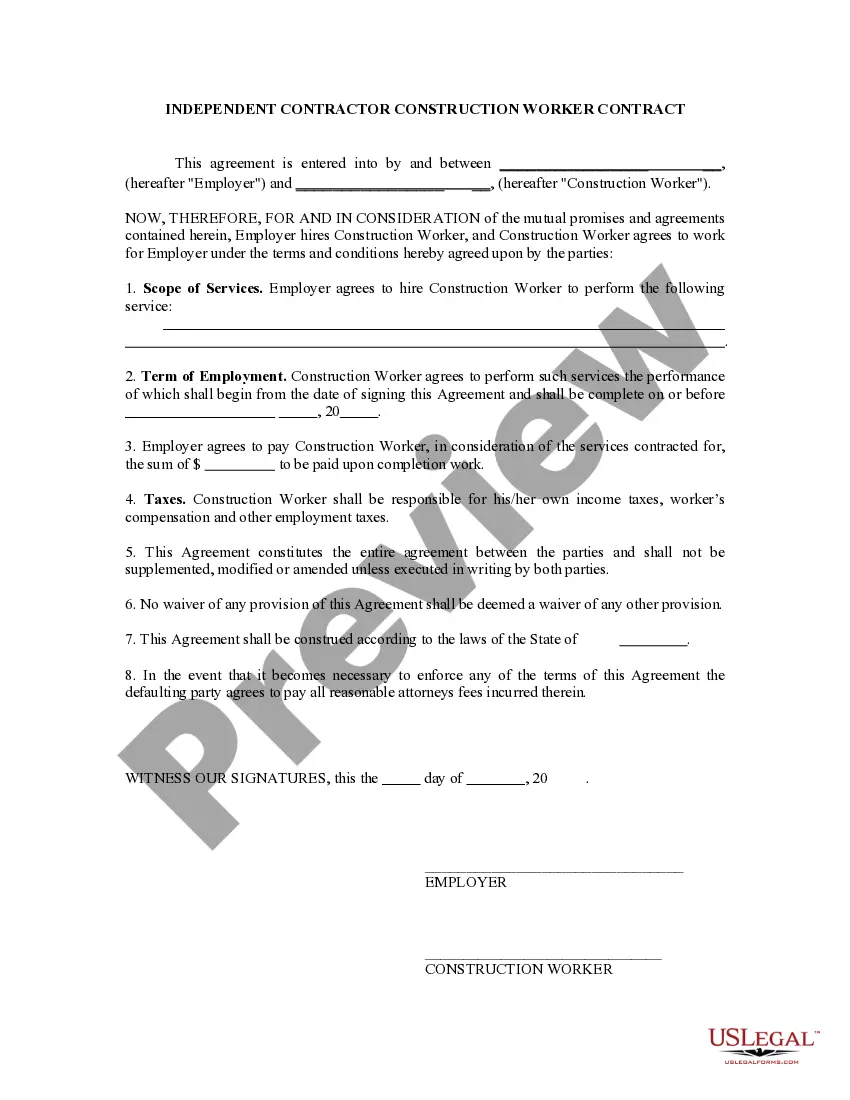
This is a contract between an employer and a runner to hire the runner as an independent contractor.
Kentucky Runner Agreement - Self-Employed Independent Contractor
State:
Multi-State
Control #:
US-INDC-36
Format:
Word;
Rich Text
Instant download
Description

Get your form ready online
Our built-in tools help you complete, sign, share, and store your documents in one place.
Built-in online Word editor
Make edits, fill in missing information, and update formatting in US Legal Forms—just like you would in MS Word.
Export easily
Download a copy, print it, send it by email, or mail it via USPS—whatever works best for your next step.
E-sign your document
Sign and collect signatures with our SignNow integration. Send to multiple recipients, set reminders, and more. Go Premium to unlock E-Sign.
Notarize online 24/7
If this form requires notarization, complete it online through a secure video call—no need to meet a notary in person or wait for an appointment.
Store your document securely
We protect your documents and personal data by following strict security and privacy standards.

Make edits, fill in missing information, and update formatting in US Legal Forms—just like you would in MS Word.

Download a copy, print it, send it by email, or mail it via USPS—whatever works best for your next step.

Sign and collect signatures with our SignNow integration. Send to multiple recipients, set reminders, and more. Go Premium to unlock E-Sign.

If this form requires notarization, complete it online through a secure video call—no need to meet a notary in person or wait for an appointment.

We protect your documents and personal data by following strict security and privacy standards.
Looking for another form?







How to fill out Runner Agreement - Self-Employed Independent Contractor?
US Legal Forms - one of the largest compilations of legal documents in the United States - offers a broad selection of legal templates that you can download or print.
By using the website, you can access thousands of forms for professional and personal use, organized by categories, states, or keywords. You will find the most recent versions of forms such as the Kentucky Runner Agreement - Self-Employed Independent Contractor within moments.
If you already possess a subscription, Log In and download the Kentucky Runner Agreement - Self-Employed Independent Contractor from the US Legal Forms library. The Download option will be available on every form you view. You have access to all previously downloaded forms from the My documents section of your profile.
Process the payment. Use your credit card or PayPal account to finalize the purchase.
Choose the format and download the form to your device. Edit. Complete, modify and print and sign the downloaded Kentucky Runner Agreement - Self-Employed Independent Contractor. Each template you added to your account has no expiration date and is yours permanently. Therefore, if you wish to download or print another copy, simply visit the My documents section and click on the form you need. Access the Kentucky Runner Agreement - Self-Employed Independent Contractor with US Legal Forms, the most extensive collection of legal document templates. Utilize thousands of professional and state-specific templates that meet your business or personal requirements.
- Make sure you have selected the appropriate form for your city/state.
- Click on the Preview button to review the form's details.
- Examine the form details to ensure that you have chosen the correct form.
- If the form does not meet your needs, use the Search bar at the top of the page to find one that does.
- If you are satisfied with the form, confirm your selection by clicking on the Purchase now button.
- Then, select the pricing plan you prefer and provide your information to create an account.
Form popularity
FAQ
How do I create an Independent Contractor Agreement?State the location.Describe the type of service required.Provide the contractor's and client's details.Outline compensation details.State the agreement's terms.Include any additional clauses.State the signing details.
A 1099 employee is a US self-employed worker that reports their income to the IRS on a 1099 tax form. Freelancers, gig workers, and independent contractors are all considered 1099 employees.
Simply put, being an independent contractor is one way to be self-employed. Being self-employed means that you earn money but don't work as an employee for someone else.
Technically, a client is required to have a contractor fill out a Form W-9 before they pay them. Not all clients follow the rules, though. It's not out of the question for a contractor to receive a W-9 near the end of the tax year, as their client scrambles to get their taxes done on time.
Becoming an independent contractor is one of the many ways to be classified as self-employed. By definition, an independent contractor provides work or services on a contractual basis, whereas, self-employment is simply the act of earning money without operating within an employee-employer relationship.
9 Form InstructionsLine 1 Name.Line 2 Business name.Line 3 Federal tax classification.Line 4 Exemptions.Lines 5 & 6 Address, city, state, and ZIP code.Line 7 Account number(s)Part I Taxpayer Identification Number (TIN)Part II Certification.
The three types of self-employed individuals include:Independent contractors. Independent contractors are individuals hired to perform specific jobs for clients, meaning that they are only paid for their jobs.Sole proprietors.Partnerships.
The law does not require you to complete a contract with your self-employed or freelance workers - a verbal contract can exist even when there is nothing in writing.
How to fill out a W-9 and a 1099In box 1, write the same name you use on your tax returns, which is likely your legal name.In box 2, write your business name or disregarded entity name if you have one in addition to your legal name.More items...
What Is an Independent Contractor? An independent contractor is a self-employed person or entity contracted to perform work foror provide services toanother entity as a nonemployee. As a result, independent contractors must pay their own Social Security and Medicare taxes.