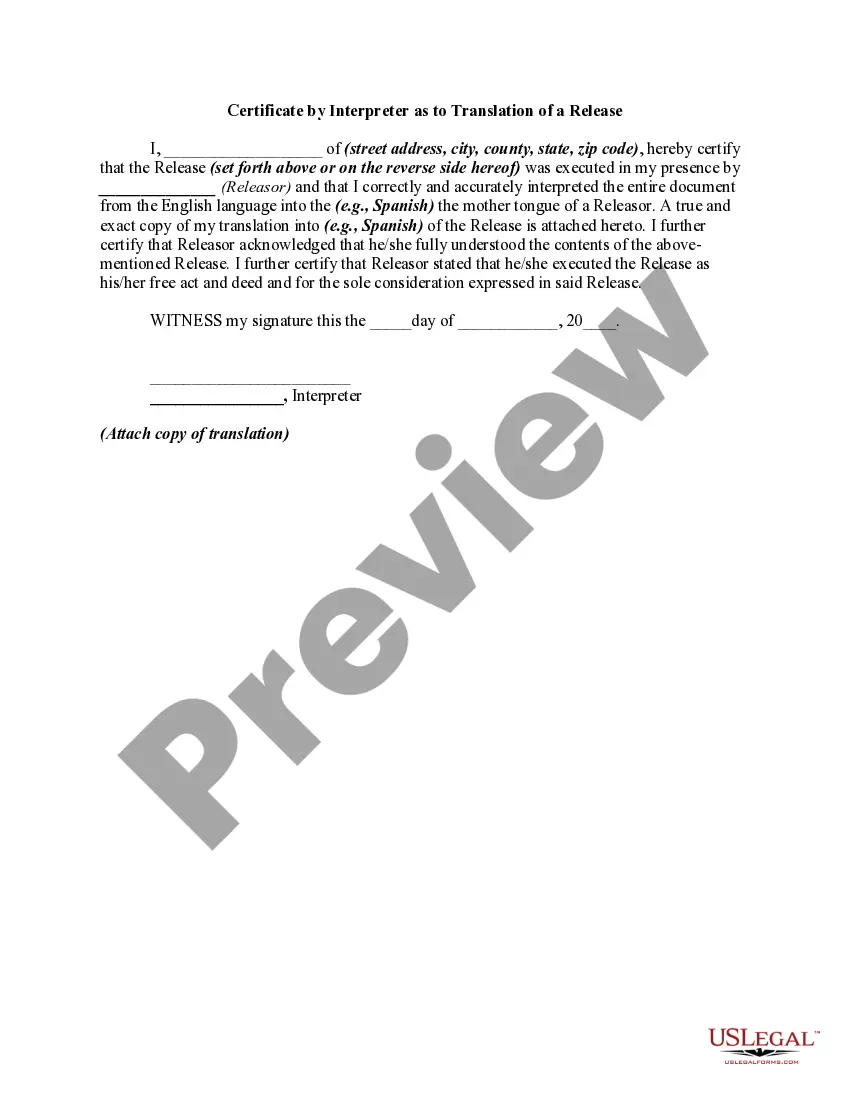
Kentucky Certificate by Interpreter as to Translation of a Release
Description

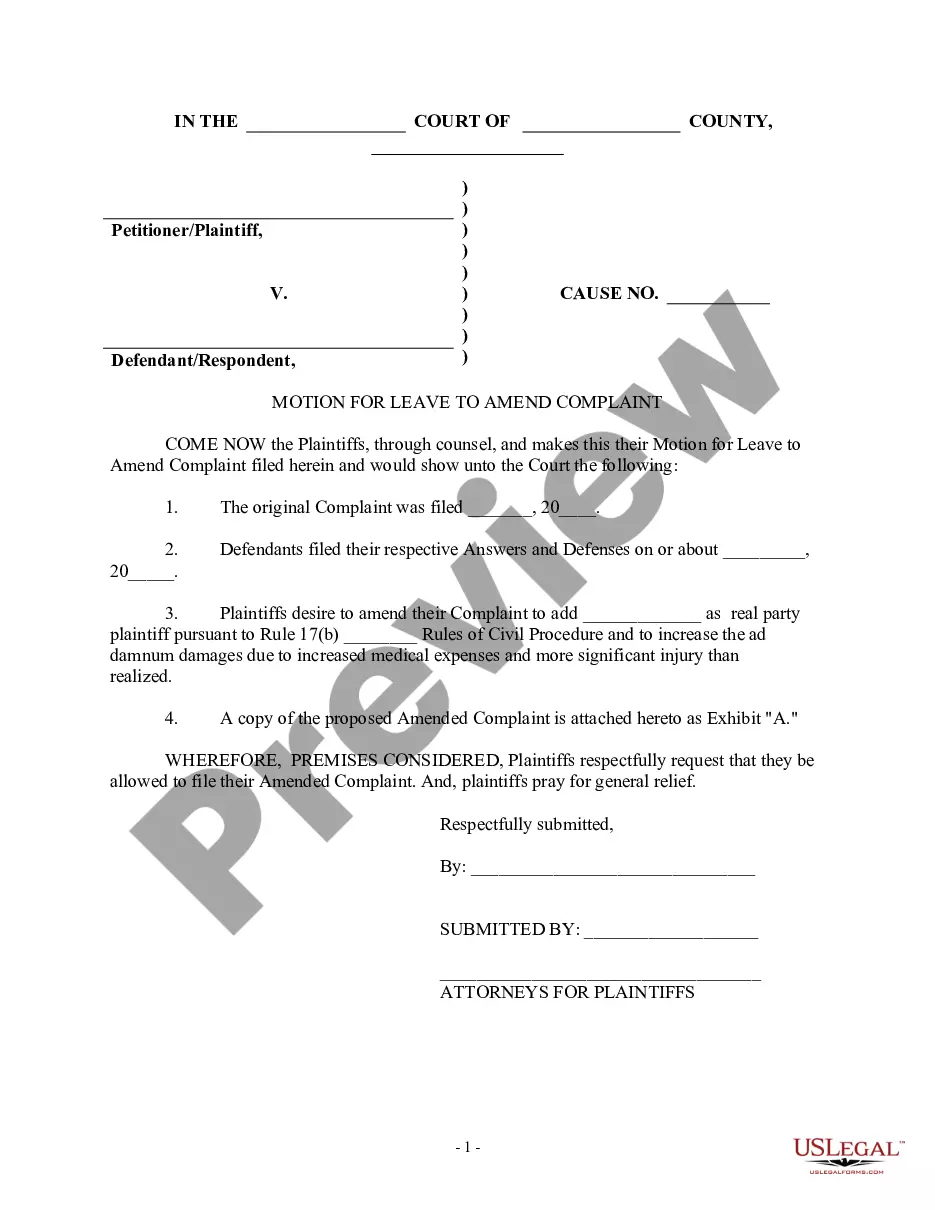
How to fill out Certificate By Interpreter As To Translation Of A Release?
Selecting the appropriate authorized document template can be challenging. Clearly, there are numerous templates accessible online, but how can you acquire the authorized document you require? Utilize the US Legal Forms website. The service provides thousands of templates, including the Kentucky Certificate by Interpreter regarding Translation of a Release, which you can use for business and personal needs. All of the forms are reviewed by professionals and comply with federal and state standards.
If you are currently registered, Log In to your account and click the Obtain button to access the Kentucky Certificate by Interpreter regarding Translation of a Release. Use your account to review the authorized forms you have purchased previously. Visit the My documents section of your account and download an additional copy of the document you need.
If you are a new user of US Legal Forms, here are simple instructions you can follow: First, ensure you have selected the correct form for your region/area. You can review the form using the Preview button and read the form description to confirm it is suitable for you. If the form does not meet your requirements, use the Search field to find the appropriate form. Once you are confident that the form is correct, click the Purchase now button to obtain the form. Choose the pricing plan you prefer and input the required information. Create your account and complete the transaction using your PayPal account or credit card. Select the document format and download the authorized document template to your device. Complete, modify, print, and sign the received Kentucky Certificate by Interpreter regarding Translation of a Release.
US Legal Forms offers a comprehensive solution for accessing legally compliant document templates tailored to your individual and business needs.
- US Legal Forms is the largest collection of authorized forms you can explore a variety of document templates.
- Utilize the service to download professionally crafted papers that adhere to state requirements.
- Ensure you thoroughly review the templates available.
- Take advantage of the preview feature to ensure the form fits your needs.
- Complete your purchase securely through multiple payment options.
- Maintain copies of your transactions for future reference.
Form popularity
FAQ
To be eligible for certification, you must have a minimum of a bachelor's degree and complete an interpreter training program. You must also pass a written and performance exam to demonstrate your proficiency in ASL interpretation.
Interpreting: Refers to the oral translation of spoken language in real-time. Interpretation: Has a broader meaning and can refer to the act of understanding, explaining, or analyzing various aspects in different contexts.
The two jobs do have similarities; however, an interpreter will not provide translation services, and a translator will not provide interpreting services.
Interpreters mediate languages orally while translators work with written material. When it comes to language skills, translators need to have solid reading comprehension, transfer, and target language production skills.
Spoken Language Interpreter Certification Attend and Complete the Orientation Workshop. ... Pass the English Written Exam. ... Pass an Oral Proficiency Interview in each Working Language. ... Complete 4 Hours of Court Observation. ... Pass the Oral Certification Exam. ... Complete the Required Hours of Court Observation. ... Approval and Contract.
Although interpreters and translators have similarities, interpreting and translation involve different skill sets. Interpreters mediate languages orally while translators work with written material.
Sworn translation is typically used for official documents that need to be verified and authenticated, such as birth certificates and marriage certificates. Legal translation, on the other hand, is used for documents related to legal matters, such as contracts and court documents.
Minimum Qualifications to Become an Interpreter Demonstrate bilingualism and literacy through language proficiency testing. Hold a certificate for professional interpreter training (at least 40 hours of training).