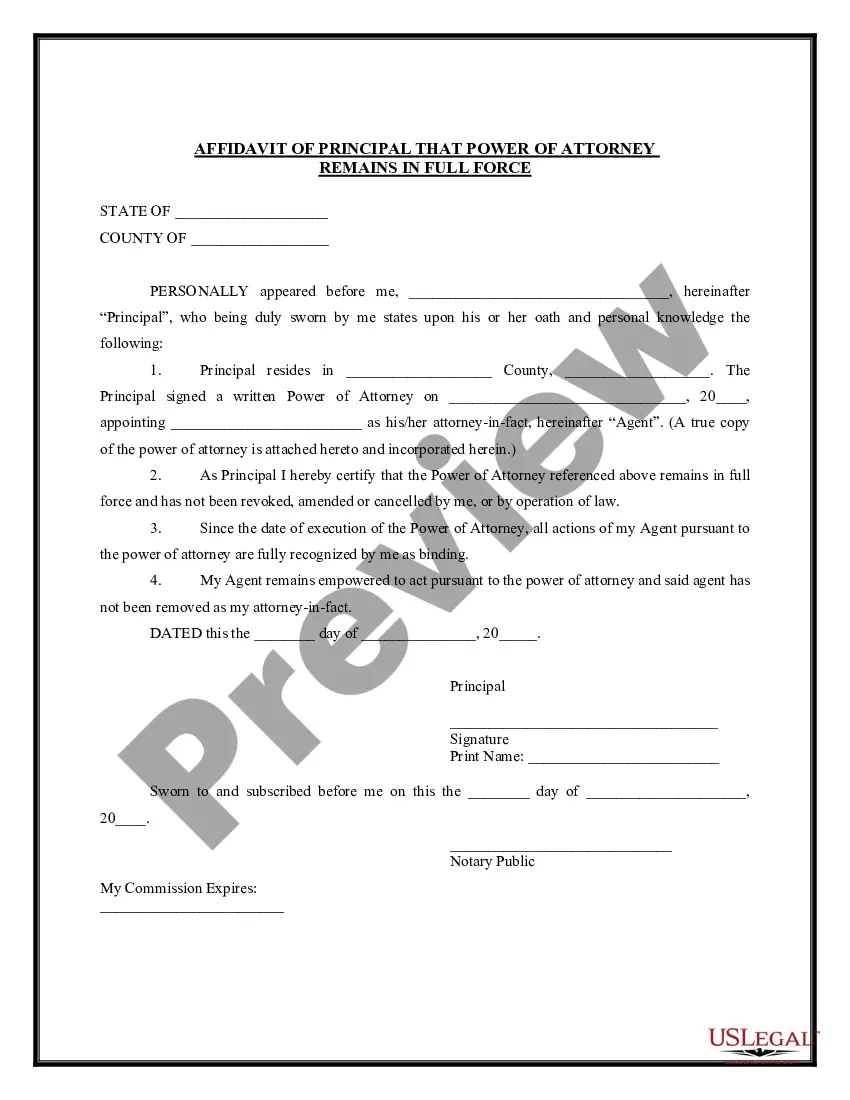
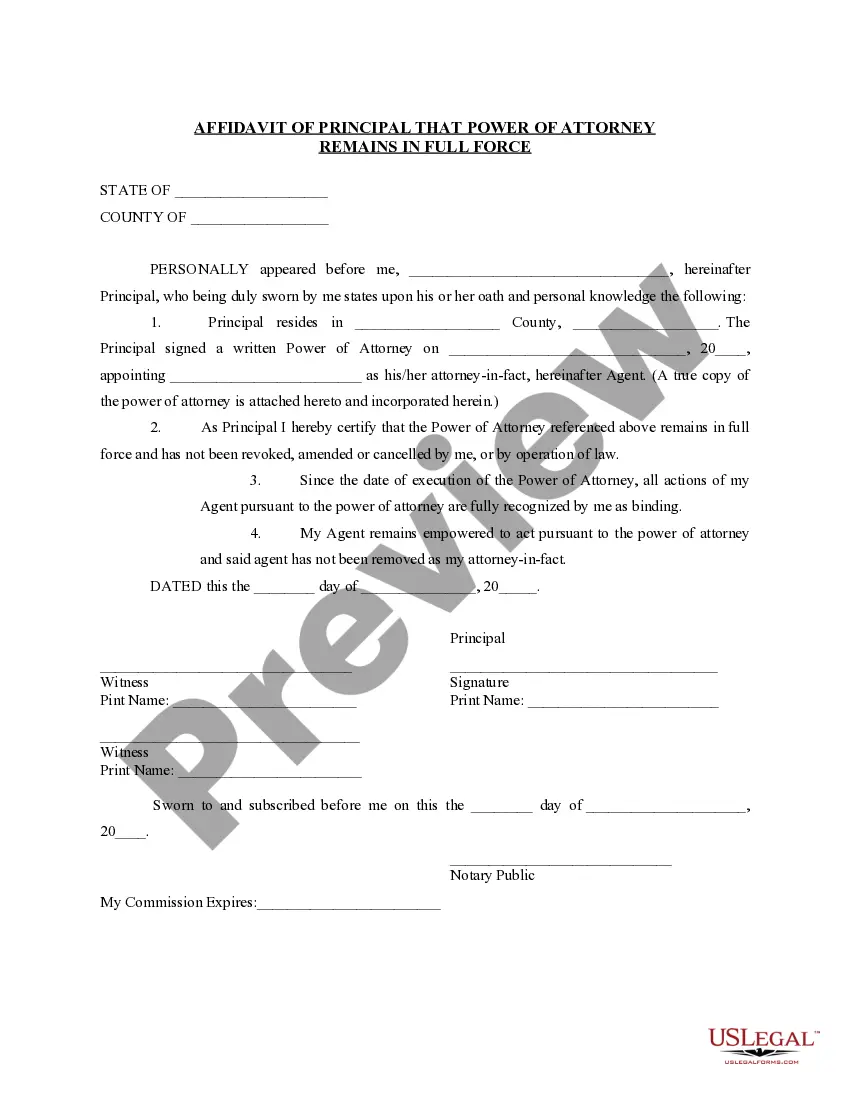
This affidavit is for a Principal to certify that the power of attorney has not been revoked and remains in full force. For all States except Florida, Georgia, Michigan, Ohio, South Carolina or Vermont.
Kansas Affidavit of Principal that Power of Attorney not Revoked and in Full Force
Category:
State:
Multi-State
Control #:
US-P098A
Format:
Word;
Rich Text
Instant download
Description

How to fill out Affidavit Of Principal That Power Of Attorney Not Revoked And In Full Force?
If you require thorough, obtain, or create authentic document templates, utilize US Legal Forms, the largest collection of legal forms available online. Take advantage of the site’s straightforward and user-friendly search feature to find the documents you need. Various templates for business and personal purposes are organized by categories and states, or keywords. Use US Legal Forms to obtain the Kansas Affidavit of Principal that Power of Attorney has not been Revoked and is in Full Force in just a few clicks.
If you are already a US Legal Forms user, Log In to your account and click the Download button to receive the Kansas Affidavit of Principal that Power of Attorney has not been Revoked and is in Full Force. You can also access forms you have previously submitted electronically in the My documents tab of your account.
If you are using US Legal Forms for the first time, refer to the instructions below: Step 1. Ensure you have selected the form for your correct city/state. Step 2. Use the Review option to examine the form’s content. Don’t forget to read the description. Step 3. If you are not satisfied with the form, use the Search field at the top of the screen to find other types of your legal form template. Step 4. After you have found the form you want, click the Buy now button. Choose the pricing plan you prefer and enter your details to register for an account. Step 5. Process the transaction. You can use your credit card or PayPal account to complete the transaction. Step 6. Select the format of your legal form and download it to your device. Step 7. Complete, modify, and print or sign the Kansas Affidavit of Principal that Power of Attorney has not been Revoked and is in Full Force.
- Every legal document template you purchase belongs to you permanently.
- You will have access to every form you downloaded in your account.
- Click on the My documents section and select a form to print or download again.
- Stay competitive and obtain, and print the Kansas Affidavit of Principal that Power of Attorney has not been Revoked and is in Full Force with US Legal Forms.
- There are millions of professional and state-specific forms you can use for your personal business or personal needs.
Form popularity
FAQ
To revoke a power of attorney in Kansas, you must create a written revocation document stating your intent to revoke the authority granted. It is important to deliver this document to the agent and any relevant parties. Additionally, filing the revocation with the court may be beneficial for clarity. This ensures that all involved parties are aware that the Kansas Affidavit of Principal that Power of Attorney not Revoked and in Full Force is no longer in effect.
When filling out an affidavit regarding a power of attorney being in full force, begin by identifying yourself and the agent. Include a statement affirming that the power of attorney is active and has not been revoked. Make sure to sign the document before a notary public, which adds credibility. This affidavit serves as a confirmation for the Kansas Affidavit of Principal that Power of Attorney not Revoked and in Full Force.
To fill out a revocation of power of attorney, start by stating your name and the name of the agent you are revoking. Clearly indicate your intent to revoke all powers previously granted. Sign the document in front of a notary public to ensure its legitimacy. This step is essential for confirming that the Kansas Affidavit of Principal that Power of Attorney not Revoked and in Full Force is no longer applicable.
Filling out a power of attorney form involves specifying the principal's name, the agent's name, and the powers you wish to grant. Clearly outline the terms and conditions, ensuring they align with your intentions. After completing the form, sign it in front of a notary public to authenticate the document. This assures that the Kansas Affidavit of Principal that Power of Attorney not Revoked and in Full Force remains valid.
To fill out an affidavit, begin by clearly stating your name, address, and the purpose of the document. Next, include a statement of facts you wish to affirm, ensuring that you are truthful and precise. Finally, sign the affidavit in the presence of a notary public to validate it. This process is crucial, especially when creating a Kansas Affidavit of Principal that Power of Attorney not Revoked and in Full Force.
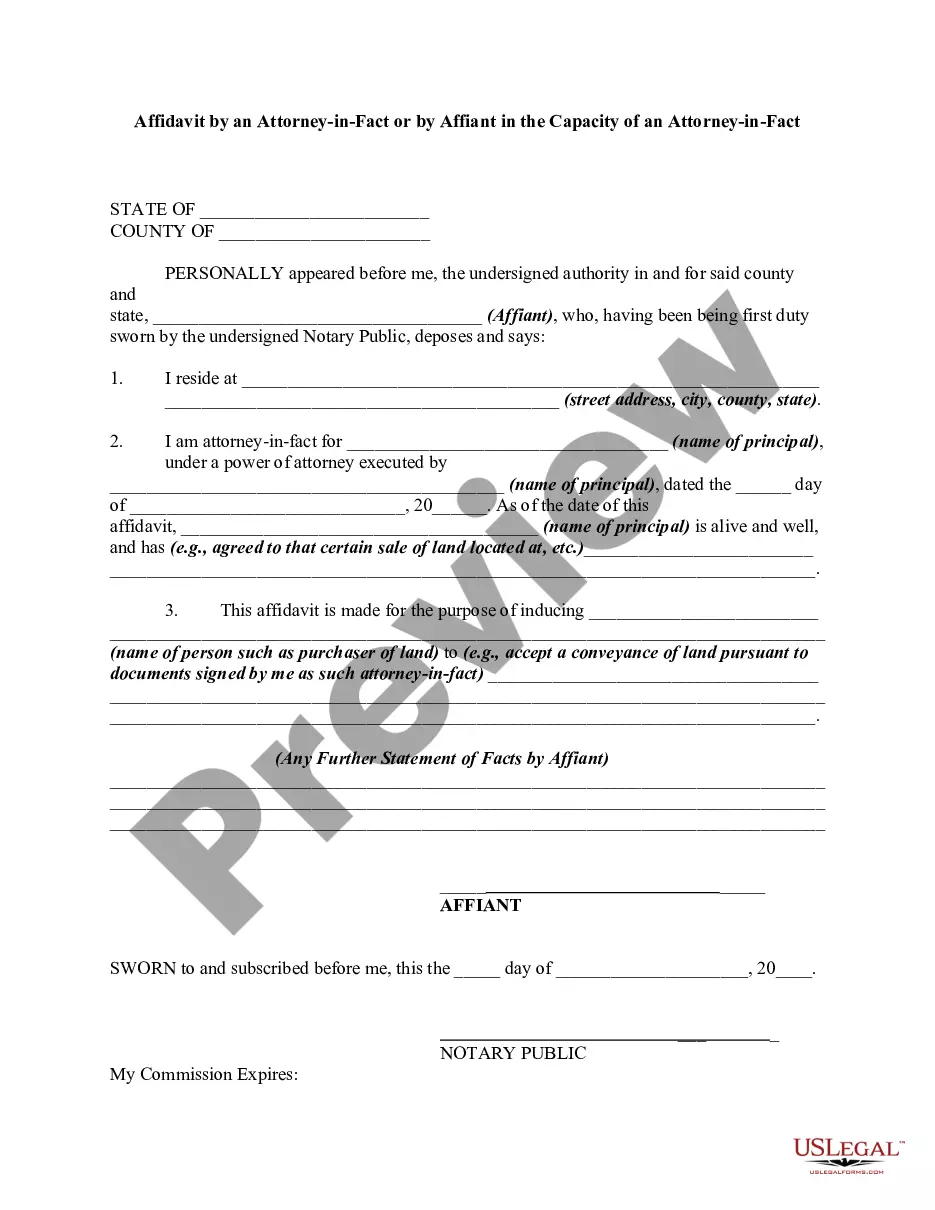
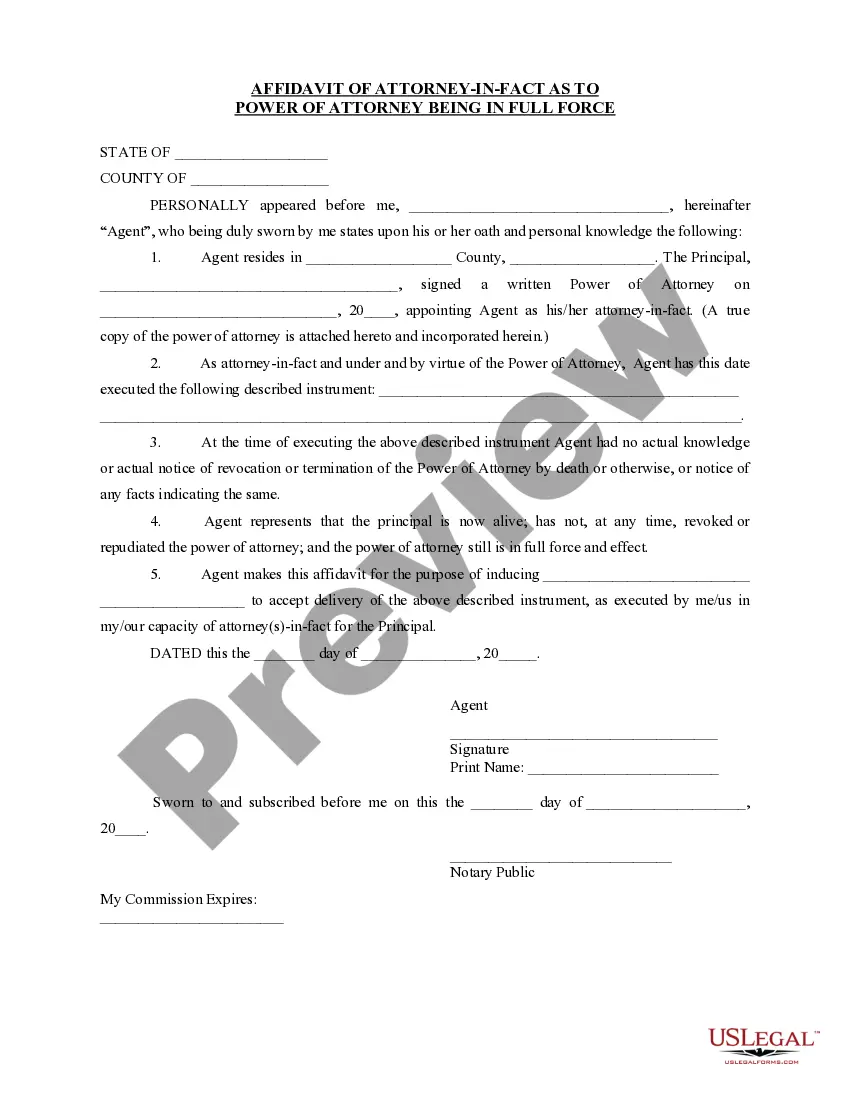
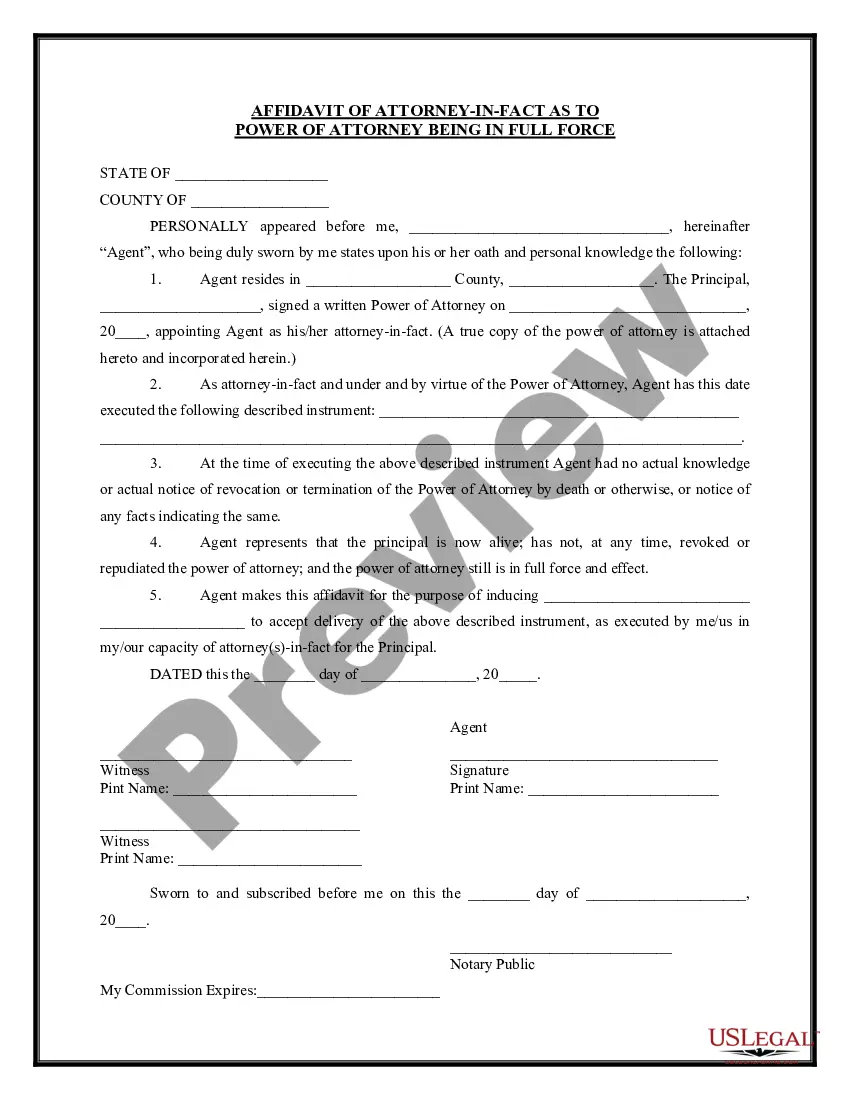
An affidavit as power of attorney being in full force signifies that the authority granted to the agent still stands and has not been revoked. This affidavit acts as confirmation that the agent can continue to act on behalf of the principal. By presenting this affidavit, individuals can ensure their transactions and decisions are executed smoothly and legally.
The main purpose of an affidavit is to provide a written and sworn statement of facts that can be used in legal proceedings. Affidavits help establish the truth of certain claims, making them valuable in various legal contexts, including powers of attorney. By using an affidavit, individuals can support their legal documents and assert their intentions clearly.
Statute 58 652 in Kansas outlines the requirements and regulations regarding powers of attorney. It specifies how these documents should be executed and the rights of the principal and agent. Understanding this statute is vital for anyone involved in creating or utilizing a power of attorney in Kansas.
A power of attorney is a legal document that grants authority to an agent to act on behalf of the principal. In contrast, an affidavit is a sworn statement that verifies information, such as the validity of the power of attorney. Essentially, the power of attorney establishes authority, while the affidavit confirms that authority is still in effect.
durable power of attorney typically lapses when the principal becomes incapacitated or when the principal passes away. These powers are designed for specific transactions and do not remain effective indefinitely. Understanding these limitations is essential for anyone considering the use of a nondurable power of attorney.