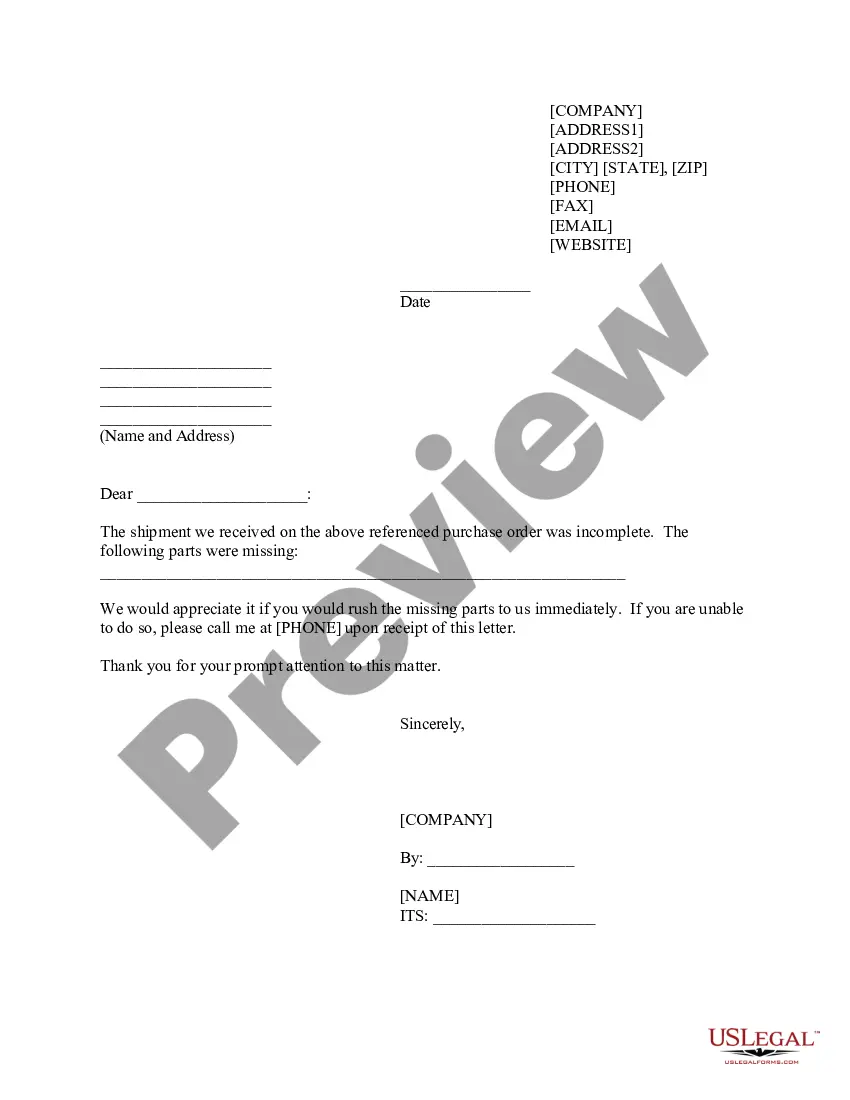
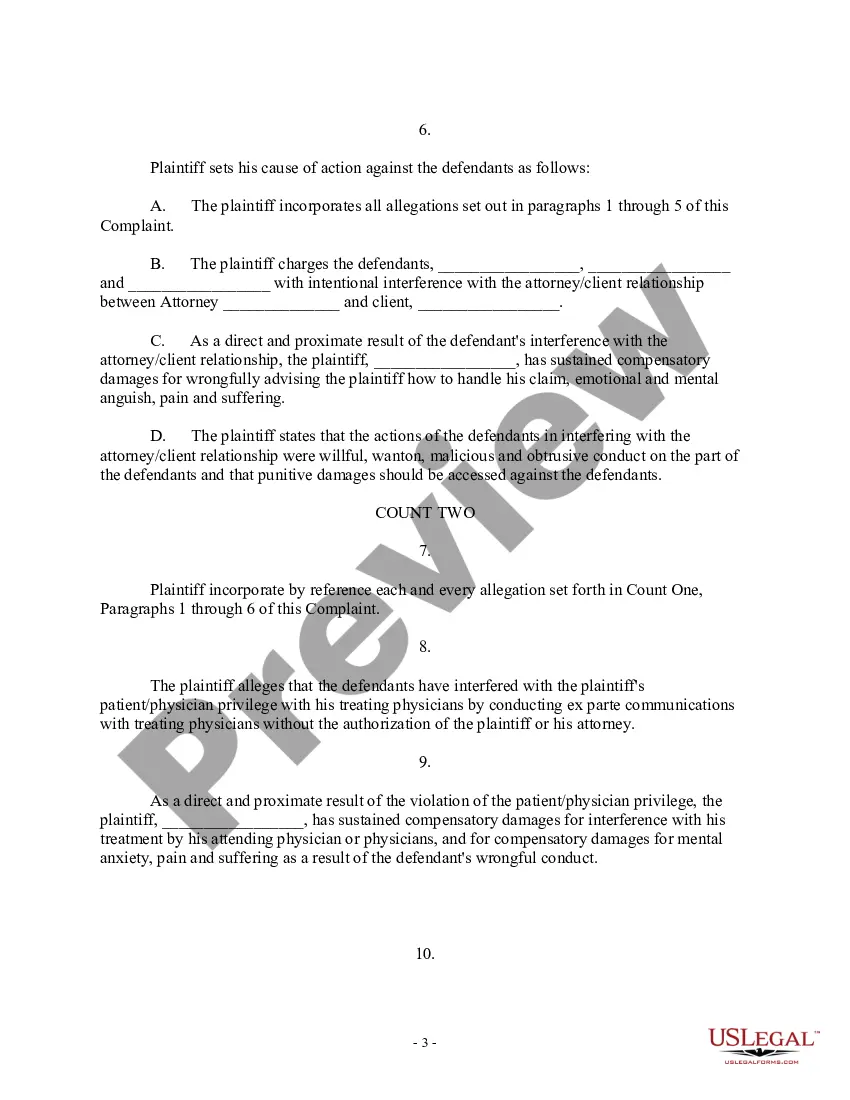
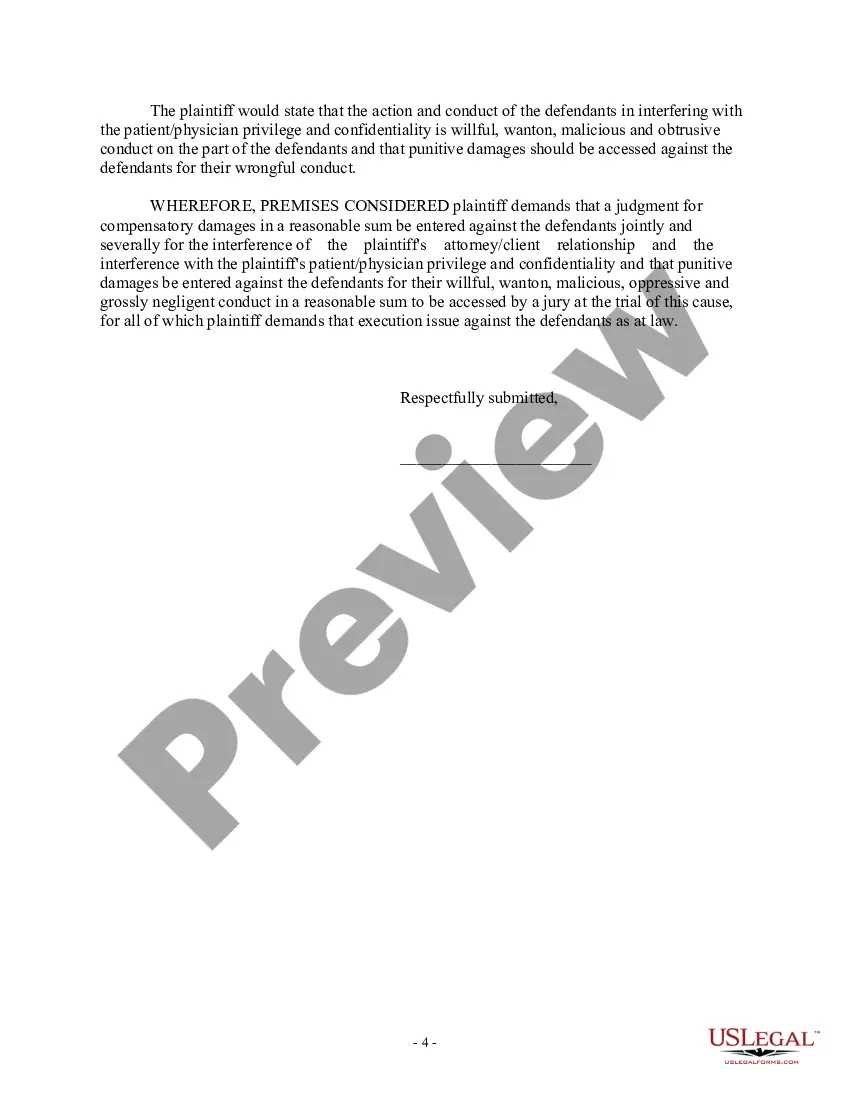
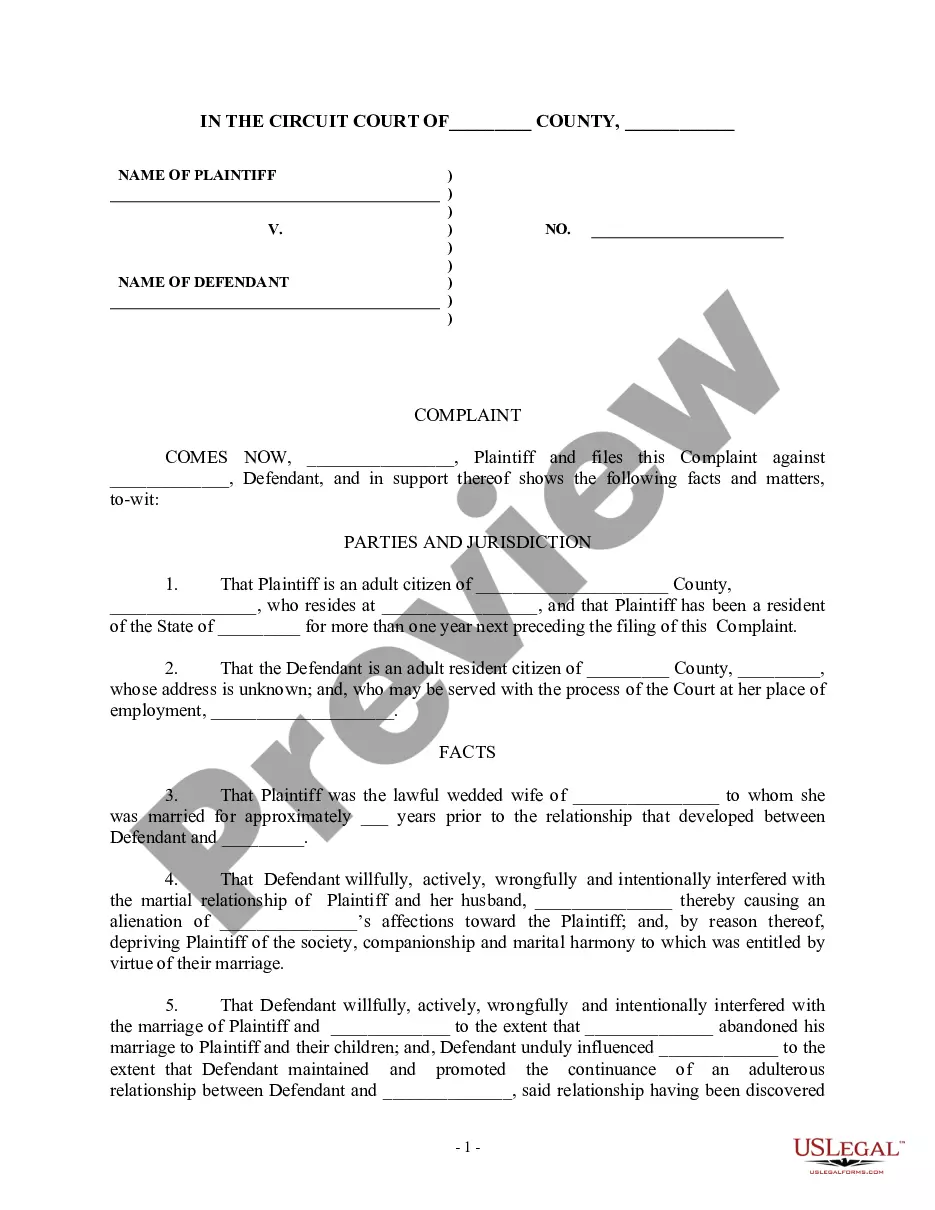
In this complaint, plaintiff charges defendants with intentional interference with the attorney/client relationship. The plaintiff states that the actions of the defendants in interfering with the attorney/client relationship were willful, wanton, malicious and obtrusive and that punitive damages should be accessed against the defendants.
Kansas Complaint For Intentional Interference With Attorney-Client Relationship
Category:
State:
Multi-State
Control #:
US-000295
Format:
Word;
Rich Text
Instant download
Description
Free preview




Get your form ready online
Our built-in tools help you complete, sign, share, and store your documents in one place.
Built-in online Word editor
Make edits, fill in missing information, and update formatting in US Legal Forms—just like you would in MS Word.
Export easily
Download a copy, print it, send it by email, or mail it via USPS—whatever works best for your next step.
E-sign your document
Sign and collect signatures with our SignNow integration. Send to multiple recipients, set reminders, and more. Go Premium to unlock E-Sign.
Notarize online 24/7
If this form requires notarization, complete it online through a secure video call—no need to meet a notary in person or wait for an appointment.
Store your document securely
We protect your documents and personal data by following strict security and privacy standards.

Make edits, fill in missing information, and update formatting in US Legal Forms—just like you would in MS Word.

Download a copy, print it, send it by email, or mail it via USPS—whatever works best for your next step.

Sign and collect signatures with our SignNow integration. Send to multiple recipients, set reminders, and more. Go Premium to unlock E-Sign.

If this form requires notarization, complete it online through a secure video call—no need to meet a notary in person or wait for an appointment.

We protect your documents and personal data by following strict security and privacy standards.
Looking for another form?




How to fill out Complaint For Intentional Interference With Attorney-Client Relationship?
If you need to finalize, download, or print legal document templates, utilize US Legal Forms, the primary collection of legal forms available online. Take advantage of the site's straightforward and user-friendly search to locate the documents you need. A variety of templates for business and personal purposes are organized by categories and states, or keywords. Use US Legal Forms to find the Kansas Complaint For Intentional Interference With Attorney-Client Relationship in just a few clicks.
If you are already a US Legal Forms customer, Log In to your account and click the Acquire button to obtain the Kansas Complaint For Intentional Interference With Attorney-Client Relationship. You can also access forms you've previously obtained in the My documents tab of your account.
If you are using US Legal Forms for the first time, refer to the instructions below: Step 1. Ensure you have selected the form for the correct city/state. Step 2. Utilize the Preview option to view the form’s content. Don’t forget to read the outline. Step 3. If you are unsatisfied with the form, use the Search field at the top of the screen to find other versions of the legal document format. Step 4. Once you have found the form you need, click the Get now button. Choose the pricing plan you prefer and provide your details to register for the account. Step 5. Process the payment. You can use your Visa or MasterCard or PayPal account to complete the transaction. Step 6. Select the format of the legal document and download it to your system. Step 7. Fill out, edit, and print or sign the Kansas Complaint For Intentional Interference With Attorney-Client Relationship.
- Every legal document template you acquire is yours permanently.
- You will have access to every document you obtained within your account.
- Click the My documents section and select a document to print or download again.
- Compete and download, and print the Kansas Complaint For Intentional Interference With Attorney-Client Relationship with US Legal Forms.
- There are millions of professional and state-specific forms available for your business or personal needs.
Form popularity
FAQ
Rule 8.4 in Kansas outlines the misconduct that can lead to disciplinary action against attorneys. It prohibits actions such as dishonesty, fraud, and conduct that adversely reflects on a lawyer's fitness to practice law. Understanding this rule is crucial if you want to file a Kansas Complaint For Intentional Interference With Attorney-Client Relationship, as it helps you identify whether your attorney's behavior violates ethical standards.
To complain about attorney ethics in Kansas, you should first gather all relevant documentation and evidence related to your case. Next, contact the Kansas Supreme Court's Office of the Disciplinary Administrator. You can file a formal complaint, including a Kansas Complaint For Intentional Interference With Attorney-Client Relationship, if you believe your lawyer has acted unethically.
Unethical behavior of a lawyer includes actions that undermine the integrity of the attorney-client relationship. Examples include conflicts of interest, dishonesty, and failing to communicate important information. If you believe your attorney has engaged in unethical practices, such as causing intentional interference with your attorney-client relationship, you can file a Kansas Complaint For Intentional Interference With Attorney-Client Relationship.
The 4.4 Rules of Professional Conduct in Kansas focus on the responsibilities of attorneys regarding third parties. Specifically, it prohibits lawyers from using means that have no substantial purpose other than to embarrass, delay, or burden a third party. This rule is particularly relevant when considering a Kansas Complaint For Intentional Interference With Attorney-Client Relationship, as it emphasizes the importance of maintaining ethical communication and respect in legal practices. Understanding these rules helps ensure that attorneys uphold their professional duties, safeguarding the integrity of client relationships.
Misappropriation of funds: Mishandling client funds or using funds intended for a specific purpose for personal use is a serious breach of trust. False statements or misrepresentations: Lying or providing false information to clients, courts, opposing parties, or other parties involved in a legal matter is unethical.
The most common disciplinary complaints filed against lawyers are for: Neglect. Lack of communication. Misrepresentation/Dishonesty.
The most common disciplinary complaints filed against lawyers are for: Neglect. Lack of communication. Misrepresentation/Dishonesty. Scope of representation. Fee disputes/Excessive fees.
Asking for recognition for someone else's job, calling in sick to go to the hill station, sabotaging someone else's work, and, in sales, falsifying the product or service to fulfill the target are all examples of unethical behavior in the workplace.
High profile legal matters can be exciting to handle. But these same cases present risks that can jeopardize a lawyer's standing and reputation. Publicity and its Ramifications. ... Conflicts of Interest. ... Publication Rights. ... Confidentiality Issues. ... Added Scrutiny.
Rule 1.8 - Client-Lawyer Relationship: Conflict of Interest: Current Clients: Specific Rules (a) A lawyer shall not enter into a business transaction with a client or knowingly acquire an ownership, possessory, security or other pecuniary interest adverse to a client unless: (1) the transaction and terms on which the ...